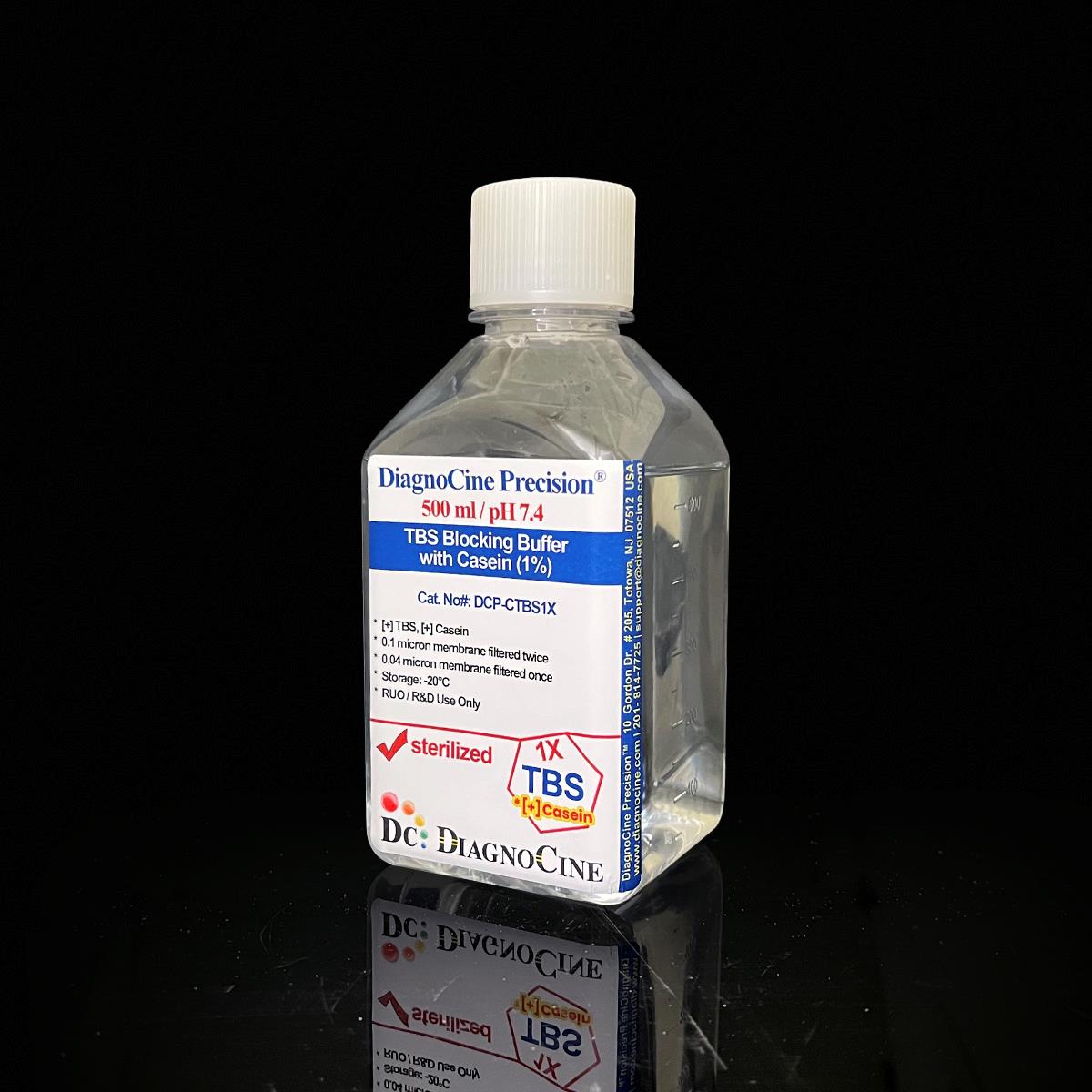
TBS Blocking Buffer with Casein (1%)
FluxMPS™ TBS Blocking Buffer with Casein (1%)
FluxMPS™ TBS Blocking Buffer with Casein (1%) (DCP-CTBS1X) is an MPS-grade, single-protein blocking reagent formulated in Tris-Buffered Saline for Western blotting, ELISA, and immunohistochemistry. Ultrapure and single-pass 0.1 µm filtered with autoclave sterilization, it delivers a stable pH 7.4 environment with minimal non-specific background for immunoassay and microfluidic workflows.
- Single-pass 0.1 µm membrane filtration plus autoclave sterilization for assay-grade purity
- 1% purified casein blocking agent minimizes non-specific binding and cross-reactivity
- Stable pH 7.4 Tris-Buffered Saline formulation (50 mM Tris-base, 150 mM NaCl)
- No DNase or RNase activity detected after 18 hr incubation at room temperature
- Formulated with Ultrapure Type 1 water (18.2 MΩ·cm)
- Manufactured under ISO 13485-certified, CE-approved facilities
- Compatible with Western blot, ELISA, IHC, and microfluidic/OoC immunoassay workflows
- Custom concentrations, additives, and pH available on request
- pH7.4
- Formulation50 mM Tris-base, 150 mM NaCl
- Blocking Agent1% Casein
- AppearanceClear, colorless liquid
- Filtration0.1 µm membrane (single pass)
- SterilizationAutoclave sterilized
- DNase ActivityNone detected
- RNase ActivityNone detected
- Storage-20°C
- Shelf Life1 year
Engineered where standard buffers fail
Conventional 0.22 µm-filtered blocking buffers can carry subvisible particulates, inconsistent pH, and higher background in sensitive immunoassays. FluxMPS™ buffers are engineered to remove these failure modes at the source.
Microchannel-safe purity
Single-pass 0.1 µm membrane filtration combined with autoclave sterilization reduces particulate load below what a standard 0.22 µm pass removes.
Precise, stable pH
Buffered at pH 7.4 in a defined Tris-Buffered Saline system (50 mM Tris-base, 150 mM NaCl) to protect protein and antibody integrity during assays.
Ultrapure-grade water
Formulated with Ultrapure Type 1 water (18.2 MΩ·cm) as the aqueous base for the buffer system.
Low background for imaging & assays
The 1% purified casein blocking layer minimizes non-specific interactions, lowering background in Western blot, ELISA, and IHC detection.
Defined, traceable composition
Every component is disclosed with concentration, and the buffer is confirmed free of detectable DNase and RNase activity.
Customization on demand
Alternate concentrations, additives, proteins, supplements, or pH values are available — contact support@diagnocine.com.
Single-stage 0.1 µm filtration
DCP-CTBS1X is processed through a single-pass 0.1 µm membrane filtration step followed by autoclave sterilization, delivering an assay-grade, ready-to-use blocking buffer.
-
1
0.1 µm Sterile Filtration
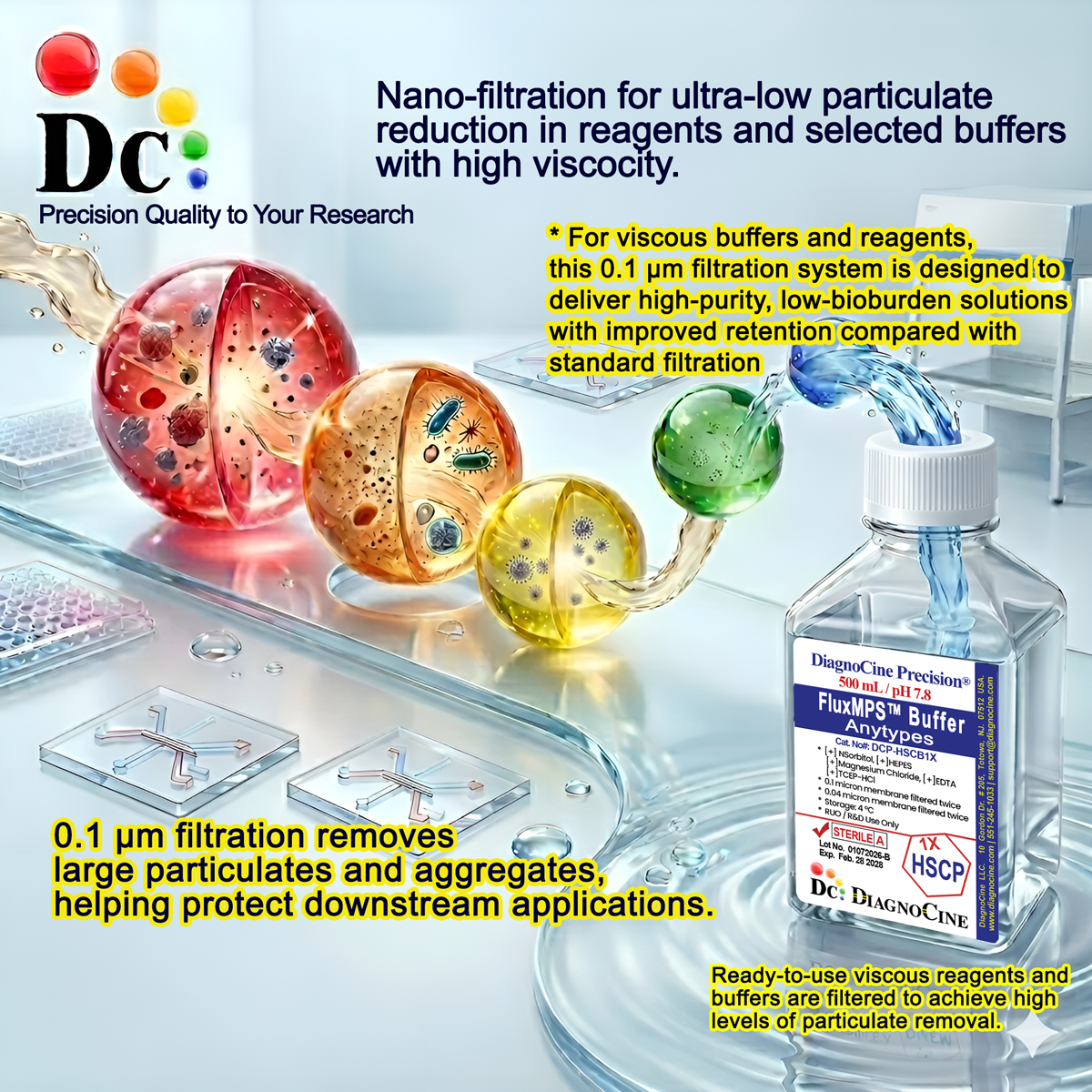
A single pass through a 0.1 µm membrane removes particulates and bioburden, followed by autoclave sterilization to secure a ready-to-use, assay-grade blocking buffer. Mycoplasma organisms, the smallest of which are about 0.2 microns in size, are retained by this sub-0.2 micron membrane pass.
Performance vs. conventional buffer
Single-pass 0.1 µm filtration removes finer particulates than a standard 0.22 µm pass, and is paired with autoclave sterilization and confirmed absence of DNase and RNase activity for assay-grade sterility assurance.
© Diagnocine® — DCP-CTBS1X
Where DCP-CTBS1X performs
A single-protein casein blocking buffer designed to reduce non-specific binding across immunoassay, imaging, and microfluidic immunostaining workflows.
Automated Bioreactors & Robotics
For automated immunoassay platforms and robotic liquid handling systems, an optional 0.01 µm (10 nm) ultra-filtered variant of DCP-CTBS1X can be produced to further protect fine-bore valves and sensors.
- Total Particulate Exclusion for sub-micron flow paths
- Valve & Sensor Protection in automated dispensing systems
- Extended Perfusion Stability for long-run automated protocols
Inquiry Required: The 0.01 µm ultra-filtered grade is produced to order — contact support@diagnocine.com.
Micro Physiological System (MPS) & Chip
Used as a blocking reagent in on-chip immunostaining steps within microfluidic devices.
Blocking, Wash & Dilution
Applied to block membranes and microplates and to rinse between immunoassay steps.
iPSC-Derived Model Immunostaining
Blocks non-specific antibody binding during immunocytochemistry of iPSC-derived cell models.
Endothelial & Primary Cell Immunostaining
Reduces non-specific binding in immunofluorescence staining of endothelial and primary cells.
ELISA, Western Blot & IHC Blocking
Blocks non-specific binding sites on membranes and microplates, including protocols using biotin-avidin complexes and alkaline phosphatase detection.
Microscopy & Optical Sensing
Lowers assay background for microscopy and optical sensing workflows that follow blocking steps.
Full specification sheet
Every value below reflects DCP-CTBS1X as manufactured and released.
| Parameter | Specification |
|---|---|
| Formulation / Composition | 50 mM Tris-base, 150 mM NaCl, 1% Casein |
| Appearance | Clear, colorless liquid |
| pH | 7.4 |
| Buffering System | Tris-Buffered Saline (TBS) |
| Blocking Agent Concentration | 1% Casein |
| Parameter | Specification |
|---|---|
| Sterility ISO | 0.1 micron membrane filtration (single pass) and autoclave sterilization |
| DNase Activity | None detected (18 hr incubation with plasmid DNA, room temperature) |
| RNase Activity | None detected (18 hr incubation with ribosomal RNA, room temperature) |
| Water Quality | Ultrapure Type 1 water (18.2 MΩ·cm) |
| Manufacturing Standard ISO 13485 | ISO 13485-certified, CE-approved facilities |
| Parameter | Specification |
|---|---|
| Storage Temperature | -20°C |
| Shelf Life | 1 year |
| Parameter | Specification |
|---|---|
| Raw Material Grade | Purified, optionally chemically modified casein (single-protein blocking agent) |
| Manufacturing QMS ISO 13485 | ISO 13485-certified, CE-approved facilities (DiagnoCine Precision suppliers) |
| Production & Customization Site | DiagnoCine R&D and Quality Testing Center; final assembly at DiagnoCine Precision, Totowa, New Jersey, USA |
| Intended Use | Research Use Only (RUO) |
Full composition
Component concentrations for DCP-CTBS1X as released, expressed in the units used at manufacture.
| Component | CAS Number | Concentration |
|---|---|---|
| Casein | 9000-71-9 | 1% |
| Tris-base | 77-86-1 | 50 mM |
| Sodium Chloride | 7647-14-5 | 150 mM |
Manufactured under controlled quality systems
DCP-CTBS1X is produced, packaged, and released under a documented quality management framework.
ISO 13485:2016 Quality Management
Manufactured under ISO 13485-certified, CE-approved facilities (Suppliers of DiagnoCine Precision).
Ultrapure Type 1 Water
Formulated using Ultrapure Type 1 water (18.2 MΩ·cm) as the aqueous base.
Controlled Fill & Finish
Final packaging, quality assurance, and testing performed at the DiagnoCine R&D and Quality Testing Center.
Micro-Batch Precision
Customization requests and assembly are completed at DiagnoCine Precision in Totowa, New Jersey, USA.
Endotoxin (USP <85> BET)
Endotoxin testing follows USP <85> Bacterial Endotoxins Test methodology as part of the standard quality release framework; specific lot data is available on the Certificate of Analysis.
Particulate (USP <788>)
Particulate control is supported by single-pass 0.1 µm membrane filtration and autoclave sterilization within the release protocol.
Osmolality (USP <785>)
Osmolality is monitored as part of the buffer release framework aligned with USP <785>.
Documentation / CoA
Appearance, pH, sterility, and DNase/RNase test results are documented and available per lot.
How DCP-CTBS1X compares
A side-by-side look at DCP-CTBS1X against conventional casein and milk-based blocking buffers.
| Parameter | DCP-CTBS1X (FluxMPS™) | Conventional 0.22 µm-filtered buffer | Standard alternative (0.22 µm filtered) |
|---|---|---|---|
| Blocking Agent | 1% Purified Casein (single-protein) | Non-fat Milk/BSA Blend | Non-fat Milk |
| Final Filtration Pore Size | 0.1 µm | 0.22 µm | 0.22 µm |
| Autoclave Sterilized | check_circle | cancel | cancel |
| DNase / RNase Tested | check_circle | cancel | cancel |
| Water Quality | Ultrapure Type 1 (18.2 MΩ·cm) | Typical Type 2/3 water | Typical Type 2/3 water |
| ISO 13485-Certified Manufacturing | check_circle | cancel | cancel |
| Microfluidic / OoC Channel Compatibility | check_circle | cancel | cancel |
| Custom Formulation Available | check_circle | cancel | cancel |
Frequently asked questions
Answers to common technical questions about DCP-CTBS1X.
Supporting literature
Curated peer-reviewed literature relevant to blocking buffer chemistry, immunoassay background reduction, and microfluidic/organ-on-a-chip applications.
- Mahmood, T., & Yang, P.C. Western blot: technique, theory, and trouble shooting. N Am J Med Sci. 2012. doi:10.4103/1947-2714.100998
- Kurien, B.T., & Scofield, R.H. Western blotting. Methods. 2006. doi:10.1016/j.ymeth.2005.07.018
- Vogt, R.F. Jr., et al. Quantitative differences among various proteins as blocking agents for ELISA microtiter plates. J Immunol Methods. 1987. doi:10.1016/0022-1759(87)90447-9
- Steinitz, M. Quantitation of the blocking effect of Tween 20 and bovine serum albumin (BSA) in ELISA microwells. Anal Biochem. 2000. doi:10.1006/abio.2000.4577
- Kenna, J.G., Major, G.N., & Williams, R.S. Methods for reducing non-specific antibody binding in enzyme-linked immunosorbent assays. J Immunol Methods. 1985. doi:10.1016/0022-1759(85)90042-0
- Good, N.E., et al. Hydrogen ion buffers for biological research. Biochemistry. 1966. doi:10.1021/bi00866a011
- Bhatia, S.N., & Ingber, D.E. Microfluidic organs-on-chips. Nat Biotechnol. 2014. doi:10.1038/nbt.2989
- Huh, D., et al. Reconstituting organ-level lung functions on a chip. Science. 2010. doi:10.1126/science.1188302
- Esch, E.W., Bahinski, A., & Huh, D. Organs-on-chips at the frontiers of drug discovery. Nat Rev Drug Discov. 2015. doi:10.1038/nrd4539