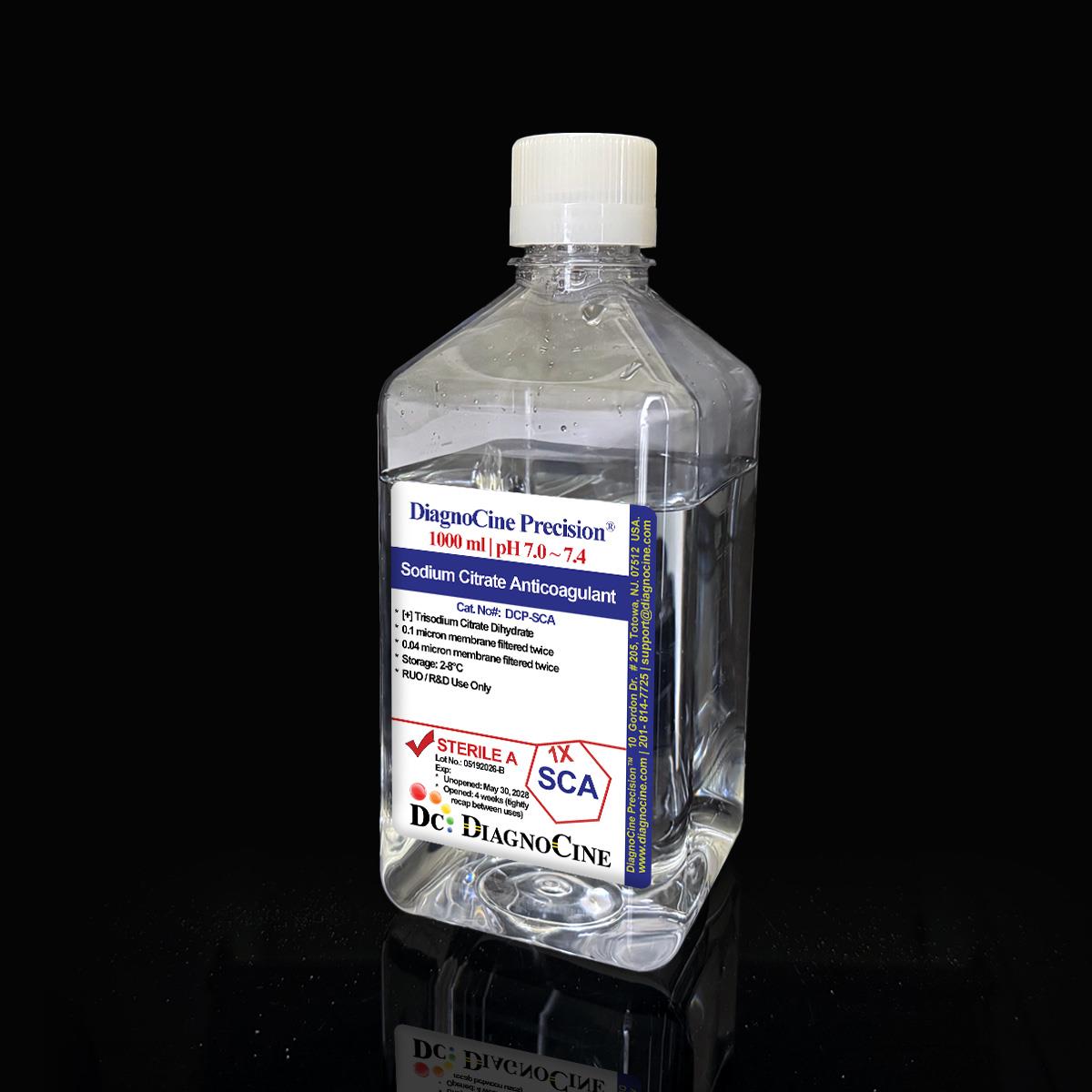
Size:1,000 mL Sterile: Filtered 0.1-micron membrane TWICE, 0.04-micron membrane TWICE
Storage: 2-8°C Shelf Life: Unopened: 24 months Opened: 4 weeks (strict aseptic, tightly recapped between uses)
*Use before the expiry date given on the product label. pH: ~7.0 - 7.4 (natural)
*Use ratio: 9 parts blood: 1 part citrate (mandatory)
Description:
A reagent fully compatible (not exclusive) with the Blood Coagulation Analyzer (Catalog No.: DCBio-SACA) [Link]
A precision-standardized, sterile aqueous solution of trisodium citrate dihydrate (Na₃C6H5O7·2H₂O) at 0.109 mol/L (3.2% w/v), supplied pre-dispensed in evacuated blood collection tubes and calibrated to accept exactly 9 parts of whole blood per 1 part anticoagulant (9:1 blood:citrate ratio, mandatory). Upon blood draw, citrate ions reversibly chelate free ionized calcium (Ca²) in plasma, arresting all calcium-dependent coagulation reactions and preserving the specimen in its native, unactivated state for transport and laboratory analysis. Because anticoagulation is reversible, addition of exogenous calcium at the testing stage (as in APTT, PT, and TT assays) fully restores the coagulation cascade, enabling accurate, reproducible quantitative assessment of all coagulation pathway components.
Mandatory fill volume: must reach ≥90% of nominal tube volume to maintain the 9:1 ratio
The 0.109 M (3.2%) concentration has been the globally standardized coagulation tube anticoagulant since ISTH formally recommended abandoning the older 3.8% (0.129 M) formulation. The biochemical rationale is robust:
At 3.2%, the final plasma calcium chelation is calibrated so that recalcification with the standardized 0.025 M CaCl₂ reagent (APTT R2) restores physiological ionized Ca²+ in the test mixture reliably and reproducibly.
Multiple peer-reviewed studies demonstrate that when responsive (sensitive) APTT and PT reagents are used, the 3.8% concentration produces statistically and clinically significant differences in clotting times compared to 3.2% — particularly for heparinized patients and oral anticoagulant monitoring.
The 3.8% concentration showed a proportional deviation in ellagic acid–containing APTT reagents (e.g., aPTT-FS), altered lupus anticoagulant confirmation testing (dRVVT), and differences in Protein C activity.
The 3.2% concentration results are equivalent to 3.8% only when non-responsive reagents are used; therefore, to ensure compatibility with the widest range of modern sensitive reagents, 3.2% is mandatory.
The 9:1 (blood:citrate) ratio is not a suggestion — it is an analytically critical fixed parameter. The pre-dispensed citrate volume in the tube (e.g., 0.3 mL in a 2.7 mL draw tube) is exactly calibrated to achieve this ratio when the tube fills to its nominal volume. The ratio is mandatory because:
Underfilling (short draw): Raises the effective citrate:blood ratio, excessively chelating calcium and producing falsely prolonged clotting times for PT, APTT, TT, and all clot-based factor assays. CLSI defines underfilling as a fill below 90% of nominal volume; tubes filled below this threshold must be rejected.
Overfilling: Reduces the effective citrate:blood ratio, leaving insufficient calcium chelation; this can allow partial ex vivo activation of the coagulation cascade and produce falsely shortened clotting times.
Regulatory and standardization compliance: WHO hemophilia guidelines specify the 9:1 ratio as mandatory; ISTH citrate shortage guidance reinforces it as the only acceptable ratio.
Composition:
Ingredients
Trisodium Citrate Dihydrate
Ultrapure Water
* All DiagnoCine Precision Sterile filtered-sterilized with 40 nanometer. Thus, mycoplasma contamination is prevented. The smallest size mycoplasma type can be about 0.2 microns.
* This product is manufactured under ISO 13485-certified and CE-approved facilities (Suppliers of DiagnoCine Precision). All final packaging, quality assurance, and testing are done at the DiagnoCine R&D and Quality Testing Center. All specific customization requests and assembly were accomplished at DiagnoCine Precision in Totowa, New Jersey, USA