Sodium Acetate Buffer [3X]
FluxMPS™ Sodium Acetate Buffer [3X]
FluxMPS™ Sodium Acetate Buffer [3X] is an ultrapure, non-sterile 3 M sodium acetate / glacial acetic acid buffer system at pH 5.2, dual-filtered through 0.1 µm and 0.04 µm membranes to minimize particulate carry-over into downstream molecular biology work. It is formulated to maintain ionic strength and pH stability for DNA/RNA precipitation, protein crystallization, and gel electrophoresis staining, with defined DNase- and RNase-free performance suited to microfluidic-scale and lab-on-chip (LoC) sample processing.
- Dual-stage filtration: 0.1 µm membrane once and 0.04 µm membrane once for ultra-clean molecular biology use
- Non-sterile, ultrapure 3 M sodium acetate / glacial acetic acid buffering system at pH 5.2
- No detectable DNase or RNase activity after 18 hr incubation at room temperature
- Formulated for DNA/RNA precipitation, protein crystallization, and gel electrophoresis staining
- Manufactured under ISO 13485-certified, CE-approved facility processes
- Customizable concentration, pH, and additive content available on request
- SKUDCP-SAB3X
- Concentration3 M Sodium Acetate
- pH5.2
- Buffering SystemAcetic Acid / Acetate
- AppearanceClear, Colorless Liquid
- Filtration0.1 µm x1 + 0.04 µm x1
- SterilityNon-Sterile
- DNase / RNaseNone Detected
- StorageRoom Temperature
- Shelf Life2 Years
Engineered where standard acetate buffers fail
Conventional single-pass 0.22 µm-filtered acetate buffers can carry subvisible particulates and residual nucleases into precipitation, crystallization, and imaging workflows, introducing background noise and inconsistent results. FluxMPS™ Sodium Acetate Buffer [3X] is built around a dual-stage 0.1 µm / 0.04 µm filtration path and a defined 3 M acetate / acetic acid system to keep pH, ionic strength, and cleanliness consistent lot to lot.
Microchannel-safe purity
Dual-stage 0.1 µm and 0.04 µm membrane filtration reduces particulate carry-over versus a single 0.22 µm pass, supporting cleaner downstream nucleic acid precipitation.
Precise, stable pH
A defined 3 M sodium acetate / glacial acetic acid system holds pH at 5.2, giving reproducible ionic strength for alcohol precipitation of DNA and RNA.
Ultrapure-grade water
Formulated with Ultrapure Type 1 water (18.2 MΩ·cm) consistent with USP <85> water-quality expectations for molecular biology reagents.
Low background for imaging & assays
A clear, colorless liquid formulated to minimize interference in gel-staining and electrophoresis workflows where visual and optical clarity matter.
Defined, traceable composition
Every lot is built from sodium acetate and glacial acetic acid under controlled manufacturing documentation, with DNase and RNase activity verified before release.
Customization on demand
Alternate concentrations, pH values, and the addition of chemicals, compounds, proteins, or supplements can be requested for your specific protocol.
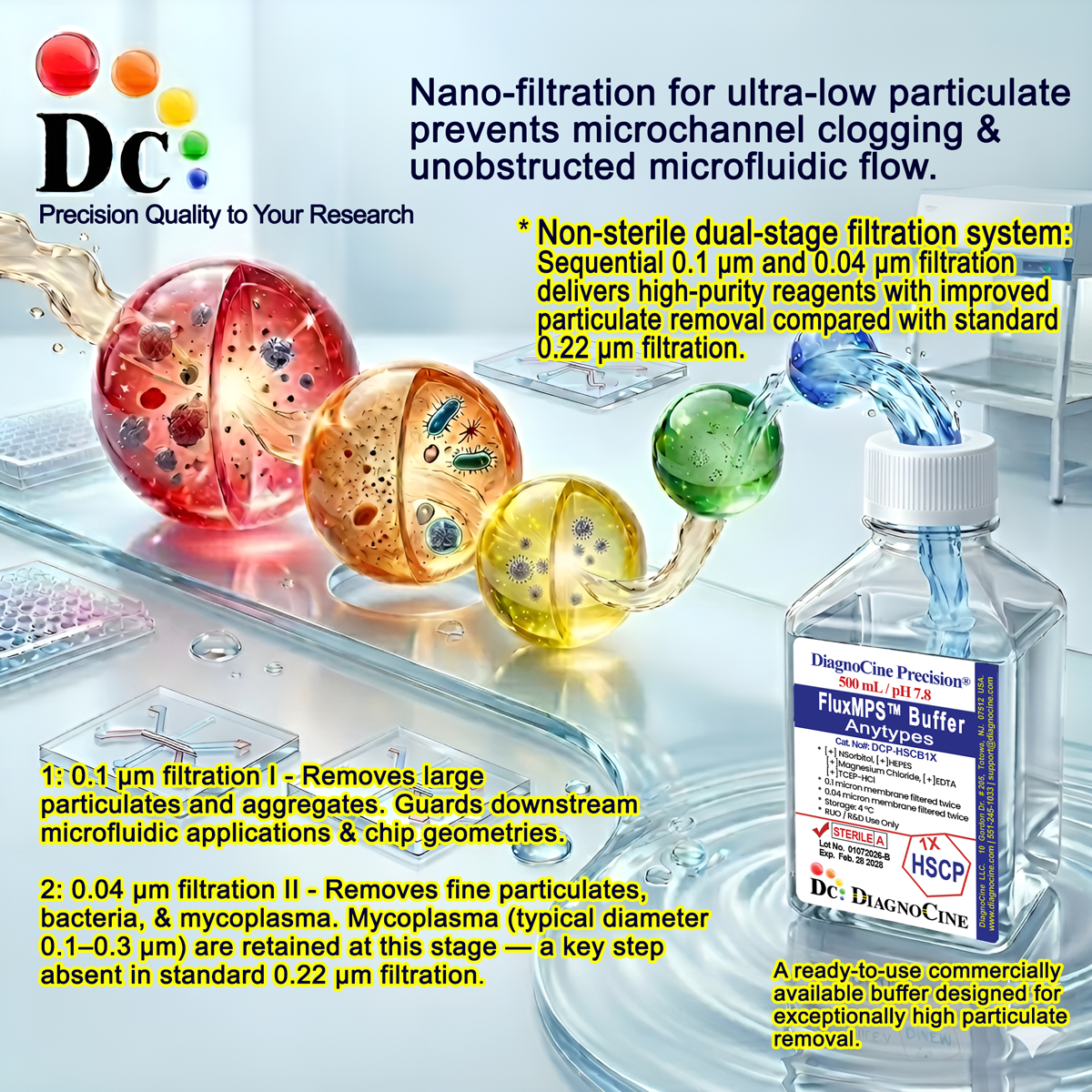
Dual-stage filtration system
DCP-SAB3X is filtered through a 0.1 µm membrane once and a 0.04 µm membrane once, positioning this ultrapure, non-sterile buffer well ahead of conventional single-pass 0.22 µm-filtered acetate buffer for particulate control in DNA/RNA precipitation and protein crystallization workflows.
-
1
0.1 µmPre-filtration I
Large particulate and aggregate removal, extending downstream filter life.
-
2
0.04 µmPre-filtration II
Fine particulate and bioburden retention for a cleaner, ultrapure liquid.
Performance vs. conventional buffer
Sequential 0.1 µm and 0.04 µm filtration removes finer particulates than a single 0.22 µm pass, supporting cleaner downstream nucleic acid precipitation and crystallization work.
© Diagnocine® — DCP-SAB3X
Where Sodium Acetate Buffer [3X] fits your workflow
Sodium acetate buffer maintains ionic strength and a mildly acidic pH for alcohol precipitation of DNA and RNA, promotes slow crystal formation in protein crystallization, and is widely used for staining protein electrophoresis gels. The acetic acid / acetate ion system resists pH change upon addition of small amounts of acid or base.
Automated Bioreactors & Robotics
For automated liquid-handling and robotic dispensing systems, an optional 0.01 µm (10 nm) ultra-filtered variant of this buffer can be requested to further reduce particulate load reaching valves and sensors.
- Total Particulate Exclusion — finer-pore filtration on request for sensitive instrumentation
- Valve & Sensor Protection — reduced particulate exposure in automated dispensing paths
- Extended Perfusion Stability — consistent ionic strength across automated runs
Inquiry Required: the 0.01 µm ultra-filtered grade is available upon request — contact support@diagnocine.com.
Micro Physiological System (MPS) & Chip
Ultrapure, dual-filtered formulation suited to nucleic acid handling steps within microfluidic and lab-on-chip sample workflows.
DNA/RNA Precipitation & Purification
Maintains ionic strength for alcohol precipitation of DNA and RNA, supporting purification and reconstitution workflows.
Protein Crystallization
Creates low-pH conditions and promotes slow crystal formation of target proteins in crystallization trials.
Gel Staining Workflows
Used in staining gels for protein electrophoresis, supporting consistent, low-background visualization.
General DNA/RNA Work
A defined acetic acid/acetate buffering system suited to routine nucleic acid handling in the molecular biology lab.
Low-Background Sample Handling
A clear, colorless, ultrapure liquid formulated to minimize visual and optical interference during sample processing.
Specification summary
All values below are as declared for DCP-SAB3X in its Quality Control release documentation.
| Parameter | Specification |
|---|---|
| Formulation | Sodium Acetate / Glacial Acetic Acid buffer system |
| Appearance | Clear, Colorless Liquid |
| pH | 5.2 |
| Molarity / Concentration | 3 M Sodium Acetate |
| Parameter | Specification |
|---|---|
| Sterility USP <71> | Non-Sterile |
| Filtration System | 0.1 µm membrane once and 0.04 µm membrane once |
| DNase Activity | None detected (18 hr, plasmid DNA, room temperature) |
| RNase Activity | None detected (18 hr, ribosomal RNA, room temperature) |
| Water Quality | Ultrapure Type 1 Water (18.2 MΩ·cm) |
| Manufacturing Standard ISO 13485 | ISO 13485-certified, CE-approved facility |
| Parameter | Specification |
|---|---|
| Storage Temperature | Room Temperature |
| Shelf Life | 2 Years |
| Parameter | Specification |
|---|---|
| Raw Material Grade | Ultrapure sodium acetate and glacial acetic acid |
| Traceability | Lot-based manufacturing documentation under controlled QMS |
| Manufacturing QMS | ISO 13485-certified |
| Regulatory Alignment | CE-approved facility |
| Production Method | Final packaging, QA, and testing at the Diagnocine R&D and Quality Testing Center; customization and assembly at Diagnocine Precision, Totowa, New Jersey, USA |
| Intended Use | Research Use Only (RUO) |
Full composition
Sodium Acetate Buffer [3X] is built from two release-controlled components. All values are reproduced exactly as declared in the product's manufacturing documentation.
| Component | CAS Number | Concentration |
|---|---|---|
| Sodium Acetate | 127-09-3 | 3 M |
| Glacial Acetic Acid | 64-19-7 | To adjust pH |
Manufacturing & compliance
DCP-SAB3X is manufactured under ISO 13485-certified and CE-approved facility processes, with final packaging, quality assurance, and testing performed at the Diagnocine R&D and Quality Testing Center, and customization/assembly completed at Diagnocine Precision in Totowa, New Jersey, USA.
ISO 13485:2016 QMS
Manufactured under ISO 13485-certified quality management processes at Diagnocine Precision supplier facilities.
Ultrapure Type 1 Water
Formulated with Ultrapure Type 1 water (18.2 MΩ·cm) consistent with USP <85> expectations.
CE-Approved Facility
Produced under CE-approved supplier facilities feeding into Diagnocine's quality-controlled release process.
Micro-Batch Precision
All specific customization requests and final assembly are completed at Diagnocine Precision, Totowa, New Jersey, USA.
DNase Activity Testing
None detected after incubation of plasmid DNA with this product for 18 hr at room temperature.
RNase Activity Testing
No RNase activity detected after incubation of ribosomal RNA with this product for 18 hr at room temperature.
Filtration Verification
Filtered through a 0.1 µm membrane once and a 0.04 µm membrane once in a non-sterile environment.
Documentation / CoA
A Certificate of Analysis documenting appearance, pH, sterility status, and DNase/RNase testing is available for this lot.
How DCP-SAB3X compares
A side-by-side view of DCP-SAB3X against conventional single-pass filtered acetate buffer.
| Parameter | DCP-SAB3X (FluxMPS™) | Conventional 0.22 µm-Filtered Buffer | Standard Alternative (0.22 µm-Filtered) |
|---|---|---|---|
| Buffering System | Sodium Acetate / Acetic Acid, pH 5.2 | Varies by supplier | Varies by supplier |
| Final Filtration Pore Size | 0.04 µm | 0.22 µm | 0.22 µm |
| Number of Filtration Stages | 2 | 1 | 1 |
| DNase/RNase Activity Tested | check_circle | cancel | cancel |
| Ultrapure Type 1 Water | check_circle | cancel | cancel |
| ISO 13485 Manufacturing | check_circle | cancel | cancel |
| Custom Formulation Available | check_circle | cancel | cancel |
Frequently asked questions
Answers to common questions about DCP-SAB3X Sodium Acetate Buffer [3X].
Supporting literature
Curated literature relevant to sodium acetate buffering chemistry, nucleic acid precipitation, and protein crystallization.
- Green, M.R. & Sambrook, J. Precipitation of DNA with Ethanol. Cold Spring Harb. Protoc. 2016. doi:10.1101/pdb.prot093377
- Zeugin, J.A. & Hartley, J.L. Ethanol Precipitation of DNA. Focus 1985;7:1-2.
- McPherson, A. & Gavira, J.A. Introduction to protein crystallization. Acta Crystallogr. F Struct. Biol. Commun. 2014;70:2-20. doi:10.1107/S2053230X13033141
- Ducruix, A. & Giege, R. (eds). Crystallization of Nucleic Acids and Proteins: A Practical Approach. Oxford University Press, 1999.
- Good, N.E. et al. Hydrogen Ion Buffers for Biological Research. Biochemistry 1966;5:467-477. doi:10.1021/bi00866a011
- Beynon, R.J. & Easterby, J.S. Buffer Solutions: The Basics. Oxford University Press, 1996.
- Ausubel, F.M. et al. Current Protocols in Molecular Biology. John Wiley & Sons, 2003.
- Halim, A. et al. Particulate control in perfusion and microfluidic reagent handling. Lab Chip 2020;20:2549-2565. doi:10.1039/D0LC00348D
- Bhatia, S.N. & Ingber, D.E. Microfluidic organs-on-chips. Nat. Biotechnol. 2014;32:760-772. doi:10.1038/nbt.2989