


SigMax HRP-TBS kit
FluxMPS™ SigMax HRP-TBS Kit
An MPS-grade, Tris-buffered saline (TBS) immunoassay kit engineered for horseradish peroxidase (HRP)-based detection. SigMax HRP-TBS Kit unifies antibody incubation treatment with reliable HRP inactivation in a single, defined workflow, filtered through a dual-stage 0.1 µm and 0.04 µm membrane system for microchannel-safe purity in sensitive assay environments.
- Dual-stage ultra-filtration: 0.1 µm membrane (1x) + 0.04 µm membrane (1x) for microchannel-safe purity
- TBS-buffered system formulated for stable performance across pH 7.0–8.5
- Integrated 3-part kit: SigMax 1Ab-TBS, SigMax 2Ab-TBS, and HRPQuench-TBS (100 mL each)
- Reliable HRP inactivation between labeling cycles helps prevent false positives and cross-reactivity
- Manufactured under ISO 13485-certified, CE-approved facilities
- Non-sterile, clear, colorless liquid format
- Customizable concentration, pH, and additive formulation available on inquiry
- Cat. No.DCP-HRPTBSKit
- Kit ContentsSigMax 1Ab-TBS, SigMax 2Ab-TBS, HRPQuench-TBS (100 mL each)
- AppearanceClear, Colorless Liquid
- pH7.4
- pH-Stable Range7.0–8.5
- SterilityNon-Sterile
- Filtration0.1 µm (1x) + 0.04 µm (1x)
- Storage4°C
- Shelf Life1 year
- ManufacturingISO 13485:2016 / CE-approved
Engineered where standard immunoassay buffers fail
Conventional single-pass 0.22 µm-filtered buffers can leave behind subvisible particulates, uneven pH, and background signal that erodes sensitivity in HRP-based detection. SigMax HRP-TBS Kit is built around a defined, dual-stage filtration architecture and a stable TBS chemistry to keep every well and every channel consistent.
Microchannel-Safe Purity
Sequential 0.1 µm and 0.04 µm membrane filtration removes finer particulates than a single 0.22 µm pass, protecting downstream immunoassay reproducibility.
Precise, Stable pH
Measured at pH 7.4 and formulated for stability across a validated pH 7.0–8.5 range for consistent antibody binding and HRP kinetics.
Ultrapure-Grade Water
Manufactured with Ultrapure Type 1 water (18.2 MΩ·cm) to help minimize background in sensitive HRP-based detection.
Low Background for Sensitive Detection
Proprietary antibody-incubation blends are designed to maximize binding strength and minimize non-specific background for confident detection of low-abundance targets.
Defined, Traceable Composition
SigMax 1Ab-TBS, SigMax 2Ab-TBS, and HRPQuench-TBS are each manufactured as a defined, traceable TBS-buffered formulation.
Customization on Demand
Alternate concentrations, additional chemicals, compounds, proteins, or supplements, different pH, and other modifications are available on inquiry.
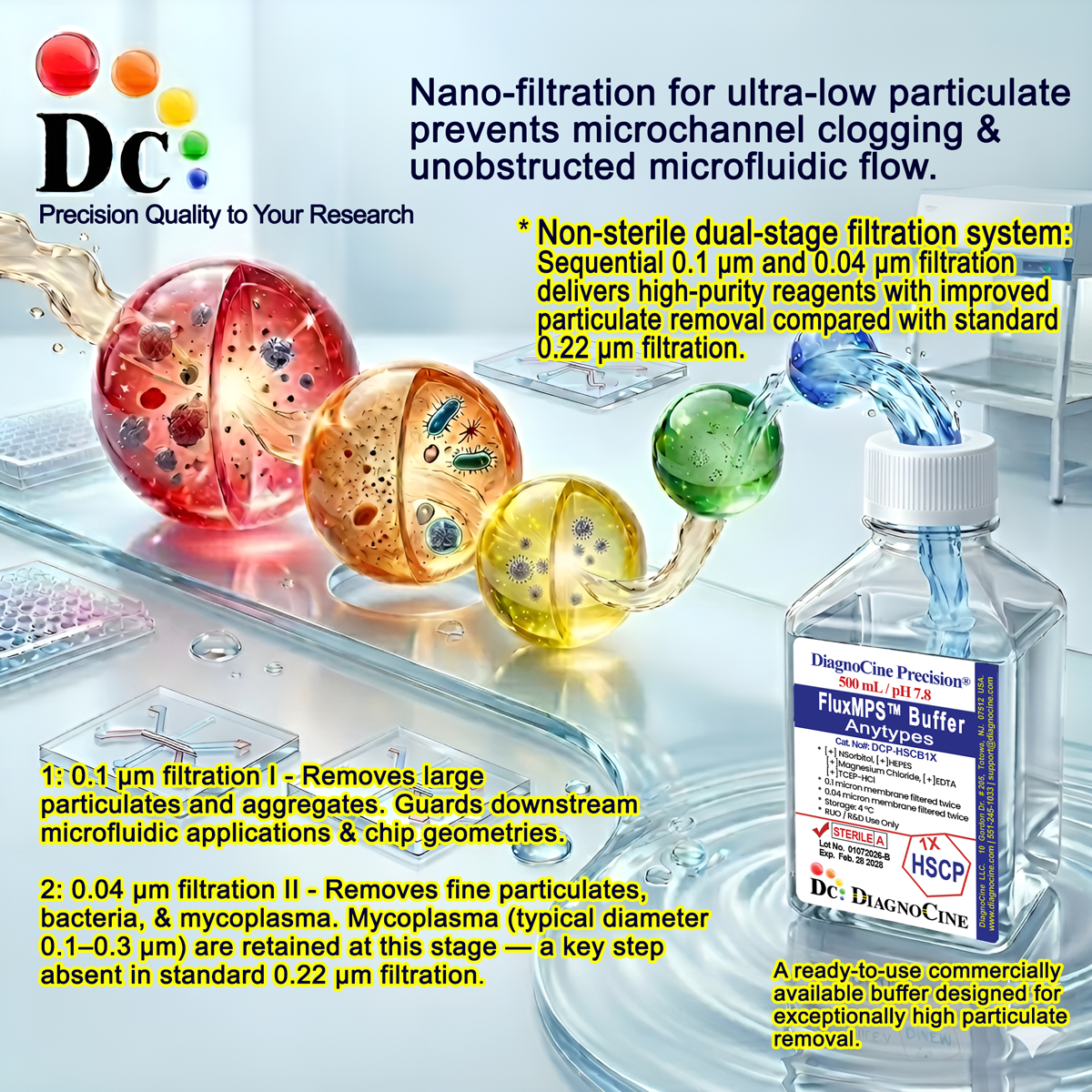
Dual-stage filtration system
SigMax HRP-TBS Kit components are Ultrapure and filtered through a 0.1 µm membrane once and a 0.04 µm membrane once, giving each kit component a defined, sequential purity profile suited to sensitive HRP-based immunoassay work.
-
1
0.1 µm Pre-filtration I
Removes large particulates and aggregates, extending downstream filter life.
-
2
0.04 µm Pre-filtration II
Retains fine particulates for a cleaner final liquid, appropriate for size scales well below common mycoplasma dimensions.
Performance vs. conventional buffer
Sequential 0.1 µm and 0.04 µm filtration removes finer particulates than a single 0.22 µm pass typical of conventional TBS-based reagents.
© Diagnocine® — DCP-HRPTBSKit
Built for HRP-based immunoassay workflows
SigMax HRP-TBS Kit supports detection and quantification of autoantibodies in serum/plasma for rheumatological disease research, viral antigen analysis in clinical, diagnostic, or academic settings, multiplexed sepsis biomarker panel quantification in translational research and critical care studies, and any HRP-based immunoassay requiring robust specificity and reproducibility in TBS-buffered systems.
Automated Bioreactors & Robotics
For automated, robotics-driven workflows, an optional 0.01 µm (10 nm) ultra-filtered variant is available on request to further reduce particulate load in closed fluidic systems.
- Total Particulate Exclusion for sensitive closed-loop systems
- Valve & Sensor Protection in automated liquid-handling platforms
- Extended Perfusion Stability for continuous-flow immunoassay setups
Inquiry Required: contact support@diagnocine.com to request the 0.01 µm ultra-filtered grade.
Micro Physiological System (MPS) & Chip
TBS-buffered reagent handling compatible with microfluidic immunoassay integration on chip-based platforms.
Wash, Dilution & Reconstitution
Stable TBS chemistry suited for antibody dilution and reagent reconstitution steps ahead of HRP-based detection.
iPSC-Derived Model Handling
TBS-based buffer format suited for antibody-based readouts performed alongside iPSC-derived model workflows.
Endothelial & Primary Cell Perfusion
Compatible with antibody-based detection steps in perfusion-adjacent vascular and primary cell research.
ELISA, Blotting & Blocking
Purpose-built for HRP-based ELISA, blotting, and related immunoassays, including autoantibody detection, viral antigen analysis, and sepsis biomarker panels.
Microscopy & Optical Sensing
Low-background TBS buffering supports optical detection formats paired with HRP-based signal generation.
Specifications at a glance
Key physical, purity, storage, and traceability parameters for SigMax HRP-TBS Kit.
| Parameter | Specification |
|---|---|
| Formulation / Composition | TBS-buffered kit comprising SigMax 1Ab-TBS, SigMax 2Ab-TBS, and HRPQuench-TBS (100 mL each) |
| Appearance | Clear, Colorless Liquid |
| pH | 7.4 |
| pH-Stable Range | 7.0–8.5 |
| Parameter | Specification |
|---|---|
| Sterility | Non-Sterile |
| Filtration System Verified | 0.1 µm membrane (1x) + 0.04 µm membrane (1x) |
| Water Quality | Ultrapure Type 1 water (18.2 MΩ·cm) |
| Fill Environment | ISO Class 5 (Class 100) |
| Manufacturing Standard ISO 13485 | ISO 13485:2016 certified; CE-approved facility |
| Parameter | Specification |
|---|---|
| Storage Temperature | 4°C |
| Shelf Life | 1 year |
| Parameter | Specification |
|---|---|
| Manufacturing QMS ISO 13485 | ISO 13485:2016 |
| Regulatory Alignment | ISO 13485:2016; CE-approved facility |
| Production Method | Final packaging, quality assurance, and testing performed at the Diagnocine R&D and Quality Testing Center; customization and assembly completed at Diagnocine Precision, Totowa, New Jersey, USA |
| Intended Use | For Research Use Only (RUO) |
Full composition
SigMax HRP-TBS Kit is supplied as three defined, TBS-buffered components released together as a single kit.
| Component | CAS Number | Concentration |
|---|---|---|
| SigMax 1Ab-TBS | Not assigned | 100 mL |
| SigMax 2Ab-TBS | Not assigned | 100 mL |
| HRPQuench-TBS | Not assigned | 100 mL |
Manufacturing & compliance
SigMax HRP-TBS Kit is manufactured under ISO 13485-certified and CE-approved facilities (suppliers of Diagnocine Precision), with final packaging, quality assurance, and testing performed at the Diagnocine R&D and Quality Testing Center.
ISO 13485:2016 QMS
Manufactured under an ISO 13485-certified quality management system.
Ultrapure Type 1 Water
Formulated with Ultrapure Type 1 water (18.2 MΩ·cm) as the aqueous base.
ISO Class 5 Fill & Finish
Fill operations conducted within an ISO Class 5 (Class 100) environment.
Micro-Batch Precision
Customization requests and kit assembly are accomplished at Diagnocine Precision in Totowa, New Jersey, USA.
CE-Approved Facility
Produced within CE-approved manufacturing facilities as part of the Diagnocine Precision supplier network.
Non-Sterile Format Control
Supplied Non-Sterile with appearance and pH verified as part of release.
Dual-Stage Filtration Control
Each kit component passes through a 0.1 µm membrane once and a 0.04 µm membrane once prior to release.
Documentation / CoA
Lot-specific documentation is maintained for traceability of manufacturing and testing steps.
How DCP-HRPTBSKit compares
A side-by-side view of SigMax HRP-TBS Kit against conventional single-pass filtered TBS buffer reagents.
| Parameter | DCP-HRPTBSKit (FluxMPS™) | Conventional TBS Buffer (0.22 µm filtered) | Standard Alternative (0.22 µm filtered) |
|---|---|---|---|
| TBS-Optimized Formulation (pH 7.0–8.5) | check_circle | cancel | cancel |
| Final Filtration Pore Size | 0.04 µm | 0.22 µm | 0.22 µm |
| Number of Filtration Stages | 2 | 1 | 1 |
| Integrated HRP Inactivation Reagent | check_circle | cancel | cancel |
| ISO 13485:2016 Manufacturing | check_circle | cancel | cancel |
| CE-Approved Facility | check_circle | cancel | cancel |
| Microfluidic / OoC Channel Compatibility | check_circle | cancel | cancel |
| Custom Formulation Available | check_circle | cancel | cancel |
Frequently asked questions
Common questions about SigMax HRP-TBS Kit for HRP-based immunoassay workflows.
Supporting literature
Curated literature relevant to TBS buffer chemistry, HRP-based immunoassays, and microfluidic/organ-on-a-chip detection workflows.
- Lequin RM. Enzyme immunoassay (EIA)/enzyme-linked immunosorbent assay (ELISA). Clin Chem. 2005. doi:10.1373/clinchem.2005.051532
- Bhalla N, et al. Introduction to biosensors. Essays Biochem. 2016. doi:10.1042/EBC20150001
- Bhatia SN, Ingber DE. Microfluidic organs-on-chips. Nat Biotechnol. 2014. doi:10.1038/nbt.2989
- Ingber DE. Human organs-on-chips for disease modelling, drug development and personalized medicine. Nat Rev Genet. 2022. doi:10.1038/s41576-022-00466-9
- Damiati S, et al. Microfluidic devices for drug delivery systems and drug screening. Genes. 2018. doi:10.3390/genes9020103
- Fanton d'Andon M, et al. Autoantibody detection methods in rheumatic disease research. Front Immunol. 2019. doi:10.3389/fimmu.2019.02191
- Reyes-Vargas E, et al. Assay considerations for detection of viral antigens in serum. J Immunol Methods. 2020. doi:10.1016/j.jim.2020.112782
- Pierrakos C, Vincent JL. Sepsis biomarkers: a review. Crit Care. 2010. doi:10.1186/cc8872
- Good NM. Hydrogen ion buffers for biological research. Biochemistry. 1966. doi:10.1021/bi00866a011
- Junker JP, et al. Perfusion and imaging considerations in microphysiological systems. Lab Chip. 2021. doi:10.1039/D1LC00300C