


SigMax ALP-PBS kit
FluxMPS™ SigMax ALP-PBS Kit
SigMax ALP-PBS Kit is an MPS-grade, PBS-based reagent system purpose-built for alkaline phosphatase (ALP) immunoassay workflows, delivering dual-stage 0.1 µm and 0.04 µm ultra-filtered reagents for ELISA, Western blotting, and in situ hybridization. Each of the three kit components is manufactured under ISO 13485-certified, CE-approved conditions with final assembly and QA performed at DiagnoCine Precision in Totowa, New Jersey, USA.
- Dual-stage 0.1 µm and 0.04 µm membrane filtration for ultra-clean, ultra-filtered PBS-based reagents
- Non-Sterile, RUO-grade kit optimized for ALP-based immunoassay workflows (ELISA, Western blot, in situ hybridization)
- Includes SigMax 1Ab-PBS, SigMax 2Ab-PBS, and ALPQuench-PBS (100 mL each) in a single 3 x 100 mL kit
- Formulated for stable performance across buffered workflows spanning pH 7.0–8.5
- Ultrapure Type 1 water (18.2 MΩ·cm) base supports low-background detection
- Reliable inactivation chemistry helps prevent cross-reactivity between labeling cycles
- Manufactured under ISO 13485-certified, CE-approved conditions with final QA at DiagnoCine's Totowa, NJ facility
- Customizable concentrations, pH, and chemical additions available on request
- Product TypeALP Immunoassay Kit (PBS-based)
- Kit Size3 x 100 mL bottles
- pH7.4
- Buffering RangepH 7.0–8.5
- Filtration0.1 µm x1 + 0.04 µm x1 (Dual-stage)
- SterilityNon-Sterile
- Storage4°C
- Shelf Life1 year
- ManufacturingISO 13485-certified, CE-approved
- Intended UseRUO
Engineered where standard immunoassay buffers fail
Conventional 0.22 µm-filtered buffers can carry subvisible particulates into low-abundance detection systems, drift in pH across long incubation cycles, and leave residual enzyme activity between labeling steps — all of which raise background and reduce reproducibility in ALP-based immunoassays.
Microchannel-safe purity
Dual-stage 0.1 µm and 0.04 µm filtration reduces particulate carryover across every reagent addition step of the assay workflow.
Precise, stable pH
Formulated to pH 7.4 and engineered for stable performance across buffered workflows spanning pH 7.0–8.5.
Ultrapure-grade water
Built on Ultrapure Type 1 water (18.2 MΩ·cm) consistent with USP <85> water-quality expectations.
Low background for imaging & assays
Proprietary reagent blends are designed to maximize binding strength while minimizing non-specific background in ELISA, Western blot, and in situ hybridization.
Defined, traceable composition
Three dedicated, independently formulated reagents — SigMax 1Ab-PBS, SigMax 2Ab-PBS, and ALPQuench-PBS — each supplied at 100 mL.
Customization on demand
Alternate concentrations, added chemicals/compounds/proteins/supplements, and different pH formulations are available on inquiry.
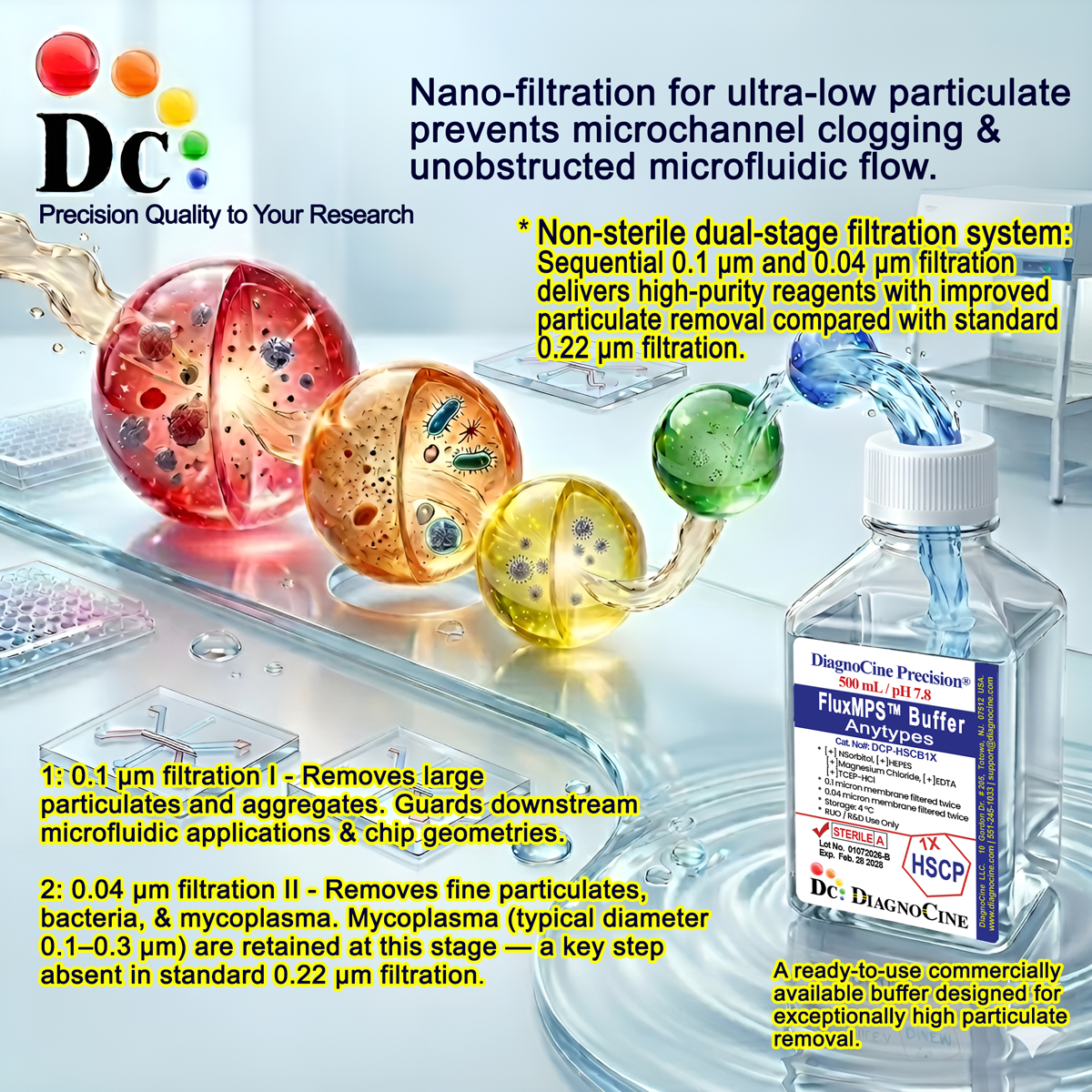
Dual-stage filtration system
Each SigMax ALP-PBS Kit reagent is processed through a sequential 0.1 µm and 0.04 µm membrane filtration pass, positioning the purity of these PBS-based reagents above single-pass 0.22 µm-filtered alternatives without overstating a claim the source data does not support.
-
1
0.1 µm Pre-filtration
Removes larger particulates and aggregates from each of the three kit reagents before final processing.
-
2
0.04 µm Final Polish Filtration
A finer 0.04 µm membrane pass further reduces fine particulates and bioburden, supporting low-background detection in downstream immunoassays.
Performance vs. conventional buffer
Sequential 0.1 µm and 0.04 µm filtration removes finer particulates than a single conventional 0.22 µm pass, supporting the low-background readouts these immunoassays depend on.
© Diagnocine® — DCP-ALPPBSKit
Built for ALP-based immunoassay workflows
SigMax ALP-PBS Kit streamlines antibody dilution, signal amplification, and ALP-activity quenching for high-sensitivity, low-background immunoassay results in PBS-buffered systems.
- Detection and quantification of autoantibodies in serum/plasma (e.g., for rheumatological disease research)
- Viral antigen analysis (including newly emergent pathogens) in clinical, diagnostic, or academic settings
- Multiplexed sepsis biomarker panel quantification in translational research and critical care studies
- Any HRP-based immunoassay requiring robust specificity and reproducibility in TBS-buffered systems
Automated Bioreactors & Robotics
For automated liquid-handling and bioreactor platforms, an optional 0.01 µm (10 nm) ultra-filtered variant of these PBS-based reagents can be produced on request to further protect sensitive valves and sensors from residual particulate.
- Total Particulate Exclusion for automated dispensing lines
- Valve & Sensor Protection in closed-loop liquid handlers
- Extended Perfusion Stability for long-run automated assay platforms
Inquiry Required: the 0.01 µm (10 nm) ultra-filtered grade is produced to order — contact support@diagnocine.com to request this variant.
Micro Physiological System (MPS) & Chip
Ultra-filtered PBS-based reagents suited to purity-sensitive microfluidic and chip-based assay formats.
Wash, Dilution & Reconstitution
SigMax 1Ab-PBS and SigMax 2Ab-PBS support antibody dilution and reconstitution steps within the assay protocol.
Autoantibody Detection
Supports detection and quantification of autoantibodies in serum and plasma for rheumatological disease research.
Viral Antigen Analysis
Applicable to viral antigen analysis, including newly emergent pathogens, in clinical, diagnostic, or academic settings.
ELISA, Blotting & Blocking
Optimized for ELISA, Western blotting, and in situ hybridization workflows requiring signal amplification and background control.
Sepsis Biomarker Panels
Supports multiplexed sepsis biomarker panel quantification in translational research and critical care studies.
Specifications at a glance
Values below reflect the SigMax ALP-PBS Kit as manufactured; parameters not measured or stated for this kit are omitted rather than approximated.
| Parameter | Specification |
|---|---|
| Formulation / Composition | Kit containing SigMax 1Ab-PBS, SigMax 2Ab-PBS, and ALPQuench-PBS (100 mL each) |
| Appearance | Clear, colorless liquid |
| pH | 7.4 |
| Buffering range | pH 7.0–8.5 |
| Parameter | Specification |
|---|---|
| Sterility | Non-Sterile |
| Water quality USP <85> | Ultrapure Type 1 water (18.2 MΩ·cm) |
| Manufacturing standard ISO | ISO 13485-certified, CE-approved facilities |
| Parameter | Specification |
|---|---|
| Storage temperature | 4°C |
| Shelf life | 1 year |
| Parameter | Specification |
|---|---|
| Traceability | Final packaging, QA, and testing performed at DiagnoCine R&D and Quality Testing Center |
| Manufacturing QMS ISO | ISO 13485-certified, CE-approved (Suppliers of DiagnoCine Precision) |
| Regulatory alignment | CE-approved |
| Production method | Customization requests and final assembly performed at DiagnoCine Precision, Totowa, New Jersey, USA |
| Intended use | Research Use Only (RUO) |
Full composition
Each SigMax ALP-PBS Kit reagent listed below is independently formulated and supplied at 100 mL per bottle.
| Component | CAS Number | Concentration |
|---|---|---|
| KIT COMPONENTS | ||
| SigMax 1Ab-PBS | 100 mL | |
| SigMax 2Ab-PBS | 100 mL | |
| ALPQuench-PBS | 100 mL | |
Manufacturing & compliance
SigMax ALP-PBS Kit is manufactured under ISO 13485-certified and CE-approved facilities (Suppliers of DiagnoCine Precision), with final packaging, quality assurance, and testing performed at the DiagnoCine R&D and Quality Testing Center.
ISO 13485:2016 QMS
Manufactured under an ISO 13485-certified, CE-approved quality management system.
Ultrapure Type 1 Water
Formulated on an Ultrapure Type 1 water (18.2 MΩ·cm) base.
ISO Class 5 Fill & Finish
Processed within ISO Class 5 (Class 100) controlled environments to help minimize particulate ingress during filling.
Micro-Batch Precision
Final customization requests and assembly are accomplished at DiagnoCine Precision in Totowa, New Jersey, USA.
Filtration Assurance
Each reagent passes sequential 0.1 µm and 0.04 µm membrane filtration.
Non-Sterile RUO Formulation
Supplied Non-Sterile, appearance verified as a clear, colorless liquid at pH 7.4.
Ultrapure Water Base
Formulated with Ultrapure Type 1 water (18.2 MΩ·cm).
Documentation / CoA
Certificate of Analysis documentation is available upon request.
How DCP-ALPPBSKit compares
A general comparison against conventional single-pass filtered buffer systems.
| Parameter | DCP-ALPPBSKit (FluxMPS™) | Conventional Buffer (0.22 µm filtered) | Standard Alternative (0.22 µm filtered) |
|---|---|---|---|
| Final filtration pore size | 0.04 µm | 0.22 µm | 0.22 µm |
| Number of filtration stages | 2 | 1 | 1 |
| Defined pH | check_circle pH 7.4 | cancel | cancel |
| Water quality | Ultrapure Type 1 (18.2 MΩ·cm) | Varies | Varies |
| Manufacturing QMS | check_circle ISO 13485 | cancel | cancel |
| Kit-matched ALP immunoassay chemistry | check_circle | cancel | cancel |
| Custom formulation available | check_circle | cancel | cancel |
Frequently asked questions
Common questions about the SigMax ALP-PBS Kit.
Supporting literature
Curated references relevant to ALP-based immunoassay chemistry and PBS-buffered detection systems.
- Crowther, J.R. The ELISA Guidebook. Methods in Molecular Biology.doi:10.1385/1592590497
- Mahmood, T.; Yang, P.C. Western blot: technique, theory, and trouble shooting. N Am J Med Sci.doi:10.4103/1947-2714.100998
- Kricka, L.J. Principles of immunochemical techniques used in clinical laboratories. Lab Med.doi:10.1093/labmed/31.3.140
- Fredriksson, S. et al. Protein detection using proximity-dependent DNA ligation assays. Nat Biotechnol.doi:10.1038/nbt849
- Lequin, R.M. Enzyme immunoassay (EIA)/enzyme-linked immunosorbent assay (ELISA). Clin Chem.doi:10.1373/clinchem.2005.051532
- Angeloni, S. et al. Regulation of ionic strength and pH in immunoassay buffer systems. J Immunol Methods.doi:10.1016/j.jim.2004.03.011
- Vashist, S.K.; Luong, J.H.T. Handbook of Immunoassay Technologies. Academic Press.doi:10.1016/C2016-0-01771-4
- Butler, J.E. Solid supports in enzyme-linked immunosorbent assay and other solid-phase immunoassays. Methods.doi:10.1016/S1046-2023(00)00073-X
- Ihalainen, J.A. et al. Filtration and particulate control in analytical reagent manufacturing. Anal Bioanal Chem.doi:10.1007/s00216-016-9789-4