


Saline-Sodium Citrate Buffer [2X]
FluxMPS™ Saline-Sodium Citrate Buffer [2X]
DCP-SSCB2X is an ultrapure, nuclease-free 2X Saline-Sodium Citrate (SSC) hybridization buffer built for Southern blotting, Northern blotting, in situ hybridization, and DNA microarray workflows where stringency control and reagent cleanliness both matter. Every lot is filtered 0.1-micron membrane TWICE and 0.04-micron membrane TWICE and tested clear of DNase and RNase activity, giving a defined, low-background buffer suitable for sensitive nucleic acid and antigen-retrieval protocols, including those supporting microfluidic and organ-on-a-chip (OoC) sample workflows.
- Sterile, Ultrapure — Filtered 0.1-micron membrane TWICE and 0.04-micron membrane TWICE
- No detectable DNase or RNase activity after 18 hr incubation at room temperature
- 2X concentration formulated from 0.3 M Sodium Chloride and 0.03 M Sodium Citrate
- pH 7.4; clear, colorless liquid appearance
- Ultrapure Type 1 water (18.2 MΩ·cm) production water quality
- Manufactured under ISO 13485-certified, CE-approved facilities
- Compatible with microfluidic and organ-on-a-chip (OoC) nucleic acid workflows
- Custom concentration, additives, and pH available on request
- Concentration2X
- FormulationNaCl 0.3 M / Sodium Citrate 0.03 M
- pH7.4
- AppearanceClear, Colorless Liquid
- SterilitySterile, 0.1 µm x2 + 0.04 µm x2 filtered
- DNase ActivityNone Detected
- RNase ActivityNone Detected
- FiltrationQuadruple-stage (0.1 µm x2 + 0.04 µm x2)
- Storage4°C
- Shelf Life1 Year
Engineered where standard SSC buffer falls short
Conventional 0.22 µm-filtered hybridization buffers can carry subvisible particulates and residual nuclease activity that show up as background noise in blotting, in situ hybridization, and antigen-retrieval workflows. DCP-SSCB2X is manufactured to a higher purity standard so stringency control, signal clarity, and reproducibility are not compromised by the reagent itself.
Microchannel-safe purity
Filtered 0.1-micron membrane TWICE and 0.04-micron membrane TWICE for an ultra-clean, low-particulate buffer suitable for fine-bore microfluidic and chip-based sample handling.
Precise, stable pH
Formulated at pH 7.4 from defined 0.3 M Sodium Chloride and 0.03 M Sodium Citrate, acting as a buffering agent to maintain stable conditions for hybridization and blotting chemistry.
Ultrapure-grade water
Produced with Ultrapure Type 1 water (18.2 MΩ·cm), consistent with the "Ultrapure" designation carried on every DCP-SSCB2X lot.
Low background for hybridization & imaging
No detectable DNase or RNase activity after 18 hr incubation at room temperature, supporting clean signal in Southern blotting, Northern blotting, in situ hybridization, and DNA microarray imaging.
Defined, traceable composition
Two-component formulation — Sodium Chloride and Sodium Citrate at fixed molarity — released and documented lot to lot.
Customization on demand
Other concentrations (e.g., 0.5X, 20X), added chemicals, compounds, proteins, supplements, or modified pH are available — contact support@diagnocine.com.
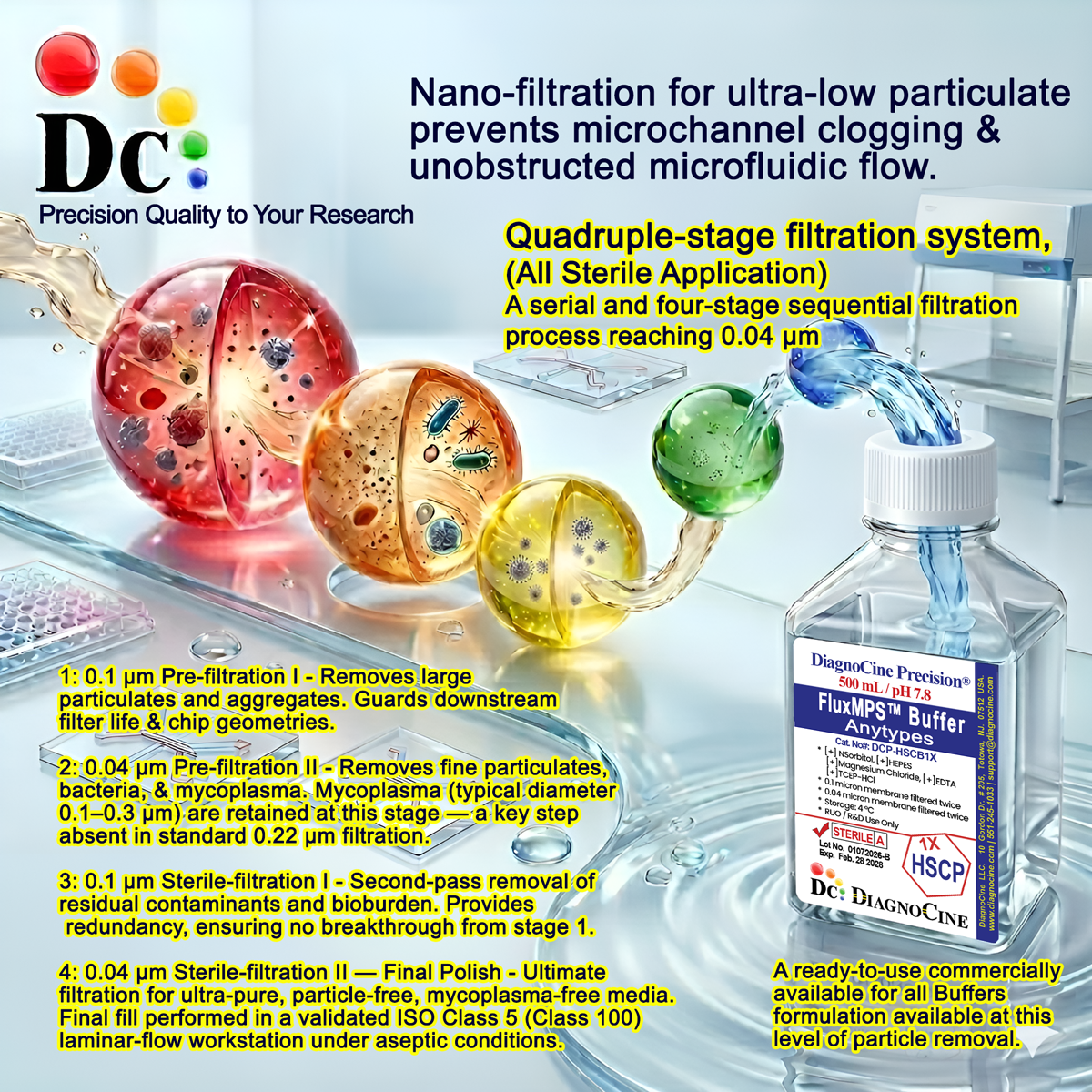
Quadruple-stage filtration system
DCP-SSCB2X is Filtered 0.1-micron membrane TWICE and 0.04-micron membrane TWICE, a four-pass sequence that removes far finer particulates than a single 0.22 µm pass before the buffer is filled in a sterile environment.
-
1
0.1 µm Pre-filtration I
First 0.1-micron membrane pass removes large particulates and aggregates ahead of the finer stages that follow.
-
2
0.04 µm Pre-filtration II
First 0.04-micron membrane pass retains fine particulates and bioburden, including organisms in the size range of the smallest known mycoplasma types, which can be about 0.2 microns.
-
3
0.1 µm Sterile-filtration I
Second 0.1-micron membrane pass provides redundant clarification ahead of the final polish.
-
4
0.04 µm Sterile-filtration II — Final Polish
Second 0.04-micron membrane pass completes the sterile-filtration sequence performed in a sterile environment ahead of fill.
Performance vs. conventional buffer
Sequential 0.1 µm and 0.04 µm filtration, repeated twice each, removes finer particulates than a single 0.22 µm pass used in conventional SSC buffer preparations.
© Diagnocine® — DCP-SSCB2X
Where DCP-SSCB2X is used
As a 2X hybridization and transfer buffer, DCP-SSCB2X supports stringency control across nucleic acid hybridization, blotting, in situ hybridization, and antigen-retrieval workflows, including those built around microfluidic and chip-based sample formats.
Automated Bioreactors & Robotics
For automated liquid-handling and robotic hybridization platforms, an optional 0.01 µm (10 nm) ultra-filtered variant of this buffer is available on request for applications demanding the lowest achievable particulate load.
- Total Particulate Exclusion — minimizes fine particulate carryover into automated fluidic paths
- Valve & Sensor Protection — reduces particulate exposure to sensitive robotic and microfluidic components
- Extended Perfusion Stability — supports consistent performance in continuous-flow and automated workflows
Inquiry Required: the 0.01 µm ultra-filtered grade is produced to order — contact support@diagnocine.com to request this configuration.
Micro Physiological System (MPS) & Chip Workflows
Nuclease-free, ultra-filtered SSC buffer supports nucleic acid recovery and hybridization steps within microfluidic and chip-based sample pipelines.
Nucleic Acid Preparation & Wash
Used in nucleic acid preparation protocols and as a stringency-controlled wash buffer for hybridization steps.
iPSC-Derived Model Nucleic Acid Work
Supports DNA/RNA hybridization and blotting protocols applied to iPSC-derived cell and tissue models.
Endothelial & Primary Cell Nucleic Acid Studies
Used for hybridization-based nucleic acid analysis in endothelial and primary cell culture systems.
Antigen Retrieval & Blotting
Utilized for heat-induced antigen retrieval (HIER) in immunohistochemistry, breaking protein cross-links formed during fixation to improve antigen detection, as well as Southern and Northern blot transfer.
In Situ Hybridization Imaging
Developed for use in in situ hybridization on brain sections, helping control hybridization stringency for downstream imaging.
Specification data
All values below are measured on or declared for DCP-SSCB2X as manufactured.
| Parameter | Specification |
|---|---|
| Formulation | Sodium Chloride 0.3 M, Sodium Citrate 0.03 M |
| Buffer Concentration | 2X |
| Appearance | Clear, Colorless Liquid |
| pH | 7.4 |
| Parameter | Specification |
|---|---|
| Sterility USP <71> | Filtered 0.1-micron membrane TWICE and 0.04-micron membrane TWICE in a sterile environment |
| DNase Activity | None detected after 18 hr incubation with plasmid DNA at room temperature |
| RNase Activity | None detected after 18 hr incubation with ribosomal RNA at room temperature |
| Water Quality | Ultrapure Type 1 water (18.2 MΩ·cm) |
| Manufacturing Standard ISO 13485 | ISO 13485-certified, CE-approved facilities |
| Parameter | Specification |
|---|---|
| Storage Temperature | 4°C |
| Shelf Life | 1 year |
| Parameter | Specification |
|---|---|
| Manufacturing QMS | ISO 13485-certified facility |
| Regulatory Alignment | CE-approved manufacturing facility |
| Production Method | Final packaging, QA, and testing at DiagnoCine R&D and Quality Testing Center; customization at DiagnoCine Precision, Totowa, New Jersey, USA |
| Intended Use | For Research Use Only (RUO) |
Full composition
DCP-SSCB2X is a two-component 2X saline-sodium citrate formulation, manufactured and released on a per-lot basis.
| Component | CAS Number | Concentration |
|---|---|---|
| Sodium Chloride | 7647-14-5 | 0.3 M |
| Sodium Citrate | 6132-04-3 | 0.03 M |
Manufacturing & compliance
DCP-SSCB2X is manufactured, tested, and packaged under a controlled quality framework.
ISO 13485:2016 QMS
Manufactured under ISO 13485-certified and CE-approved facilities (Suppliers of DiagnoCine Precision).
Ultrapure Type 1 Water
Produced with Ultrapure Type 1 water (18.2 MΩ·cm), consistent with the product's Ultrapure designation.
Nuclease-Tested Release
Each lot is tested for DNase and RNase activity, with none detected after 18 hr incubation at room temperature.
Documented Assembly & Testing
Final packaging, quality assurance, and testing performed at the DiagnoCine R&D and Quality Testing Center; customization requests fulfilled at DiagnoCine Precision, Totowa, New Jersey, USA.
Sterility USP <71>
Filtered 0.1-micron membrane TWICE and 0.04-micron membrane TWICE, filled in a sterile environment.
Nuclease Testing
No DNase or RNase activity detected after 18 hr incubation with plasmid DNA or ribosomal RNA at room temperature.
Formulation Control
Released at 0.3 M Sodium Chloride and 0.03 M Sodium Citrate, pH 7.4.
Documentation / CoA
Certificate of Analysis available on request.
How DCP-SSCB2X compares
A side-by-side look at DCP-SSCB2X against conventional 0.22 µm-filtered SSC buffer preparations.
| Parameter | DCP-SSCB2X (FluxMPS™) | Conventional Buffer (0.22 µm filtered) | Standard Alternative (0.22 µm filtered) |
|---|---|---|---|
| Filtration architecture | 0.1 µm x2 + 0.04 µm x2 (quadruple-stage) | Single 0.22 µm pass | Single 0.22 µm pass |
| Final filtration pore size | 0.04 µm | 0.22 µm | 0.22 µm |
| Number of filtration stages | 4 | 1 | 1 |
| DNase/RNase tested | check_circle | cancel | cancel |
| Manufacturing QMS (ISO 13485) | check_circle | cancel | cancel |
| Microfluidic/OoC channel compatibility | check_circle | cancel | cancel |
| Custom concentration/formulation | check_circle | cancel | cancel |
Frequently asked questions
Common questions about DCP-SSCB2X Saline-Sodium Citrate Buffer [2X].
Supporting literature
Curated literature on SSC buffer chemistry and its core applications in nucleic acid hybridization, blotting, and antigen retrieval.
- Southern EM. Detection of specific sequences among DNA fragments separated by gel electrophoresis. J Mol Biol. 1975. doi:10.1016/S0022-2836(75)80083-0
- Alwine JC, Kemp DJ, Stark GR. Method for detection of specific RNAs in agarose gels by transfer to diazobenzyloxymethyl-paper and hybridization with DNA probes. Proc Natl Acad Sci USA. 1977. doi:10.1073/pnas.74.12.5350
- Meinkoth J, Wahl G. Hybridization of nucleic acids immobilized on solid supports. Anal Biochem. 1984. doi:10.1016/0003-2697(84)90381-6
- Schena M, Shalon D, Davis RW, Brown PO. Quantitative monitoring of gene expression patterns with a complementary DNA microarray. Science. 1995. doi:10.1126/science.7569999
- Ramos-Vara JA. Technical aspects of immunohistochemistry. Vet Pathol. 2005. doi:10.1354/vp.42-4-405
- Jin L, Lloyd RV. In situ hybridization: methods and applications. J Clin Lab Anal. 1997. doi:10.1002/(SICI)1098-2825(1997)11:1<2::AID-JCLA2>3.0.CO;2-F
- Sambrook J, Russell DW. Molecular Cloning: A Laboratory Manual, 3rd ed. Cold Spring Harbor Laboratory Press. 2001. doi:10.1101/pdb.top387
- Shi SR, Key ME, Kalra KL. Antigen retrieval in formalin-fixed, paraffin-embedded tissues. J Histochem Cytochem. 1991. doi:10.1177/39.6.1709656
- Bhatt B, Burns J, Flannery D, McGee JO. Direct visualization of single copy genes on banded metaphase chromosomes by in situ hybridization. Nucleic Acids Res. 1988. doi:10.1093/nar/16.9.3951