

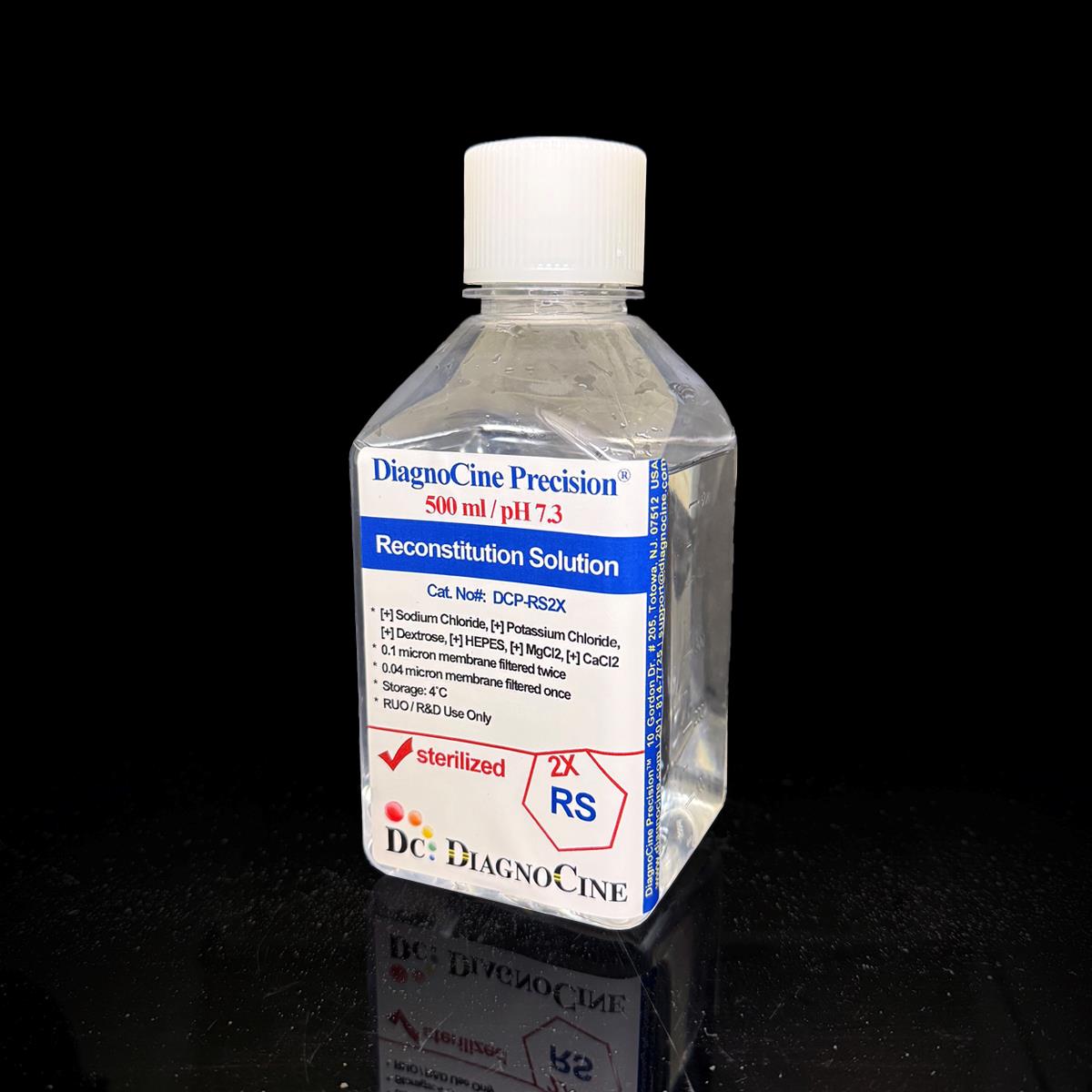
Reconstitution Solution
FluxMPS™ Reconstitution Solution
Microfluidics Suitable, quadruple-stage ultra-filtered (0.1 µm ×2 + 0.04 µm ×2) HEPES-buffered reconstitution solution formulated for dissolving lyophilized powders and biological materials with defined ionic strength, energy support, and divalent cation balance. Engineered for microfluidic channels, organ-on-a-chip (OoC) and other microphysiological system (MPS) workflows where particulate control and nuclease-free handling are essential.
- HEPES-buffered (10 mM) reconstitution solution with balanced Na+/K+ ionic strength for cell and molecular biology workflows[1]
- Contains dextrose (10 mM) as a defined energy source, plus Mg2+ (1 mM) and Ca2+ (2 mM) for enzymatic and signal-transduction support
- Quadruple-stage ultra-filtration (0.1 µm ×2 + 0.04 µm ×2) reaching a 0.04 µm final cut-off in a sterile environment
- No DNase activity detected after 18-hour incubation with plasmid DNA at room temperature
- No RNase activity detected after 18-hour incubation with ribosomal RNA at room temperature
- Manufactured under an ISO 13485:2016 quality management system; final packaging, QC and customization completed at Diagnocine, Totowa, NJ
- pH 7.3, clear solution, formulated specifically for reconstituting lyophilized powders and biological materials
- Custom concentrations, tracking dye additions, and pH adjustments available on request
- FormulationHEPES-buffered; Dextrose, Ca2+, Mg2+
- Sodium Chloride125 mM
- Potassium Chloride5 mM
- Dextrose (Glucose)10 mM
- pH (USP <791>)7.3
- AppearanceClear solution
- Filtration0.1 µm ×2 + 0.04 µm ×2 (Quadruple-stage)
- DNase / RNaseNot detected (18 h, RT)
- Storage4°C
- Shelf Life12 months from date of manufacture (unopened)
Engineered where standard reconstitution buffers fall short
Conventional 0.22 µm-filtered diluents can carry sub-micron particulates, mycoplasma-sized contaminants, and undetected nuclease activity into sensitive molecular biology and microfluidic workflows. FluxMPS™ Reconstitution Solution is built to remove those failure modes at the source.
Microchannel-safe purity
A 0.04 µm final filter stage, reached through a validated quadruple-pass train, controls the sub-micron particulate load that can foul narrow microfluidic channels and sensor surfaces.
Defined ionic & energy balance
Sodium and potassium chloride maintain osmotic balance and ionic strength, dextrose supplies a defined energy source, and magnesium and calcium chloride support enzymatic and signaling activity — no undefined additives.
Nuclease-tested formulation
Each formulation is challenged with plasmid DNA and ribosomal RNA for 18 hours at room temperature; no DNase or RNase activity is detected, supporting use in nucleic-acid-sensitive applications.
Low background for imaging
A clear, particulate-controlled solution supports confocal and other optical readouts without introducing visible turbidity into the imaging field.
Defined, minimal-additive composition
Six defined components — NaCl, KCl, dextrose, HEPES, MgCl2, CaCl2 — at fixed concentrations, with every value released against a documented specification.
Customization on demand
Alternate concentrations, tracking dye additions, and pH adjustments are available — contact support@diagnocine.com.
Quadruple-stage filtration system
DCP-RS2X is manufactured through a validated four-pass filtration train — two dedicated 0.1 µm prefilter/0.04 µm final-filter pairs run in series — reaching a 0.04 µm final pore size in a sterile environment.
- 1
0.1 µm Prefiltration I
Removes large particulate and protein aggregates; protects the first 0.04 µm final-filter cartridge.
- 2
0.04 µm Final filtration I
First 0.04 µm pass; retains sub-micron particulates and microaggregates that a 0.22 µm filter would pass through.
- 3
0.1 µm Prefiltration II
A second dedicated prefilter, protecting the second 0.04 µm final-filter cartridge.
- 4
0.04 µm Final filtration II — Polish
Ultimate polishing filter; aseptic fill & finish in a sterile environment.
Performance vs. conventional media
A quadruple-stage train (0.1 µm ×2 + 0.04 µm ×2) reaches a 0.04 µm final cut-off, five times finer than the 0.22 µm membranes used for conventional sterile filtration.

© Diagnocine® — DCP-RS2X
Where DCP-RS2X is used
As a defined, nuclease-tested, ultra-filtered reconstitution solution, DCP-RS2X supports applications where ionic balance, particulate control, and nucleic-acid integrity all matter simultaneously.
Automated Bioreactors & Robotics
For automated liquid-handling and bioreactor platforms where even 0.04 µm-scale particulate can accumulate on valves and sensors over long perfusion runs, Diagnocine offers an optional 0.01 µm (10 nm) ultra nano-filtered MPS Grade variant of this formulation, built on a six-stage cascade beyond the standard quadruple-stage process.
- Total Particulate Exclusion — six-stage cascade down to 0.01 µm
- Valve & Sensor Protection — minimizes long-run fouling in automated systems
- Extended Perfusion Stability — supports multi-week unattended operation
Inquiry Required: the 0.01 µm MPS Grade variant is available on request — contact support@diagnocine.com.
Buffer Reconstitution for Chip-Based Systems
Prepares reagents and buffers for perfusion into microfluidic and chip-based culture systems without introducing channel-clogging particulate.
Nuclease-Free DNA/RNA Reconstitution
DNase- and RNase-negative formulation supports resuspension of plasmid DNA, RNA, and other nucleic-acid preparations without degradation risk.
Lyophilized Powder Reconstitution
Formulated diluent for converting lyophilized powders into usable, isotonic, defined-pH solutions.
Ionic Balance & Cell Viability Support
Sodium, potassium, magnesium, and calcium chloride maintain physiological ionic conditions relevant to membrane potential and cellular stability during experimental handling.
HEPES-Buffered Assay Preparation
Stable pH 7.3 buffering supports downstream biochemical and immunoassay procedures requiring a defined, non-bicarbonate buffer system.
Low-Background Optical Applications
A clear, particulate-controlled solution suited to confocal and fluorescence imaging workflows requiring minimal optical interference.
Full specification sheet
All values below are release specifications reproduced from the Diagnocine formulation record for DCP-RS2X.
| Parameter | Specification |
|---|---|
| Formulation | HEPES-buffered; Dextrose, Ca2+, Mg2+ (no phenol red, no bicarbonate) |
| Appearance | Clear solution |
| pH (USP <791>) USP | 7.3 |
| Sodium Chloride | 125 mM |
| Potassium Chloride | 5 mM |
| Dextrose | 10 mM |
| HEPES | 10 mM |
| Magnesium Chloride (MgCl2) | 1 mM |
| Calcium Chloride (CaCl2) | 2 mM |
| Parameter | Specification |
|---|---|
| Sterility (USP <71>) USP | Filtered 0.1 µm ×2 + 0.04 µm ×2 in a sterile environment |
| Mycoplasma | 0.1 µm mycoplasma-retentive filtration (not tested per lot) |
| DNase activity | Not detected (18 h, RT, plasmid DNA challenge) |
| RNase activity | Not detected (18 h, RT, ribosomal RNA challenge) |
| Manufacturing standard ISO | ISO 13485:2016 certified QMS |
| Parameter | Specification |
|---|---|
| Storage temperature | 4°C |
| Shelf life | 12 months from date of manufacture (unopened) |
| Parameter | Specification |
|---|---|
| Raw material grade | Ultrapure reagents (per manufacturer specification) |
| Traceability | Lot-based; final QC, packaging & customization at Diagnocine, Totowa, NJ, USA |
| Manufacturing QMS ISO | ISO 13485:2016 |
| UNSPSC | 41116155 — Molecular biology and cell culture growth media (UNv260801) |
| Regulatory alignment | ISO 13485:2016 aligned (manufactured under ISO 13485-certified supplier facilities) |
| Intended use | Research Use Only (RUO) |
Full composition
Six defined components, released per lot against fixed molar concentrations. Every ingredient in the source formulation record is reproduced below.
| Component | CAS Number | Concentration (mM) |
|---|---|---|
| Sodium Chloride | 7647-14-5 | 125 |
| Potassium Chloride | 7447-40-7 | 5 |
| Magnesium Chloride (MgCl2) | 7786-30-3 | 1 |
| Calcium Chloride (CaCl2) | 10043-52-4 | 2 |
| Component | CAS Number | Concentration (mM) |
|---|---|---|
| HEPES | 7365-45-9 | 10 |
| Component | CAS Number | Concentration (mM) |
|---|---|---|
| Dextrose (D-Glucose) | 50-99-7 | 10 |
Manufacturing & compliance
DCP-RS2X is manufactured, filtered, and released under a documented quality system with final processing performed at Diagnocine's New Jersey facility.
Sterility (USP <71>)
Confirmed through the validated quadruple-pass filtration process performed in a sterile environment.
DNase / RNase activity
Not detected following 18-hour incubation with plasmid DNA and ribosomal RNA, respectively, at room temperature.
Manufacturing QMS
ISO 13485:2016 certified quality management system governs manufacturing, testing, and release.
Documentation / CoA
A Certificate of Analysis is available on request, documenting lot number, appearance, pH, filtration confirmation, and nuclease test results.
How DCP-RS2X compares
Comparison of DCP-RS2X against conventional 0.22 µm-filtered reconstitution buffers and, for endotoxin specifically, against published supplier specifications for classical cell culture media.
| Parameter | DCP-RS2X (FluxMPS™) | Comparison |
|---|---|---|
| Grade | Microfluidics Suitable (0.04 µm final cut-off) | Conventional 0.22 µm-filtered buffers — no defined grade tier |
| Final filtration pore size | 0.04 µm | 0.22 µm (standard sterile filtration) |
| Number of filtration stages | 4 (0.1 µm ×2 + 0.04 µm ×2) | 1 (single 0.22 µm pass) |
| Mycoplasma barrier filtration | check_circle 0.1 µm retentive stage ×2 | cancel Not typically included |
| Endotoxin (release specification) | Not specified for this product | Corning classical liquid media — < 0.25 EU/mL Sigma-Aldrich DMEM complete medium — ≤ 2 EU/mL Gibco classical DMEM — Not specified (recorded per lot) |
| DNase / RNase tested | check_circle Not detected (18 h, RT) | cancel Not typically specified |
| Manufacturing QMS | ISO 13485:2016 | Varies by supplier |
| Microfluidic channel compatibility | check_circle Engineered for microchannel use | cancel Not validated |
| Custom formulation | check_circle pH, salts, dyes on request | cancel Fixed formulation only |
Comparison figures from published supplier specifications, accessed 2026-09-02. Suppliers that publish no numeric endotoxin specification are shown as "Not specified".
Frequently asked questions
Common questions about DCP-RS2X Reconstitution Solution.
Supporting literature
DCP-RS2X does not carry product-specific published citations. The literature below supports the underlying buffering, filtration, and microfluidic application context described on this page.
- Good, N.E. et al. Hydrogen ion buffers for biological research. Biochemistry 5, 467–477 (1966). doi:10.1021/bi00866a011
- Bhatia, S.N. & Ingber, D.E. Microfluidic organs-on-chips. Nat Biotechnol 32, 760–772 (2014). doi:10.1038/nbt.2989
- Huh, D. et al. Reconstituting organ-level lung functions on a chip. Science 328, 1662–1668 (2010). doi:10.1126/science.1188302
- Uphoff, C.C. & Drexler, H.G. Detection of mycoplasma in leukemia-lymphoma cell lines using polymerase chain reaction. Leukemia 16, 289–293 (2002). doi:10.1038/sj.leu.2402365
- Rottem, S. & Barile, M.F. Beware of mycoplasmas. Trends Biotechnol 11, 143–151 (1993). doi:10.1016/0167-7799(93)90089-r
- Freshney, R.I. Culture of Animal Cells: A Manual of Basic Technique and Specialized Applications, 7th ed. Wiley-Blackwell (2016). doi:10.1002/9781118873656
- Halldorsson, S. et al. Advantages and challenges of microfluidic cell culture in polydimethylsiloxane devices. Biosens Bioelectron 63, 218–231 (2015). doi:10.1016/j.bios.2014.07.029
- van Meer, B.J. et al. Small molecule absorption by PDMS in the context of drug response bioassays. Biochem Biophys Res Commun 482, 323–328 (2017). doi:10.1016/j.bbrc.2016.11.062
- Duffy, D.C. et al. Rapid prototyping of microfluidic systems in poly(dimethylsiloxane). Anal Chem 70, 4974–4984 (1998). doi:10.1021/ac980656z
- Reslova, N. et al. xMAP technology: applications in detection of pathogens. Front Microbiol 8, 55 (2017). doi:10.3389/fmicb.2017.00055