RapidSPALM, Protein S-Palmitoylation Detection Kit
Cat. No.: FNK-F017A
Storage: -20°C
size: 12 assays
Kit information
Kit
Catalog No.
Product name
SizeNote
info.
Reaction Kit
FNK-F017A
RapidSPALM, Protein S-Palmitoylation Detection Kit
12 assays
this page
Purification Kit
FNK-F017B
RapidSPALM, Additional Components for Affinity Purification
24 columns
Note 1. “1 assay” of Reaction Kit contains reagents enough to prepare three control experiments (-/-, -/+, and +/+) mentioned above from one biological sample.
Note 2. For purification application, “1 assay” basically needs two control experiments (-/+ and +/+) from one biological sample. So, 24 columns (=1 kit) are enough to perform 12 assays.
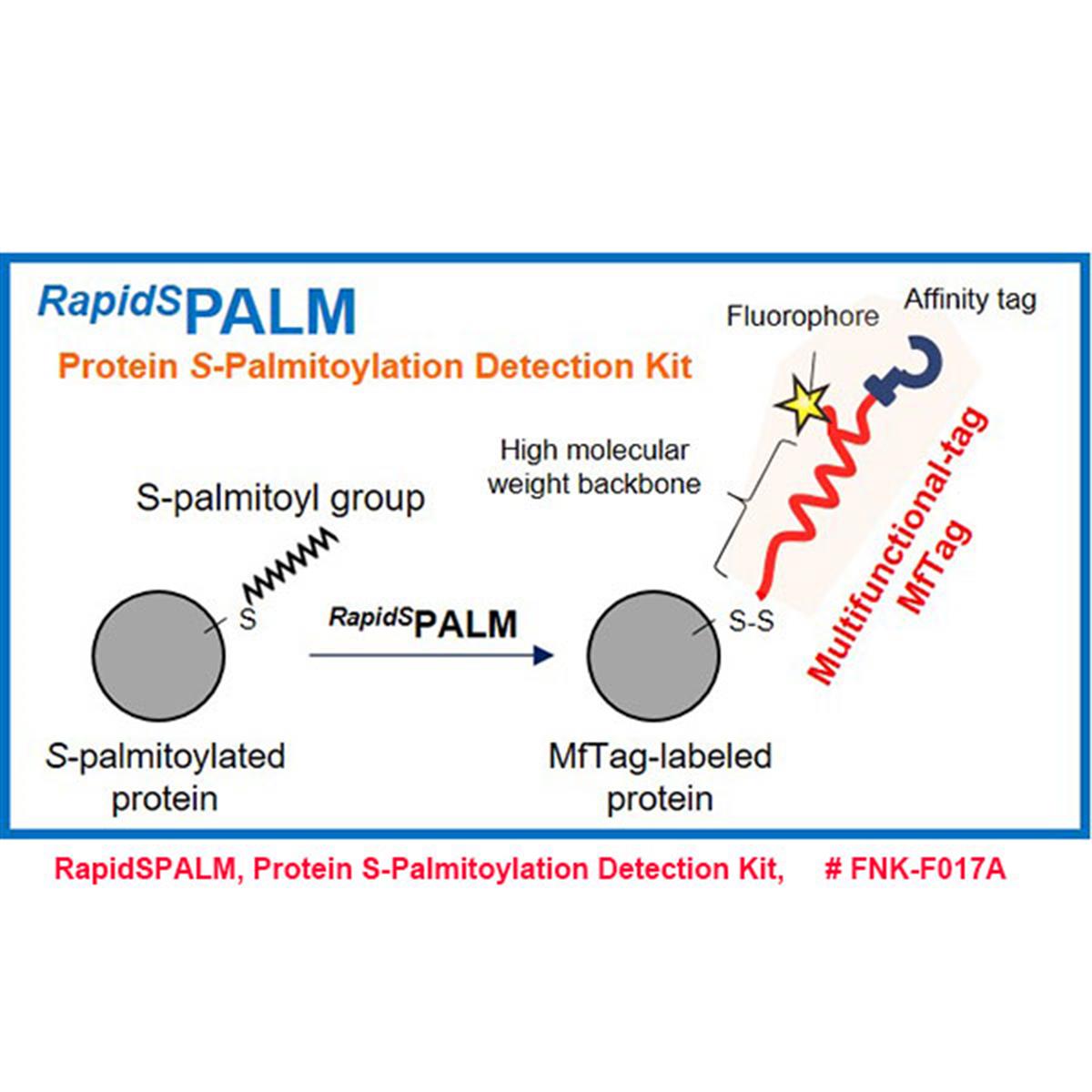
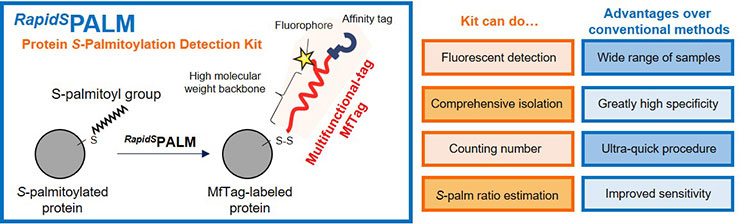
RapidSPALM, Protein S-Palmitoylation Detection Kit is a novel and comprehensive analysis kit for the protein S-palmitoylation, including S-acylation. RapidSPALM kit converts the S-palmitoyl/acyl group on proteins to a unique multifunctional-tag (hereafter MfTag) by stepwise chemical reaction and provides information about total S-palmitoylation amounts in multiple samples, comprehensive S-palmitoylated proteins, number of S-palmitoyl group on target proteins, and ratio of S-palm/non-palm form. A wide range of samples, including animal tissues, cultured cells and plant tissues, etc., can be applied to this kit and RapidSPALM is significantly faster and easier than conventional analytic methods for protein S-palmitoylation.
What is protein S-palmitoylation?
Protein lipidation is one of a category of protein posttranslational modification in which lipid moieties are covalently attached to proteins. Major function of protein lipidation is increasing the hydrophobicity of proteins to promote accessibility to membranes. S-palmitoylation, N-myristoylation and S-prenylation are major types of protein lipidation. While N-myristoylation and S-prenylation are irreversible modification, only S-palmitoylation is a reversibly regulated and considered as a key factor of functional regulation of various proteins.
Protein S-palmitoylation (also called S-acylation) is an addition of lipids mainly C16 palmitate (recently C14-18 fatty acids including unsaturated fatty acids reported) to a specific cysteine residue via a thioester bond enzymatically regulated by zDHHC protein acyl transferases (PAT) and palmitoyl protein thioesterases reversely. So far wide range of proteins including signaling proteins (e.g. oncogene Ras family, Src family, Gα subunits), membrane proteins (e.g. receptors, ion channels and adherent proteins) and virus proteins (e.g. HA protein of influenza virus, glycoprotein of HIV, spike protein of SARS-CoV-2) are identified as S-palmitoylated proteins and S-palmitoylation of some proteins highly contributes to express it functions on membranes. S-palmitoylation also triggers to accumulate to lipid raft which is considered as functional domain of membrane including synapses and immunosynapses etc. As S-palmitoylation contributes to express protein function such as oncogene Ras etc, S-palmitoylation is one of pharmaceutical targets to develop novel drugs. Furthermore, as S-palmitoylation of virus proteins is very important to express inflectional activities of virus, inhibition of S-palmitoylation on virus proteins are promising antivirus drug strategy.
Overview of conventional analysis for protein S-palmitoylation
There are mainly two types of strategies, 1) metabolic labeling of palmitate analogs and 2) chemical substitution, to detect S-palmitoylated proteins. These analytic methods greatly contribute to identify S-palmitoylated proteins and investigate biological functions of protein S-palmitoylation. However, conventional methods have several limitations including narrow applications, low specificity and long-term and laborious procedures. Our RapidSPALM kit which is one of the chemical substitution method overcomes current limitations and accomplishes to set up various types of applications.
Table: Major methods for protein S-palmitoylation
Strategy
Method
Detection
Purpose
Time
Compatible samples
Limitation
Metabolic labeling
Radioisotope-labeled palmitic acids
Autoradiography
- Estimation of S-palmitoylation on target proteins
A few days to months
Only cultured cells
- Need radioisotope facility
- Low sensitivity
- Low specificity
Clickable (azide or alkyne-labeled) palmitate analog
Click chemistry
- Estimation of S-palmitoylation on target proteins
- Comprehensive purification and identification
1-2 days
Only cultured cells
- Low specificity
- Not compatible to tissue samples
Chemical substitution
ABE
(Acyl-Biotin Exchange)
Purification by avidin beads
- Comprehensive purification and identification
1-2 days
Cultured cells, tissues, plants etc.
- Low specificity
APEGS
(Acyl-PEGyl Exchange Gel Shift)
Gel shift assay
- Estimation of S-palm number on target proteins
1-2 days
Cultured cells, tissues, plants etc.
- Low specificity
RapidSPALM
(Rapid Substitution of Protein S-Acylation for Multifunctional-tag)
Fluorometric assay
Gel shift assay
Purification by affinity beads
- Quantification of total S-palmitoylation amounts
- Estimation of S-palm number and ratio on target proteins
- Comprehensive purification and identification
2-3 hours
Cultured cells, tissues, plants etc.
Overview of RapidSPALM
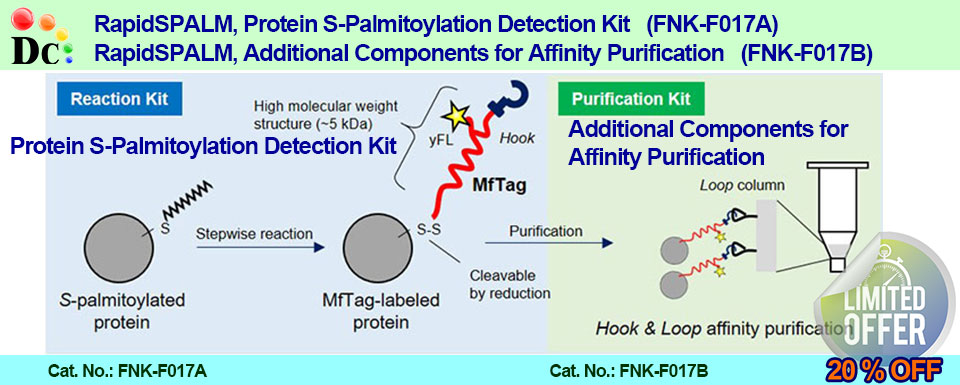
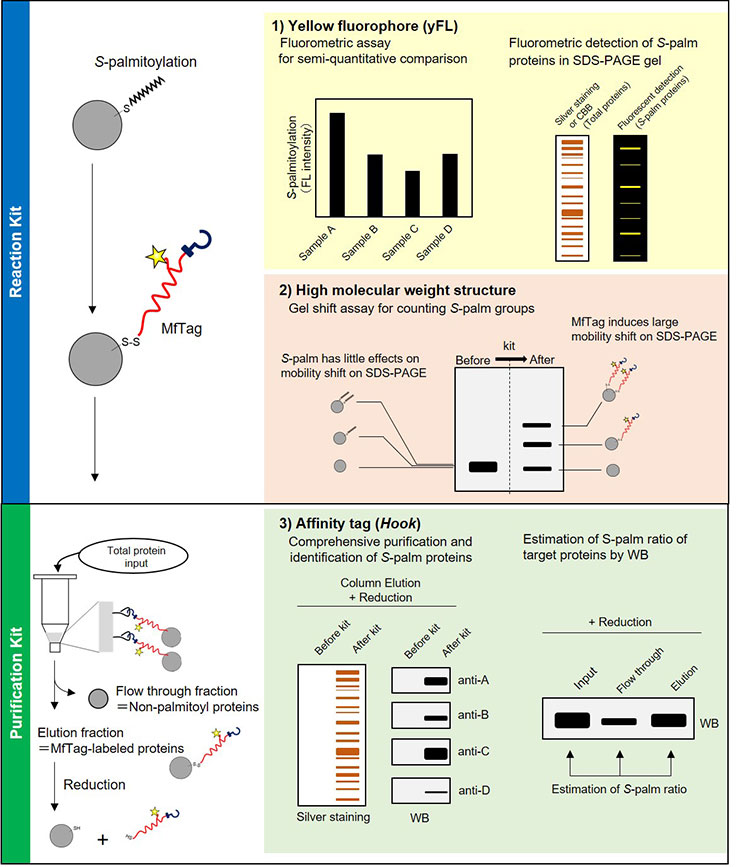
BioDynamics Laboratory Inc., developed a novel chemical strategy called RapidSubstitution of Protein S-Acylation for Multifunctional-tag (RapidSPALM [r'æpizpáːm]) with only 2-3 hours time-course and highly improved specificity. RapidSPALM can converts the S-palmitoyl group on proteins to the unique MfTag which can semi-quantitate total amount of S-palmitoylation, purify comprehensively S-palmitoylated proteins, and count number of S-palmitoyl group. RapidSPALM, Protein S-palmitoylation Detection Kit consists of two kit parts, including a Reaction Kit (Cat. No. #F017A) and Purification Kit (Cat. No. #F017B). Firstly, S-palmitoyl groups on proteins in any samples are converted to MfTag by the Reaction Kit. RapidSPALM’s MfTag contains three functional units, including a yellow fluorophore (yFL), affinity tag (Hook), and a high molecular weight (~5 kDa) backbone and will label to the cysteine residues, which are originally S-palmitoylated via a disulfide bond. The Hook group on the MfTag can be specifically and quickly isolated by a Loop affinity column provided in Purification Kit. After purification, the MfTag is easily cleaved by reducing reagent.
The principle of RapidSPALM Reaction kit
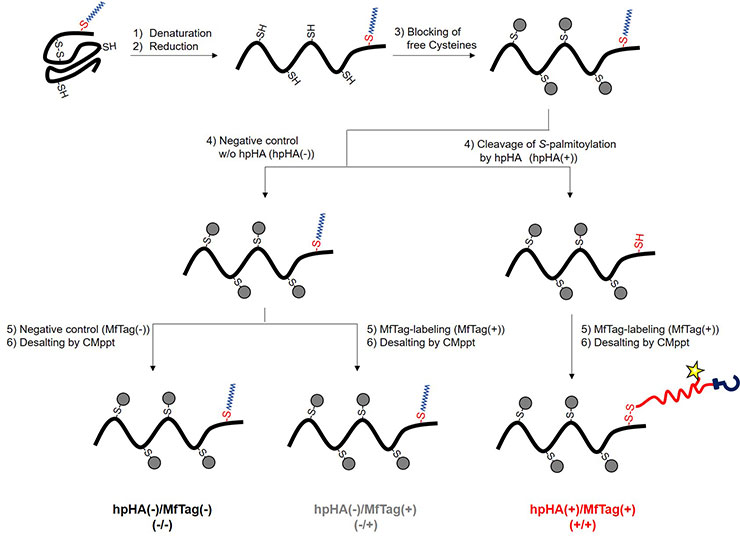
Our RapidSPALM Reaction kit converts S-palmitoyl groups on proteins to a unique MfTag by stepwise chemical reactions similar to conventional S-palmitoylation detection methods, including Acyl-Biotin Exchange (ABE), Acyl-Resin Assisted Capture (Acyl-RAC) and Acyl-PEGyl Exchange Gel Shift assay (APEGS). Unlike ABE, Acyl-RAC or APEGS, RapidSPALM includes several original and high-performance reagents with a highly optimized protocol and will reduce non-specific labeling reaction, dramatically shorten each reaction time, and omit time-consuming steps. Owing to the RapidSPALM reagents and protocol, ultra-quick and easy preparation is accomplished.
Step-1 Strong denaturation of proteins
A strong denaturant and heat denature proteins to increase the accessibility of the following reagents.
Step-2 Reduction of disulfide bond
Disulfide bonds are cleaved by a potent reducing reagent.
Step-3 Blocking of free cysteines
Unique and high-performance thiol-specific reagents block free cysteines.
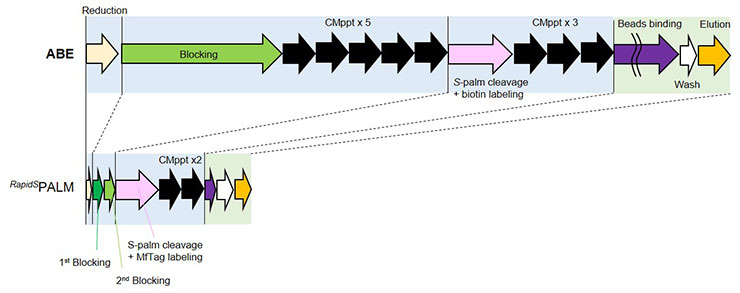
Step-4 Cleavage of S-palmitoyl thioester S-palmitoyl thioesters are cleaved by our high performance hydroxylamine-derivative (hpHA). Then, hpHA(-) sample (Tris-treatment) is also prepared as a negative control for the estimation of non-specific MfTag labeling.
Step-5 MfTag labeling
Free-cysteines newly generated from the hpHA cleavage of S-palmitoyl thioester are labeled with MfTag by a cysteine-specific MfTag-labeling reagent. If blocking of non-palmitoyl free-cysteines in Step-3 is insufficient, MfTag non-specifically binds to proteins in the hpHA(-) sample in S-palmitoylation independent manner. MfTag (-) sample is also prepared as a completely negative control.
Step-6 Desalting unreacted reagents by Chloroform/Methanol precipitation (CMppt)
According to reaction procedures above, three control experiments for each sample are required. Hereafter, each control experiment called hpHA(-)/MfTag(-), hpHA(-)/MfTag(+) and hpHA(+)/MfTag(+), and abbreviated as -/-, -/+, and +/+ in the article.
Figure Stepwise chemical reaction of RapidSPALM
The principle of RapidSPALM Purification kit
Hook&Loop affinity purification is based on a non-proteinous and small molecular interaction system. Due to a non-protein-based method, all procedures can be performed under completely denatured conditions, and non-specific binding of applied proteins to affinity beads are highly suppressed. The spin-column format provides an easy procedure, including only the addition of reagent solutions to the column and spinning-down.
Time course comparison between RapidS PALM and conventional ABE method
ABE, the most popular conventional detection method for protein S-palmitoylation, requires over one-day procedures from sample preparation to affinity purification. Our RapidSPALM kit has ultra-quick procedures and requires only two hours for the MfTag-labeling reaction and an hour for the purification step. Our RapidSPALM saves time and labor and provides half-day experiments.
Feature
Easy procedure offers only two hours for Reaction Kit and one hour for Purification Kit.*
Comprehensive applications can be performed by only one platform.
A wide range of samples, including animal tissue, cultured cells, plant tissues, etc., can be applied.
As spin-column format in the purification kit provide easy and quick procedures.
* Working time is an estimate for one assay
Applications
Quantification of total S-palmitoylation amounts in samples by fluorometric measurement
Detection of S-palmitoylation protein bands in SDS-PAGE gel by fluorometric imager
Estimation of S-palmitoyl group number on target proteins by gel shift assay
Comprehensive purification of S-palmitoylated proteins by affinity column
Estimation of S-palmitoylated ratio of target proteins by affinity column and western blotting
Kit selection guide
There are two parts of RapidSPALM kit, Reaction kit and Purification kit. Reaction kit is an essential part to perform RapidSPALM experiment and can perform fluorometric assay and gel shift assay. Purification kit is an optional component to perform affinity purification. Please select adequate kit format according to experimental purposes listed in the Table below.
In RapidSPALM experiment, reducing or non-reducing condition on SDS-PAGE is important depending on experimental purposes. Please confirm the recommended condition on your experiments.
Note: Purification Kit alone could not prepare RapidSPALM experiments. You need Reaction Kit alone or pair of Reaction Kit and Purification Kit.
Table Selection guide by experimental purpose
Purpose
Detection method
Required kit
To compare total amount of S-palmitoylation modification
between multiple samples
Fluorometric assay
(Measure fluorescent intensity Ex 325/Em 525) by
fluorescent spectrometry)
Reaction kit
To detect S-palmitoylated proteins in SDS-PAGE gel
Fluorescent detection in SDS-PAGE gel
(Non-reducing SDS-PAGE/Fluorescent imager)
Reaction kit
To estimate number of S-palmitoyl group on target protein
Affinity purification and Reducing SDS-PAGE/Silver staining
Reaction kit
+ Purification kit
To identify S-palmitoylated proteins
Affinity purification and Reducing SDS-PAGE/WB
Reaction kit
+ Purification kit
To estimate S-palmitoylation level of target protein
Affinity purification and both Reducing and Non-reducing
SDS-PAGE/WB
Reaction kit
+ Purification kit
Kit information
Kit
Catalog No.
Product name
SizeNote
Reaction Kit
FNK-F017A
RapidSPALM, Protein S-Palmitoylation Detection Kit
12 assays
Purification Kit
FNK-F017B
RapidSPALM, Additional Components for Affinity Purification
24 columns
Note 1. “1 assay” of Reaction Kit contains reagents enough to prepare three control experiments (-/-, -/+, and +/+) mentioned above from one biological sample.
Note 2. For purification application, “1 assay” basically needs two control experiments (-/+ and +/+) from one biological sample. So, 24 columns (=1 kit) are enough to perform 12 assays.
Autophagy is regulated by sequential recruitment of ATG proteins. This study shows that ULK1 is palmitoylated by ZDHHC13 at Cys927 and Cys1003 residues, enabling translocation of the ULK1 complex to autophagosome formation sites upon autophagy induction. Palmitoylation of ULK1 is essential for ATG14L phosphorylation, VPS34 kinase activation, and efficient autophagy. The RapidSPALM (acyl-MfTag exchange) assay was employed to confirm S-palmitoylation status of target proteins, alongside click chemistry–based palmitoylation assays.
2
PNASOpen AccessPubMed Central
TEX38 localizes ZDHHC19 to the plasma membrane and regulates sperm head morphogenesis in mice
Tex38 knockout male mice are infertile due to abnormal sperm head morphogenesis with excess residual cytoplasm retention. TEX38 interacts with ZDHHC19, a testis-enriched palmitoyltransferase, at the plasma membrane of spermatids. TEX38 and ZDHHC19 mutually stabilize each other; loss of either protein causes mislocalization of the partner. ZDHHC19 palmitoylates ARRDC5, an arrestin family protein essential for sperm differentiation. The acyl-MfTag exchange (AME) assay — using the RapidSPALM kit — was employed to detect ZDHHC19-mediated S-palmitoylation in testes and cultured cells.
3
PNASOpen AccessPubMed Central
TEX38 localizes ZDHHC19 to the plasma membrane and regulates sperm head morphogenesis in mice
Tex38 knockout male mice are infertile. TEX38 interacts with ZDHHC19 at the plasma membrane of spermatids. Mice deficient in ZDHHC19 or carrying a C142S catalytic mutation phenocopy Tex38 KO. ZDHHC19 palmitoylates ARRDC5, an arrestin family protein. The acyl-MfTag exchange (AME) assay using the RapidSPALM kit confirmed substrate palmitoylation in testes and HEK293T / COS-7 cell systems, establishing this kit's utility for testis-enriched palmitoylation studies.