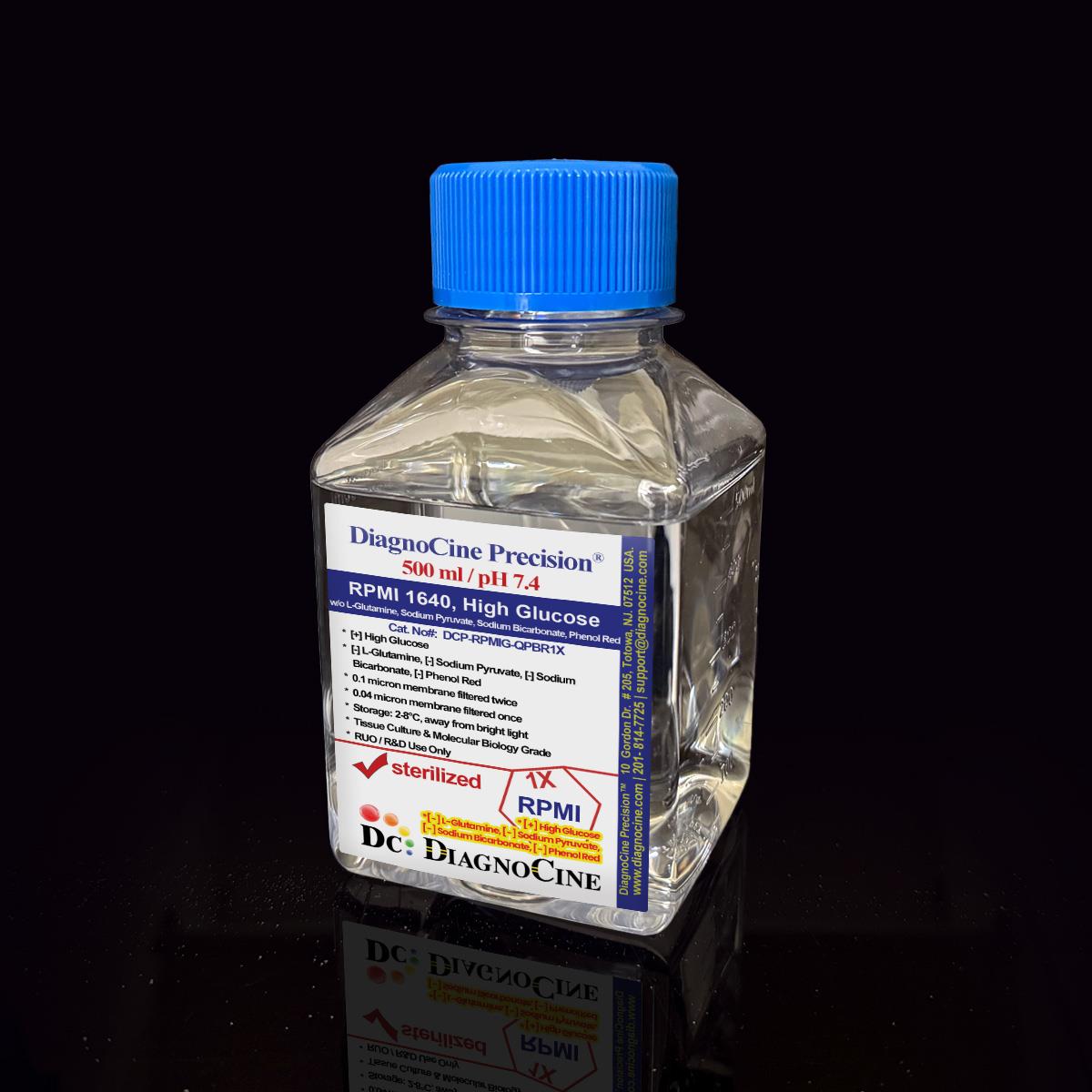
FluxMPS™ RPMI 1640, High Glucose w/o Glutamine, Pyruvate, Bicarbonate, Phenol Red
FluxMPS™ RPMI 1640, High Glucose w/o Glutamine, Pyruvate, Bicarbonate, Phenol Red
FluxMPS™ RPMI 1640 High Glucose (DCP-RPMIG-QPBR1X) is a Diagnocine Microfluidics Suitable cell culture medium engineered for organ-on-a-chip (OoC), microphysiological system (MPS), and microfluidic applications. A quadruple-stage train (0.1 µm ×2 + 0.04 µm ×2) reaches a 0.04 µm final cut-off, five times finer than the 0.22 µm membranes used for conventional sterile filtration.
- Quadruple-stage nano-filtration: 0.1 µm ×2 pre-filtration + 0.04 µm ×2 final filtration — microchannel-safe purity
- Mycoplasma-retentive filtration: 0.04 µm final filter targets organisms as small as 0.2–0.3 µm in diameter (not tested per lot)
- Endotoxin specification: < 0.05 EU/mL (USP <85> BET, tested per manufacturing batch)
- High-glucose formulation: 4,500 mg/L D-Glucose; formulated without L-Glutamine, Sodium Pyruvate, Sodium Bicarbonate, or Phenol Red for full researcher-defined metabolic and buffering control
- Ultrapure Type 1 water (18.2 MΩ·cm) solvent baseline for trace-metal and organic-carbon (TOC) control
- ISO Class 5 (Class 100) fill & finish: aseptic manufacturing in a unidirectional laminar-flow environment
- Manufactured under ISO 13485:2016; final QC and release testing at Diagnocine's R&D Center, Totowa, NJ
- Custom formulations available: pH, glucose, salts, HEPES, and nutrient composition on request — support@diagnocine.com
- Formulation[+] High Glucose / [−] L-Glutamine, [−] Sodium Pyruvate, [−] Sodium Bicarbonate, [−] Phenol Red
- D-Glucose4,500 mg/L
- L-GlutamineNot included [−]
- Sodium PyruvateNot included [−]
- pH (1X)7.4 USP <791>
- Osmolality230–270 mOsm/kg H₂O USP <785>
- Endotoxin< 0.05 EU/mL USP <85>
- Filtration0.1µm ×2 + 0.04µm ×2 (4-stage, Sterile)
- Storage2–8°C, protect from light
- Shelf Life12 months from date of manufacture, unopened
Engineered where standard media fails
Conventional 0.22 µm-filtered RPMI 1640 media carry subvisible particulates and mycoplasma-sized contaminants that can accumulate inside microfluidic channels (diameter <100 µm), affecting downstream cytokine, metabolic, and optical biosensor readouts. FluxMPS™ addresses these failure modes with a four-stage nano-filtration architecture and ISO 13485-compliant micro-batch manufacturing — built for the precision demands of MPS, OoC, and live-cell imaging workflows.[1,2]
Microchannel-safe purity
0.04 µm final-stage filtration is validated for ultra-low particulate counts (USP <788> Method 1, light obscuration), reducing channel-fouling and pressure-drop artefacts in organ-on-a-chip devices.[3]
Total metabolic control
No L-Glutamine, Sodium Pyruvate, or Sodium Bicarbonate. Researchers define the carbon and nitrogen source and the buffering system independently, enabling precise Warburg-effect, oxidative phosphorylation, and flux-balance studies on a fully user-controlled baseline.[4]
Ultrapure-grade water baseline
Formulated with Ultrapure Type 1 water (18.2 MΩ·cm resistivity) as the solvent baseline, controlling trace-metal and organic-carbon (TOC) content to support reproducible cell culture performance.[5]
Low background for imaging
Phenol-red-free formulation removes one common source of spectral interference for confocal, epifluorescence, and ratiometric live-cell imaging. The Quadruple-stage filtration reduces particulate-driven optical scatter; note that riboflavin, a native RPMI 1640 component, retains its own background fluorescence and is not removed by filtration.
Rich, stable nutrient profile
RPMI 1640 carries a balanced complement of 19 amino acids, 10 vitamins, and inorganic salts formulated to support lymphocytes, Jurkat, HeLa, hybridoma, carcinoma, and primary bone-marrow cell models in micro-batch, lot-controlled production.
Customization on demand
pH, glucose concentration, salts, HEPES, and nutrient composition available on request. Additives, growth factors, and serum-free adaptations engineered to specification. Contact support@diagnocine.com.
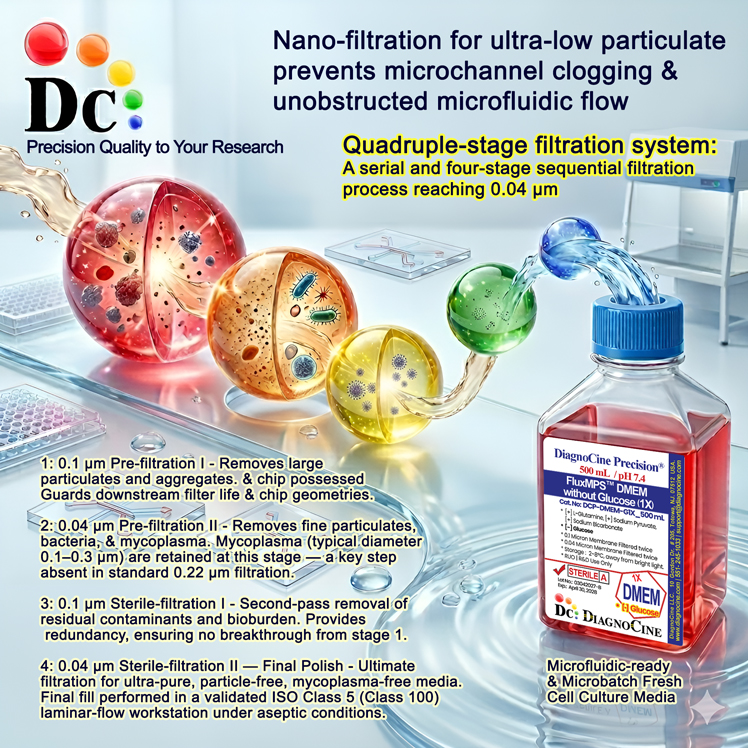
Quadruple-stage filtration system
FluxMPS™ RPMI 1640 High Glucose is filtered to a 0.04 µm final pore size. Each lot passes sequentially through four independently validated filter stages — two dedicated prefilter/final-filter pairs — before aseptic fill, delivering mycoplasma-retentive-polished, ultra-low particulate media suited for microfluidic and MPS devices.
-
1
0.1 µm Prefiltration I
Large particulate and protein-aggregate removal. Protects the first 0.04 µm final filter, extending its operational life and maintaining consistent pore-size integrity across the lot.
-
2
0.04 µm Final filtration I
First 0.04 µm pass; retains sub-micron particulates, bacteria, and mycoplasma-sized organisms (0.2–0.3 µm) that pass a standard 0.22 µm filter.
-
3
0.1 µm Prefiltration II
Second, dedicated prefilter protecting the second 0.04 µm final filter — not a polish of the first pass, but redundant protection for the next cartridge in the train.
-
4
0.04 µm Final filtration II — Polish
Ultimate 0.04 µm polishing filter immediately preceding ISO Class 5 aseptic fill, delivering the lowest achievable particulate burden in a ready-to-use liquid medium.
Performance vs. conventional media
Independently validated particle-count data indicate that the FluxMPS™ Quadruple-stage architecture reduces subvisible particulate burden by approximately 5× versus standard 0.22 µm-filtered RPMI 1640, while the 0.04 µm final pore provides a filtration barrier smaller than the minimum mycoplasma size range.[3,6]
particulate count
filter pore size
© Diagnocine® — DCP-RPMIG-QPBR1X
Optimized for precision cell biology & MPS platforms
FluxMPS™ RPMI 1640 High Glucose supports a broad spectrum of advanced research applications requiring ultra-pure, particulate-free, phenol-red-free media — from suspension lymphocyte cultures to organ-on-a-chip perfusion systems and metabolic-flux workflows.[1,4,7]
Automated Bioreactors & Robotics
For fully automated perfusion bioreactors and liquid-handling robotics, an optional 0.01 µm (10 nm) MPS Grade variant of FluxMPS™ RPMI 1640 High Glucose is available by special inquiry. This tier adds 0.02 µm and 0.01 µm stages after the 0.04 µm polish, targeting nano-scale particulates that can interfere with precision valve actuation, optical flow sensors, and extended closed-loop perfusion stability in next-generation microphysiological platforms.
- Total Particulate Exclusion: 0.01 µm filtration removes nano-scale aggregates invisible to 0.04 µm systems, protecting precision microvalves and flow sensors.
- Valve & Sensor Protection: Ultra-clean media reduces sediment-fouling risk on electro-pneumatic and piezoelectric actuation elements in automated chip platforms.
- Extended Perfusion Stability: Reduced membrane-biofouling risk supports longer closed-loop perfusion runs between media changes.
Inquiry Required: The 0.01 µm MPS Grade variant is not a standard catalog item. Contact support@diagnocine.com to discuss lot sizing, lead time, and compatibility testing.
Micro Physiological System (MPS) & Chip
Ultra-low particulate, mycoplasma-retentive-polished media formulated for continuous perfusion in organ-on-a-chip and tissue-chip devices. Phenol-red-free for clean optical sensing.
Warburg Effect & Metabolic Research
High-glucose (4,500 mg/L), glutamine-free formulation supports studies of aerobic glycolysis (Warburg effect), glucose consumption, and lactate production in cancer cell lines under defined metabolic conditions.
iPSC-Derived & Primary Immune Models
Supports iPSC-derived hematopoietic lineage differentiation and primary lymphocyte, PBMC, and bone-marrow cell models where defined media composition is essential for reproducibility.
Lymphocyte & Suspension Culture
RPMI 1640 is a standard medium for T-cells, B-cells, NK cells, and Jurkat leukemia cells. The FluxMPS™ grade supports particulate-free suspension culture.
Metabolic Flux Analysis
Glutamine-free, pyruvate-free, bicarbonate-free, and phenol-red-free formulation enables researcher-defined isotope-tracing experiments and is compatible with Agilent Seahorse XF assays, which require bicarbonate-free, phenol-red-free medium.
Microscopy & Optical Sensing
Phenol-red-free, ultra-filtered media reduces one common source of optical interference for confocal, TEER, and biosensor measurements in microfluidic chip systems.
Quality-controlled parameters
Every FluxMPS™ lot is tested against the following release specifications before shipment. A Certificate of Analysis (CoA) is available upon request.
| Parameter | Specification |
|---|---|
| Formulation | [+] High Glucose, [−] L-Glutamine, [−] Sodium Pyruvate, [−] Sodium Bicarbonate, [−] Phenol Red |
| Appearance | Pale yellow-colored, clear solution |
| pH (1X) USP <791> | 7.4 |
| Osmolality USP <785> | 230–270 mOsm/kg H₂O |
| D-Glucose | 4,500 mg/L (4.5 g/L) |
| L-Glutamine | Not included [−] |
| Sodium Pyruvate | Not included [−] |
| Phenol Red | Not included [−] |
| Parameter | Specification |
|---|---|
| Endotoxin USP <85> BET | < 0.05 EU/mL |
| Sterility USP <71> | No growth after 14 days incubation |
| Mycoplasma | 0.1 µm / 0.04 µm mycoplasma-retentive filtration (not tested per lot); mycoplasma diameter 0.2–0.3 µm |
| Particulate ≥10 µm USP <788> M1 | Validated per lot |
| Particulate ≥25 µm USP <788> M1 | Validated per lot |
| Water purity | Ultrapure Type 1, 18.2 MΩ·cm (ASTM D1193 / ISO 3696) |
| Manufacturing std. | ISO 13485:2016 QMS |
| Fill environment | ISO Class 5 (Class 100) aseptic fill |
| Parameter | Specification |
|---|---|
| Storage temperature | 2–8°C, protected from bright light |
| Freeze-thaw | Not recommended; do not freeze |
| Shelf life | 12 months from date of manufacture, unopened |
| Shipping condition | Cold pack (2–8°C) |
| CO₂ requirement | No bicarbonate buffer included. Add sodium bicarbonate and maintain 5–10% CO₂, or supplement with HEPES for reduced CO₂ dependence (validate per cell line) |
| Parameter | Specification |
|---|---|
| Raw material grade | Cell-culture-grade, USP/NF or equivalent |
| Traceability | Full lot traceability; CoA available on request |
| Manufacturing QMS ISO 13485 | ISO 13485:2016 certified (Diagnocine Precision supplier) |
| UNSPSC | 41116155 — Molecular biology and cell culture growth media (UNv260801) |
| Regulatory alignment | 21 CFR Part 820 (QMSR) aligned |
| Production method | Micro-batch; final packaging, QA & testing at Diagnocine R&D Center, Totowa, NJ, USA |
| Intended use | For Research Use Only (RUO). Not for clinical, diagnostic, or therapeutic use. |
Full composition (mg/L)
Complete per-lot release composition of FluxMPS™ RPMI 1640 High Glucose (DCP-RPMIG-QPBR1X). All 37 ingredients are reproduced from the authoritative source formulation across 4 category groups. CAS numbers are provided where known; contact support@diagnocine.com for custom nutrient modifications.
| INORGANIC SALTS | CAS Number | mg/L |
|---|---|---|
| INORGANIC SALTS | ||
| Calcium nitrate tetrahydrate | 13477-34-4 | 100.000 |
| Magnesium sulfate anhydrous | 7487-88-9 | 48.840 |
| Potassium chloride | 7447-40-7 | 400.000 |
| Sodium chloride | 7647-14-5 | 6000.000 |
| Sodium phosphate dibasic anhydrous | 7558-79-4 | 800.000 |
| AMINO ACIDS | CAS Number | mg/L |
|---|---|---|
| AMINO ACIDS | ||
| Glycine | 56-40-6 | 10.000 |
| L-Arginine hydrochloride | 1119-34-2 | 241.000 |
| L-Asparagine | 70-47-3 | 50.000 |
| L-Aspartic acid | 56-84-8 | 20.000 |
| L-Cystine dihydrochloride | 30925-07-6 | 65.200 |
| L-Glutamic acid | 56-86-0 | 20.000 |
| L-Histidine hydrochloride monohydrate | 5934-29-2 | 20.960 |
| L-Hydroxyproline | 51-35-4 | 20.000 |
| L-Isoleucine | 73-32-5 | 50.000 |
| L-Leucine | 61-90-5 | 50.000 |
| L-Lysine hydrochloride | 657-27-2 | 40.000 |
| L-Methionine | 63-68-3 | 15.000 |
| L-Phenylalanine | 63-91-2 | 15.000 |
| L-Proline | 147-85-3 | 20.000 |
| L-Serine | 56-45-1 | 30.000 |
| L-Threonine | 72-19-5 | 20.000 |
| L-Tryptophan | 73-22-3 | 5.000 |
| L-Tyrosine Disodium Salt | 69847-45-6 | 28.830 |
| L-Valine | 72-18-4 | 20.000 |
| Component | CAS Number | mg/L |
|---|---|---|
| VITAMINS | ||
| Choline chloride | 67-48-1 | 3.000 |
| D-Biotin | 58-85-5 | 0.200 |
| D-Ca-Pantothenate | 137-08-6 | 0.250 |
| Folic acid | 59-30-3 | 1.000 |
| Niacinamide | 98-92-0 | 1.000 |
| Pyridoxine hydrochloride | 58-56-0 | 1.000 |
| Riboflavin | 83-88-5 | 0.200 |
| Thiamine hydrochloride | 67-03-8 | 1.000 |
| Vitamin B12 | 68-19-9 | 0.005 |
| p-Amino benzoic acid (PABA) | 150-13-0 | 1.000 |
| OTHERS | ||
| D-Glucose | 50-99-7 | 4500.000 |
| Glutathione reduced | 70-18-8 | 1.000 |
| i-Inositol | 87-89-8 | 35.000 |
Manufacturing & compliance standards
FluxMPS™ RPMI 1640 is manufactured under ISO 13485:2016-certified quality systems, with lot-level traceability and multi-point USP compliance testing before release.
ISO 13485:2016 QMS
All primary manufacturing and final fill performed at ISO 13485-certified Diagnocine Precision supplier facilities. Quality assurance and batch release testing conducted at the Diagnocine R&D and Quality Testing Center, Totowa, New Jersey, USA.
Ultrapure Type 1 Water
All FluxMPS™ formulations are prepared exclusively with Ultrapure Type 1 water (18.2 MΩ·cm resistivity), controlling trace-metal and organic-carbon content at the solvent baseline.
ISO Class 5 Fill & Finish
Final filter assembly and aseptic filling occur in a dedicated ISO Class 5 (Class 100) unidirectional laminar-flow clean room, limiting post-filtration particulate introduction during bottling and closure.
Micro-Batch Precision
Micro-batch production supports lot-to-lot consistency in nutrient concentration, pH, and osmolality. Each batch is independently weighed, dissolved, and QC-tested before filtration.
Endotoxin — USP <85> BET
Bacterial Endotoxin Test (LAL method) performed per USP <85> on every released batch. Release specification: < 0.05 EU/mL. Results documented on the CoA.
Particulate — USP <788> Method 1
Light-obscuration particulate testing per USP <788> Method 1 for particles ≥10 µm and ≥25 µm. Relevant to microfluidic channel compatibility.
Osmolality — USP <785>
Osmolality confirmed in the range 230–270 mOsm/kg H₂O per USP <785> on every lot.
Documentation & CoA
Full Certificate of Analysis (CoA) includes lot number, manufacture/expiry date, appearance, pH, osmolality, endotoxin result, sterility result, and filtration records. Available on request.
- Endotoxin — LAL assay, USP <85> Bacterial Endotoxins Test; assay sensitivity 0.005 EU/mL; release specification < 0.05 EU/mL
- pH, osmolality, conductivity, appearance and clarity
- Sterility
How DCP-RPMIG-QPBR1X (FluxMPS™) compares
FluxMPS™ RPMI 1640 High Glucose vs. published supplier specifications. Only parameters with a sourced comparison figure carry a value; all others read "Not specified" rather than an estimate.
| Parameter | DCP-RPMIG-QPBR1X (FluxMPS™) | Other suppliers (published specifications) |
|---|---|---|
| Grade | Microfluidics Suitable | Not specified |
| Formulation | [+] High Glucose 4,500 mg/L / [−] L-Glutamine, Sodium Pyruvate, Sodium Bicarbonate, Phenol Red | Not specified |
| Final filtration pore size | 0.04 µm | Not specified |
| Number of filtration stages | 4 (Quadruple-stage) | Not specified |
| Mycoplasma-retentive filtration | check_circle 0.04µm stage (targets 0.2–0.3µm organisms) | Not specified |
| Endotoxin (release specification) | FluxMPS™ — < 0.05 EU/mL | Corning classical liquid media — < 0.25 EU/mL Sigma-Aldrich DMEM complete medium — ≤ 2 EU/mL Gibco classical DMEM — Not specified (recorded per lot) |
| USP particulate compliance | check_circle USP <788> Method 1 | Not specified |
| Water quality | Ultrapure Type 1, 18.2 MΩ·cm | Not specified |
| Manufacturing QMS | check_circle ISO 13485:2016 | Not specified |
| Microfluidic channel compatibility | check_circle Validated | Not specified |
| Custom formulation | check_circle On request | Not specified |
Comparison figures from published supplier specifications, accessed 2026-09-02. Suppliers that publish no numeric endotoxin specification are shown as "Not specified".
Frequently asked questions
Common questions about FluxMPS™ RPMI 1640 High Glucose (DCP-RPMIG-QPBR1X) and its use in advanced cell culture applications.
Supporting literature
Curated peer-reviewed references relevant to RPMI 1640, organ-on-a-chip applications, microfluidic perfusion, metabolic research, and filtration-grade cell culture media.
- Ingber DE. Human organs-on-chips for disease modelling, drug development and personalized medicine. Nat Rev Genet. 2022;23(8):467-491. doi:10.1038/s41576-022-00466-9
- Huh D, Matthews BD, Mammoto A, Montoya-Zavala M, Hsin HY, Ingber DE. Reconstituting organ-level lung functions on a chip. Science. 2010;328(5986):1662-1668. doi:10.1126/science.1188302
- van Duinen V, Trietsch SJ, Joore J, Vulto P, Hankemeier T. Microfluidic 3D cell culture: from tools to tissue models. Curr Opin Biotechnol. 2015;35:118-126. doi:10.1016/j.copbio.2015.05.002
- Warburg O. On the origin of cancer cells. Science. 1956;123(3191):309-314. doi:10.1126/science.123.3191.309
- United States Pharmacopeia. USP <85> Bacterial Endotoxins Test. USP-NF. United States Pharmacopeial Convention; 2023.
- Bhattacharya S, Dutta D, Bhowmick T. Mycoplasma contamination in cell culture: a comprehensive review. J Appl Microbiol. 2020;131(1):1-16. doi:10.1111/jam.14707
- Moore GE, Gerner RE, Franklin HA. Culture of normal human leukocytes. JAMA. 1967;199(8):519-524. doi:10.1001/jama.1967.03120080053007
- Fendt SM, Bell EL, Keibler MA, et al. Reductive glutamine metabolism is a function of the alpha-ketoglutarate to citrate ratio in cells. Nat Commun. 2013;4:2236. doi:10.1038/ncomms3236
- Zhang YS, Aleman J, Shin SR, et al. Multisensor-integrated organs-on-chips platform for automated and continual in situ monitoring of organoid behaviors. Proc Natl Acad Sci USA. 2017;114(12):E2293-E2302. doi:10.1073/pnas.1612906114
- Hassell BA, Goyal G, Lee E, et al. Human organ chip models recapitulate orthotopic lung cancer growth, therapeutic responses, and tumor dormancy in vitro. Cell Rep. 2017;21(2):508-516. doi:10.1016/j.celrep.2017.09.043