

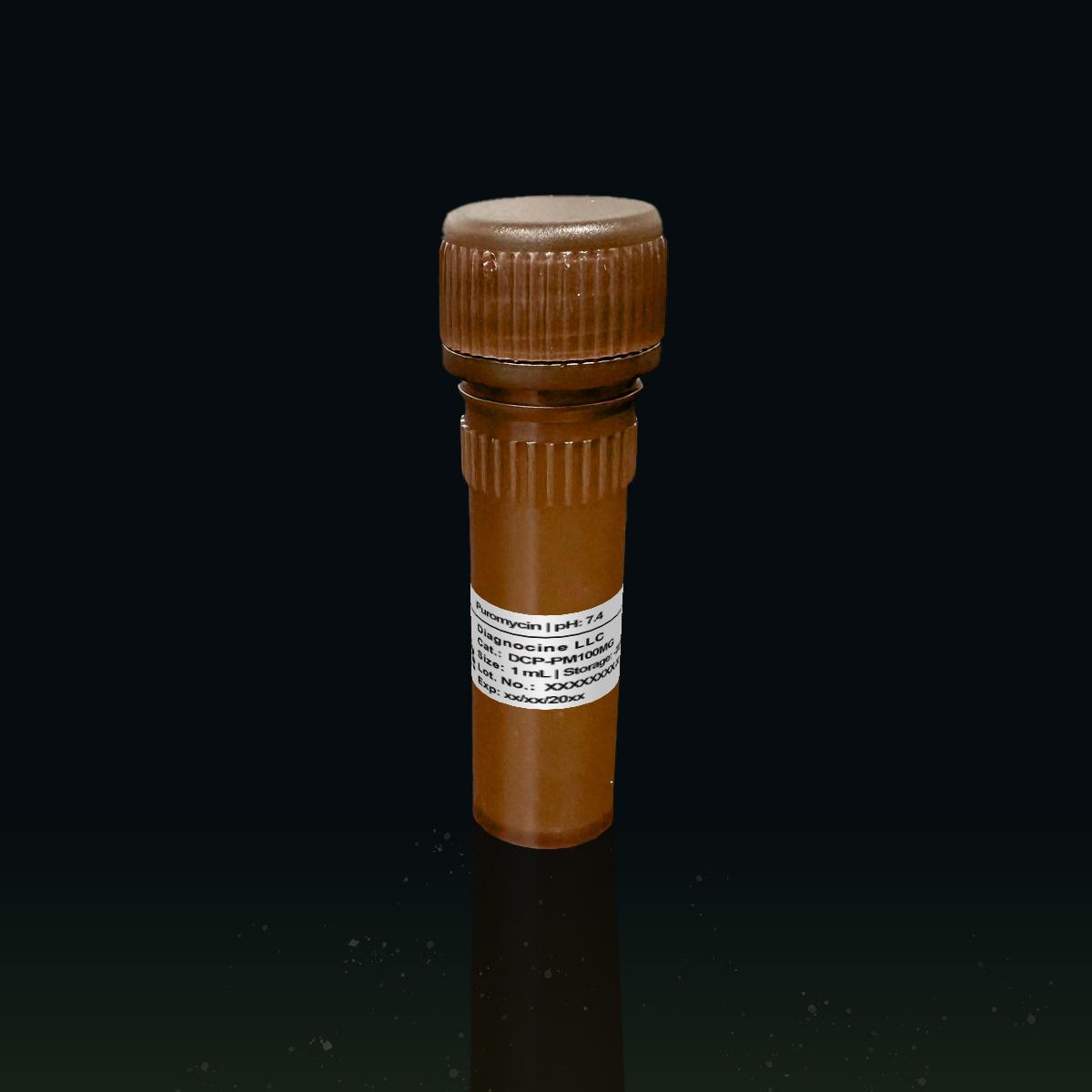
FluxMPS™ Puromycin (10 mg/mL) Selection Antibiotic Solution
A Microfluidics Suitable, dual-stage filtered (0.1 µm x1 + 0.04 µm x1) puromycin dihydrochloride solution supplied ready-to-use at 10 mg/mL in phosphate-buffered saline (PBS). Formulated for rapid, reliable selection pressure in cells carrying puromycin-resistance genes (e.g. pac), with compatibility for microfluidic dosing, organ-on-a-chip (OoC) perfusion, and conventional multiwell selection workflows.
- Ready-to-use 10 mg/mL (10,000 mg/L) puromycin dihydrochloride solution, pre-dissolved in PBS for direct dilution into culture medium
- Protein synthesis inhibitor that enters the ribosome and causes premature polypeptide chain termination, selecting for cells expressing puromycin resistance (pac, puromycin N-acetyltransferase)
- Aminonucleoside antibiotic originally derived from Streptomyces alboniger; favored for fast-acting kill curves during selection optimization
- Filtered through a 0.1 µm and 0.04 µm membrane train; supplied as a clear, colorless liquid at pH 7.4
- Confirmed absence of detectable DNase and RNase activity after 18-hour incubation with plasmid DNA and ribosomal RNA at room temperature
- Manufactured under an ISO 13485-certified quality management system; final packaging, QA, and testing performed at the Diagnocine R&D and Quality Testing Center, Totowa, NJ, USA
- Supplied in a 10 mL format packaged as 10 x 1 mL single-use aliquots; stored at -20°C/-80°C protected from light with a 24-month shelf life
- Custom concentrations, additives, and pH modifications available on request
- Active IngredientPuromycin dihydrochloride
- Concentration10 mg/mL (10,000 mg/L)
- Carrier / VehiclePhosphate-buffered saline (PBS)
- AppearanceClear, colorless liquid
- pH (USP <791>)7.4
- Filtration0.1 µm x1 + 0.04 µm x1 (dual-stage)
- DNase ActivityNone detected (18 hr, RT)
- RNase ActivityNone detected (18 hr, RT)
- Storage-20°C/-80°C, protected from light
- Shelf Life24 months from date of manufacture, unopened
Engineered where standard antibiotic solutions fall short
Conventional puromycin preparations are often supplied as unfiltered powder or minimally characterized stock solutions, leaving particulate load, nuclease contamination, and lot-to-lot consistency unaddressed — risks that compound quickly in microfluidic channels, organ-on-a-chip perfusion loops, and long selection timelines.
Dual-stage filtration
Processed through a 0.1 µm prefilter followed by a 0.04 µm final filter, reducing particulate and microbial bioburden for microchannel-safe, microfluidic-compatible delivery.
Fast, reliable kill curves
Puromycin’s rapid ribosomal mechanism of action supports quick selection optimization, letting researchers establish an effective working concentration in a short timeframe.
Nuclease-tested formulation
Each lot is evaluated for DNase and RNase activity by 18-hour incubation with plasmid DNA and ribosomal RNA at room temperature, with none detected, protecting nucleic-acid-sensitive workflows.
Ready-to-use PBS solution
Supplied pre-dissolved in phosphate-buffered saline for direct, accurate dilution into culture medium — no weighing powder, no solvent compatibility guesswork.
Validated resistance-marker compatibility
Formulated to select for cells expressing the puromycin N-acetyltransferase (pac) resistance gene, supporting stable transfection, gene-editing, and reporter-line selection workflows.
Customization on demand
Alternate concentrations, additional chemicals/compounds/proteins/supplements, different pH, and other modifications are available — contact support@diagnocine.com.
Dual-stage filtration system
DCP-PM100MG is processed through a validated two-stage membrane train reaching a 0.04 µm final pore size: a 0.1 µm prefilter removes larger particulate and microbial-scale material, followed by a dedicated 0.04 µm final filter that polishes the solution for microfluidic-safe delivery.
-
1
0.1 µm Prefiltration
Removes particulate matter and mycoplasma-scale organisms ahead of the final polishing filter, protecting the 0.04 µm cartridge downstream.
-
2
0.04 µm Final filtration — Polish
Final 0.04 µm polishing filter retains sub-micron particulates and microaggregates, producing a solution suited to microchannel and organ-on-a-chip dosing.
Filtration summary
Two dedicated filtration passes — one prefilter, one final filter — are applied to every lot of this product.
Where DCP-PM100MG is used
Puromycin (10 mg/mL) supports selection pressure maintenance, translational research, and antibiotic sensitivity assays across a broad range of cell culture and microfluidic workflows.
Automated Bioreactors & Robotics
For automated bioreactor and robotic liquid-handling platforms where valve and sensor longevity is critical, Diagnocine offers an optional 0.01 µm (10 nm) ultra nano-filtered MPS Grade variant of this formulation, engineered for extended system uptime.
- Total Particulate Exclusion — six-stage cascade filtration down to 0.01 µm
- Valve & Sensor Protection — minimizes fouling in fine-bore automated dosing lines
- Extended Perfusion Stability — supports long-duration, unattended selection protocols
Inquiry Required: the 0.01 µm MPS Grade variant is produced to order — contact support@diagnocine.com to request this formulation.
Selection in Microphysiological Systems (MPS) & Chip Culture
Suitable for maintaining puromycin selection pressure in perfused microfluidic devices and organ-on-a-chip platforms.
Stable Transfection & Selection
Maintains selection pressure in cells stably transfected with a puromycin-resistance (pac) marker.
CRISPR/Cas9 & Knock-in Selection
Used to enrich for successfully edited or knocked-in clones carrying a puromycin-resistance cassette.
Antibiotic Sensitivity & Kill Curve Assays
Rapid mechanism of action makes puromycin favored for dose-titration and kill-curve optimization studies.
Protein Synthesis & Translational Control Studies
As a ribosome-targeting translation inhibitor, puromycin is used in research on protein synthesis and translational control mechanisms.
iPSC & Primary Cell Selection Workflows
Applied in selection of engineered iPSC and primary cell lines carrying puromycin-resistance reporter constructs.
Full specification sheet
Every parameter below reflects the manufacturer’s stated formulation and quality control data for DCP-PM100MG.
Available pack size: 10 mL (10 x 1 mL)
| Parameter | Specification |
|---|---|
| Active Ingredient | Puromycin dihydrochloride |
| Concentration | 10 mg/mL (10,000 mg/L) |
| Carrier / Vehicle | Phosphate-buffered saline (PBS) |
| Appearance | Clear, colorless liquid |
| pH (USP <791>) | 7.4 |
| Parameter | Specification |
|---|---|
| Filtration | 0.1 µm x1 + 0.04 µm x1 (dual-stage) Filtered |
| Mycoplasma | 0.1 µm mycoplasma-retentive filtration (not tested per lot) |
| DNase Activity | None detected (18 hr, RT, plasmid DNA) |
| RNase Activity | None detected (18 hr, RT, ribosomal RNA) |
| Manufacturing Standard | ISO 13485:2016-certified facility ISO 13485 |
| Parameter | Specification |
|---|---|
| Storage Temperature | -20°C/-80°C, protected from light |
| Shelf Life | 24 months from date of manufacture, unopened |
| Pack Size | 10 mL (10 x 1 mL) |
| Parameter | Specification |
|---|---|
| Raw Material Source | Aminonucleoside antibiotic derived from Streptomyces alboniger |
| Traceability | Manufactured, packaged & QC-tested at Diagnocine, Totowa, NJ, USA |
| Manufacturing QMS | ISO 13485-certified facility (Suppliers of Diagnocine Precision) |
| UNSPSC | 41116155 — Molecular biology and cell culture growth media (UNv260801) |
| Regulatory Alignment | Research Use Only (RUO); not for human therapeutic or diagnostic use |
| Production Method | Aseptic dilution and dual-stage membrane filtration; final QC at Diagnocine R&D and Quality Testing Center |
| Intended Use | Research Use Only |
Full composition
DCP-PM100MG contains a single formulated active ingredient dissolved in a phosphate-buffered saline (PBS) carrier. The manufacturer’s source description does not itemize discrete PBS salt concentrations or amino acid/vitamin components for this product — unlike a full cell culture growth medium, this is a single-analyte selection reagent. Total: 1 formulated active ingredient (carrier PBS components not itemized by the manufacturer).
| Component | CAS Number | mg/L |
|---|---|---|
| PBS carrier salts (not individually itemized by manufacturer) | — | Not specified |
| Component | CAS Number | mg/L |
|---|---|---|
| No amino acids are formulated in this product | — | — |
| Component | CAS Number | mg/L |
|---|---|---|
| Puromycin dihydrochloride (active ingredient) | 58-58-2 | 10,000 mg/L (10 mg/mL) |
Manufacturing & compliance
DCP-PM100MG is produced under a documented quality management system with per-lot verification of filtration integrity and nuclease activity.
ISO 13485-Certified Manufacturing
Manufactured under an ISO 13485-certified facility (Suppliers of Diagnocine Precision).
Dual-Stage Filtration
0.1 µm prefiltration followed by 0.04 µm final filtration on every lot.
Nuclease-Tested Formulation
Per-lot DNase and RNase activity testing, 18-hour incubation at room temperature.
Finished in Totowa, NJ
Final packaging, quality assurance, and testing performed at the Diagnocine R&D and Quality Testing Center, Totowa, New Jersey, USA.
Filtration Validation
0.1 µm mycoplasma-retentive membrane filtration; 0.04 µm final polishing filter.
DNase / RNase Testing
None detected after 18-hour incubation with plasmid DNA / ribosomal RNA at room temperature.
pH Verification (USP <791>)
Confirmed at 7.4 per release testing.
Documentation / CoA
A Certificate of Analysis is available on request.
How DCP-PM100MG compares
Comparisons below use Diagnocine’s own release specifications alongside published supplier data where available.
| Parameter | DCP-PM100MG (FluxMPS™) | Other Suppliers (Published Specifications) |
|---|---|---|
| Grade | Microfluidics Suitable | Not specified |
| Formulation | Ready-to-use 10 mg/mL puromycin dihydrochloride in PBS | Not specified |
| Final filtration pore size | 0.04 µm | Not specified |
| Number of filtration stages | 2 (0.1 µm + 0.04 µm) | Not specified |
| Mycoplasma-retentive filtration | check_circle 0.1 µm stage | Not specified |
| DNase/RNase testing | check_circle None detected | Not specified |
| Endotoxin (release specification) | FluxMPS™ — Not specified | Corning classical liquid media — < 0.25 EU/mL Sigma-Aldrich DMEM complete medium — ≤ 2 EU/mL Gibco classical DMEM — Not specified (recorded per lot) |
| Manufacturing QMS | ISO 13485:2016 | Not specified |
| Microfluidic channel compatibility | check_circle | Not specified |
| Custom formulation available | check_circle | Not specified |
Comparison figures from published supplier specifications, accessed 2026-09-02. Suppliers that publish no numeric endotoxin specification are shown as "Not specified".
Frequently asked questions
Common questions about DCP-PM100MG, Puromycin (10 mg/mL).
Supporting literature
Curated literature relevant to puromycin selection, mechanism of action, and microfluidic/organ-on-a-chip applications.
- Vara JA, Perez-Gonzalez JA, Jimenez A. Biosynthesis of puromycin by Streptomyces alboniger: characterization of puromycin N-acetyltransferase. Biochemistry. 1985. doi:10.1021/bi00330a027
- de la Luna S, Soriano I, Puig-Antich J, Ortin J, Jimenez A. Efficient transformation of mammalian cells with constructs containing a puromycin-resistance marker. Gene. 1988. doi:10.1016/0378-1119(88)90066-3
- Schmidt EK, Clavarino G, Ceppi M, Pierre P. SUnSET, a nonradioactive method to monitor protein synthesis. Nat Methods. 2009. doi:10.1038/nmeth.1314
- Goodman CA, Hornberger TA. Measuring protein synthesis with SUnSET: a valid alternative to traditional techniques. Exerc Sport Sci Rev. 2013. doi:10.1097/JES.0b013e3182798a95
- Aviner R. The science of puromycin: from studies of protein synthesis to applications in biotechnology. Comput Struct Biotechnol J. 2020. doi:10.1016/j.csbj.2020.02.014
- Bhatia SN, Ingber DE. Microfluidic organs-on-chips. Nat Biotechnol. 2014. doi:10.1038/nbt.2989
- Huh D, Matthews BD, Mammoto A, Montoya-Zavala M, Hsin HY, Ingber DE. Reconstituting organ-level lung functions on a chip. Science. 2010. doi:10.1126/science.1188302
- Zaher HS, Green R. Fidelity at the molecular level: lessons from protein synthesis. Cell. 2009. doi:10.1016/j.cell.2009.01.036
- Uphoff CC, Drexler HG. Detection of mycoplasma contamination in cell cultures. Methods Mol Biol. 2011. doi:10.1007/978-1-61779-108-6_1
- Vazquez D. Inhibitors of protein biosynthesis. Mol Biol Biochem Biophys. 1979. doi:10.1007/978-3-642-81309-2