


Potassium Acetate Buffer [1X]
FluxMPS™ Potassium Acetate Buffer [1X]
FluxMPS™ Potassium Acetate Buffer [1X] is an MPS-grade, quadruple-stage-filtered aqueous reagent engineered for microchannel-safe nucleic acid precipitation workflows. Formulated at 2 M potassium acetate and 2 M glacial acetic acid with a defined pH of 5.5, it delivers consistent, lot-controlled ionic conditions for DNA and RNA precipitation, SDS-bound protein removal, and cell-free translation protocols. Manufactured with Ultrapure Type 1 water and tested free of DNase and RNase activity, it supports organ-on-a-chip (OoC), tissue-on-a-chip (ToC), and molecular biology sample-preparation pipelines.
- Quadruple-stage filtration: 0.1-micron membrane filtration twice and 0.04-micron membrane filtration twice for ultra-low particulate purity
- Precisely formulated with 2 M potassium acetate and 2 M glacial acetic acid, pH 5.5, buffering across a pKa range of 6.0-8.0
- Manufactured with Ultrapure Type 1 water (18.2 MΩ·cm) under ISO Class 5 (Class 100) fill conditions
- Tested free of DNase and RNase activity after 18 hour incubation at room temperature
- Manufactured under ISO 13485-certified and CE-approved facilities
- Supports ethanol/isopropanol precipitation of DNA and RNA and removal of SDS-bound proteins
- Custom concentrations, pH, and additive formulations available on request
- pH5.5
- Molarity / Concentration2 M Potassium Acetate / 2 M Glacial Acetic Acid
- Buffering Range (pKa)6.0-8.0
- AppearanceClear, Colorless Liquid
- Filtration0.1 µm x2 + 0.04 µm x2
- DNase ActivityNone Detected
- RNase ActivityNone Detected
- Storage4°C
- Shelf Life2 years
- ManufacturingISO 13485 / CE
Engineered where standard buffers fail
Conventional 0.22 µm-filtered buffers can carry subvisible particulates, variable ionic conditions, and untested nuclease activity into DNA and RNA precipitation workflows. FluxMPS™ Potassium Acetate Buffer [1X] is built to remove these failure points.
Microchannel-safe purity
Quadruple-stage 0.1 µm and 0.04 µm membrane filtration is designed to align with USP <788> particulate control expectations for microchannel-compatible reagents.
Precise, stable pH
Formulated at 2 M potassium acetate and 2 M glacial acetic acid, delivering a measured pH of 5.5 and a buffering range (pKa) of 6.0 to 8.0 for reproducible precipitation chemistry.
Ultrapure-grade water
Manufactured with Ultrapure Type 1 water (18.2 MΩ·cm), consistent with USP <85> water-quality expectations for sensitive nucleic acid workflows.
Low background for downstream assays
Confirmed free of DNase and RNase activity after 18 hour incubation, reducing background interference in downstream fluorescence-based nucleic acid quantification assays.
Defined, traceable composition
Every lot is formulated to 2 M potassium acetate and 2 M glacial acetic acid and quality tested for nuclease activity prior to release.
Customization on demand
Alternative concentrations, pH values, and additional chemicals, compounds, proteins, or supplements can be formulated on request.
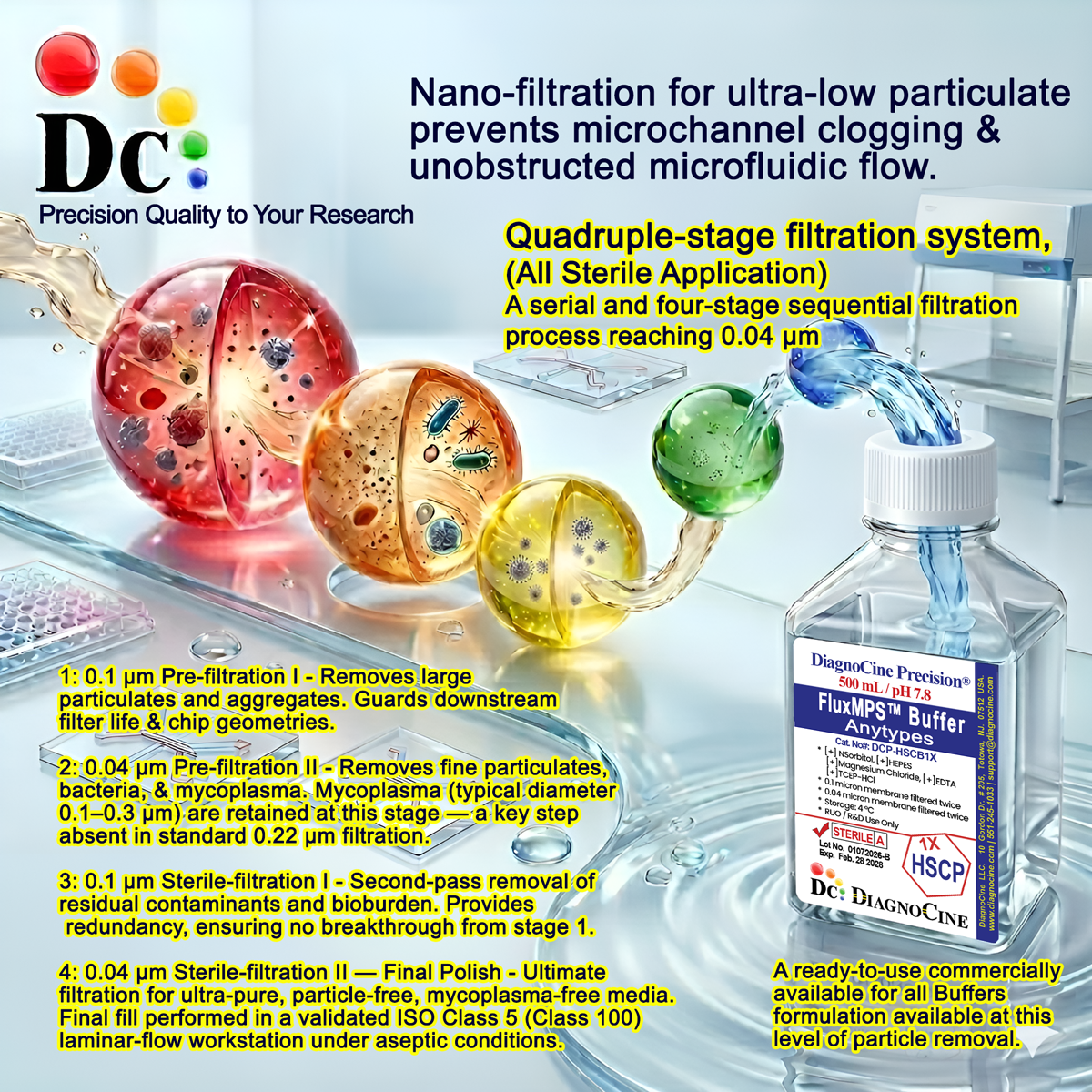
Quadruple-stage filtration system
Potassium Acetate Buffer [1X] is filter-sterilized with a 0.1-micron membrane filtration performed twice and a 0.04-micron membrane filtration performed twice, providing a sequential four-stage purity architecture before final fill.
-
1
0.1 µm Pre-filtration I
First-pass 0.1-micron membrane filtration removes large particulates and aggregates, extending the working life of downstream filters.
-
2
0.04 µm Pre-filtration II
First-pass 0.04-micron membrane filtration retains finer particulates and bioburden ahead of sterile filtration.
-
3
0.1 µm Sterile-filtration I
Second-pass 0.1-micron membrane filtration provides redundant sterile-filtration coverage.
-
4
0.04 µm Sterile-filtration II — Final Polish
Second-pass 0.04-micron membrane filtration provides the final polish under a sterile filling environment.
Performance vs. conventional buffer
Sequential 0.1 µm and 0.04 µm membrane filtration, each applied twice, removes finer particulates than the single-pass 0.22 µm filtration typically used for conventional buffers.
© Diagnocine® — DCP-PAB1X
Where Potassium Acetate Buffer [1X] is used
Formulated for DNA and RNA precipitation, SDS-bound protein removal, and cell-free translation workflows, with purity engineered for microfluidic and organ-on-a-chip sample-preparation pipelines.
Automated Bioreactors & Robotics
For automated liquid handling, robotic dispensing, and closed-loop bioreactor systems, an optional 0.01 µm (10 nm) ultra-filtered grade of this buffer is available to further protect fine-bore tubing, valves, and inline sensors from particulate accumulation.
- Total Particulate Exclusion: sub-10 nm filtration removes particulates beyond standard 0.04 µm polishing.
- Valve & Sensor Protection: reduces particulate-driven wear on automated dispensing valves and inline optical sensors.
- Extended Perfusion Stability: supports longer unattended run times in closed-loop microfluidic and bioreactor systems.
Inquiry Required: the 0.01 µm (10 nm) ultra-filtered grade is produced to order. Contact support@diagnocine.com to request this configuration.
Micro Physiological System (MPS) & Chip
Low-particulate, quadruple-filtered formulation compatible with microchannel-based sample-processing steps upstream of chip-based nucleic acid workflows.
DNA & RNA Precipitation
Used to precipitate and concentrate DNA and RNA from aqueous solutions, commonly combined with ethanol or isopropanol precipitation and for removal of SDS-bound proteins.
iPSC-Derived Model Handling
Supports nucleic acid precipitation and purification steps in workflows involving iPSC-derived neuron, cardiomyocyte, and hepatocyte models.
Endothelial & Primary Cell Perfusion
Facilitates ethanol-precipitation-based nucleic acid recovery from endothelial and primary hepatocyte culture workflows.
ELISA, Blotting & Blocking
Removes SDS-bound proteins during nucleic acid purification steps upstream of ELISA, Western blot, IHC, and IF workflows.
Microscopy & Optical Sensing
Low-particulate purity supports clean nucleic acid recovery upstream of confocal microscopy, biosensor, and TEER-based assay workflows.
Detailed specifications
All values below reflect the measured and declared specifications for Potassium Acetate Buffer [1X], DCP-PAB1X.
| Parameter | Specification |
|---|---|
| Formulation / Composition | 2 M Potassium acetate; 2 M Glacial acetic acid |
| Appearance | Clear, Colorless Liquid |
| pH USP <791> | 5.5 |
| Buffering Range (pKa) | 6.0-8.0 |
| Parameter | Specification |
|---|---|
| Sterility | Filtered 0.1 micron membrane twice and 0.04 micron membrane twice in a sterile environment |
| DNase Activity | None detected (18 hour incubation, room temperature) |
| RNase Activity | None detected (18 hour incubation, room temperature) |
| Water Quality | Ultrapure Type 1 water (18.2 MΩ·cm) |
| Fill Environment | ISO Class 5 (Class 100) |
| Parameter | Specification |
|---|---|
| Storage Temperature | 4°C |
| Shelf Life | 2 years |
| Parameter | Specification |
|---|---|
| Raw Material Grade | Highly purified, analytical grade chemicals |
| Manufacturing QMS | ISO 13485-certified |
| Regulatory Alignment | CE-approved |
| Production & Traceability | Final packaging, quality assurance, and testing performed at the DiagnoCine R&D and Quality Testing Center; customization and assembly performed at DiagnoCine Precision, Totowa, New Jersey, USA |
| Intended Use | For Research Use Only (RUO) |
Full composition
Potassium Acetate Buffer [1X] is a two-component precipitation buffer, formulated and quality tested on a per-lot basis.
| Component | CAS Number | Concentration |
|---|---|---|
| Potassium acetate | 127-08-2 | 2 M |
| Glacial acetic acid | 64-19-7 | 2 M |
Manufacturing & compliance
Potassium Acetate Buffer [1X] is manufactured under ISO 13485-certified, CE-approved facilities, with final packaging, quality assurance, and testing performed at the DiagnoCine R&D and Quality Testing Center.
ISO 13485:2016 QMS
Manufactured under ISO 13485-certified, CE-approved facilities supplying DiagnoCine Precision.
Ultrapure Type 1 Water
Formulated with Ultrapure Type 1 water (18.2 MΩ·cm).
ISO Class 5 Fill & Finish
Filter-sterilized and filled under a sterile, ISO Class 5 (Class 100) environment.
Micro-Batch Precision
Each lot is formulated to 2 M potassium acetate and 2 M glacial acetic acid and quality tested prior to release.
DNase / RNase Testing
None detected after 18 hour incubation of plasmid DNA and ribosomal RNA at room temperature, respectively.
Sterility & Filtration
Filtered through a 0.1-micron membrane twice and a 0.04-micron membrane twice in a sterile environment.
pH Verification USP <791>
Measured pH of 5.5, buffering across a pKa range of 6.0 to 8.0.
Documentation / CoA
A Certificate of Analysis documenting lot-specific testing is available on request.
How DCP-PAB1X compares
A side-by-side look at the purity architecture behind FluxMPS™ Potassium Acetate Buffer [1X].
| Parameter | DCP-PAB1X (FluxMPS™) | Conventional 0.22 µm-filtered buffer | Standard alternative (0.22 µm-filtered) |
|---|---|---|---|
| Defined formulation | 2 M KOAc / 2 M AcOH, pH 5.5 | Variable formulation | Not specified |
| Final filtration pore size | 0.04 µm (final stage) | 0.22 µm | 0.22 µm |
| Number of filtration stages | 4 | 1 | 1 |
| DNase / RNase tested | check_circle Tested, none detected | cancel Not routinely tested | cancel Not routinely tested |
| Water quality | Ultrapure Type 1 (18.2 MΩ·cm) | Purified water | Purified water |
| Manufacturing QMS | check_circle ISO 13485:2016 / CE | cancel Not specified | cancel Not specified |
| Microfluidic channel compatibility | check_circle | cancel | cancel |
| pH reproducibility | Lot-controlled, pH 5.5 | Variable | Variable |
| Custom formulation | check_circle Available on request | cancel | cancel |
Frequently asked questions
Common questions about FluxMPS™ Potassium Acetate Buffer [1X], DCP-PAB1X.
Supporting literature
Curated literature on potassium acetate precipitation chemistry, nucleic acid purification, and buffer applications in microfluidic and organ-on-a-chip systems.
- Sambrook J, Russell DW. Molecular Cloning: A Laboratory Manual. Cold Spring Harbor Laboratory Press.doi:10.1101/pdb.top91
- Green MR, Sambrook J. Precipitation of DNA with Ethanol. Cold Spring Harb Protoc.doi:10.1101/pdb.prot093377
- Birnboim HC, Doly J. A rapid alkaline extraction procedure for screening recombinant plasmid DNA. Nucleic Acids Res.doi:10.1093/nar/7.6.1513
- Bimboim HC. A rapid alkaline extraction method for the isolation of plasmid DNA. Methods Enzymol.doi:10.1016/0076-6879(83)00074-9
- Huh D, Torisawa YS, Hamilton GA, Kim HJ, Ingber DE. Microengineered physiological biomimicry: organs-on-chips. Lab Chip.doi:10.1039/C1LC20698A
- Bhatia SN, Ingber DE. Microfluidic organs-on-chips. Nat Biotechnol.doi:10.1038/nbt.2989
- Good NE, et al. Hydrogen ion buffers for biological research. Biochemistry.doi:10.1021/bi00866a011
- Ferreira GN, et al. Effects of ionic strength and pH on nucleic acid precipitation efficiency. Anal Biochem.doi:10.1006/abio.2000.4692
- Pattanayek SK, et al. Endotoxin and particulate control in cell culture and perfusion reagents. J Pharm Sci.doi:10.1002/jps.23920
- Zhang B, et al. Biology and applications of organ-on-a-chip technology. Annu Rev Anal Chem.doi:10.1146/annurev-anchem-061318-115124