

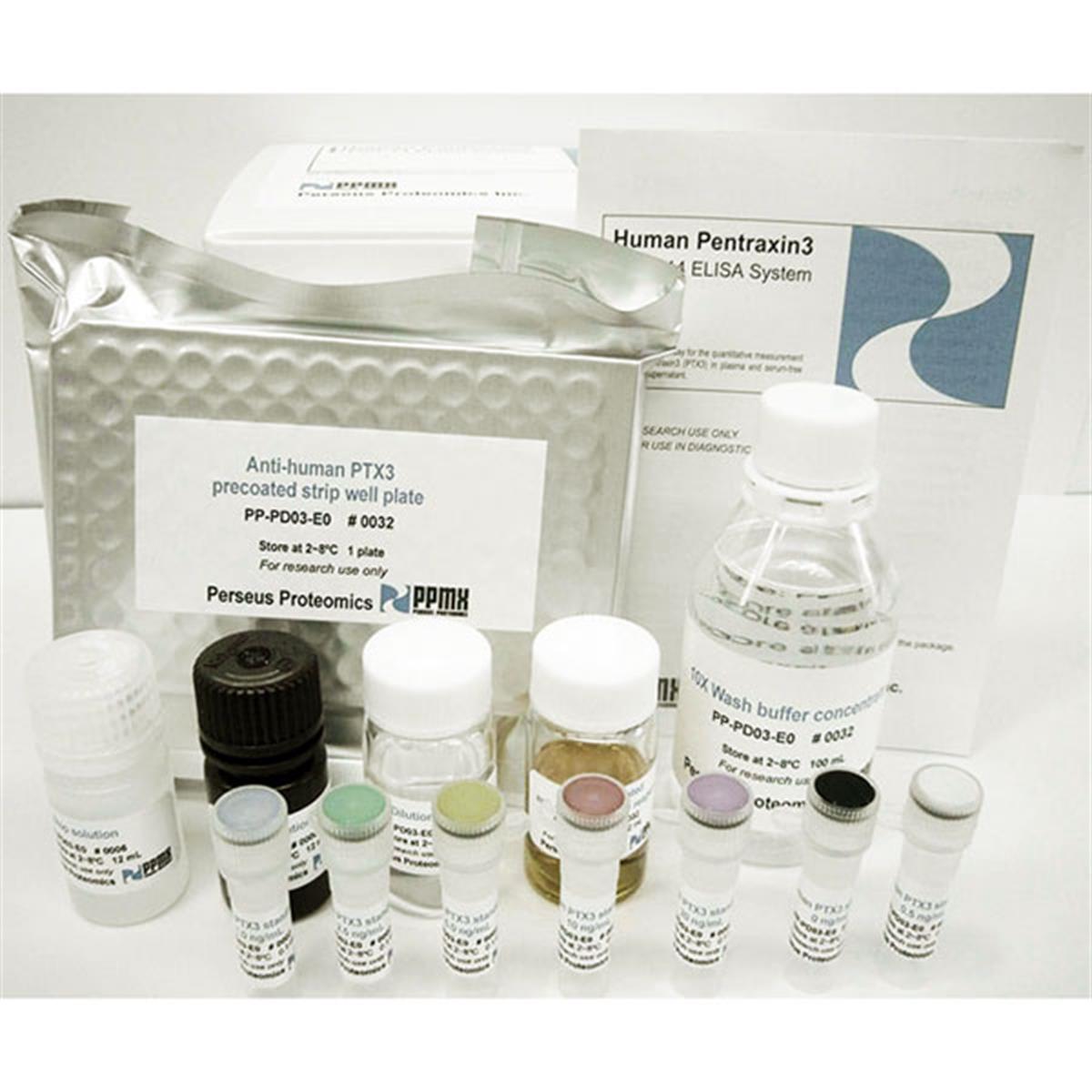
Pentraxin 3,Human, ELISA Kit
Pentraxin 3,Human, ELISA Kit <TSG-14,ELISA System>
DiagnoCine offers excellent TSG-14 | PTX3 | Pentaxin3 antibodies and ELISA for researchers studying inflammatory cytokines, inflammation stimuli, Immune-response in mesenchymal, epithelial cells, endothelial cells, and mononuclear phagocytes | fibrocyte differentiation, regulation pathways in inflammation and complement activation | regulation of innate resistance to pathogens, clearance of self-components and female fertility | association with virion binding and (1->3)-beta-D-glucan binding.
Human diseases include Infectious Myocarditis, Takayasu Arteritis, Innate Immune System, and Lung Fibrosis.
TSG-14 | PTX3 | Pentaxin3 antibodies have excellent quality and this highly pure antibody can be adapted for Western Blots, ELISA, Immunohistochemistry, Immunofluorescence research with optimization.
Cat. No. FNK-PP-PD03-E0
Size 1 Kit
Storage 4°C
Description
Pentraxin 3 (PTX3), also known as tumor necrosis factor-stimulated gene sequence-14 (TSG-14), is categorized in Long Pentraxin among Pentraxin family which is a member of inflammatory protein such as CRP and SAP.
PTX3 is secreted by vascular endothelial cells, macrophages, fibroblasts and smooth muscle cells in response to inflammatory signals like LPS, IL-1 and TNF. PTX3 is a potential biomarker of Myocardial Infarction and Atherosclerosis.
Immunosorbent assay for the quantitative measurement of human Pentraxin3(PTX3) in plasma and serum-free cell culture supernatant
Perseus Proteomics have established a high sensitivity PTX3 detection method, which we expect to be a breakthrough biomarker capable of predicting patients' risk of atherosclerosis in the earliest stages.
We start selling our high sensitivity PTX3 ELISA kit “Human Pentraxin 3 / TSG-14 ELISA System” for research use only.
Specification
- Species : Human
- Assay Range : 0.5 - 20 ng/mL
- Sensitivity : 0.1 ng/mL
- Sample : EDTA plasma, FBS-free Cell culture supernatants
- Average recovery : 97.3%
- Cross reactivity with CRP and SAP : < 0.1 ng/mL
Kit Components
- Anti-human PTX3 antibody precoated strip well plate, 1 (96 well)
- HRP conjugated anti-PTX3 antibody reagent, 1 vial (12 mL)
- Human PTX3 standards 0, 0.5, 1.0, 2.5, 5.0, 10, 20 ng/mL, 7 vials (0.1 mL)
- 10X Wash buffer concentrate, 1 vial (100 mL)
- Dilution buffer, 1 vial (15 mL) containing preservative
- TMB solution, 1 vial (12 mL)
- Stop solution, 1 vial (12 mL)
- Adhesive plate covers, 3 sheets
- Instruction manual
Assay Protocol
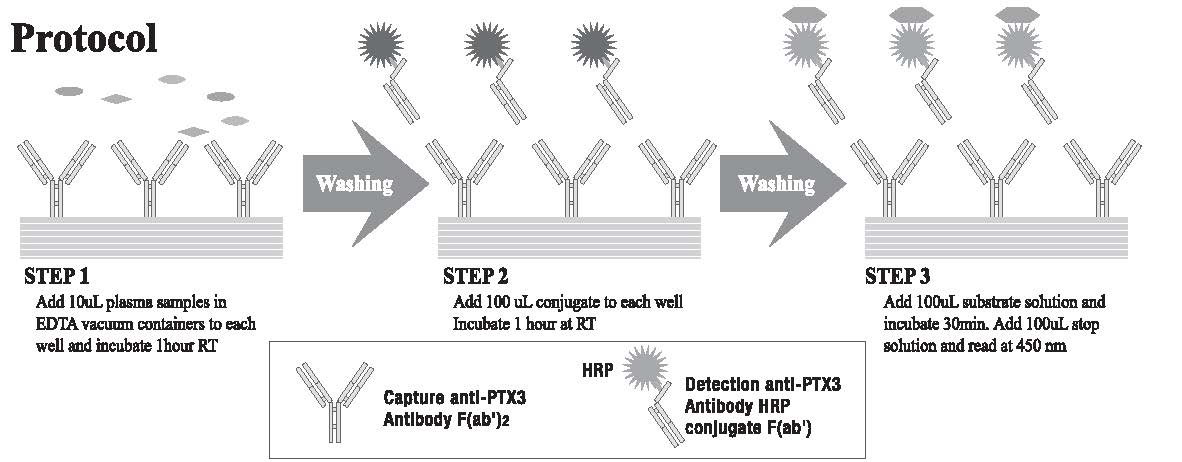
Sample preparation
- Plasma
After collecting blood, centrifuge for 10 minutes at 3,000 rpm. Assay immediately or aliquot and store samples at <−20℃ within 2 hours.
Caution: Serum, heparin plasma and citrate plasma samples can NOT be used with this kit.
- Cell culture supernatants

Performance cheracteristics --Lineality and Detection limit --
Lineality and Detection limit :
Representative calibration curve based on PTX3 calibrators of 0.5-20ng/mL. The lower limit of detection is 0.1ng/mL
Performance cheracteristics --Spike and Recovery--
Average recovery is 97.3.
Performance cheracteristics --Cross reactivity--
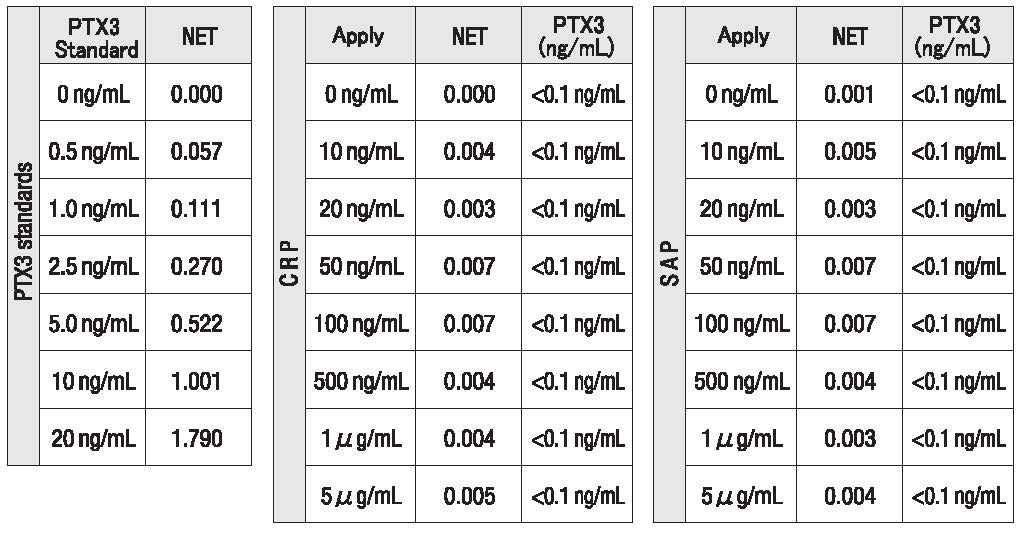
Cross reactivity with CRP and SAP is <0.1ng/mL, Cross reactivity test
Performance cheracteristics --Reproducibility--
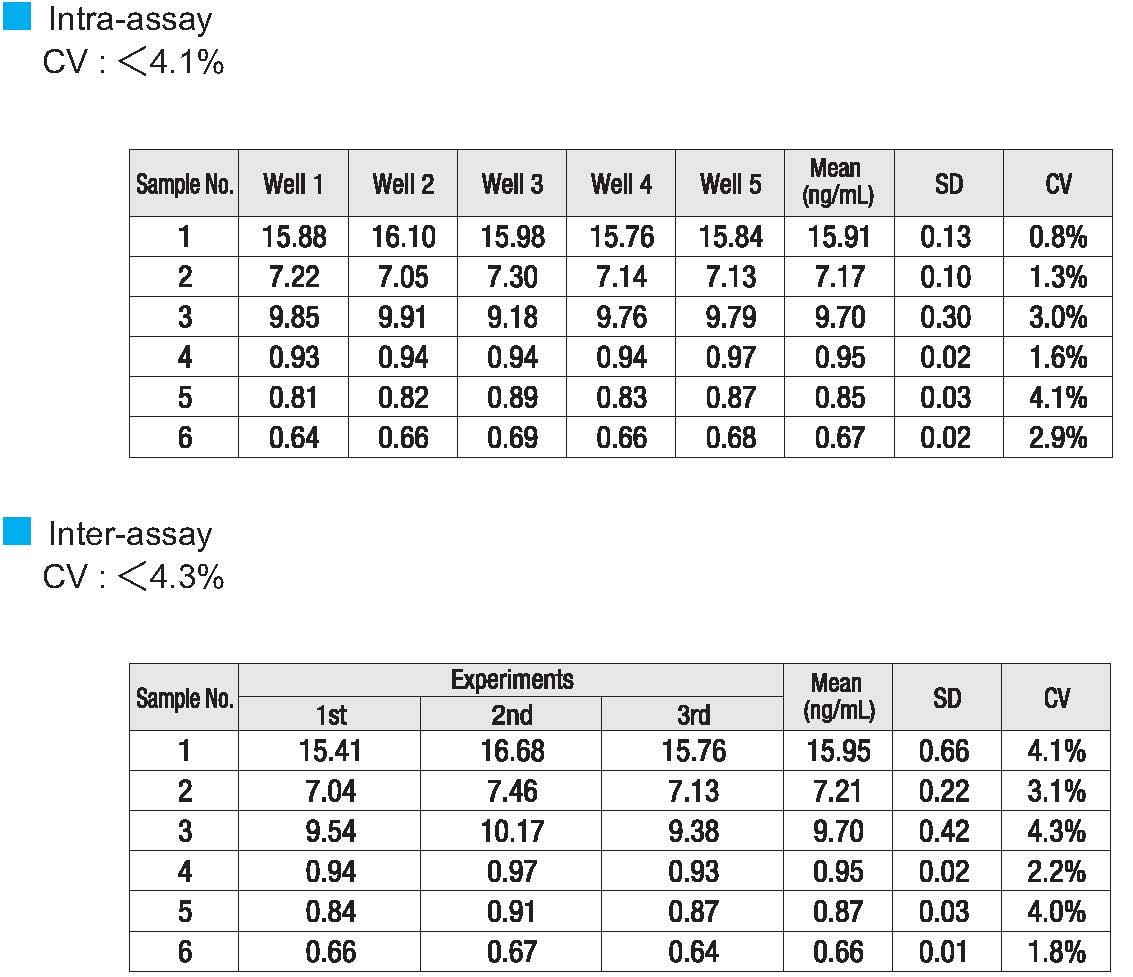
Intra-assay within 4.1%, Inter-assay within 4.3%, Intra-assay and Inter-assay
Publications / Citations
- Arterioscler Thromb Vasc Biol. 2007 ; 27(1) : 161-7. Inoue K et al.
- Clin J Am Soc Nephrol. 2007 ; 2(5) : 889-97. Tong M et al.
- Cell Immunol. 2007 ; 248(2) : 86-94. Imamura M et al.
- J Pathol. 2008 ; 215(1) : 48-55. Savchenko A et al.
- Atherosclerosis 2008 ; 197(1) : 368-74 Kotooka N et al., Inoue T et al.
- Am Heart J. 2008 ; 155(1) : 75-81. Suzuki S et al.
- Dig Dis Sci. 2008 ; 53(7) : 1910-6. Kato S et al.
- Int J Cardiol. 2008 ; 130(1) : 19-22. Kotooka N et al.
- Clin Chem Lab Med. 2009 ; 47(4) : 471-7. Yamasaki K et al.
- Journal of Analytical Bio-Science 2010 ; 33(4) : 289-97 Inoue K. et al.
- Journal of Analytical Bio-Science 2010 ; 33(4) : 298-306 Yamaguchi N. et al.
- Journal of Analytical Bio-Science 2010 ; 33(4) : 307-12 Kotooka N.
- Journal of Analytical Bio-Science 2010 ; 33(4) : 313-20 Maemura K et al.
- Journal of Analytical Bio-Science 2010 ; 33(4) : 321-8 Kato S et al.
- Journal of Analytical Bio-Science 2010 ; 33(4) : 329-38 Naito M et al.
- Journal of Analytical Bio-Science 2010 ; 33(4) : 339-46 Ogawa T et al.
- Journal of Analytical Bio-Science 2010 ; 33(4) : 347-54 Hatakeyama K et al.
- Clin J Am Soc Nephrol. 2014 ; 9(7) : 1207-16 Yilmaz MI et al.
