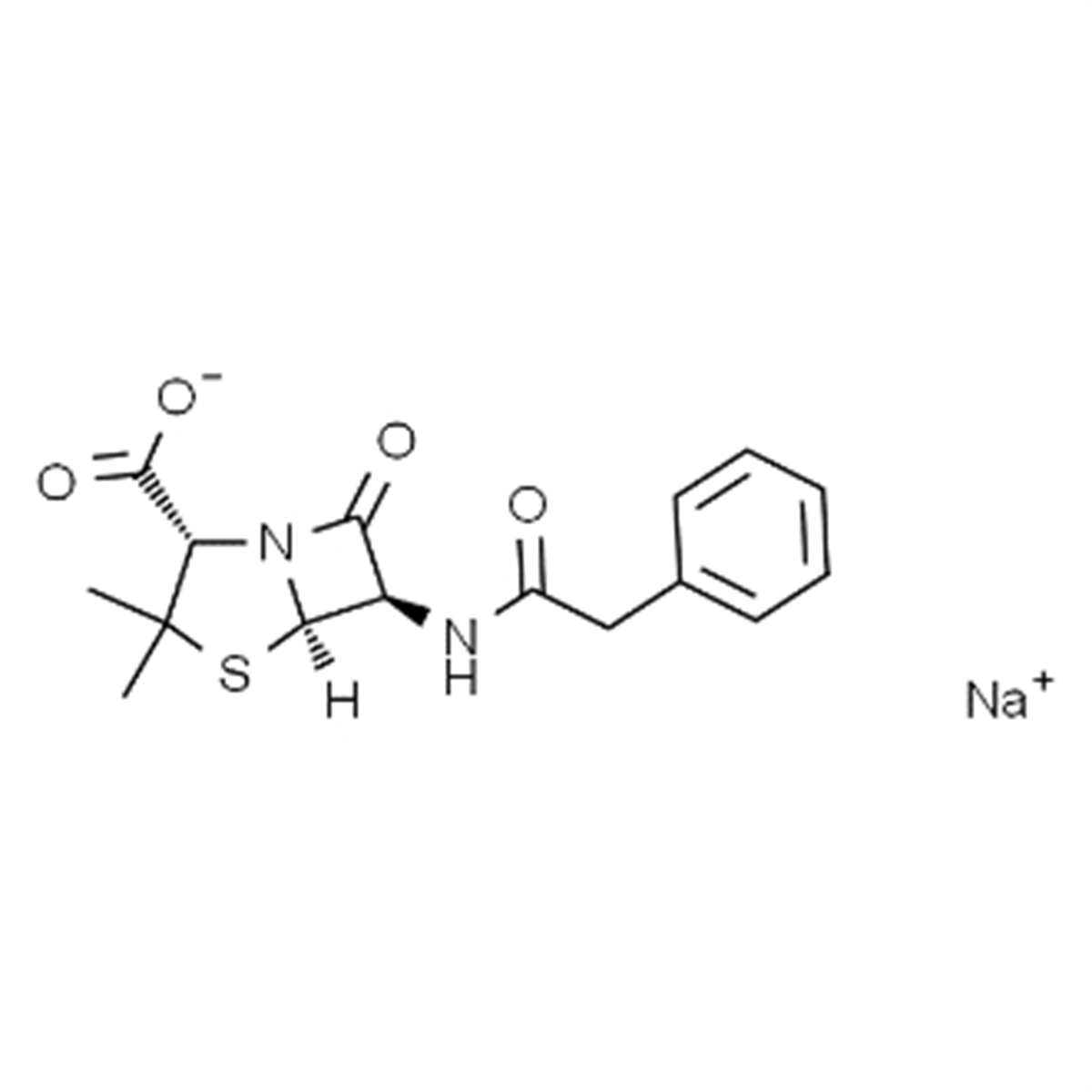
Penicillin G Sodium Salt
Cat. No.: SB-GC301003-1g
Size: 1g
Description
Penicillin antibiotics are the general term of β-lactam antibiotics. It has a narrow antibacterial spectrum and is mainly effective against Gram-positive bacteria. Penicillin has the advantages of strong antibacterial action, high efficacy and low toxicity, so it is still widely used. It functions by inhibiting bacterial cell wall synthesis, which is crucial for bacterial growth and survival. It achieves this by binding to penicillin-binding proteins (PBPs), which are essential for peptidoglycan cross-linking in bacterial cell walls. This action disrupts the integrity of the bacterial cell wall, leading to cell lysis and death, particularly in Gram-positive bacteria. Regarding cell signaling pathways, Penicillin G sodium salt does not directly engage in typical cell signaling pathways like MAPK/ERK or PI3K/Akt/mTOR, which are involved in cellular communication and regulation in eukaryotic cells. Its primary role is antimicrobial, targeting bacterial cells rather than modulating eukaryotic cell signaling pathways This antibiotic is effective against various types of streptococci, including Streptococcus pneumoniae and groups A, B, C, and G streptococci, as well as nonenterococcal group D streptococci and viridans group streptococci. It is also used for non-penicillinase producing staphylococci.
Penicillin is an organic acid that can combine with a variety of metals to form salts, commonly known as sodium or potassium salts. Penicillin can be chemically cleaved to remove the acyl group to produce 6-APA (6-aminopic illanic acid), an intermediate of various semi-synthetic penicillins. For cell culture, the recommended working concentration of penicillin in cell culture medium is 100U/ml. The penicillin G sodium salt was dissolved in deionized water or PBS, then the bacterium ia was re moved by filtration in 0.22 μm filter, and the concentrated solution was stored in -20 ℃ .
Basic Attributes
| Name |
Penicillin G Sodium salt |
| Synonyms |
Penicillin G sodium salt; Penicillin sodium |
| CAS |
69-57-8 |
| Molecular formula |
C16H17N2O4SNa |
| Molecular mass |
356.37 |
| Purity |
Potency (Anhydrous) (U/mg) 1550 |
| Appearance (character) |
White powder |
| Storage conditions |
2-8 °C |
| Unit |
bottle |
| Spec. |
1g |
| Pubchem CIDs |
0 |
| MDL No. |
MFCD00069666 |
| EC No. |
200-710-2 |
| Related categories |
Biochemical reagent, Anti-biotic |
| Solubility |
100 mg/ mL in Water |
| Validity |
36 months |
Storage and Handling Conditions
Transport and storage at 2-8 ℃ , valid for 36 months.
Note:
For your safety and health, please wear lab coat and disposable gloves.
Relevance in Human Disease
Penicillin G Sodium Salt is primarily used to treat infections caused by susceptible bacteria. Some of the common conditions treated with this antibiotic include:
- Respiratory tract infections: Such as pneumonia caused by Streptococcus species.
- Skin infections: Including those caused by Streptococcus pyogenes.
- Bacterial endocarditis: Prevention in patients with certain heart conditions undergoing surgery.
- Meningitis: Particularly in newborns, caused by group B Streptococcus.