Particulate Thermoprobe
Particulate Thermoprobe
Cat. No. FNK-FDV-0003
Size 100 ug
Storage RT, For reconstituted solution, store at +4℃. Protected from light.
Average Diameter 48 nm Average Diameter:
Purity >99%
Appearance Yellow powder
Solubility Soluble in water
Temperature resolution better than 0.5 ℃
License This product is licensed by Tokyo University
Reconstitution Reconstitute at 10 mg/ml in 80 mM KCl, 10 mM K2HPO4, 4 mM NaCl.
Description
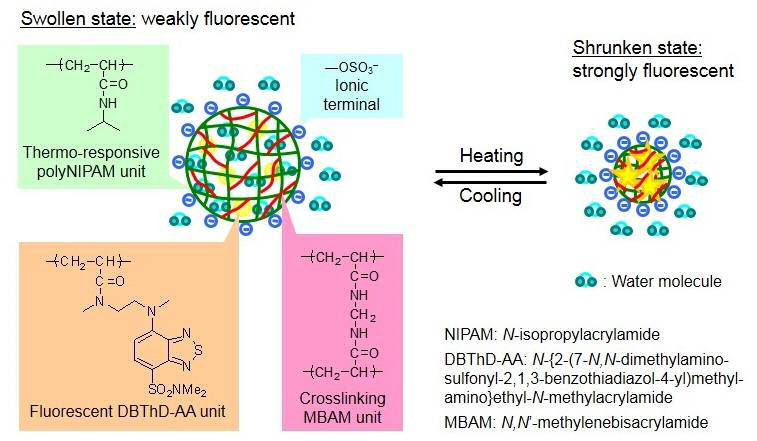
Particulate Thermoprobe is a fluorescent nanogel thermometer for living cells. It aggregates in proportion to increase in the temperature and fluorescence intensity is proportional to its aggregation.Ultrasensitive Fluorescent Thermometer for cellular temperature monitoring The "Particulate Thermoprobe" Useful Tools to monitor cellular activity.
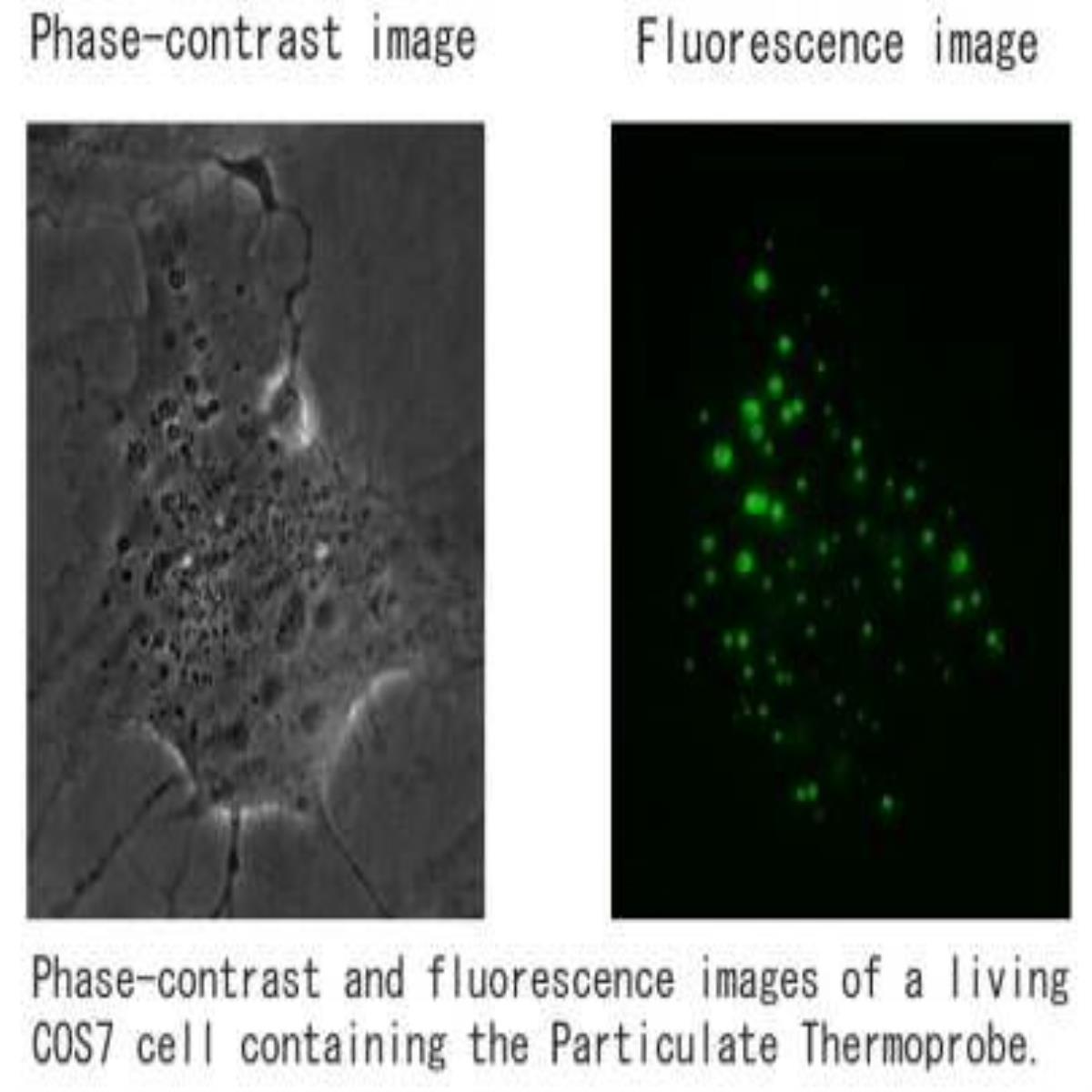
Fluorescence intensity is observed by fluorescence microscopy. Thermoprobe measures the average temperature of the whole cells, and it provides unprecedented experimental approach.
This product is licensed by Tokyo University.
Features
- The Particulate Thermoprobe is a fluorescent nanogel thermometer.
It gives us the average intracellular temperature to monitor cellular activity. - Cellular temperature will be measured by fluorescence microscopy following microinjection into cells.
- The temperature resolution of Particulate Thermoprobe is better than 0.5C.
- Particulate Thermoprobe is not affected by cellular environmental conditions such as pH, ionic strength, protein etc.
- Average Diameter : 48 nm
- Purity : >99%
- Solubility: Soluble in water
- Appearance: Yellow powder
Structure & Functional Diagram
Fluorescence Intensity of the Particulate Thermoprobe
- The fluorescence intensity of the Particulate Thermoprobe increased 5.9-fold in the COS7 cell extract when the solution temperature was increased from 23 to 35C.
- The fluorescence lifetime of the Particulate Thermoprobe extended from 6.6 to 14.8 ns as the temperature increased from 20 to 32C.
- Behavior of the Particulate Thermoprobe (0.002 w/v%) in the COS7 cell extract. Variation in the fluorescence intensity (●) and lifetime (○) with temperature.
Reconstitution and microinjection
- Before open the top, spin vial down briefly.
- Reconstitute 100µg powder of Particulate Thermoprobe at 10µl of 80 mM KCl, 10 mM K2HPO4, 4 mM NaCl.
- Dissolve it completely by vortex or tapping etc.
- Stand it at +4℃ for overnight (at least 8 hours).
- Take 1µl solution from vial, and fill it up to glass capillary needle for microinjection.
- Microinject it into cytoplasm with a glass capillary needle below 30℃*1.
- Leave cells for 30min.
- Analyze intracellular temperature by fluorescence microscopy with an excitation at 460 nm and an emission at 560 nm.
*1 At higher temperature, it may cause clog
How to generate calibration curve
- After microinjecting Particulate Thermoprobe into cytoplasm, set the temperature at the lowest you want (e.g. 22℃).
- Leave cells at least 30 min.
- Measure the fluorescence intensity for single whole cell.
- Increase the temperature at your choice (e.g. 23℃).
- Leave it at least 1 min (until medium temperature will be steady).
- Measure the fluorescence intensity for single whole cell.
- Repeat step 4-6 until signal intensity reach plateau to obtain a calibration curve.
- Estimate the temperature of your sample based on the calibration curve.
Note
References
- Uchiyama S, et al., Chem. Eur. J. 2012 Jul 27;18(31):9552-9563
- Gota C, et al., J. Am. Chem. Soc. 2009; 131: 2766-2767
- Kimura H, et al., Sci Rep, . 2017 7(1):12978.
- Hoshi Y, et al., J Neurosci. 2018 38(25):5700-5709.
- Halip H, et al., Methods Appl Fluoresc. 2020 8(2):025003.
- Kato H, et al., Life Sci Alliance 2020 3(3):e201900576.