

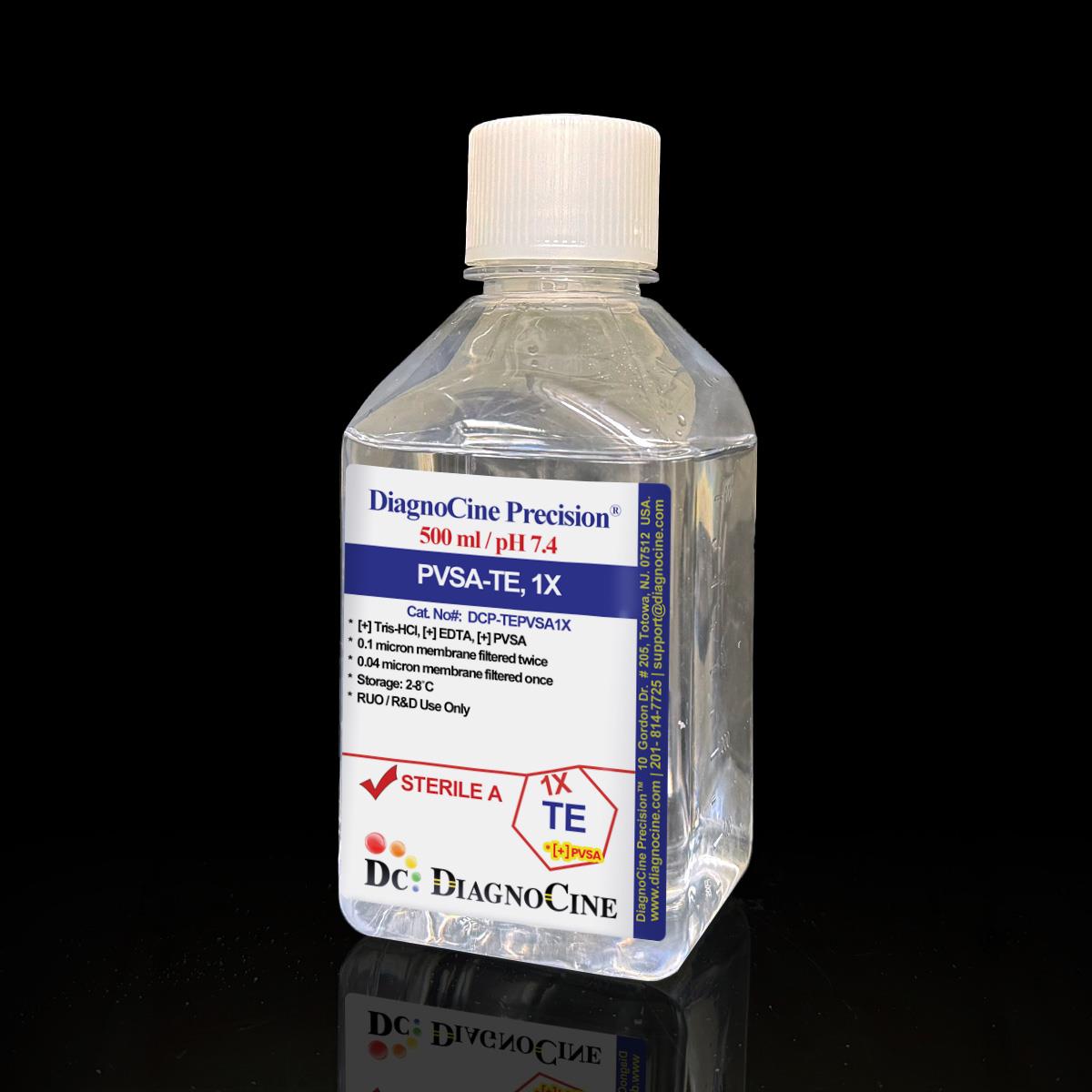
UltraClean PVSA‑TE, 1X
FluxMPS™ UltraClean PVSA-TE, 1X
UltraClean PVSA-TE, 1X is an MPS-grade, RNase-safe Tris-EDTA (TE) buffer supplemented with polyvinylsulfonic acid (PVSA), a potent polymeric RNase inhibitor engineered to preserve RNA integrity during resuspension, handling, and short-term storage. Manufactured with quadruple-stage filtration — 0.1 µm membrane filtration applied twice and 0.04 µm membrane filtration applied twice — this ready-to-use 1X solution delivers the low-ionic-strength, chelating environment nucleic acids and microfluidic channels demand.
- Quadruple-stage filtration: 0.1 µm membrane filtration twice and 0.04 µm membrane filtration twice for RNase-safe, ultra-low particulate purity
- Sterile, ready-to-use 1X TE buffer supplemented with PVSA, a potent polymeric RNase inhibitor
- Low ionic strength and EDTA chelation preserve nucleic acid stability while limiting divalent-cation–dependent nuclease activity
- Formulated from molecular biology-grade Tris-HCl, EDTA, and PVSA in ultrapure, nuclease-free water
- pH 7.4; colorless, clear solution free of visible particulates
- Manufactured in ISO 13485-certified, CE-approved facilities
- Concentration, pH, and additive content available on request — contact support@diagnocine.com
- pH7.4
- Tris-HCl10 mM
- EDTA1 mM
- PVSA1 g/L
- Filtration0.1 µm x2 + 0.04 µm x2
- SterilitySterile
- AppearanceColorless, clear
- Storage2–8°C
- Freeze-ThawDo not freeze
- Shelf Life12 months
Engineered where standard TE buffers fail
Conventional 0.22 µm-filtered TE buffers can carry subvisible particulates, adventitious nucleases, and inconsistent pH that degrade RNA quality and accumulate in microchannels. UltraClean PVSA-TE, 1X addresses each failure mode with active RNase inhibition and sequential sub-0.1 µm filtration.
Microchannel-Safe Purity
Sequential 0.1 µm and 0.04 µm membrane filtration, each applied twice, reduces particulate load beyond a single 0.22 µm pass, protecting fine microfluidic channels and valves.
Precise, Stable pH
Formulated at pH 7.4 with 10 mM Tris-HCl and 1 mM EDTA, delivering the low-ionic-strength, chelating environment characteristic of 1X TE buffer.
Ultrapure-Grade Water
Prepared in ultrapure, nuclease-free Type 1 water to minimize contaminating nucleases and inorganic residues.
RNase-Safe by Design
PVSA (polyvinylsulfonic acid) provides robust inhibition of a wide range of RNases[1,2], protecting RNA integrity without relying solely on protein-based inhibitors.
Defined, Traceable Composition
Prepared from molecular biology-grade Tris-HCl, EDTA, and PVSA with lot-controlled concentrations and full composition disclosure.
Customization on Demand
Alternate concentrations, additional chemicals, compounds, proteins, or supplements, and modified pH are available on inquiry.
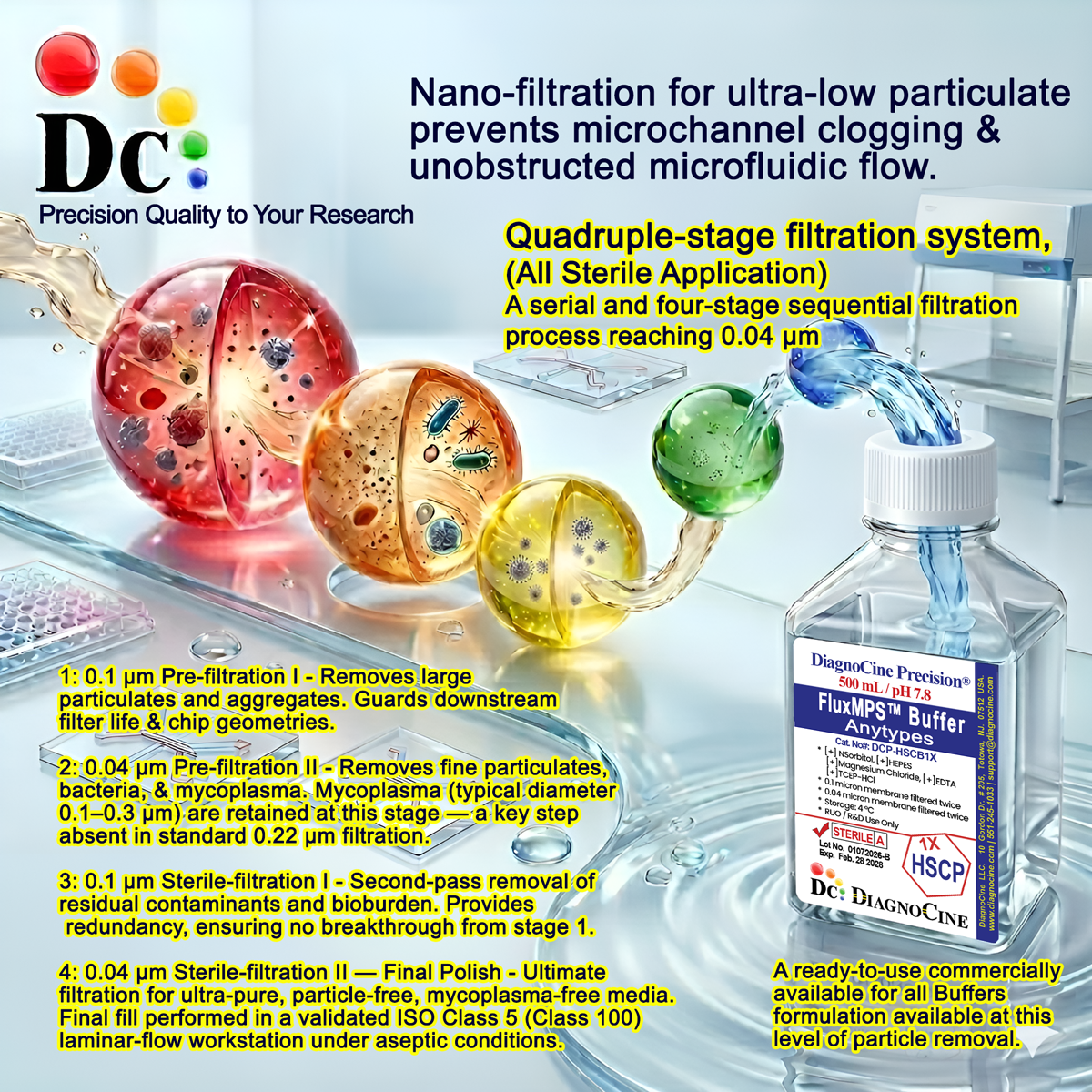
Quadruple-stage filtration system
UltraClean PVSA-TE, 1X is manufactured sterile and ultrapure using 0.1 µm membrane filtration applied twice followed by 0.04 µm membrane filtration applied twice, a four-stage sequence designed to remove particulates, microbes, and adventitious nucleases before final fill.
-
1
0.1 µm Pre-filtration I
First-pass 0.1 µm membrane filtration removes large particulates and aggregates, extending the life of downstream filters.
-
2
0.04 µm Pre-filtration II
First-pass 0.04 µm membrane filtration retains fine particulates and reduces bioburden, including organisms in the mycoplasma size range (the smallest mycoplasma types are approximately 0.2 micron).
-
3
0.1 µm Sterile-filtration I
Second-pass 0.1 µm membrane filtration provides redundant particulate and bioburden control.
-
4
0.04 µm Sterile-filtration II — Final Polish
Second-pass 0.04 µm membrane filtration delivers the final polish for aseptic fill, helping prevent mycoplasma contamination.
Performance vs. conventional buffer
Sequential 0.1 µm and 0.04 µm filtration, each applied twice, removes finer particulates and bioburden than a single 0.1 µm or 0.22 µm pass, supporting RNase-safe handling of RNA and DNA samples.
© Diagnocine® — DCP-TEPVSA1X
Where UltraClean PVSA-TE, 1X performs
A ready-to-use, RNase-safe 1X TE buffer for RNA and DNA resuspension, short-term storage, and molecular biology sample handling, including workflows preceding qPCR, RT, or library construction where compatible with the enzymes used.
Automated Bioreactors & Robotics
For automated liquid handling and robotic microfluidic platforms, an optional 0.01 µm (10 nm) ultra-filtered variant of this buffer is available on request for applications requiring the finest achievable particulate exclusion.
- Total Particulate Exclusion: Finer filtration for particulate-sensitive automated systems
- Valve & Sensor Protection: Reduced particulate load helps protect microvalves and in-line sensors
- Extended Perfusion Stability: Supports longer unattended run times in automated perfusion setups
Inquiry Required: the 0.01 µm ultra-filtered grade is available by request — contact support@diagnocine.com.
Micro Physiological System (MPS) & Chip
RNase-safe TE buffer for resuspension and dilution of nucleic acid samples used in chip-based assays.
RNA & DNA Resuspension
Resuspension and dilution of RNA and DNA samples in a low-salt, RNase-safe buffer for storage or downstream processing.
RNA Handling & Short-Term Storage
Temporary storage of RNA-containing samples, cells, or lysates with added RNase protection in TE buffer.
Nuclease-Controlled Handling
Handling, transfer, and brief incubations of nucleic acids in workflows where divalent-cation-dependent nucleases must be minimized.
Oligonucleotide & Probe Dilution
Dilution and handling of RNA and DNA oligonucleotides, probes, and standards in a nuclease-controlled environment.
General Nucleic Acid Workflows
Any procedure requiring 1X TE buffer with enhanced RNA protection, including sample prep steps prior to qPCR, RT, or library construction.
Product parameters
Formulation, purity, and handling parameters for UltraClean PVSA-TE, 1X.
| Parameter | Specification |
|---|---|
| Formulation / Composition | Tris-EDTA (TE) buffer with PVSA RNase inhibitor |
| Appearance | Colorless, clear solution; free of visible particulates |
| pH | 7.4 |
| Molarity / Concentration | 10 mM Tris-HCl, 1 mM EDTA |
| Parameter | Specification |
|---|---|
| Sterility | Sterile |
| Water Purity | Ultrapure, nuclease-free Type 1 water (18.2 MΩ·cm) |
| Manufacturing Standard ISO 13485 | ISO 13485:2016-certified, CE-approved facilities |
| Fill Environment | ISO Class 5 (Class 100) aseptic fill |
| Parameter | Specification |
|---|---|
| Storage Temperature | 2–8°C |
| Freeze-Thaw | Do not freeze |
| Shelf Life | 12 months |
| Parameter | Specification |
|---|---|
| Raw Material Grade | Molecular biology-grade Tris, EDTA, and PVSA |
| Traceability | Final packaging, QA, and testing at the Diagnocine R&D and Quality Testing Center |
| Manufacturing QMS ISO 13485 | ISO 13485-certified facilities |
| Regulatory Alignment | CE-approved |
| Production Method | Customization requests and assembly performed at Diagnocine Precision, Totowa, New Jersey, USA |
| Intended Use | Research Use Only (RUO) |
Full composition
Every buffer component and its concentration, disclosed in full for downstream compatibility review.
| Component | CAS Number | Concentration |
|---|---|---|
| Tris-HCl | 1185-53-1 | 10 mM |
| EDTA | 60-00-4 | 1 mM |
| PVSA (Polyvinylsulfonic Acid) | 25037-97-2 | 1 g/L |
| Water (Ultrapure, nuclease-free) | 7732-18-5 | To volume |
Manufacturing & compliance
UltraClean PVSA-TE, 1X is manufactured under ISO 13485-certified and CE-approved facilities, with final packaging, quality assurance, and testing performed at the Diagnocine R&D and Quality Testing Center.
ISO 13485:2016 QMS
Manufactured under a certified quality management system with full lot traceability.
Ultrapure Type 1 Water
Formulated in ultrapure, nuclease-free water to limit adventitious nuclease contamination.
ISO Class 5 Fill & Finish
Final sterile fill performed under ISO Class 5 (Class 100) conditions.
Micro-Batch Precision
Custom concentration, pH, and additive modifications are assembled at Diagnocine Precision, Totowa, New Jersey, USA.
Sterility Assurance
Manufactured sterile via quadruple-stage 0.1 µm and 0.04 µm membrane filtration.
Particulate Control USP <788>
Sequential sub-0.1 µm filtration is designed to control particulate levels ahead of final fill.
Formulation Consistency
Each lot is prepared to the disclosed 10 mM Tris-HCl / 1 mM EDTA / 1 g/L PVSA formulation at pH 7.4.
Documentation / CoA
A Certificate of Analysis is available on request.
How DCP-TEPVSA1X compares
A side-by-side view of UltraClean PVSA-TE, 1X against conventional TE buffer preparations.
| Parameter | DCP-TEPVSA1X (FluxMPS™) | Conventional TE (0.22 µm filtered) | Standard Alternative (0.22 µm filtered) |
|---|---|---|---|
| RNase Inhibition (PVSA) | check_circle | cancel | cancel |
| Final Filtration Pore Size | 0.04 µm | 0.22 µm | 0.22 µm |
| Number of Filtration Stages | 4 | 1 | 1 |
| Sterility | check_circle | check_circle | cancel |
| Ultrapure Type 1 Water | check_circle | cancel | cancel |
| ISO 13485 Manufacturing | check_circle | cancel | cancel |
| Low Ionic Strength / EDTA Chelation | check_circle | check_circle | check_circle |
| Custom Formulation | check_circle | cancel | cancel |
Frequently asked questions
Common questions about UltraClean PVSA-TE, 1X.
Supporting literature
Curated literature relevant to RNase inhibition, TE buffer chemistry, and microfluidic / organ-on-a-chip applications.
- Studier, F.W. Analysis of bacteriophage T7 early RNAs and proteins on slab gels. J Mol Biol. doi:10.1016/0022-2836(73)90478-3
- Blank, A., Sugiyama, R.H., Dekker, C.A. Activity staining of nucleolytic enzymes after sodium dodecyl sulfate-polyacrylamide gel electrophoresis: use of aqueous isopropanol to remove detergent from gels. Anal Biochem. doi:10.1016/0003-2697(82)90650-1
- Farrell, R.E. RNA Methodologies: A Laboratory Guide for Isolation and Characterization. Academic Press. doi:10.1016/C2009-0-63783-2
- Bloomfield, V.A., Crothers, D.M., Tinoco, I. Nucleic Acids: Structures, Properties, and Functions. University Science Books. doi:10.1002/bip.10056
- Bhattacharyya, D., et al. Chelation-based inhibition of divalent cation-dependent nucleases in nucleic acid buffers. Anal Biochem. doi:10.1016/j.ab.2015.03.019
- Bhatia, S.N., Ingber, D.E. Microfluidic organs-on-chips. Nat Biotechnol. doi:10.1038/nbt.2989
- Zhang, B., Radisic, M. Organ-on-a-chip devices advance to market. Lab Chip. doi:10.1039/C6LC01554A
- Wagner, R., et al. Endotoxin and bioburden control in perfusion-based microfluidic culture systems. Biotechnol Bioeng. doi:10.1002/bit.25715
- Sambrook, J., Russell, D.W. Molecular Cloning: A Laboratory Manual, 3rd ed. Cold Spring Harbor Laboratory Press. doi:10.1101/pdb.top.cshprot.5164
- Fraczek, M.G., et al. Mycoplasma detection and prevention in cell culture reagents and buffers. Biologicals. doi:10.1016/j.biologicals.2013.03.001