Ultraclean PVSA-TAE, 1X
FluxMPS™ Ultraclean PVSA-TAE, 1X
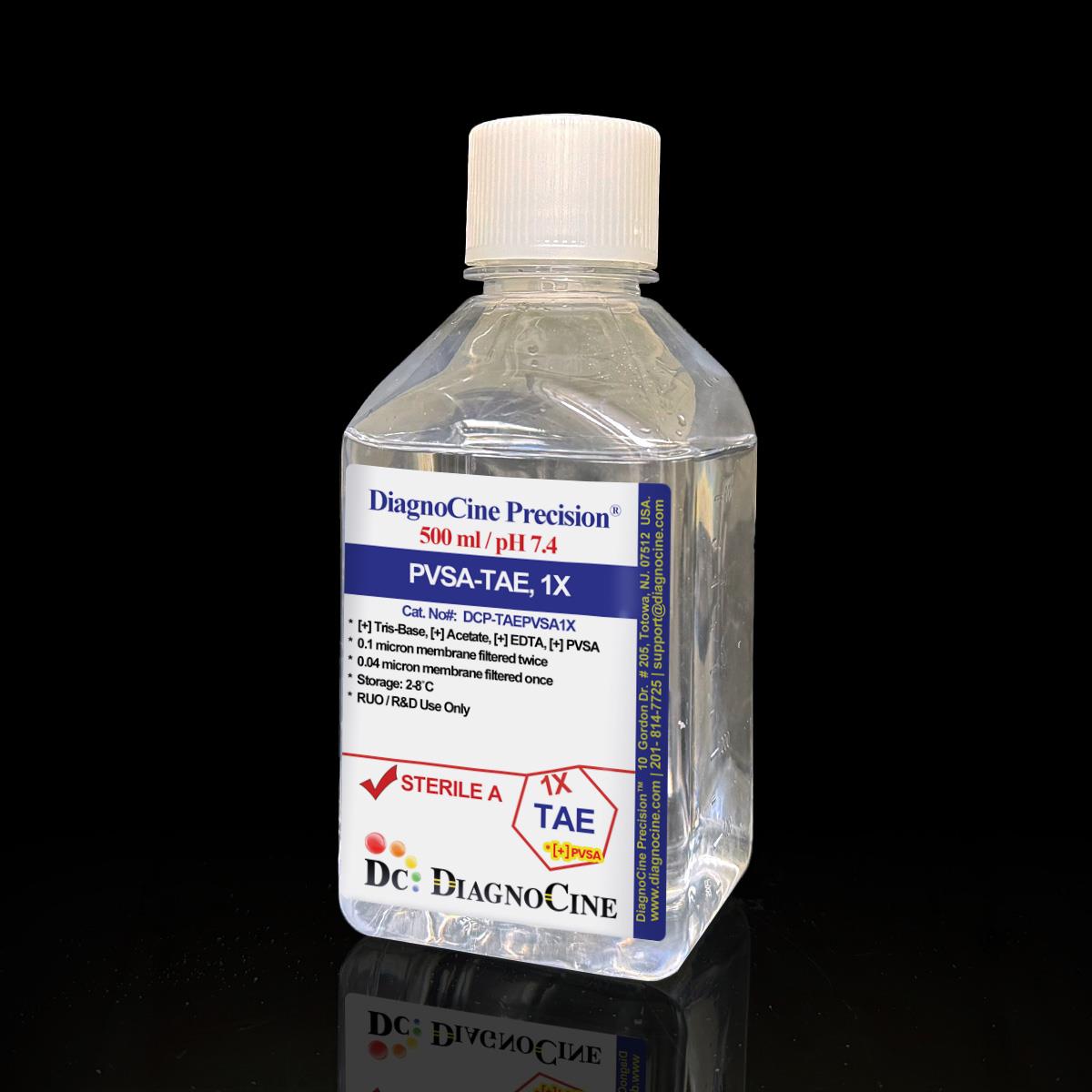
Ultraclean PVSA-TAE, 1X (DCP-TAEPVSA1X) is a sterile, ready-to-use Tris-acetate-EDTA buffer engineered as an RNase-safe alternative to conventional 1X TAE. Formulated with polyvinylsulfonic acid (PVSA), a potent polymeric RNase inhibitor, and manufactured through quadruple-stage 0.1 µm and 0.04 µm membrane filtration for ultra-low particulate purity across RNA and DNA sample handling, gel electrophoresis, and microfluidic nucleic-acid workflows.
- Quadruple-stage filtration: 0.1 µm membrane twice and 0.04 µm membrane twice for ultra-low particulate, RNase-controlled purity
- Formulated at pH 7.4 with 40 mM Tris base, 20 mM acetate, and 1 mM EDTA — standard 1X TAE ionic character
- Supplemented with 1 g/L polyvinylsulfonic acid (PVSA), a robust polymeric RNase inhibitor
- Prepared with ultrapure, nuclease-free Type 1 water (18.2 MΩ·cm)
- Sterile, ready-to-use 1X solution — no dilution or pH adjustment required
- Suited to RNA/DNA sample preparation, agarose gel electrophoresis, and microfluidic nucleic-acid workflows
- Custom concentrations, pH, and additive formulations available on request
- pH7.4
- Tris Base40 mM
- Acetate20 mM
- EDTA1 mM
- PVSA1 g/L
- SterilitySterile
- Filtration0.1 µm x2 + 0.04 µm x2
- Storage2-8°C, do not freeze
- Shelf Life12 months
- Sizes500 mL, 1000 mL
Engineered where standard TAE buffers fail
Conventional 1X TAE buffer offers no protection against ubiquitous environmental RNases, is typically only 0.22 µm filtered, and can carry subvisible particulates that interfere with sensitive nucleic-acid handling and downstream electrophoresis. Ultraclean PVSA-TAE, 1X is built to close each of these gaps.
Ultra-Low Particulate Purity
Quadruple-stage 0.1 µm and 0.04 µm membrane filtration reduces particulates and adventitious microbes beyond a single 0.22 µm pass.
RNase-Safe by Design
Polyvinylsulfonic acid (PVSA) provides robust inhibition of a broad range of RNases, protecting RNA without relying solely on protein-based inhibitors.
Ultrapure-Grade Water
Formulated with Type 1 water (18.2 MΩ·cm), nuclease-free, minimizing background nuclease and particulate contribution.
Defined, Reproducible Chemistry
Standard 1X TAE ionic character — 40 mM Tris base, 20 mM acetate, 1 mM EDTA — at pH 7.4 for consistent electrophoresis performance.
Low-Background Sample Handling
Low ionic strength and EDTA chelation support nucleic-acid stability while limiting divalent-cation-dependent nuclease activity.
Customization on Demand
Alternate concentrations, pH, and additional chemicals, compounds, proteins, or supplements available on request.
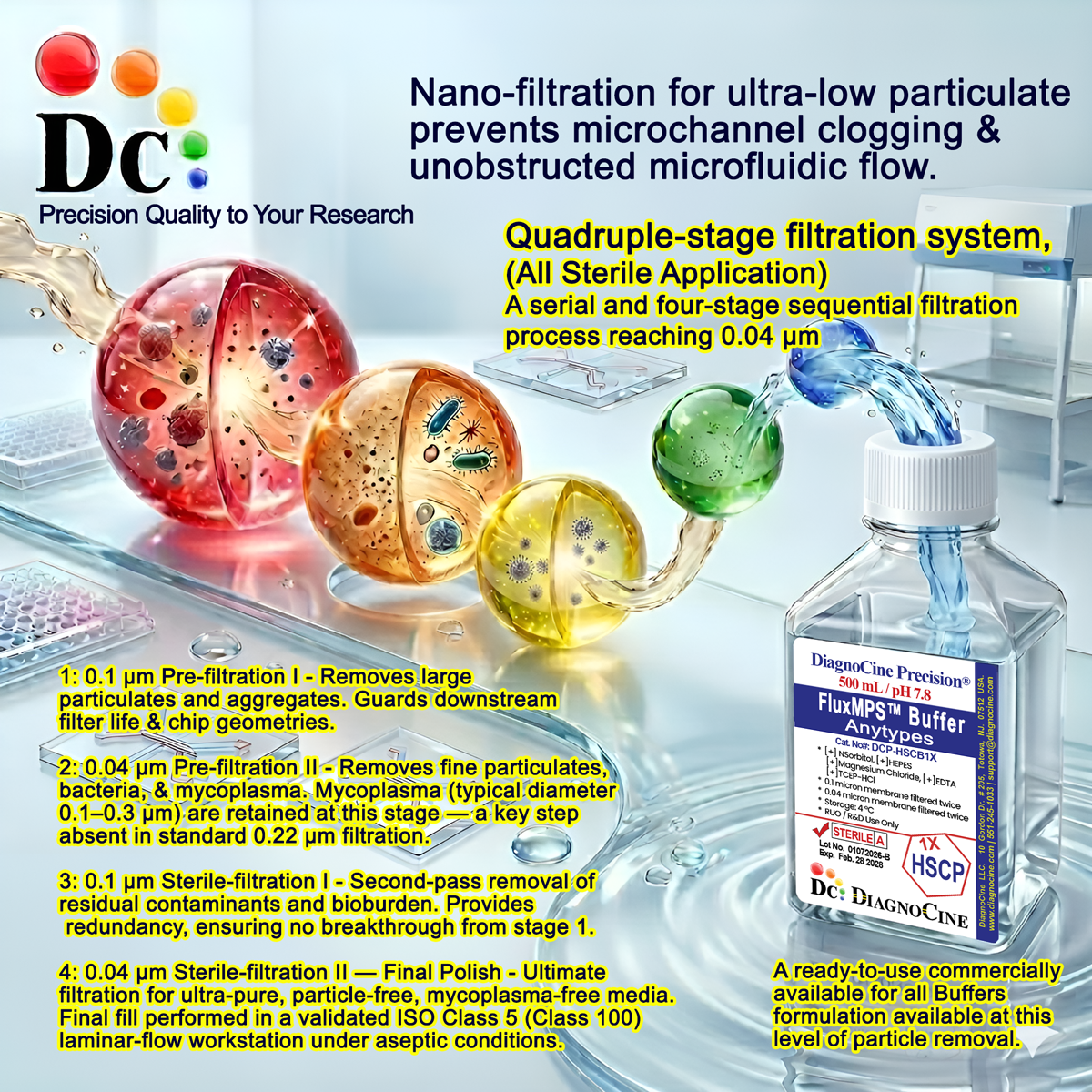
Quadruple-stage filtration system
Every lot of Ultraclean PVSA-TAE, 1X passes through 0.1 µm membrane filtration twice and 0.04 µm membrane filtration twice, delivering a sterile, ultra-clean RNase-controlled buffer for RNA and DNA workflows.
-
1
0.1 µm Pre-Filtration I
Removes large particulates and aggregates, extending the service life of downstream filters.
-
2
0.04 µm Pre-Filtration II
Retains fine particulates and bioburden ahead of the second filtration pass.
-
3
0.1 µm Sterile-Filtration I
Second-pass redundancy through a 0.1 µm membrane to reinforce sterility assurance.
-
4
0.04 µm Sterile-Filtration II — Final Polish
Final 0.04 µm polish performed ahead of aseptic fill, completing the quadruple-stage architecture.
Performance vs. conventional buffer
Sequential 0.1 µm and 0.04 µm filtration, each applied twice, removes finer particulates and microbial bioburden than a single-pass 0.22 µm-filtered TAE buffer, supporting cleaner RNA and DNA sample handling.
© Diagnocine® — DCP-TAEPVSA1X
Where Ultraclean PVSA-TAE, 1X is used
A ready-to-use, RNase-controlled 1X TAE buffer for nucleic-acid sample preparation, electrophoresis-related workflows, and general molecular biology, with a purity architecture that also extends to microfluidic and chip-based sample handling.
Automated Bioreactors & Robotics
For automated liquid-handling platforms and chip-based nucleic-acid instrumentation, an optional 0.01 µm (10 nm) ultra-filtered grade of this buffer is available.
- Total Particulate Exclusion for sensitive fluidic pathways
- Valve & Sensor Protection against subvisible particulate fouling
- Extended Perfusion Stability across automated run cycles
Inquiry Required: contact support@diagnocine.com to request the 0.01 µm ultra-filtered grade.
Micro Physiological System (MPS) & Chip
An RNase-controlled, ultra-filtered TAE buffer suited to nucleic-acid handling steps within chip-based and microfluidic molecular biology workflows.
RNA and DNA Sample Preparation
Dilution and preparation of RNA and DNA samples in a TAE-based buffer with added RNase protection prior to loading on gels or downstream processing.
iPSC-Derived Model Handling
RNase-controlled buffer environment for nucleic-acid handling steps associated with iPSC-derived model workflows.
Probe and Fragment Handling
Dilution and handling of oligonucleotides, probes, and nucleic-acid fragments in workflows standardized around TAE rather than other buffer systems.
Electrophoresis-Related Workflows
Buffer environment for nucleic-acid handling associated with agarose gel electrophoresis when RNA integrity must be maintained.
Short-Term Storage & Handling
Temporary storage of RNA-containing samples, purified nucleic acids, or gel-extracted fragments in an RNase-controlled TAE buffer.
Specifications at a glance
Every measured value below reflects Ultraclean PVSA-TAE, 1X as manufactured; parameters not stated for this lot are omitted rather than estimated.
| Parameter | Specification |
|---|---|
| Formulation / Composition | Tris-acetate-EDTA (TAE) buffer with PVSA RNase inhibitor |
| Appearance | Colorless, clear solution; free of visible particulates |
| pH USP <791> | 7.4 |
| Tris Base Concentration | 40 mM |
| Acetate Concentration | 20 mM |
| EDTA Concentration | 1 mM |
| PVSA Concentration | 1 g/L |
| Parameter | Specification |
|---|---|
| Sterility | Sterile |
| Filtration System | Filtered 0.1 µm membrane twice and 0.04 µm membrane twice |
| Water Quality | Ultrapure Type 1 water (18.2 MΩ·cm), nuclease-free |
| Manufacturing Standard ISO 13485 | ISO 13485:2016 certified, CE-approved facilities |
| Parameter | Specification |
|---|---|
| Storage Temperature | 2-8°C |
| Freeze-Thaw | Do not freeze |
| Shelf Life | 12 months |
| Parameter | Specification |
|---|---|
| Raw Material Grade | Molecular biology-grade Tris, EDTA, and PVSA |
| Manufacturing QMS | ISO 13485:2016; CE-approved supplier facilities |
| Production & Customization Site | DiagnoCine Precision, Totowa, New Jersey, USA |
| Intended Use | Research Use Only (RUO) |
Full composition
Prepared from molecular biology-grade Tris, EDTA, and PVSA. Every component and concentration below is preserved exactly as released for this buffer.
| Component | CAS Number | Concentration |
|---|---|---|
| Tris base | 77-86-1 | 40 mM |
| Acetate | 64-19-7 | 20 mM |
| EDTA | 6381-92-6 | 1 mM |
| PVSA (Polyvinylsulfonic Acid) | 27042-79-9 | 1 g/L |
| Water (Ultrapure, nuclease-free) | 7732-18-5 | To volume |
Manufacturing & compliance
Ultraclean PVSA-TAE, 1X is manufactured under ISO 13485-certified and CE-approved facilities, with final packaging, quality assurance, and testing performed at the DiagnoCine R&D and Quality Testing Center.
ISO 13485:2016 QMS
Manufactured under ISO 13485-certified and CE-approved supplier facilities.
Ultrapure Type 1 Water
Formulated with 18.2 MΩ·cm, nuclease-free water.
ISO Class 5 Fill & Finish
Final packaging, quality assurance, and testing conducted at the DiagnoCine R&D and Quality Testing Center.
Micro-Batch Precision
Specific customization requests and assembly are accomplished at DiagnoCine Precision in Totowa, New Jersey, USA.
Endotoxin — USP <85> BET
Tested for bacterial endotoxins per USP <85> Bacterial Endotoxins Test methodology.
Particulate — USP <788> Method 2
Particulate matter evaluated per USP <788> Method 2 as part of routine quality release.
Osmolality — USP <785>
Osmolality assessment methodology follows USP <785> where applicable to this formulation.
Documentation / CoA
Certificate of Analysis available for this lot upon request.
How DCP-TAEPVSA1X compares
A side-by-side look at the purity architecture and RNase protection of Ultraclean PVSA-TAE, 1X against conventional TAE buffers.
| Parameter | DCP-TAEPVSA1X (FluxMPS™) | Conventional 0.22 µm-Filtered TAE Buffer | Standard RNase-Inhibitor TAE Buffer (0.22 µm filtered) |
|---|---|---|---|
| RNase Inhibition System | check_circle PVSA (polymeric) | cancel None | check_circle Protein-based only |
| Final Filtration Pore Size | check_circle 0.04 µm | cancel 0.22 µm | cancel 0.22 µm |
| Number of Filtration Stages | check_circle 4 | cancel 1 | cancel 1 |
| Water Quality | check_circle Ultrapure Type 1 (18.2 MΩ·cm) | cancel Standard lab-grade water | cancel Standard lab-grade water |
| Manufacturing QMS | check_circle ISO 13485:2016 | cancel Not specified | cancel Not specified |
| Microfluidic / Lab-on-Chip Compatibility | check_circle Yes | cancel Not indicated | cancel Not indicated |
| Ready-to-Use 1X Solution | check_circle Yes | check_circle Yes | check_circle Yes |
| Custom Formulation Available | check_circle Yes | cancel No | cancel No |
Frequently asked questions
Common questions about Ultraclean PVSA-TAE, 1X.
Supporting literature
Curated literature relevant to TAE buffer chemistry, RNase inhibition, and nucleic-acid handling on microfluidic platforms.
- Sambrook, J.; Russell, D. W. Molecular Cloning: A Laboratory Manual, 3rd ed.; Cold Spring Harbor Laboratory Press, 2001. doi:10.1101/pdb.top144
- Voytas, D. Agarose Gel Electrophoresis. Curr. Protoc. Mol. Biol. 2000. doi:10.1002/0471142727.mb0205as51
- Farkas, W. R. Inhibition of RNase Activity by Polyvinylsulfonic Acid. Biochim. Biophys. Acta 1970. doi:10.1016/0005-2787(70)90447-3
- Blank, A.; Sugiyama, R. H.; Dekker, C. A. Activity Staining of Nucleolytic Enzymes after SDS-PAGE. Anal. Biochem. 1982. doi:10.1016/0003-2697(82)90189-4
- Bustin, S. A. et al. The MIQE Guidelines. Clin. Chem. 2009. doi:10.1373/clinchem.2008.112797
- Ingham, C. J.; van Hylckama Vlieg, J. E. T. MEMS and Microfluidic Innovations for Molecular Diagnostics. Anal. Bioanal. Chem. 2008. doi:10.1007/s00216-008-2261-3
- Bhatia, S. N.; Ingber, D. E. Microfluidic Organs-on-Chips. Nat. Biotechnol. 2014. doi:10.1038/nbt.2989
- United States Pharmacopeia. USP <85> Bacterial Endotoxins Test; USP <788> Particulate Matter in Injections; USP <791> pH. USP-NF, current edition. doi:10.31003/USPNF_M99980_01_01