
PD-L1 TN-cyclon ELISA Kit
PD-L1 TN-cyclon ELISA Kit
Cat. No.: FNK-BPMA-TNPDL1-1e
Size: 1kit
Storage: 4℃, -20℃ (antibodies, antigens, and reagents)
Description:
The measurement of PD-L1 with this kit is based on TN-cyclon, a proprietary technology that combines the sandwich ELISA and enzymatic cycling methods. This method enables highly sensitive quantification of human PD-L1 in serum or exosome samples. No special equipment is required, and the assay can be performed with an ordinary absorption plate reader.
Assay samples: Serum, Exosomes. Cross-species: Human. Detection limit: 0.2 pg/ml or less.
Kit Components
Reagents
- Capture Ab (Antibody) Diluent
- Wash Buffer
- Sample Diluent
- Blocking Reagent
- Detection Ab Diluent
- Enzyme Cycling Diluents (2 types)
- Enzyme Cycling Reagents (4 types)
Accessories
- 96-well plate (1 plate)
- Adhesive Plate Seals (5 units)
- User Manual
What is the improved enzyme cycling method (TN-cyclon™)?
TN-cyclon™ (improved enzyme cycling method)
The improved enzyme cycling method (TN-cyclon™) is a unique protein detection technology developed by BioPhenoMA that combines sandwich ELISA and enzyme cycling methods. This technology enables more sensitive detection than conventional sandwich ELISAs.
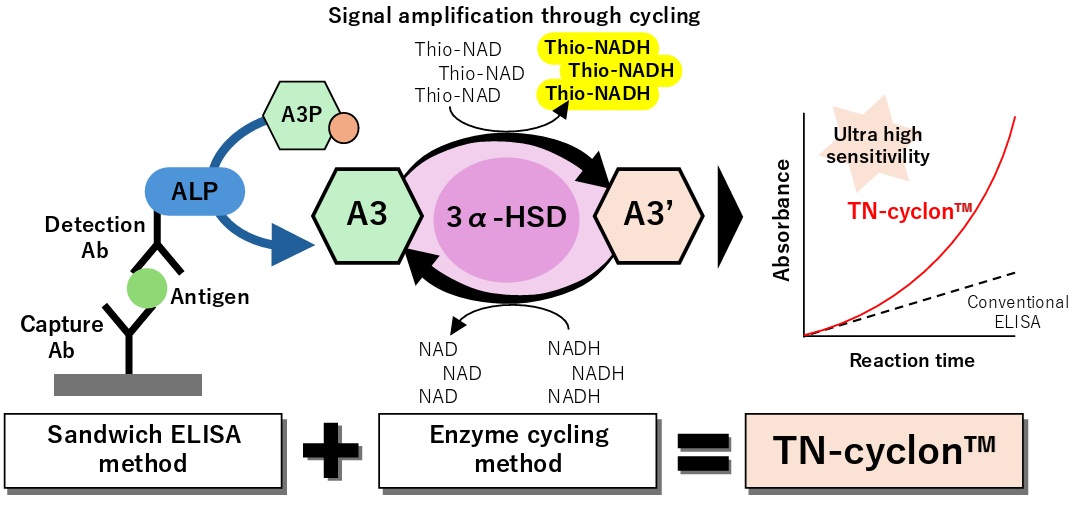
In this method, the ELISA method is used as the first reaction to sandwich an antigen by capture and detection antibodies. The detection antibody is labeled with Alkaline Phosphatase (ALP) and works with A3P which is a unique BioPhenoMA’s ALP substrate. Conventional ELISAs quantify the amount of antigen by measurement of the reaction product (shown as A3 in the figure below). In contrast, the initial reaction product is used as the next substrate of the cycling reaction in the improved enzyme cycling method (TN-cyclon™).
In the cycling reaction, A3’ is generated by dehydrogenation (oxidation) of A3P and A3 that is the reaction product with ALP by 3α-hydroxysteroid-dehydrogenase (3α-HSD). In addition, the reverse reaction also occurs repeatedly. As the cycling reaction proceeds, the coenzymes thio-NAD and NADH are consumed and the by-products from the consumption, thio-NADH and NAD, are accumulated. Maximum absorbance of this thio-NADH is 405 nm and measurement of the wavelength change of the maximum absorbance enable to estimate the original concentration of the antigen.
The amplification method allows to measure the amount of an ultra-low-abundant antigen that is lower than detection limit by sensitivity of the conventional ELISA.
References
1. Watabe, S., et al., Biophysics, 10, 49~54 (2014). [PMID:27493498]
2. Kobayashi, Y., et al., Front. Immunol., 15, 1445771 (2024). [PMID:39687610]
Features of improved enzyme cycling method (TN-cyclon™)
- Ultra-sensitive protein detection.
- Simple method and no dedicated equipment required*1.
- Applicable to a wide variety of biomarkers*2.
*1 Absorbance plate reader is required for measurement.
*2 Please prepare your own matched-pair antibodies (capture and detection antibodies) to your targeted antigen.
Assay example
The experimental results were obtained according to the assay protocol described in the user manual. The data were provided by BioPhenoMA.
* Obtained results and values by the kit may not necessarily be the same as the examples below because the measurement results may differ depending on the selected antibodies and antigens.
| Standard Curve | |
 |
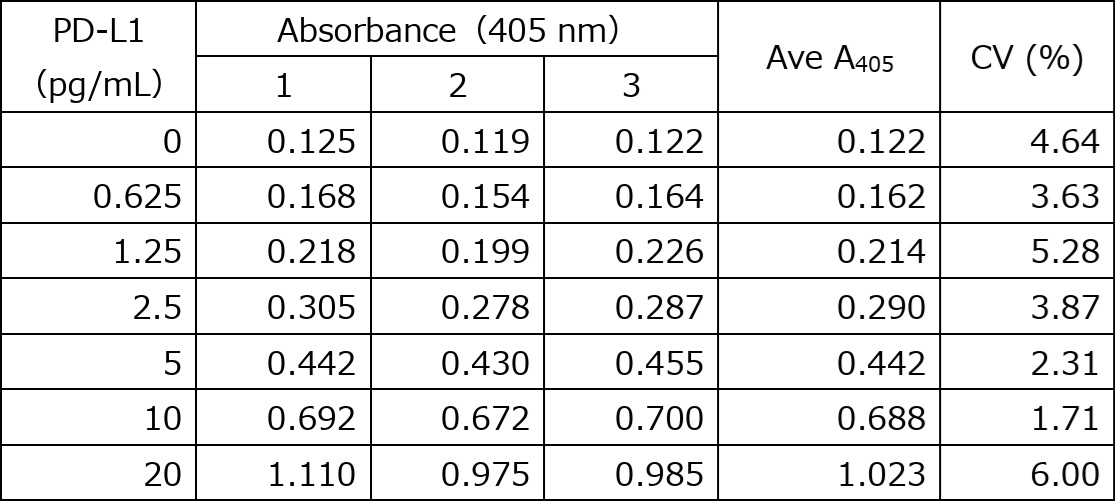 |
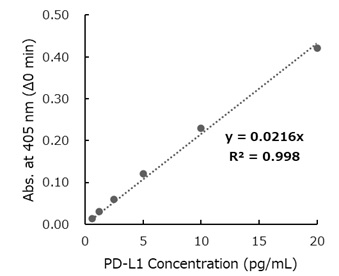
The left graph shows the calibration curve of the standard PD-L1 concentrations (pg/ml) obtained from the absorbance data (405 nm (Δ0min)). The right table shows the absorbance and the coefficient of variation (CV) data of each PD-L1 concentration.
Measurement wavelength : 405 nm (Primary Wavelength), 660 nm (Secondary Wavelength), Measurement time: 60 min
The limit of detection, calculated using the standard deviation (SD) of the blank absorbance (3SD applied) and the slope of the calibration curve, was below 0.2 pg/mL (0.154 pg/mL in the example above).
Spike and recovery test
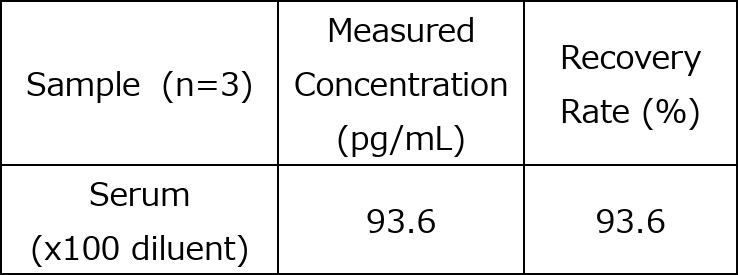
PD-L1 with a known concentration (100pg/ml) was added to serum samples and the recovery rate of it was calculated.
* The serum samples were diluted 100 fold before use in Sample Diluent.