

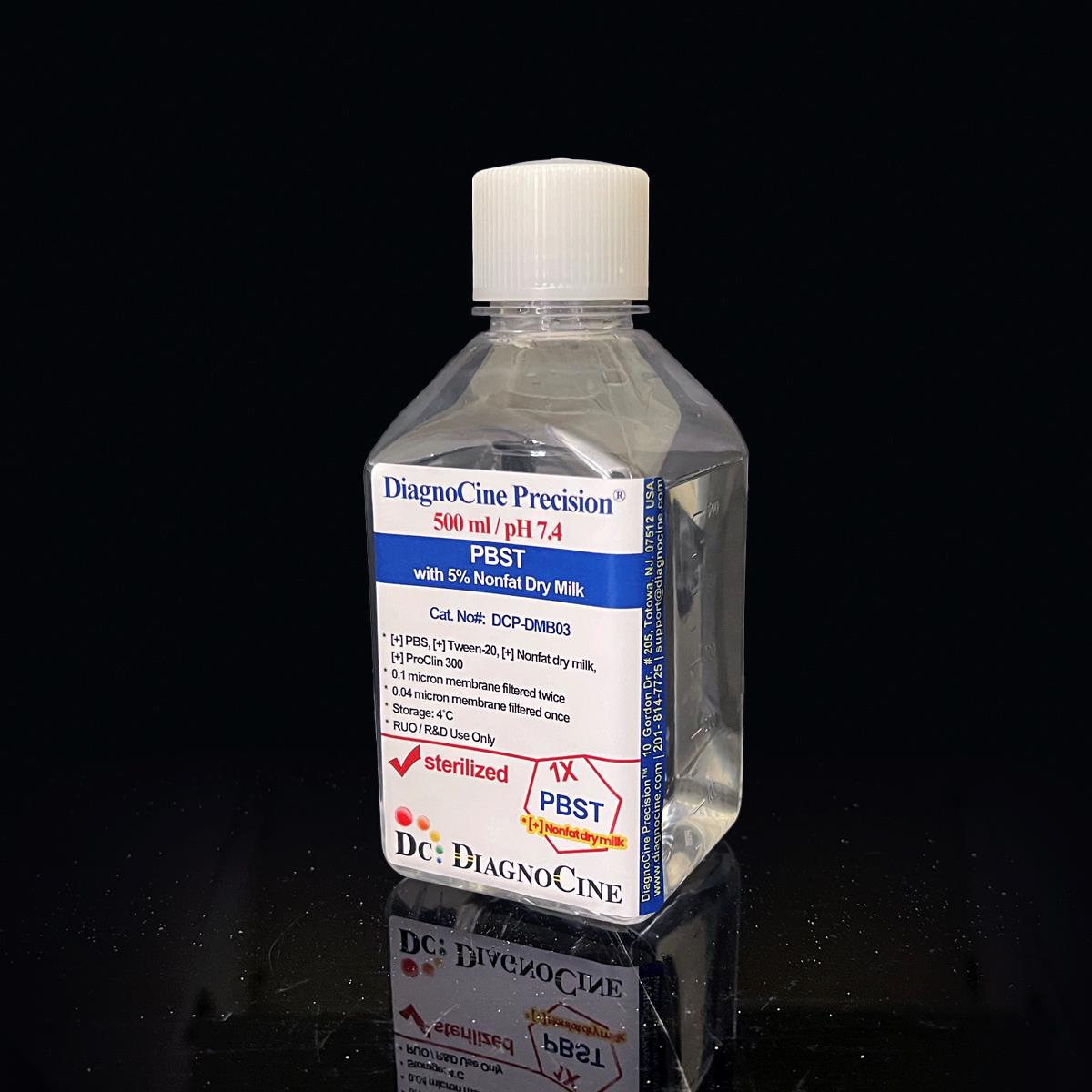
PBST with 5% Nonfat Dry Milk
PBST with 5% Nonfat Dry Milk
PBST with 5% Nonfat Dry Milk is a research-grade Western blot blocking and antibody dilution buffer built on a stable, PBS-based pH 7.4 platform. 0.1 µm filtration removes large particulates and aggregates, helping protect downstream applications. Preserved with ProClin 300, it is a nonsterile, DNase- and RNase-free reagent for immunoblotting, ELISA, and general molecular biology workflows.
- 0.1 µm membrane filtration (single step)
- Nonsterile, ultrapure formulation confirmed DNase- and RNase-free by QC testing
- Stable PBS-based pH 7.4 buffering for reliable antibody-antigen interactions
- 5% Nonfat Dry Milk blocking agent reduces background banding in Western blots
- 0.05% Tween-20 detergent minimizes non-specific binding
- ProClin 300 preservative (0.05%) extends shelf life
- Ultrapure Type 1 water (18.2 MΩ·cm) formulation base
- Custom concentrations, pH, and additive formulations available on request
- pH7.4
- FormulationPBS + 5% Nonfat Dry Milk + 0.05% Tween-20
- Sodium Chloride137 mM
- Potassium Chloride2.7 mM
- Sodium Phosphate dibasic10 mM
- Potassium Phosphate monobasic1.8 mM
- PreservativeProClin 300, 0.05%
- Filtration0.1 µm membrane filtration (single step)
- Storage4 °C
- Shelf Life1 year
Engineered where standard blocking buffers fail
Particulates and inconsistent pH in blocking buffers can contribute to elevated background and lot-to-lot variability in sensitive immunodetection workflows. This buffer is built to a defined purity and consistency standard.[1,2]
0.1 µm filtered
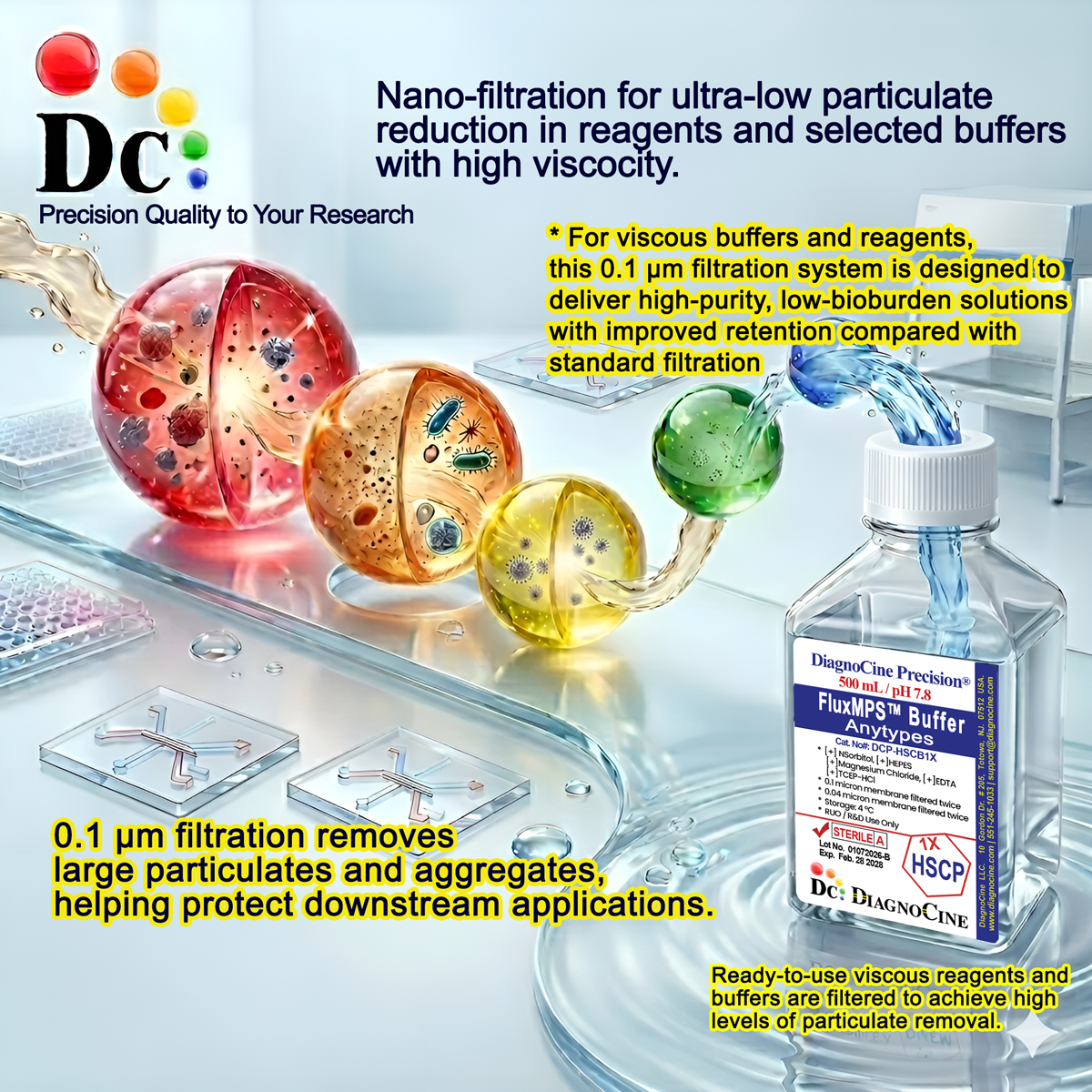
0.1 µm filtration removes large particulates and aggregates, helping protect downstream applications.
Precise, stable pH
PBS-based formulation is set to pH 7.4, supporting consistent antibody-antigen interactions across replicate blots.
Ultrapure-grade water
Formulated with Ultrapure Type 1 water (18.2 MΩ·cm), aligned with USP <85> water-quality expectations.
Low background for imaging & assays
5% Nonfat Dry Milk blocking agent occupies vacant binding sites, improving signal-to-noise ratio in Western blots.
Defined, traceable composition
Every salt, detergent, blocking protein, and preservative is documented at its declared concentration for full traceability.
Customization on demand
Alternate concentrations, additives, or pH available — contact support@diagnocine.com.
0.1 µm membrane filtration
0.1 µm filtration removes large particulates and aggregates, helping protect downstream applications.
-
1
0.1 µm Membrane Filtration
Removes large particulates and aggregates, helping protect downstream applications.
Filtration summary
0.1 µm filtration removes large particulates and aggregates, helping protect downstream applications.
© Diagnocine® — DCP-DMB03
Where PBST with 5% Nonfat Dry Milk is used
Formulated as a blocking and antibody dilution buffer for Western blotting, this PBS-Tween/milk solution also supports immunoassays, sample preparation, and general aqueous reagent needs across life-science research.
Dot Blot & Protein Arrays
Blocks unoccupied membrane binding sites to reduce non-specific antibody binding in dot blots and protein arrays.
Wash, Dilution & Reconstitution
PBS-based buffer suitable for general wash, dilution, and reconstitution steps across molecular biology workflows.
iPSC-Derived Model Handling
Ultrapure buffer formulation suitable for supporting wash and dilution steps around iPSC-derived model workflows.
Endothelial & Primary Cell Workflows
Filtered, DNase- and RNase-free buffer suitable for general aqueous reagent needs in primary and endothelial cell workflows.
ELISA, Blotting & Blocking
Purpose-built 5% Nonfat Dry Milk and Tween-20 formulation for blocking non-specific binding and diluting primary and secondary antibodies in immunoblotting.
Microscopy & Optical Sensing
Low-particulate, ultrapure buffer suitable for supporting wash and dilution steps in optical and imaging-based assays.
Full specification set
Physical, chemical, storage, and traceability parameters for DCP-DMB03.
| Parameter | Specification |
|---|---|
| Formulation | PBS-based buffer with 5% Nonfat Dry Milk, 0.05% Tween-20, 0.05% ProClin 300 |
| Appearance | Clear, Colorless Liquid |
| pH | 7.4 |
| Sodium Chloride concentration | 137 mM |
| Potassium Chloride concentration | 2.7 mM |
| Sodium Phosphate dibasic concentration | 10 mM |
| Potassium Phosphate monobasic concentration | 1.8 mM |
| Parameter | Specification |
|---|---|
| Sterility | Nonsterile |
| DNase Activity | None detected after 18 hr incubation with plasmid DNA at room temperature |
| RNase Activity | None detected after 18 hr incubation with ribosomal RNA at room temperature |
| Water Quality | Ultrapure Type 1 water (18.2 MΩ·cm) |
| Manufacturing Standard ISO 13485 | ISO 13485-certified manufacturing facility |
| Parameter | Specification |
|---|---|
| Storage Temperature | 4 °C |
| Shelf Life | 1 year |
| Parameter | Specification |
|---|---|
| Manufacturing QMS | ISO 13485-certified facility (Suppliers of DiagnoCine Precision) |
| Traceability | Final packaging, QA, and testing performed at the DiagnoCine R&D and Quality Testing Center |
| Production Method | Custom formulation and assembly at DiagnoCine Precision, Totowa, New Jersey, USA |
| Intended Use | For Research Use Only (RUO) |
Full composition
Every declared ingredient and concentration in DCP-DMB03, reproduced in full below.
| Component | CAS Number | Concentration |
|---|---|---|
| Nonfat Dry Milk | 5% | |
| ProClin 300 | 0.05% | |
| Potassium Chloride (KCl) | 7447-40-7 | 2.7 mM |
| Sodium Chloride (NaCl) | 7647-14-5 | 137 mM |
| Sodium Phosphate dibasic (Na2HPO4) | 7558-79-4 | 10 mM |
| Potassium Phosphate monobasic (KH2PO4) | 7778-77-0 | 1.8 mM |
| Tween-20 (Polysorbate 20) | 9005-64-5 | 0.05% |
Manufacturing & compliance
DCP-DMB03 is manufactured, filtered, and packaged under a controlled, certified quality system.
ISO 13485:2016 QMS
Manufactured under ISO 13485-certified facilities (Suppliers of DiagnoCine Precision).
Ultrapure Type 1 Water
Formulated with Ultrapure Type 1 water (18.2 MΩ·cm) as the aqueous base.
0.1 µm Membrane Filtration
0.1 µm membrane filtration (single step).
Micro-Batch Precision
Final packaging, quality assurance, and testing are performed at the DiagnoCine R&D and Quality Testing Center.
DNase Activity
None detected after incubation of plasmid DNA with this product for 18 hr at room temperature.
RNase Activity
No RNase activity detected after incubation of ribosomal RNA with this product for 18 hr at room temperature.
Appearance & pH
Clear, colorless liquid at pH 7.4.
Documentation / CoA
Customization requests and assembly are completed at DiagnoCine Precision in Totowa, New Jersey, USA.
How DCP-DMB03 compares
DCP-DMB03 versus conventional blocking buffer alternatives.
| Parameter | DCP-DMB03 | Conventional Buffer | Standard Alternative |
|---|---|---|---|
| Stable, PBS-based pH control | check_circle pH 7.4 | Not specified | Not specified |
| DNase/RNase-free confirmed | check_circle | cancel | cancel |
| Ultrapure Type 1 water base | check_circle | cancel | cancel |
| ISO 13485:2016 manufacturing | check_circle | cancel | cancel |
| Custom formulation available | check_circle | cancel | cancel |
Frequently asked questions
Common questions about DCP-DMB03, PBST with 5% Nonfat Dry Milk.
Supporting literature
Curated peer-reviewed and standards references relevant to Western blot blocking chemistry and buffer purity.
- Mahmood T, Yang PC. Western blot: technique, theory, and trouble shooting. N Am J Med Sci. 2012. doi:10.4103/1947-2714.100998
- Kurien BT, Scofield RH. Western blotting. Methods. 2006. doi:10.1016/j.ymeth.2005.11.007
- Eaton SL, et al. Total protein analysis as a reliable loading control for quantitative western blotting. PLoS One. 2013. doi:10.1371/journal.pone.0072457
- United States Pharmacopeia. General Chapter <85> Bacterial Endotoxins Test. USP-NF.
- United States Pharmacopeia. General Chapter <788> Particulate Matter in Injections. USP-NF.
- International Organization for Standardization. ISO 13485:2016 Medical devices — Quality management systems.
- Halfter K, et al. Choice of blocking reagent influences the sensitivity of protein detection in western blotting. Anal Biochem. 2010.