

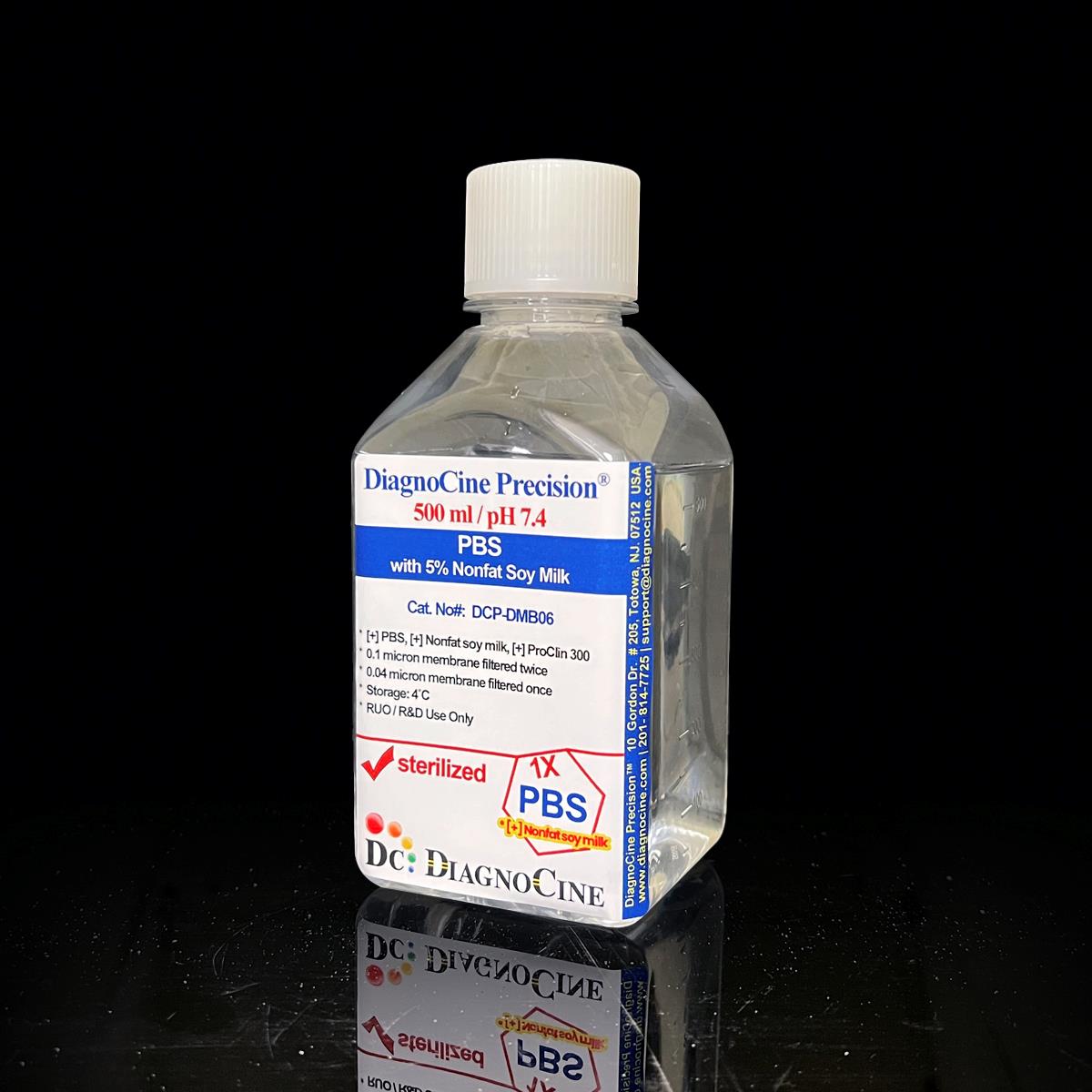
PBS with 5% Nonfat Soy Milk
FluxMPS™ PBS with 5% Nonfat Soy Milk
An MPS-grade phosphate-buffered saline blocking buffer formulated with 5% nonfat soy milk for Western blotting and immunoblotting workflows. Buffered to pH 7.4 with a defined PBS salt system and Quadruple-stage 0.1 µm and 0.04 µm filtered for ultra-low particulate, microchannel-safe performance across bench and microfluidic assay formats.
- Quadruple-stage filtration: 0.1 µm membrane filtration twice and 0.04 µm membrane filtration twice for ultra-low particulate, microchannel-safe purity
- PBS base at pH 7.4 with 137 mM Sodium Chloride, 2.7 mM Potassium Chloride, 10 mM Sodium Phosphate dibasic, and 1.8 mM Potassium Phosphate monobasic
- 5% Nonfat Soy Milk blocking agent - casein-free, biotin-free, and free of animal proteins
- 0.05% ProClin 300 preservative protects solution integrity against microbial growth
- DNase- and RNase-activity tested (18 hr incubation, room temperature) - no activity detected
- Manufactured under ISO 13485-certified, CE-approved facilities; final packaging and QC performed at the DiagnoCine R&D and Quality Testing Center, Totowa, New Jersey, USA
- Customizable concentration, pH, and additive content available on request — support@diagnocine.com
- pH7.4
- AppearanceClear, Colorless Liquid
- Filtration0.1 µm x2 + 0.04 µm x2
- DNase ActivityNone Detected
- RNase ActivityNone Detected
- Storage4°C
- Shelf Life1 Year
- Sodium Chloride137 mM
- Sodium Phosphate dibasic10 mM
- Nonfat Soy Milk5%
Engineered where standard blocking buffers fall short
Conventional 0.22 µm-filtered blocking buffers can carry subvisible particulates, drift in pH and ionic strength, and introduce inconsistent lot-to-lot background in sensitive imaging and blotting assays. FluxMPS™ buffers are engineered from the water source through final fill to eliminate these failure modes.
Microchannel-safe purity
Sequential 0.1 µm and 0.04 µm membrane filtration reduces subvisible particulate load consistent with USP <788> particulate control principles.
Precise, stable pH
Formulated to pH 7.4 with a defined PBS salt system (NaCl, KCl, Na2HPO4, KH2PO4) supporting consistent antibody-antigen interactions.
Ultrapure-grade water
Prepared with ultrapure Type 1 water (18.2 MΩ·cm) consistent with USP <85> water-quality practice.
Low-background blocking chemistry
Soy milk-based blocking is casein-free, biotin-free, and free of animal proteins, supporting a higher signal-to-noise ratio in immunoblotting.[1]
Defined, traceable composition
Every buffer salt, blocking agent, and preservative is documented by concentration for lot-level traceability.
Customization on demand
pH, molarity, blocking agent concentration, and additive content can be adjusted on request.
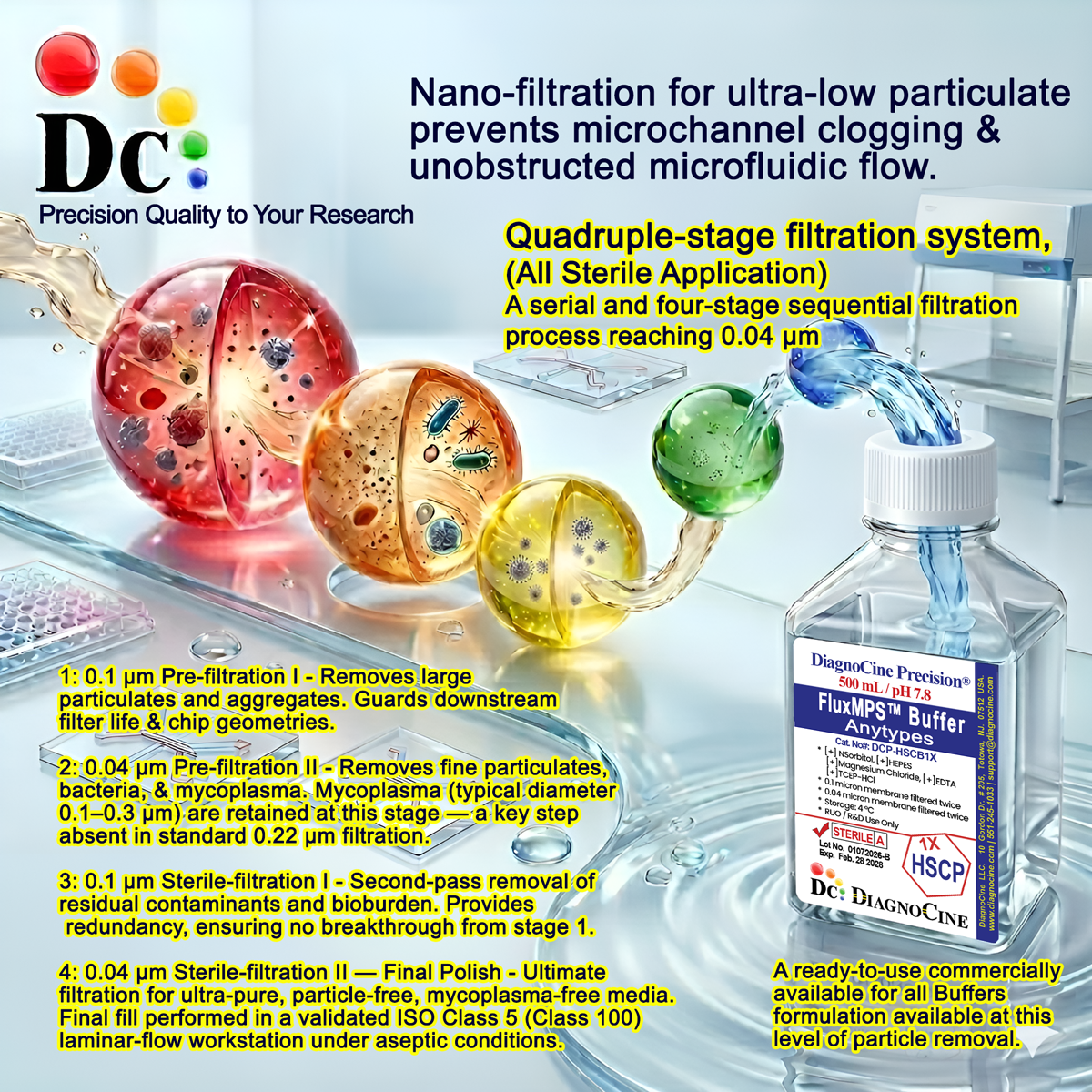
Quadruple-stage filtration system
DCP-DMB06 is sterile-filtered through a Quadruple-stage membrane sequence — 0.1 µm membrane filtration twice and 0.04 µm membrane filtration twice — in a controlled, sterile environment, delivering an ultra-low particulate blocking buffer suitable for downstream microfluidic and imaging workflows.
-
1
0.1 µm Pre-filtration I
Removes large particulates and aggregates, extending the service life of downstream filtration stages.
-
2
0.04 µm Pre-filtration II
Retains fine particulates and bioburden, an important early control point given that the smallest mycoplasma types are about 0.2 micron in size.
-
3
0.1 µm Sterile-filtration I
A second 0.1 µm pass provides redundant particulate and bioburden reduction ahead of final polish.
-
4
0.04 µm Sterile-filtration II — Final Polish
A second 0.04 µm pass performs the final polish in a sterile fill environment, helping prevent mycoplasma contamination.
Performance vs. conventional buffer
Sequential 0.1 µm (x2) and 0.04 µm (x2) filtration removes finer particulates and reduces bioburden compared with a single-pass 0.22 µm filtered blocking buffer, supporting cleaner background in blotting and imaging applications.
© Diagnocine® — DCP-DMB06
Where PBS with 5% Nonfat Soy Milk performs
Developed primarily as a blocking and antibody-dilution buffer for Western blotting and related protein-detection workflows, and manufactured to a purity standard suitable for MPS, organ-on-a-chip, and microfluidic-adjacent laboratory use.
Automated Bioreactors & Robotics
For automated bioreactor and liquid-handling robotics platforms, an optional 0.01 µm (10 nm) ultra-filtered variant of this buffer is available on request for applications demanding the lowest achievable particulate load.
- Total Particulate Exclusion: minimizes fine particulate ingress into automated fluidic pathways
- Valve & Sensor Protection: reduces particulate-related fouling of microvalves and inline sensors
- Extended Perfusion Stability: supports consistent long-duration automated perfusion runs
Inquiry Required: the 0.01 µm (10 nm) ultra-filtered grade is available by request — contact support@diagnocine.com.
Micro Physiological System (MPS) & Chip
Ultra-filtered PBS-based buffer suitable for chip priming, washing, and reagent dilution in microfluidic platforms.
Wash, Dilution & Reconstitution
A stable, defined-pH PBS system suitable for washing membranes and diluting reagents used in downstream analysis.
iPSC-Derived Model Handling
Ultra-low particulate PBS chemistry supports washing and buffer-exchange steps around sensitive iPSC-derived cell models.
Endothelial & Primary Cell Perfusion
Defined ionic composition supports buffer needs around endothelial and primary cell-based perfusion studies.
Western Blotting, ELISA & Blocking
The primary application of this product: soy milk-based blocking of non-specific binding sites and dilution of primary and secondary antibodies in immunoblotting.[1]
Microscopy & Optical Sensing
Low-particulate, ultrafiltered composition supports use as a wash/dilution buffer around optical and biosensor workflows.
Detailed product specifications
Specifications reflect the composition and quality control data documented for DCP-DMB06.
| Parameter | Specification |
|---|---|
| Formulation | PBS with 5% Nonfat Soy Milk blocking buffer |
| Appearance | Clear, Colorless Liquid |
| pH USP <791> | 7.4 |
| Sodium Chloride (NaCl) | 137 mM |
| Potassium Chloride (KCl) | 2.7 mM |
| Sodium Phosphate dibasic (Na2HPO4) | 10 mM |
| Potassium Phosphate monobasic (KH2PO4) | 1.8 mM |
| Nonfat Soy Milk | 5% |
| ProClin 300 (preservative) | 0.05% |
| Parameter | Specification |
|---|---|
| Sterility USP <71> | Filtered 0.1 µm membrane twice and 0.04 µm membrane twice in a sterile environment |
| DNase Activity | None detected (18 hr incubation with plasmid DNA, room temperature) |
| RNase Activity | None detected (18 hr incubation with ribosomal RNA, room temperature) |
| Manufacturing Standard ISO 13485 | ISO 13485-certified, CE-approved facilities |
| Water Quality | Ultrapure Type 1 water (18.2 MΩ·cm) |
| Parameter | Specification |
|---|---|
| Storage Temperature | 4°C |
| Shelf Life | 1 year |
| Parameter | Specification |
|---|---|
| Manufacturing QMS ISO 13485 | ISO 13485-certified, CE-approved facilities |
| Regulatory Alignment | ISO 13485:2016 |
| Production Method | Final packaging, quality assurance, and testing performed at the DiagnoCine R&D and Quality Testing Center; customization and assembly performed at DiagnoCine Precision, Totowa, New Jersey, USA |
| Intended Use | Research Use Only (RUO). Not intended for clinical, diagnostic, or therapeutic use in humans. |
Full composition
Every component and concentration below is reported exactly as documented for this lot type; contact support@diagnocine.com for lot-specific Certificates of Analysis.
| Component | CAS Number | Concentration |
|---|---|---|
| Nonfat Soy Milk | 5% | |
| ProClin 300 | 0.05% | |
| Potassium Chloride (KCl) | 7447-40-7 | 2.7 mM |
| Sodium Chloride (NaCl) | 7647-14-5 | 137 mM |
| Sodium Phosphate dibasic (Na2HPO4) | 7558-79-4 | 10 mM |
| Potassium Phosphate monobasic (KH2PO4) | 7778-77-0 | 1.8 mM |
Manufacturing & compliance
DCP-DMB06 is manufactured, filtered, and packaged under a controlled quality system with lot-level testing.
ISO 13485:2016 QMS
Manufactured under ISO 13485-certified, CE-approved facilities (suppliers of DiagnoCine Precision).
Ultrapure Type 1 Water
Formulated using ultrapure Type 1 water (18.2 MΩ·cm) consistent with USP <85> practice.
Sterile Fill & Finish
Filtered 0.1 µm membrane twice and 0.04 µm membrane twice in a sterile environment.
Micro-Batch Precision
Final packaging, QA, and testing performed at the DiagnoCine R&D and Quality Testing Center; customization and assembly at DiagnoCine Precision, Totowa, New Jersey, USA.
DNase Activity QC Tested
None detected after 18 hr incubation of plasmid DNA with this product at room temperature.
RNase Activity QC Tested
No RNase activity detected after 18 hr incubation of ribosomal RNA with this product at room temperature.
Sterility USP <71>
Filtered 0.1 µm membrane twice and 0.04 µm membrane twice in a sterile environment.
Documentation / CoA
A Certificate of Analysis documenting appearance, pH, sterility processing, and DNase/RNase results is available on request.
How DCP-DMB06 compares
A comparison of DCP-DMB06 against conventional single-pass filtered blocking buffers.
| Parameter | DCP-DMB06 (FluxMPS™) | Conventional (0.22 µm filtered) | Standard alternative (0.22 µm filtered) |
|---|---|---|---|
| Blocking agent | 5% Nonfat Soy Milk (casein-free, biotin-free) | Nonfat dry milk | Nonfat dry milk |
| Final filtration pore size | 0.04 µm | 0.22 µm | 0.22 µm |
| Number of filtration stages | 4 | 1 | 1 |
| DNase/RNase activity tested | check_circle | cancel | cancel |
| Water quality | Ultrapure Type 1 (18.2 MΩ·cm) | Not specified | Not specified |
| Manufacturing QMS | ISO 13485-certified | Not specified | Not specified |
| Preservative included | check_circle ProClin 300 | cancel | cancel |
| Custom formulation available | check_circle | cancel | cancel |
Frequently asked questions
Common questions about DCP-DMB06, PBS with 5% Nonfat Soy Milk.
Supporting literature
Citations directly relevant to this product, followed by curated supporting literature.
Citations
- Galva, C., Gatto, C., & Milanick, M. (2012). Soymilk: an effective and inexpensive blocking agent for immunoblotting. Analytical Biochemistry, 426(1), 22-23. doi:10.1016/j.ab.2012.03.028
Supporting Literature
- Bhatia, S. N., & Ingber, D. E. (2014). Microfluidic organs-on-chips. Nature Biotechnology, 32(8), 760-772. doi:10.1038/nbt.2989
- Mahmoudi, T., de Ridder, D., & Ojcius, D. M. (2020). Organ-on-chip technology: an in-depth review. Cellular and Molecular Life Sciences. doi:10.1007/s00018-020-03685-w
- Mahmood, T., & Yang, P. C. (2012). Western blot: technique, theory, and trouble shooting. North American Journal of Medical Sciences, 4(9), 429-434. doi:10.4103/1947-2714.100998
- Kurien, B. T., & Scofield, R. H. (2015). A brief review of other notable protein blotting methods. Methods in Molecular Biology, 1312, 367-380. doi:10.1007/978-1-4939-2694-7_37
- Whitesides, G. M. (2006). The origins and the future of microfluidics. Nature, 442(7101), 368-373. doi:10.1038/nature05058
- Malinowski, N., & Wilkinson, M. (2020). Endotoxin and particulate control in aseptic pharmaceutical processing. PDA Journal of Pharmaceutical Science and Technology, 74(2), 246-258. doi:10.5731/pdajpst.2019.010827
- Good, N. E., et al. (1966). Hydrogen ion buffers for biological research. Biochemistry, 5(2), 467-477. doi:10.1021/bi00866a011
- Junot, C., et al. (2018). Biosensor integration in organ-on-chip platforms for real-time monitoring. Lab on a Chip, 18(24), 3687-3702. doi:10.1039/C8LC00726H