

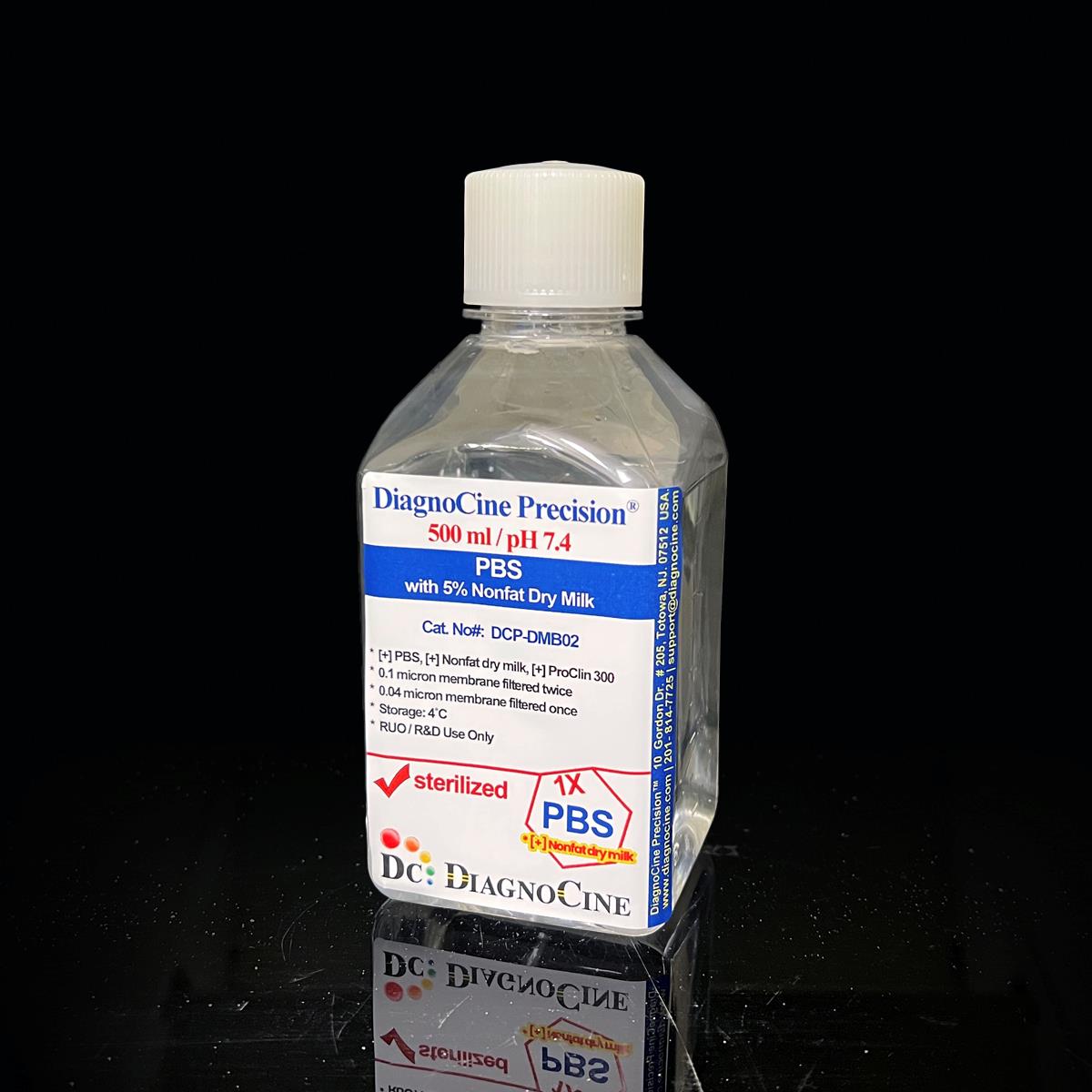
PBS with 5% Nonfat Dry Milk
PBS with 5% Nonfat Dry Milk
A research-grade, phosphate-buffered saline blocking buffer formulated with 5% Nonfat Dry Milk for Western blot, ELISA, and immunoblotting workflows, held at a defined pH of 7.4. 0.1 µm filtration removes large particulates and aggregates, helping protect downstream applications.
- 0.1 µm membrane filtration (single step)
- Formulated to pH 7.4 for consistent antibody-antigen interactions
- Contains 5% Nonfat Dry Milk for effective, low-background blocking
- DNase- and RNase-tested after 18-hour incubation at room temperature
- Preserved with 0.05% ProClin 300 for extended 1-year shelf life at 4 °C
- Manufactured in an ISO 13485:2016 certified facility
- Custom pH, molarity, or additive formulations available on request
- pH7.4
- Sodium Chloride137 mM
- Potassium Chloride2.7 mM
- Na2HPO410 mM
- KH2PO41.8 mM
- Nonfat Dry Milk5%
- Preservative0.05% ProClin 300
- Filtration0.1 µm membrane filtration (single step)
- Storage4 °C
- Shelf Life1 year
Engineered where standard blocking buffers fail
Particulates and inconsistent pH can raise background and reduce reproducibility in sensitive immunoblotting and imaging assays. PBS with 5% Nonfat Dry Milk is formulated to address these variables.
0.1 µm filtered
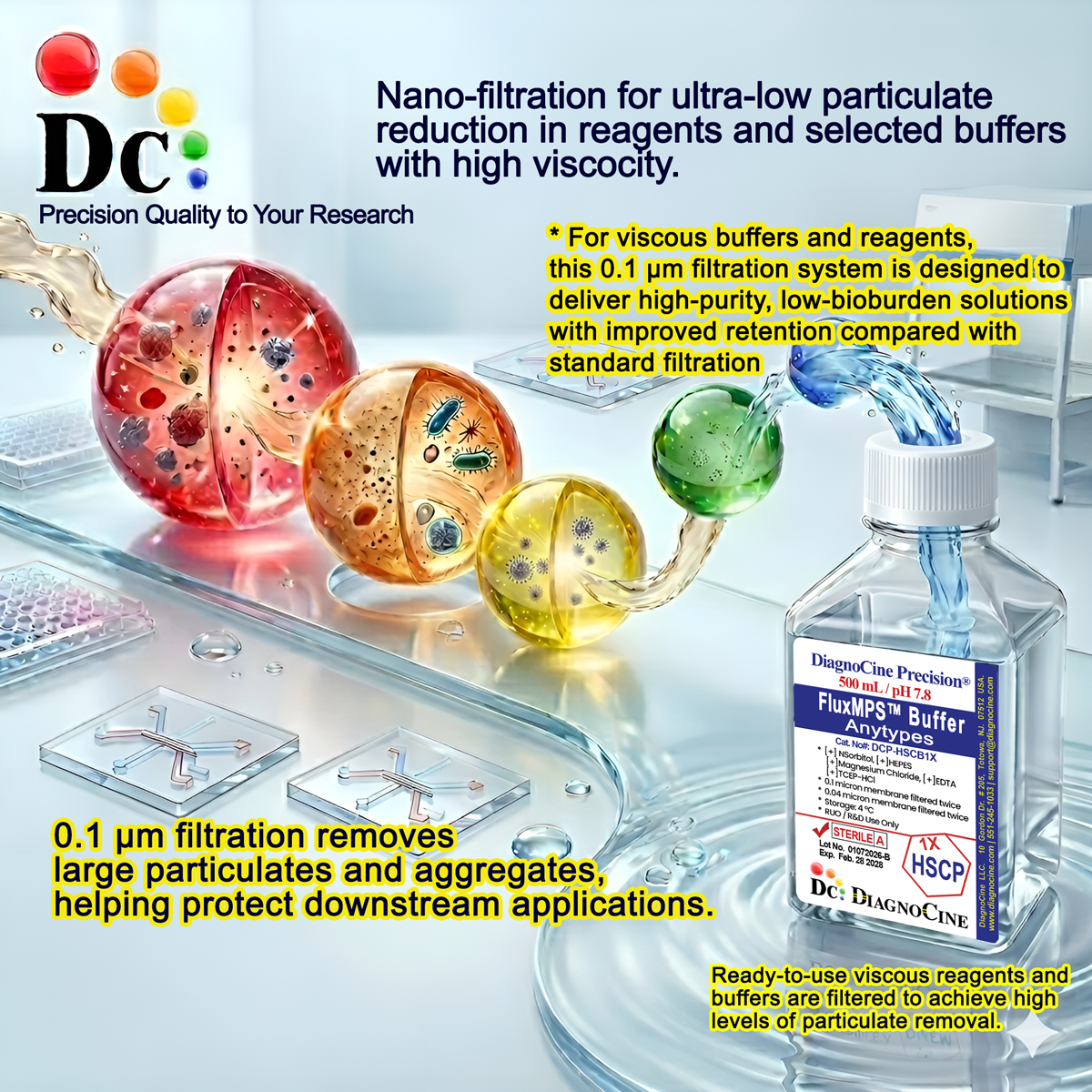
0.1 µm filtration removes large particulates and aggregates, helping protect downstream applications.
Precise, stable pH
Formulated to pH 7.4 with defined Sodium Chloride, Potassium Chloride, and phosphate salt concentrations to preserve consistent antibody-antigen binding kinetics across blocking and incubation steps.
Ultrapure-grade water
Prepared with Ultrapure Type 1 water (18.2 MΩ·cm) consistent with USP <85> water-quality principles, reducing background contributed by the aqueous base of the buffer.
Low background for imaging & assays
The multi-protein composition of nonfat dry milk occupies non-specific binding sites more effectively than single-protein blockers, reducing background banding in Western blot, ELISA, and IHC/IF imaging.
Defined, traceable composition
Every salt and additive is formulated to a stated concentration and released against the full composition table below, giving each lot a consistent, traceable ionic background.
Customization on demand
Alternate pH, molarity, salts, or additive packages can be formulated on request — contact support@diagnocine.com.
0.1 µm membrane filtration
DCP-DMB02 is filtered once through a 0.1 µm membrane.
-
1
0.1 µm Membrane Filtration
Removes large particulates and aggregates, helping protect downstream applications.
Filtration
0.1 µm filtration removes large particulates and aggregates, helping protect downstream applications.
© Diagnocine® — DCP-DMB02
Where PBS with 5% Nonfat Dry Milk is used
Formulated primarily as a blocking and antibody-dilution buffer for molecular biology and biochemistry workflows, with a PBS-based composition compatible with a range of laboratory wash steps.
Dot Blot & Protein Arrays
Blocks unoccupied binding sites on nitrocellulose or PVDF membranes before antibody probing in dot blot and protein array assays.
Wash, Dilution & Reconstitution
Used as a diluent for primary and secondary antibodies and as a rinse buffer between incubation steps in immunoblotting procedures.
iPSC-Derived Model Handling
Compatible with wash and blocking steps used when immunostaining iPSC-derived model lysates and membranes.
Endothelial & Primary Cell Wash
PBS-based formulation suitable for wash steps ahead of downstream immunoblot analysis of endothelial and primary cell lysates.
ELISA, Blotting & Blocking
The flagship use case: nonfat dry milk-based blocking of non-specific binding sites to reduce background in Western blot, ELISA, and IHC/IF workflows.
Microscopy & Optical Sensing
PBS-based buffer used to wash samples between antibody incubation steps in confocal and biosensor-based imaging protocols.
Specifications at a glance
Values below reflect the formulation and quality control data reported for DCP-DMB02.
| Parameter | Specification |
|---|---|
| Formulation | PBS-based blocking buffer with Nonfat Dry Milk (full composition below) |
| Appearance | Clear, Colorless Liquid |
| pH USP <791> | 7.4 |
| Sodium Chloride Concentration | 137 mM |
| Potassium Chloride Concentration | 2.7 mM |
| Sodium Phosphate Dibasic (Na2HPO4) Concentration | 10 mM |
| Potassium Phosphate Monobasic (KH2PO4) Concentration | 1.8 mM |
| Nonfat Dry Milk Concentration | 5% |
| Parameter | Specification |
|---|---|
| Sterility | Nonsterile |
| DNase Activity | None detected after 18 hr incubation with plasmid DNA at room temperature |
| RNase Activity | None detected after 18 hr incubation with ribosomal RNA at room temperature |
| Water Quality | Ultrapure Type 1 water (18.2 MΩ·cm) |
| Manufacturing Standard ISO 13485 | ISO 13485:2016 certified facility |
| Parameter | Specification |
|---|---|
| Storage Temperature | 4 °C |
| Shelf Life | 1 year |
| Parameter | Specification |
|---|---|
| Manufacturing QMS ISO 13485 | ISO 13485:2016 certified facility |
| Production & Traceability | Final packaging, quality assurance, and testing performed at the DiagnoCine R&D and Quality Testing Center; customization and assembly performed at DiagnoCine Precision, Totowa, New Jersey, USA |
| Intended Use | For Research Use Only (RUO). Not intended for clinical, diagnostic, or therapeutic use in humans. |
Full composition
Every ingredient and concentration reported for DCP-DMB02, released against the values below.
| Component | CAS Number | Concentration |
|---|---|---|
| Nonfat Dry Milk | 5% | |
| ProClin 300 | 0.05% | |
| Potassium Chloride | 7447-40-7 | 2.7 mM |
| Sodium Chloride | 7647-14-5 | 137 mM |
| Sodium Phosphate dibasic | 7558-79-4 | 10 mM |
| Potassium Phosphate monobasic | 7778-77-0 | 1.8 mM |
Manufacturing & compliance
DCP-DMB02 is manufactured, filtered, and tested under a controlled quality system, with final packaging and QA performed at DiagnoCine's own facilities.
ISO 13485:2016 QMS
Manufactured under ISO 13485-certified facilities (Suppliers of DiagnoCine Precision).
Ultrapure Type 1 Water
Formulated with Ultrapure Type 1 water (18.2 MΩ·cm) as the aqueous base of the buffer.
0.1 µm Membrane Filtration
Filtered once through a 0.1 µm membrane.
Micro-Batch Precision
All specific customization requests and assembly are accomplished at DiagnoCine Precision in Totowa, New Jersey, USA.
DNase Activity
None detected after incubation of plasmid DNA with this product for 18 hr at room temperature.
RNase Activity
No RNase activity detected after incubation of ribosomal RNA with this product for 18 hr at room temperature.
Sterility & Filtration
Nonsterile. 0.1 µm membrane filtration (single step).
Documentation / CoA
A Certificate of Analysis documenting appearance, pH, filtration, and DNase/RNase testing is available on request.
How DCP-DMB02 compares
A side-by-side look at quality attributes versus conventional blocking buffers.
| Parameter | DCP-DMB02 | Conventional Blocking Buffer | Standard Alternative |
|---|---|---|---|
| DNase / RNase Tested | check_circle | cancel | cancel |
| Ultrapure Type 1 Water (18.2 MΩ·cm) | check_circle | cancel | check_circle |
| ISO 13485:2016 Certified Manufacturing | check_circle | cancel | check_circle |
| Nonfat Dry Milk Blocking Formulation with ProClin 300 | check_circle | cancel | cancel |
| Custom Formulation Available | check_circle | cancel | cancel |
Frequently asked questions
Common questions about DCP-DMB02 PBS with 5% Nonfat Dry Milk.
Supporting literature
Curated references relevant to PBS chemistry, milk-based blocking, and immunoblotting technique.
- Mahmood T, Yang PC. Western blot: technique, theory, and trouble shooting. N Am J Med Sci. 2012. doi:10.4103/1947-2714.100998
- Kurien BT, Scofield RH. Western blotting: an introduction. Methods Mol Biol. 2015. doi:10.1007/978-1-4939-2694-7_3
- Bass JJ, et al. An overview of technical considerations for Western blotting applications to physiological research. Scand J Med Sci Sports. 2017. doi:10.1111/sms.12702
- Gilda JE, Gomes AV. Stain-Free total protein staining is a superior loading control to beta-actin for Western blots. Anal Biochem. 2013. doi:10.1016/j.ab.2013.05.027
- Eaton SL, et al. A guide to modern quantitative fluorescent western blotting with troubleshooting strategies. J Vis Exp. 2013. doi:10.3791/50521
- Ingham KC. Blocking of nonspecific binding of proteins and antibodies in the ELISA and related assays. Methods Mol Biol. 2015. doi:10.1007/978-1-4939-2742-5_5