

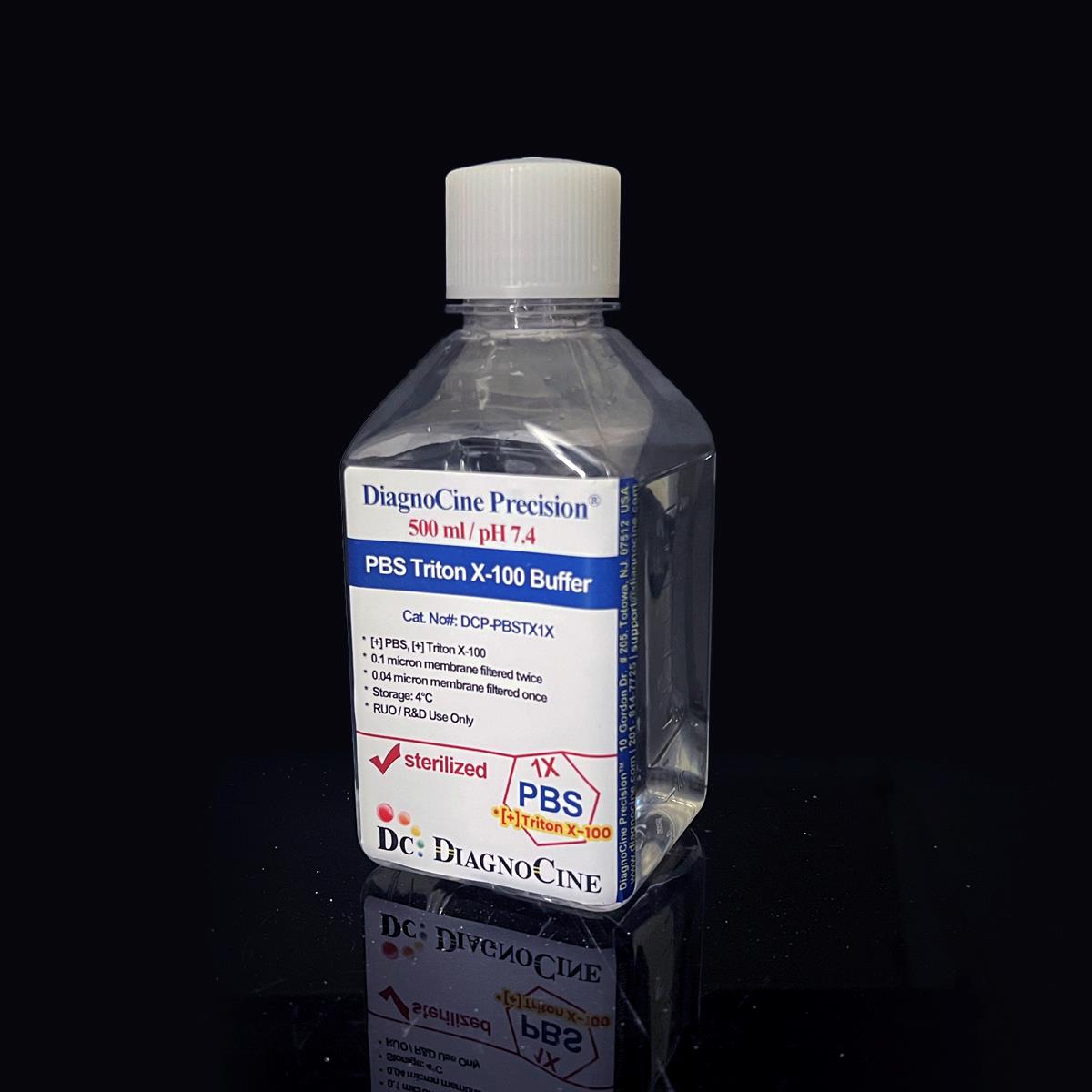
PBS Triton X-100 Buffer [1X]
FluxMPS™ PBS Triton X-100 Buffer [1X]
A physiological pH 7.4 phosphate-buffered saline formulated with 1% Triton X-100, a nonionic detergent that solubilizes membrane proteins while preserving native protein-protein interactions. Dual-stage 0.1 µm and 0.04 µm membrane filtration delivers a microchannel-safe, ultra-clean buffer for cell lysis, immunoassay, and microfluidic workflows.
- Dual-stage filtration: 0.1 µm membrane once and 0.04 µm membrane once for ultra-clean, low-particulate performance
- Formulated with 1% Triton X-100, a nonionic detergent that preserves native protein structure during lysis and extraction
- Physiological pH 7.4 phosphate-buffered saline base for stable, reproducible biological assays
- Prepared with Ultrapure Type 1 water (18.2 MΩ·cm) for low-background molecular and cell biology work
- Supplied Non-Sterile, research-grade, manufactured under ISO 13485-certified, CE-approved facilities
- Compatible with microfluidic channels, organ-on-a-chip perfusion loops, and automated liquid handling systems
- Custom concentrations, pH, and additive formulations available on request
- pH7.4
- AppearanceClear, colorless liquid
- SterilityNon-Sterile
- Filtration0.1 µm once + 0.04 µm once
- DetergentTriton X-100, 1%
- Buffer baseNaCl, KCl, Na2HPO4, KH2PO4
- Storage4°C
- Shelf Life1 year
Engineered where standard buffers fail
Conventional single-pass 0.22 µm-filtered buffers can carry subvisible particulates that accumulate in narrow microfluidic channels, drift in pH and ionic composition between lots, and add unwanted assay background. FluxMPS™ buffers are built to a tighter purity and consistency standard from the first pass.
Microchannel-safe purity
Sequential 0.1 µm and 0.04 µm membrane filtration reduces particulate load below what a single-pass 0.22 µm filter can achieve, protecting narrow microfluidic and organ-on-a-chip channels.
Precise, stable pH
Formulated to a physiological pH of 7.4 using a defined phosphate-buffered saline base for consistent, reproducible cell and molecular biology results.
Ultrapure-grade water
Prepared with Ultrapure Type 1 water (18.2 MΩ·cm) to minimize trace contaminants that can interfere with sensitive downstream assays.
Low background for imaging & assays
The nonionic Triton X-100 detergent solubilizes membrane proteins without denaturing them, helping preserve signal fidelity in Western blot, ELISA, and immunostaining protocols.
Defined, traceable composition
Every salt and detergent component is listed with its exact concentration in the full composition table below.
Customization on demand
Alternate concentrations, pH values, or added chemicals, compounds, proteins, and supplements can be formulated on request.
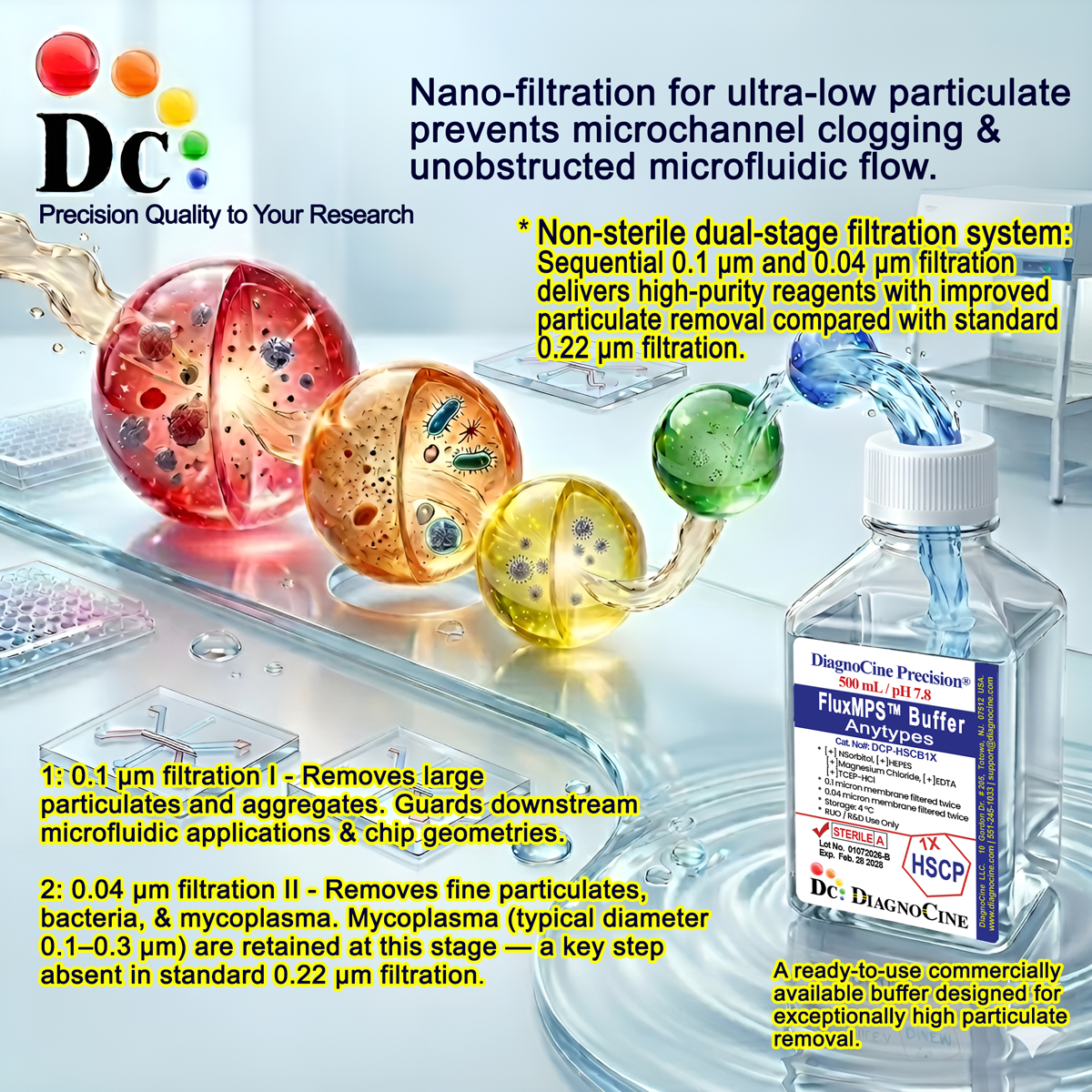
Dual-stage filtration system
DCP-PBSTX1X is processed through a 0.1 µm membrane once and a 0.04 µm membrane once, progressively reducing particulate and bioburden load before final packaging.
-
1
0.1 µm Pre-filtration I
Removes large particulates and aggregates, extending the life of the downstream 0.04 µm membrane.
-
2
0.04 µm Pre-filtration II
Retains fine particulates and reduces bioburden ahead of packaging, forming the final purity stage of this buffer.
Performance vs. conventional buffer
Sequential 0.1 µm and 0.04 µm filtration removes finer particulates than a single 0.22 µm pass used in conventional buffer preparations.
© Diagnocine® — DCP-PBSTX1X
Where PBS Triton X-100 Buffer is used
The combination of physiological phosphate-buffered saline and a nonionic detergent makes this buffer suitable for a range of cell and molecular biology workflows requiring gentle membrane solubilization.
Automated Bioreactors & Robotics
For automated perfusion systems and robotic liquid handlers, an optional 0.01 µm (10 nm) ultra-filtered variant of this buffer can be formulated on request to further protect sensitive valves and sensors.
- Total Particulate Exclusion: finer filtration reduces particulate exposure to microfluidic hardware
- Valve & Sensor Protection: lower particulate load helps protect precision automated components
- Extended Perfusion Stability: cleaner input buffer supports longer unattended run times
Inquiry Required: contact support@diagnocine.com to request the 0.01 µm ultra-filtered grade.
Micro Physiological System (MPS) & Chip
Wash and dilution buffer for microfluidic and organ-on-a-chip perfusion systems.
Cell Lysis & Protein Extraction
Triton X-100 solubilizes membrane proteins while preserving functional protein-protein interactions during cell lysis and extract preparation.
ELISA, Western Blotting & Blocking
Used as a wash buffer in ELISA and Western blotting to reduce background by removing unbound antibodies and reagents.
Immunohistochemistry & Permeabilization
Permeabilizes fixed tissues and cell membranes to facilitate antibody access to target antigens during immunostaining protocols.
Cell Wash & Treatment Buffer
Washes cells before and after treatments while maintaining physiological conditions ahead of downstream analysis.
DNA Extraction
Used in select DNA extraction protocols to lyse cells and release nucleic acids for subsequent purification.
Detailed specifications
Measured and declared parameters for DCP-PBSTX1X.
| Parameter | Specification |
|---|---|
| Formulation | Phosphate-buffered saline with Triton X-100 |
| Appearance | Clear, colorless liquid |
| pH USP <791> | 7.4 |
| Triton X-100 concentration | 1% |
| Parameter | Specification |
|---|---|
| Sterility | Non-Sterile |
| Filtration | 0.1 µm membrane once and 0.04 µm membrane once |
| Water quality | Ultrapure Type 1 water (18.2 MΩ·cm) |
| Manufacturing standard ISO 13485 | ISO 13485-certified, CE-approved facility |
| Parameter | Specification |
|---|---|
| Storage temperature | 4°C |
| Shelf life | 1 year |
| Parameter | Specification |
|---|---|
| Manufacturing QMS ISO 13485:2016 | ISO 13485-certified, CE-approved supplier facility |
| Final QA & packaging | Performed at the Diagnocine R&D and Quality Testing Center |
| Customization & assembly | Diagnocine Precision, Totowa, New Jersey, USA |
| Intended use | Research Use Only (RUO) |
Full composition
Component concentrations for DCP-PBSTX1X as released.
| Component | CAS Number | Concentration |
|---|---|---|
| Sodium Chloride | 7647-14-5 | 137 mM |
| Potassium Chloride | 7447-40-7 | 2.7 mM |
| Sodium Phosphate dibasic | 7558-79-4 | 10 mM |
| Potassium Phosphate monobasic | 7778-77-0 | 1.8 mM |
| Triton X-100 | 9002-93-1 | 1% |
Manufacturing & compliance
DCP-PBSTX1X is produced, tested, and released under a controlled quality system.
ISO 13485:2016 QMS
Manufactured under ISO 13485-certified and CE-approved supplier facilities.
Ultrapure Type 1 Water
Prepared with Ultrapure Type 1 water (18.2 MΩ·cm).
Dual-Stage Filtration
Filtered through a 0.1 µm membrane once and a 0.04 µm membrane once.
Traceable Final Assembly
Final packaging, QA, and testing performed at the Diagnocine R&D and Quality Testing Center; customization assembled at Diagnocine Precision, Totowa, New Jersey, USA.
Sterility Status
Supplied Non-Sterile.
Filtration Record
0.1 µm membrane once, 0.04 µm membrane once.
pH Control
Formulated and QC-checked to pH 7.4.
Documentation
Certificate of Analysis available on request.
How DCP-PBSTX1X compares
A side-by-side look at filtration architecture and formulation control.
| Parameter | DCP-PBSTX1X (FluxMPS™) | Conventional 0.22 µm Buffer | Standard Alternative |
|---|---|---|---|
| Detergent | Nonionic Triton X-100, 1%, native-state preserving | Varies, often not disclosed | Varies |
| Final filtration pore size | 0.04 µm | 0.22 µm | 0.22 µm |
| Number of filtration stages | 2 | 1 | 1 |
| Sterility status | Non-Sterile | Varies | Varies |
| Water quality | Ultrapure Type 1 (18.2 MΩ·cm) | Standard purified water | Standard purified water |
| Manufacturing QMS | check_circle ISO 13485 | cancel | cancel |
| Microfluidic channel compatibility | check_circle | cancel | cancel |
| Custom formulation available | check_circle | cancel | cancel |
Frequently asked questions
Common questions about DCP-PBSTX1X.
Supporting literature
Curated references relevant to phosphate-buffered saline, Triton X-100, and microfluidic buffer applications.
- Ingham, K.C. Precipitation of proteins with polyethylene glycol. Methods Enzymol. 1990. doi:10.1016/0076-6879(90)82022-2
- Koley, D.; Bard, A.J. Triton X-100 concentration effects on membrane permeability. Proc. Natl. Acad. Sci. 2010. doi:10.1073/pnas.1007861107
- Bhairi, S.M.; Mohan, C. Detergents: A Guide to the Properties and Uses of Detergents in Biological Systems. Calbiochem, 2007.
- Bhattacharya, R.; et al. Organs-on-chips: Into the next decade. Nat. Rev. Drug Discov. 2021. doi:10.1038/s41573-020-0079-3
- Bhatia, S.N.; Ingber, D.E. Microfluidic organs-on-chips. Nat. Biotechnol. 2014. doi:10.1038/nbt.2989
- Kim, B.J.; et al. Effects of detergent choice on immunoblot signal quality. J. Immunol. Methods. 2016. doi:10.1016/j.jim.2015.09.001
- Ramsden, J.J. Buffer selection and its impact on biosensor and immunoassay performance. Biosens. Bioelectron. 2008. doi:10.1016/j.bios.2007.10.001
- Green, M.R.; Sambrook, J. Molecular Cloning: A Laboratory Manual, 4th ed. Cold Spring Harbor Laboratory Press, 2012.