

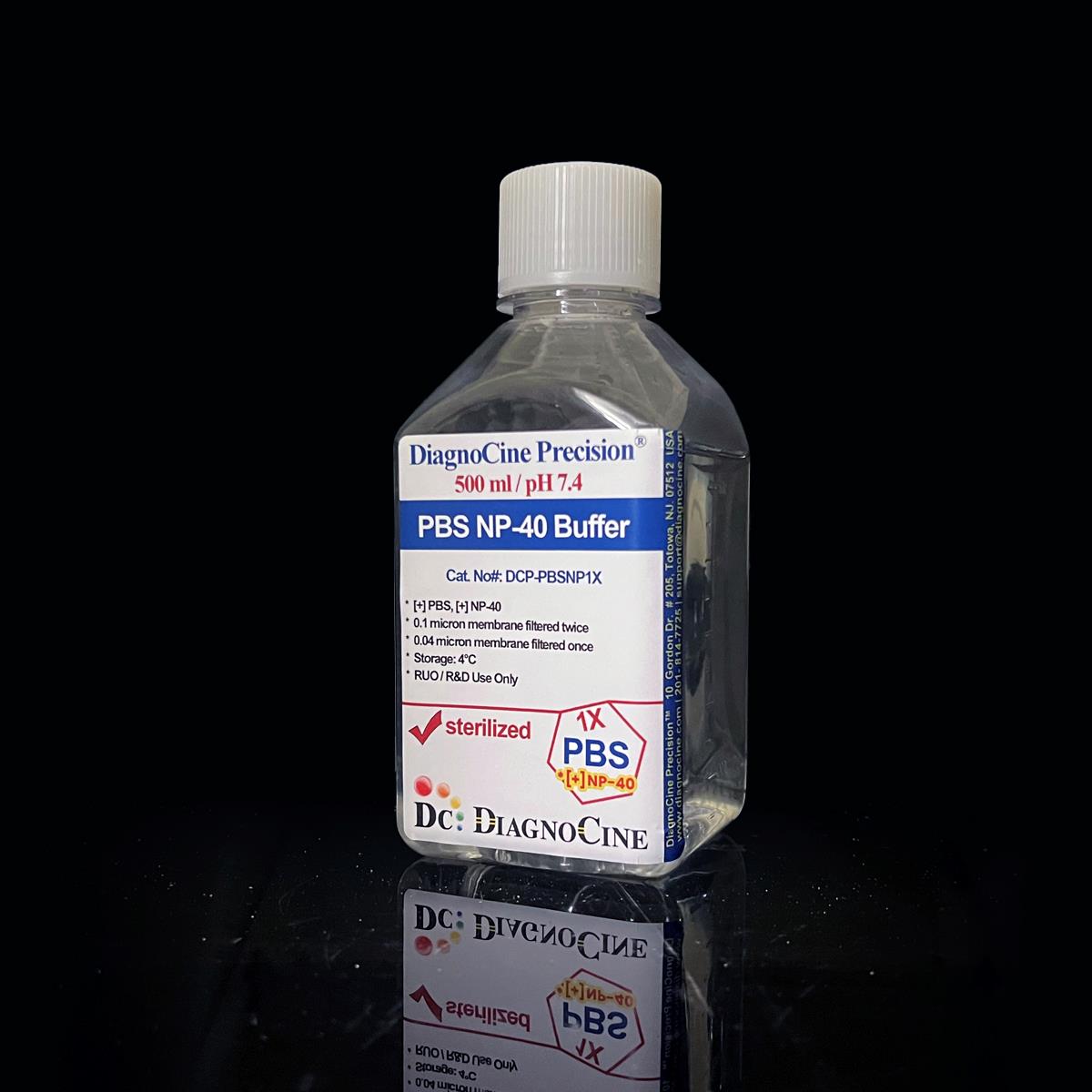
PBS NP-40 Buffer [1X]
FluxMPS™ PBS NP-40 Buffer [1X]
MPS-grade phosphate buffered saline formulated with 1% NP-40 non-ionic detergent for gentle, non-denaturing cell lysis and protein extraction. Manufactured at pH 7.4 with ultrapure Type 1 water and dual-stage 0.1 µm and 0.04 µm membrane filtration, this buffer supports clean, reproducible lysates for western blotting, immunoprecipitation, and other protein analysis workflows.
- Dual-stage ultra-filtration: 0.1 µm membrane once and 0.04 µm membrane once
- 1% NP-40 non-ionic detergent for gentle, non-denaturing lysis
- Physiological pH 7.4 phosphate-buffered saline base
- Formulated with ultrapure Type 1 water (18.2 MΩ·cm)
- Preserves protein-protein interactions for western blot and immunoprecipitation
- No detectable DNase or RNase activity
- Supplied Non-Sterile for general cell and molecular biology use
- Custom concentrations, pH, and additive formulations available on request
- pH7.4
- FormulationPBS + 1% NP-40 detergent
- AppearanceClear, colorless liquid
- Filtration0.1 µm once + 0.04 µm once
- SterilityNon-Sterile
- DNase ActivityNone detected
- RNase ActivityNone detected
- Storage4°C
- Shelf Life1 year
- Water QualityUltrapure Type 1 (18.2 MΩ·cm)
Engineered where standard lysis buffers fall short
Conventional 0.22 µm-filtered lysis buffers can carry subvisible particulates and lot-to-lot variability that interfere with downstream protein assays. FluxMPS™ PBS NP-40 Buffer [1X] is formulated and filtered to reduce that variability while preserving the mild, non-denaturing character of NP-40.
Dual-stage filtered purity
Sequential 0.1 µm and 0.04 µm membrane filtration reduces particulate carryover before it reaches your lysate or downstream assay.
Precise, stable pH
Formulated at pH 7.4 to maintain physiological osmolarity and a stable environment for extracted proteins.
Ultrapure-grade water
Prepared with Type 1 water (18.2 MΩ·cm) as the formulation base.
Gentle, non-denaturing lysis
1% NP-40, a mild non-ionic detergent, solubilizes membrane and cytoplasmic proteins while preserving protein-protein interactions and enzyme activity.
Defined, traceable composition
Every salt and detergent component is formulated to a stated concentration — see the full composition table below.
Customization on demand
Alternate concentrations, pH, and additional chemicals, compounds, proteins, or supplements available on request.
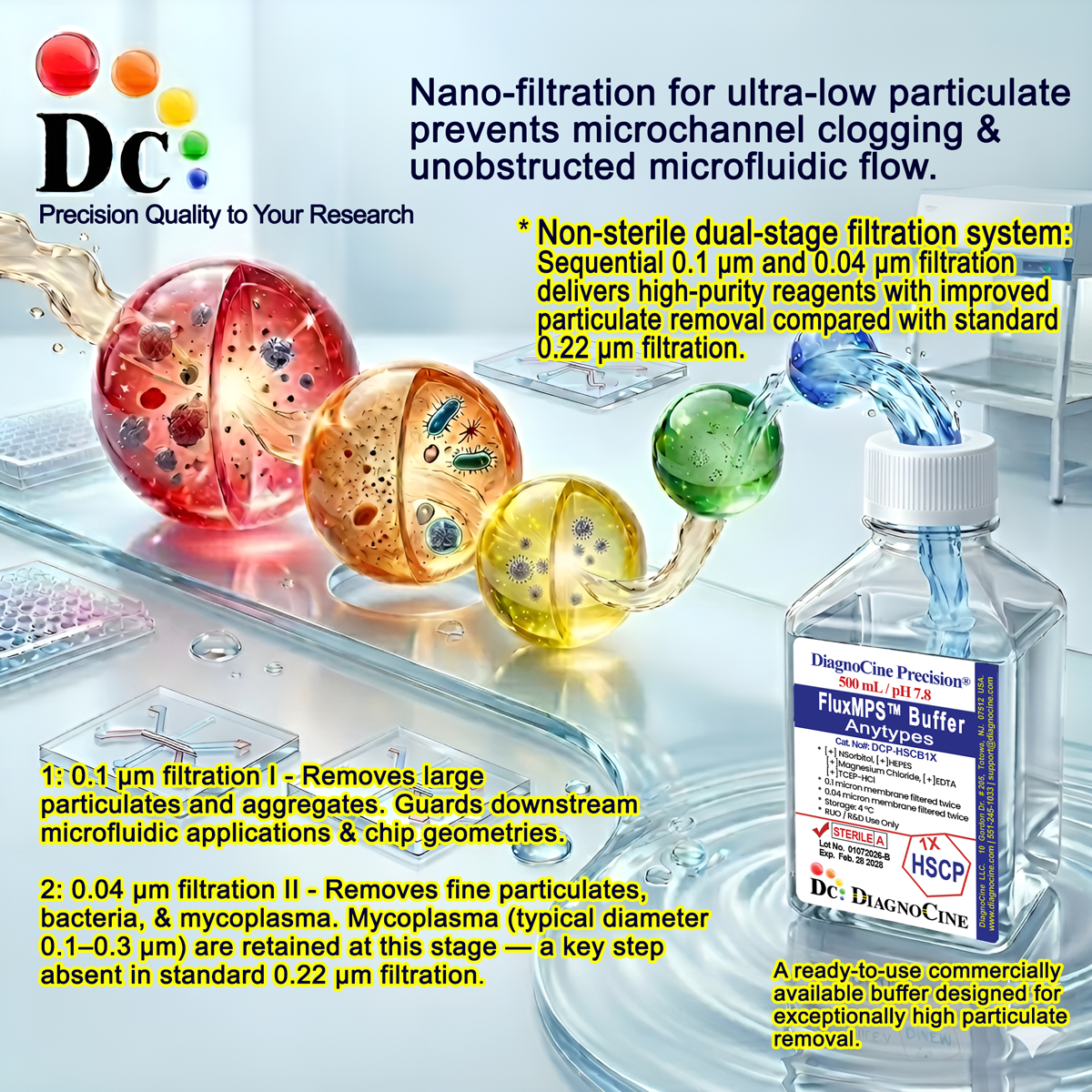
Dual-stage filtration system
PBS NP-40 Buffer [1X] passes through a sequential 0.1 µm and 0.04 µm membrane filtration process, reducing particulate load beyond a single conventional 0.22 µm pass while keeping the NP-40 detergent intact.
-
01
0.1 µm Pre-filtration I
Removes large particulates and aggregates, extending the working life of the downstream filter stage.
-
02
0.04 µm Pre-filtration II
Retains fine particulates for a cleaner final buffer prior to fill.
Performance vs. conventional buffer
Sequential 0.1 µm and 0.04 µm membrane filtration removes finer particulates than a single 0.22 µm pass, supporting cleaner lysates for downstream protein analysis.
© Diagnocine® — DCP-PBSNP1X
Built for cell lysis, protein extraction, and immunoassay workflows
PBS NP-40 Buffer [1X] balances effective protein extraction with preservation of protein structure, making it suitable for a range of cell and molecular biology applications.
Automated Bioreactors & Robotics
An optional 0.01 µm (10 nm) ultra-filtered variant is available for automated liquid handling and robotic sample-preparation platforms where finer particulate exclusion is desired.
- Total Particulate Exclusion: minimizes residual particulate load entering automated fluid paths
- Valve & Sensor Protection: reduces particulate contact with automated dispensing hardware
- Extended Perfusion Stability: supports consistent buffer quality across automated runs
Inquiry Required: the 0.01 µm ultra-filtered grade is available upon request at support@diagnocine.com.
Micro Physiological System (MPS) & Chip Sample Processing
Suitable for lysing cells cultured within microfluidic and organ-on-a-chip formats prior to downstream protein analysis.
Cell Lysis & Protein Extraction
Effectively disrupts cell membranes to release cellular contents, suitable for cultured cells and tissue samples.
iPSC-Derived Model Lysis
Applicable for protein extraction from iPSC-derived cell models for downstream western blot or immunoprecipitation analysis.
Endothelial & Primary Cell Protein Analysis
Compatible with lysis and protein extraction workflows for endothelial and other primary cell types.
Western Blotting, Blocking & Immunoprecipitation
Used to prepare whole cell lysates for western blotting, immunoprecipitation experiments, and washing steps in immunoassays.
Protein-Protein Interaction Studies
The mild, non-ionic NP-40 detergent preserves protein-protein interactions better than harsher ionic detergents.
Detailed product specifications
Every parameter below reflects the properties formulated and tested for this product.
| Parameter | Specification |
|---|---|
| Formulation | PBS with 1% NP-40 non-ionic detergent, 1X |
| Appearance | Clear, colorless liquid |
| pH USP <791> | 7.4 |
| Parameter | Specification |
|---|---|
| Sterility Status | Non-Sterile |
| Filtration | 0.1 µm membrane once + 0.04 µm membrane once |
| DNase Activity | None detected (18 hr, room temperature, plasmid DNA) |
| RNase Activity | None detected (18 hr, room temperature, ribosomal RNA) |
| Water Quality | Ultrapure Type 1 water (18.2 MΩ·cm) |
| Manufacturing Standard ISO 13485 | ISO 13485-certified, CE-approved facility |
| Parameter | Specification |
|---|---|
| Storage Temperature | 4°C |
| Shelf Life | 1 year |
| Parameter | Specification |
|---|---|
| Raw Material Grade | Ultrapure-grade raw materials |
| Manufacturing Facility | ISO 13485-certified and CE-approved facility (Diagnocine Precision Suppliers) |
| Final QA & Testing | Diagnocine R&D and Quality Testing Center |
| Customization & Assembly Location | Diagnocine Precision, Totowa, New Jersey, USA |
| Intended Use | Research Use Only (RUO) |
Full composition
Formulated to the concentrations below; each lysis buffer component is listed with its CAS number where known.
| Component | CAS Number | Concentration |
|---|---|---|
| Sodium Chloride | 7647-14-5 | 137 mM |
| Potassium Chloride | 7447-40-7 | 2.7 mM |
| Sodium Phosphate dibasic | 7558-79-4 | 10 mM |
| Potassium Phosphate monobasic | 7778-77-0 | 1.8 mM |
| NP-40 | 9016-45-9 | 1% |
Manufactured under controlled quality systems
PBS NP-40 Buffer [1X] is manufactured, packaged, and tested under the following quality framework.
ISO 13485-Certified Facility
Manufactured under ISO 13485-certified and CE-approved facilities (Diagnocine Precision Suppliers).
Ultrapure Type 1 Water
Formulated using Type 1 water (18.2 MΩ·cm) as the base solvent.
Dual-Stage Membrane Filtration
Filtered through a 0.1 µm membrane once and a 0.04 µm membrane once before fill.
Final QA at Diagnocine R&D Center
Final packaging, quality assurance, and testing performed at the Diagnocine R&D and Quality Testing Center, Totowa, New Jersey, USA.
DNase Activity Testing
None detected after 18 hr incubation of plasmid DNA with this product at room temperature.
RNase Activity Testing
No RNase activity detected after 18 hr incubation of ribosomal RNA with this product at room temperature.
Appearance & pH Verification
Verified as a clear, colorless liquid at pH 7.4 prior to release.
Documentation
Certificate of Analysis available upon request.
How DCP-PBSNP1X compares
A side-by-side look at PBS NP-40 Buffer [1X] against conventional 0.22 µm-filtered alternatives.
| Parameter | DCP-PBSNP1X (FluxMPS™) | Conventional Buffer | Standard Alternative |
|---|---|---|---|
| Non-ionic detergent | 1% NP-40 | Varies / unspecified | Varies / unspecified |
| Final filtration pore size | 0.04 µm | 0.22 µm | 0.22 µm |
| Number of filtration stages | 2 | 1 | 1 |
| pH | 7.4 | Varies | Varies |
| Water quality | Ultrapure Type 1 (18.2 MΩ·cm) | cancel | cancel |
| Manufacturing QMS | check_circle ISO 13485 | cancel | cancel |
| DNase/RNase tested | check_circle | cancel | Varies |
| Custom formulation available | check_circle | cancel | cancel |
Frequently asked questions
Common questions about PBS NP-40 Buffer [1X].
Supporting literature
Curated literature relevant to PBS-based lysis buffers, NP-40 detergent chemistry, and microfluidic sample preparation.
- Bhatia SN, Ingber DE. Microfluidic organs-on-chips. Nat Biotechnol. 2014. doi:10.1038/nbt.2989
- Ross PL, et al. Membrane protein solubilization strategies for proteomics. Anal Chem. 2003. doi:10.1021/ac026117i
- Duckworth HW, et al. Nonionic detergents in protein purification. Methods Enzymol. 1990. doi:10.1016/0076-6879(90)82004-1
- Mahmood T, Yang PC. Western blot: technique, theory, and trouble shooting. N Am J Med Sci. 2012. doi:10.4103/1947-2714.100998
- Phizicky EM, Fields S. Protein-protein interactions: methods for detection and analysis. Microbiol Rev. 1995. doi:10.1128/mr.59.1.94-123.1995
- Free RB, Hazelwood LA, Sibley DR. Identifying novel protein-protein interactions using co-immunoprecipitation and mass spectrometry. Curr Protoc Neurosci. 2009. doi:10.1002/0471142301.ns0528s46
- Huh D, et al. Microengineered physiological biomimicry: organs-on-chips. Lab Chip. 2012. doi:10.1039/c2lc40089h
- Kim JY, Kim KM. Sample preparation for western blot analysis. J Anal Sci Technol. 2018. doi:10.1186/s40543-018-0154-0