


PBS Blocking Buffer with Casein (1%)
PBS Blocking Buffer with Casein (1%)
A research-grade phosphate buffered saline blocking reagent formulated with 1% purified casein at a precise, stable pH of 7.4, for Western blotting, ELISA, and immunohistochemistry. 0.1 µm filtration removes large particulates and aggregates, helping protect downstream applications.
- Filtration: 0.1 µm membrane filtration (single step)
- Precise, stable pH of 7.4 supports antibody and protein integrity throughout immunoassay protocols
- 1% purified casein blocking agent minimizes non-specific binding with lower background than milk-based blockers in biotin-avidin systems
- DNase- and RNase-tested: no activity detected after 18-hour incubation at room temperature
- Manufactured under ISO 13485-certified facilities with final QC at the Diagnocine R&D and Quality Testing Center
- Nonsterile, opaque liquid supplied ready for use from long-term -20°C storage
- Customizable concentration, pH, and additive package available on request
- pH7.4
- AppearanceOpaque Liquid
- Casein Content1%
- Buffer BasePhosphate Buffered Saline (PBS)
- Filtration0.1 µm membrane filtration (single step)
- DNase ActivityNone Detected
- RNase ActivityNone Detected
- Storage-20°C, Long Term
- Shelf Life1 Year
- ManufacturingISO 13485-Certified
Engineered where standard blocking buffers fail
Inconsistent pH and higher assay background are common problems — especially in biotin-avidin detection systems where milk-based blockers introduce endogenous biotin interference. PBS Blocking Buffer with Casein (1%) is built to remove those variables at the source.
0.1 µm filtered
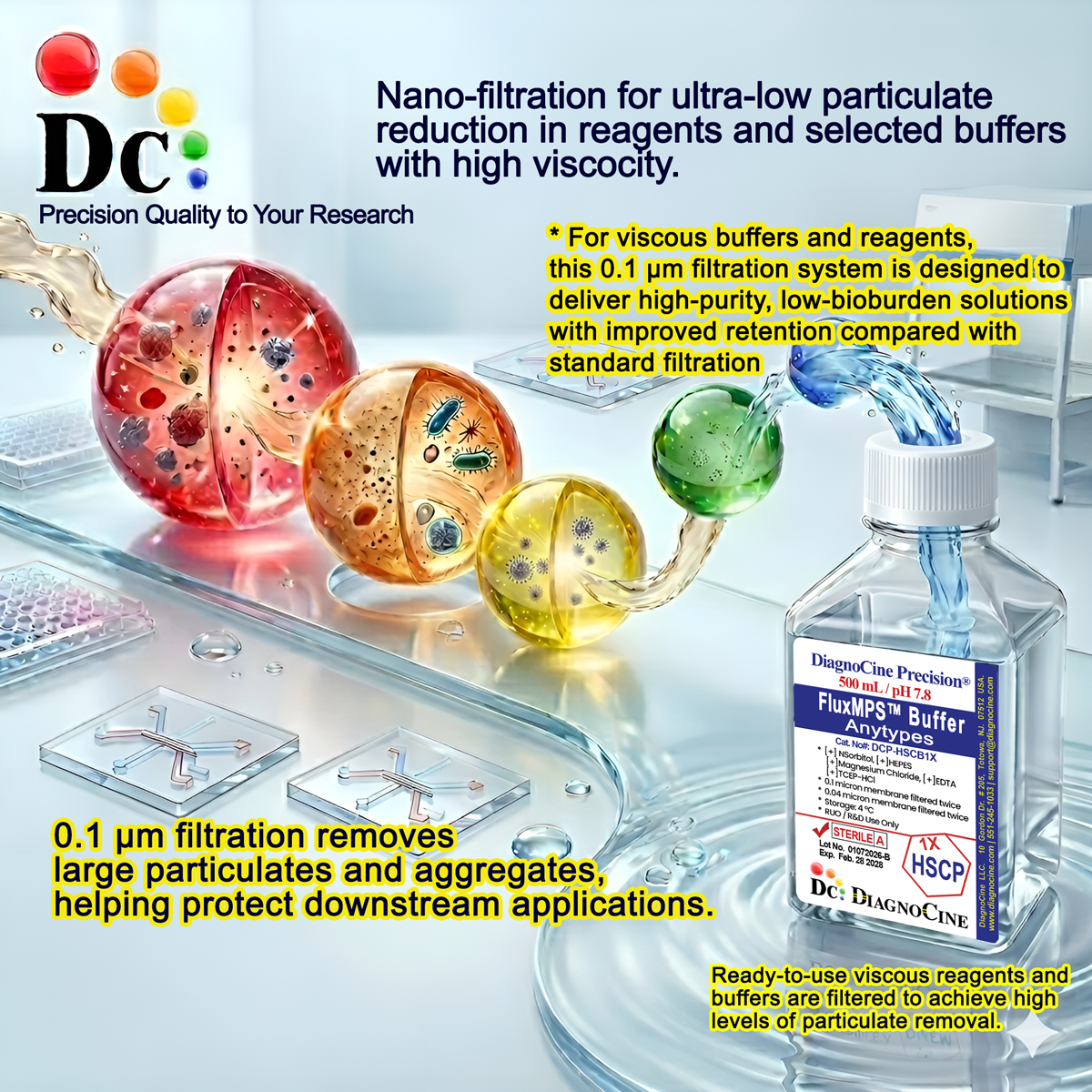
0.1 µm filtration removes large particulates and aggregates, helping protect downstream applications.
Precise, stable pH
Buffered to pH 7.4 with defined PBS salt concentrations, preserving protein and antibody integrity throughout the blocking step.
Ultrapure-grade water
Formulated with Type 1 water (18.2 MΩ·cm), consistent with USP <85> water quality expectations.
Low background for imaging & assays
Single-protein casein blocking reduces cross-reactivity versus serum or milk, giving lower background in biotin-avidin and fluorescence-based detection.
Defined, traceable composition
Every PBS salt and the casein blocking protein is listed with concentration, plus lot-level DNase/RNase testing.
Customization on demand
Concentration, pH, and additive modifications available — contact support@diagnocine.com.
Filtration system
DCP-CPBS1X is ultrapure and nonsterile. 0.1 µm filtration removes large particulates and aggregates, helping protect downstream applications.
-
1
0.1 µm Membrane Filtration
Removes large particulates and aggregates, helping protect downstream applications.
Particulate control
0.1 µm filtration removes large particulates and aggregates, helping protect downstream applications.
© Diagnocine® — DCP-CPBS1X
Where DCP-CPBS1X is used
A casein-based blocking buffer for immunoassay and imaging workflows where non-specific binding must be minimized without introducing cross-reactivity.
Dot Blot & Protein Arrays
Blocks unoccupied binding sites on nitrocellulose or PVDF membranes before antibody probing.
Wash, Dilution & Reconstitution
The PBS base supports washing steps between blocking and antibody incubation.
iPSC-Derived Model Handling
Blocks non-specific antibody binding in immunocytochemistry of iPSC-derived cell models.
Endothelial & Primary Cell Staining
Low-background blocking supports immunostaining of endothelial and primary cell cultures.
ELISA, Blotting & Blocking
Blocks non-specific binding sites on membranes and microplates, enhancing specificity and sensitivity; recommended for biotin-avidin complex assays over milk-based blockers.
Microscopy & Optical Sensing
Lower background than milk-based blockers supports cleaner fluorescence-based imaging.
Specifications at a glance
Values below reflect DCP-CPBS1X as described in its formulation and quality control records.
| Parameter | Specification |
|---|---|
| Formulation / Composition | Phosphate Buffered Saline with 1% purified casein USP <791> |
| Appearance | Opaque Liquid |
| pH | 7.4 |
| Parameter | Specification |
|---|---|
| Sterility | Nonsterile |
| DNase Activity | None detected (18 hr, plasmid DNA, room temperature) |
| RNase Activity | None detected (18 hr, ribosomal RNA, room temperature) |
| Water Quality | Ultrapure Type 1 water (18.2 MΩ·cm) |
| Manufacturing Standard ISO 13485 | ISO 13485-certified facility |
| Parameter | Specification |
|---|---|
| Storage Temperature | -20°C, Long Term |
| Shelf Life | 1 Year |
| Pre-Use Equilibration | Bring to room temperature or 37°C before use to minimize temperature-induced variables |
| Parameter | Specification |
|---|---|
| Raw Material Grade | Purified, casein blocking protein |
| Manufacturing QMS | ISO 13485-certified facility (Diagnocine Precision suppliers) |
| Production Method | Final packaging, QA, and testing at the Diagnocine R&D and Quality Testing Center; customization and assembly at Diagnocine Precision, Totowa, New Jersey, USA |
| Intended Use | Research Use Only (RUO) |
Full composition
All components and concentrations below are reproduced exactly from the product formulation record.
| Component | CAS Number | Concentration |
|---|---|---|
| Casein | 9000-71-9 | 1% |
| Sodium Chloride | 7647-14-5 | 137 mM |
| Potassium Chloride | 7447-40-7 | 2.7 mM |
| Sodium Phosphate Dibasic Anhydrous (Na2HPO4) | 7558-79-4 | 10.1 mM |
| Potassium Phosphate Monobasic Anhydrous (KH2PO4) | 7778-77-0 | 1.76 mM |
Manufacturing & compliance
DCP-CPBS1X is manufactured, quality-tested, and packaged under a controlled quality system.
ISO 13485:2016 QMS
Manufactured under ISO 13485-certified facilities.
Ultrapure Type 1 Water
Formulated with Type 1 water (18.2 MΩ·cm).
Fill & Finish
Final packaging and QA performed at the Diagnocine R&D and Quality Testing Center.
Micro-Batch Precision
Customization and assembly completed at Diagnocine Precision, Totowa, New Jersey, USA.
DNase Activity Tested
None detected after incubation of plasmid DNA with this product for 18 hours at room temperature.
RNase Activity Tested
No RNase activity detected after incubation of ribosomal RNA with this product for 18 hours at room temperature.
Sterility
Nonsterile.
Documentation / CoA
Certificate of Analysis available on request.
How DCP-CPBS1X compares
A side-by-side look at DCP-CPBS1X versus conventional casein and milk-based blocking buffers.
| Parameter | DCP-CPBS1X | Conventional Casein Buffer | Milk-Based Blocking Buffer |
|---|---|---|---|
| Blocking Agent | Purified Casein, 1% | Casein, unspecified purity | Non-fat dry milk |
| DNase / RNase Tested | check_circle | cancel | cancel |
| pH Defined & QC-Verified | check_circle 7.4 | cancel | cancel |
| Ultrapure Type 1 Water | check_circle | cancel | cancel |
| ISO 13485 Manufacturing | check_circle | cancel | cancel |
| Low Background in Biotin-Avidin Assays | check_circle | check_circle | cancel |
| Custom Formulation Available | check_circle | cancel | cancel |
Frequently asked questions
Common questions about DCP-CPBS1X PBS Blocking Buffer with Casein (1%).
Supporting literature
Curated references supporting the use of casein-based blocking buffers, PBS chemistry, and filtration control in immunoassay workflows.
- Engvall E, Perlmann P. Enzyme-linked immunosorbent assay (ELISA): quantitative assay of immunoglobulin G. Immunochemistry. 1971. doi:10.1016/0019-2791(71)90454-X
- Renart J, Reiser J, Stark GR. Transfer of proteins from gels to diazobenzyloxymethyl-paper and detection with antisera. Proc Natl Acad Sci USA. 1979. doi:10.1073/pnas.76.7.3116
- Bordeaux J, Welsh A, Agarwal S, et al. Antibody validation. BioTechniques. 2010. doi:10.2144/000113382
- Steinberg TH, Jones LJ, Haugland RP, Singer VL. Fluorescence-based western blot and blocking chemistry considerations. Anal Biochem. 1996. doi:10.1006/abio.1996.0230
- Wilchek M, Bayer EA. The avidin-biotin complex in bioanalytical applications. Anal Biochem. 1988. doi:10.1016/0003-2697(88)90090-7
- Ramsden JJ. Puzzles and paradoxes in protein adsorption and blocking chemistry. Chem Soc Rev. 1995. doi:10.1039/CS9952400073
- Williams KL. Endotoxins: Pyrogens, LAL Testing and Depyrogenation. CRC Press reference chemistry chapter on reagent purity control. 2007. doi:10.1201/9781420020595