

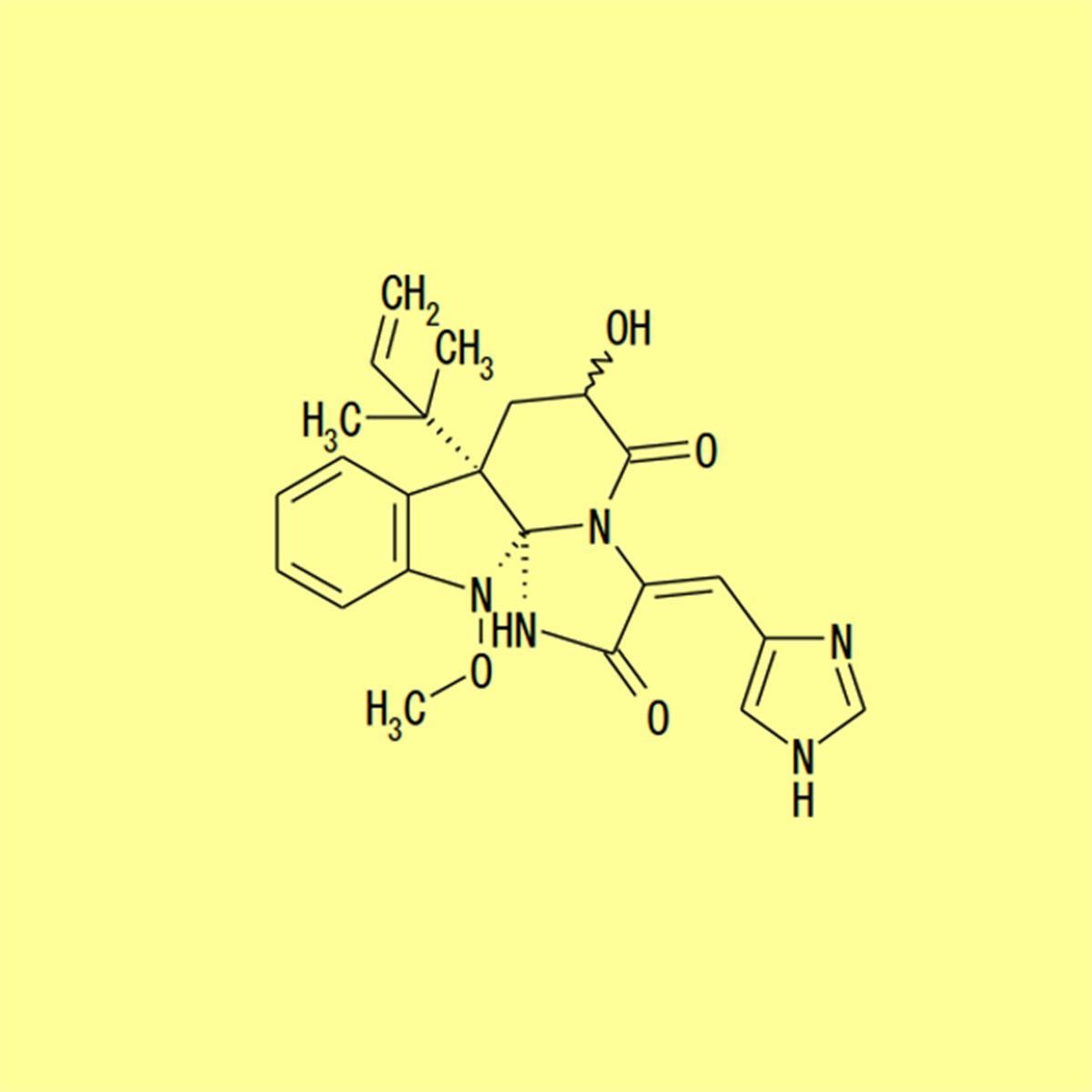
Neoxaline, 5mg
Product#: FNK-BLK-0530-5mg
$475.59
Availability:
Ships in 1-2 Weeks
Neoxaline (5mg)
Cat No: FNK-BLK-0530-5mg
Product ID and Size
| Cat No. | Description | Size | Link |
| FNK-BLK-0530-100μg | Neoxaline | 100μg |  |
| FNK-BLK-0530-1mg | Neoxaline | 1mg | |
| FNK-BLK-0530-5mg | Neoxaline | 5mg | |
Description
Neoxaline, which is alkaloide, was isolated from Aspergillus japonicus1) . Neoxaline is a antimitotic agent. Neoxaline show weak inhibitory activity of blood platelet aggregation induced by stimulation of the central nervous system2)
Origin: Aspergillus japonicus . Fg-551
CAS Registry Number: 71812-10-7
CA Index Name: 7a-(1,1-Dimethyl-2-propenyl)- 6,7,7a,12-tetrahydro-6-hydroxy-3- (1H-imidazol-4-ylmethylene)-12- methoxy-1H,5Himidazo[1',2':1,2]pyrido[2,3-b]indole2,5(3H)-dione
Appearance: white solid
Molecular Formula/ Weight: C23H25N5O4=435.48
Melting Point: 205℃ dec.
Purity: 98>% by HPLC
Solubility: Sol. MeOH, Chloroform, EtOAc Inso. Water, Hexane
Handling and Storage: Store at -20℃.
Relevance in Human Disease
There is no direct evidence or information in the provided search results linking neoxaline to any specific human disease. Neoxaline is described as a bio-active compound isolated from the fungus Aspergillus japonicus. It is known to be an antimitotic agent, meaning it can interfere with cell division, and it shows weak inhibitory activity on blood platelet aggregation. Additionally, neoxaline stimulates the central nervous system but does not possess antimicrobial properties
Potential Pathways Affected
While specific studies on neoxaline's effects are not detailed, it is reasonable to infer from its classification as an alkaloid that it might influence similar pathways:
- MAPK Pathway: This pathway is involved in regulating cell growth and survival. Alkaloids have been shown to modulate this pathway, potentially affecting cancer cell proliferation and resistance.
- Wnt Signaling Pathway: This pathway plays a critical role in cell proliferation and differentiation. It is known that modulation of the Wnt pathway can influence apoptotic processes in various cell types, including neurons and cardiomyocytes.
- PI3K/AKT/mTOR Pathway: This is a major signaling pathway involved in cell survival and growth. Many natural compounds, including alkaloids, can target this pathway to exert anticancer effects.
References
- A. Hirano, et. al., J Antibiot (Tokyo), 32, 781-785 (1979).
- S. Omura, et. al., Chemical screening Chap. 14 in The Search for bioactive compounds from microorganisms. pp. 269 (1992).
