
Native Loading Buffer [5X]
FluxMPS™ Native Loading Buffer [5X]
An MPS-grade, dual-stage filtered 5X native (non-denaturing) sample buffer for native PAGE and protein complex analysis. Formulated with Tris-HCl, glycerol, and bromophenol blue tracking dye, it preserves native protein conformation, oligomeric states, and protein-protein interactions without SDS or reducing agents. Diagnocine describes it as the world's cleanest buffer for all cell and molecular biology experiments.
- Dual-stage filtration: 1 µm membrane once and 0.45 µm membrane once, performed in a sterile environment
- Sterile, ultrapure formulation — the world's cleanest buffer for all cell and molecular biology experiments
- Non-denaturing: no SDS or reducing agents; preserves native conformation, oligomeric states, and protein-protein interactions
- pH 6.8, glycerol-based 5X native sample buffer with bromophenol blue tracking dye
- No detectable DNase or RNase activity after 18 hr incubation at room temperature
- Cat No. DCP-NLB5X · supplied at 20 mL
- Manufactured under ISO 13485-certified, CE-approved facilities; final QA and packaging at the DiagnoCine R&D and Quality Testing Center
- Custom pH, concentration, and additive formulations available on request
- pH6.8
- FormulationNon-denaturing, Tris-HCl based
- AppearanceBlue
- Filtration1 µm once + 0.45 µm once
- SterilitySterile-filtered in a sterile environment
- DNase ActivityNone detected (18 hr, RT)
- RNase ActivityNone detected (18 hr, RT)
- Storage4°C
- Shelf Life1 year
- Size20 mL
Engineered where standard native loading buffers fail
Conventional native loading buffers are often single-pass 0.22 µm filtered, leaving finer particulates and variable trace contaminants that can interfere with native protein complex integrity, nuclease-sensitive samples, and downstream detection. FluxMPS™ Native Loading Buffer [5X] is dual-stage filtered and QC-tested for nuclease activity to protect the native structure and interactions you are trying to preserve.
Dual-stage filtered purity
Sequential 1 µm and 0.45 µm membrane filtration, performed in a sterile environment, reduces particulate carryover into your native PAGE sample prep.
Precise, stable pH
Formulated at pH 6.8 with 250 mM Tris-HCl to support native protein conformation during sample loading and electrophoresis.
Ultrapure-grade water
Prepared with Ultrapure Type 1 water (18.2 MΩ·cm), aligned with USP <85>, for reagent-grade cleanliness in sensitive molecular biology work.
Low background for downstream detection
A clean, defined formulation with no SDS or reducing agents minimizes interference in downstream immunoblotting and native complex detection.
Defined, traceable composition
Tris-HCl, glycerol, and bromophenol blue are combined in a fixed, lot-controlled ratio for consistent sample loading and migration tracking.
Customization on demand
Alternate concentrations, additional chemicals, compounds, proteins, supplements, or a different pH can be formulated on request.
Dual-stage filtration system
Native Loading Buffer [5X] is filtered through a 1 µm membrane once and a 0.45 µm membrane once, with the second pass carried out in a sterile environment, to deliver a sterile, ultrapure buffer without introducing denaturing agents into the formulation.
-
1
1 µm Pre-filtration
Removes larger particulates and aggregates, protecting the downstream sterile filter and preserving buffer clarity.
-
2
0.45 µm Sterile-filtration — Final Polish
A 0.45 µm membrane pass performed in a sterile environment produces the final, ready-to-use sterile buffer.
Performance vs. conventional buffer
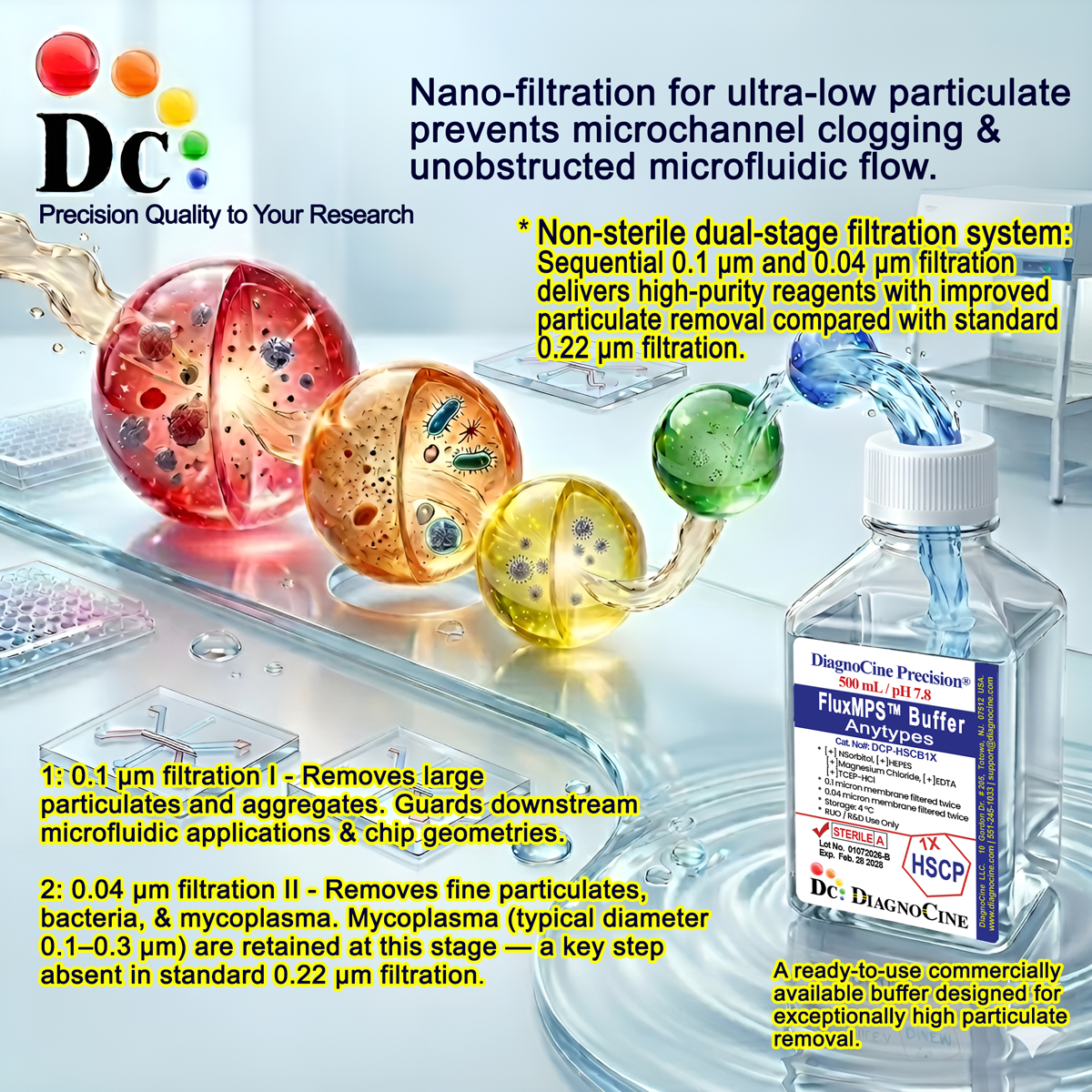
Sequential 1 µm and 0.45 µm membrane filtration, executed in a sterile environment, provides a cleaner starting buffer than a single-pass 0.22 µm filtration protocol, without adding denaturants that would compromise native protein structure.
© Diagnocine® — DCP-NLB5X
Where Native Loading Buffer [5X] is used
Native Loading Buffer [5X] prepares samples for native PAGE under non-denaturing conditions, allowing proteins to retain biological activity, oligomeric states, and protein-protein interactions for downstream analysis, and is positioned by Diagnocine as the world's cleanest buffer for all cell and molecular biology experiments.
Automated Bioreactors & Robotics
For labs integrating native sample preparation into automated liquid-handling or robotic platforms, an optional 0.01 µm (10 nm) ultra-filtered variant of this buffer can be produced to further reduce particulate load in automated dispensing systems.
- Total Particulate Exclusion for automated dispensing lines
- Valve & Sensor Protection in robotic liquid handlers
- Extended System Uptime for high-throughput native PAGE workflows
Inquiry Required: the 0.01 µm ultra-filtered grade is produced to order — contact support@diagnocine.com.
On-Chip Native Protein Analysis
Compatible with microfluidic and chip-based sample prep steps upstream of native protein complex analysis.
Native Sample Loading & Migration Tracking
Bromophenol blue tracking dye and glycerol density allow visual tracking of sample loading and migration during native electrophoresis.
iPSC-Derived Protein Complex Handling
Preserves native protein-protein interactions when analyzing lysates from iPSC-derived cell models.
Native Complex Analysis from Primary Cells
Supports native PAGE analysis of protein complexes extracted from endothelial and primary cell cultures.
Downstream Blotting & Detection
A clean, non-denaturing formulation minimizes interference in downstream immunoblotting following native PAGE separation.
Complex-Preserving Sample Handling
Non-denaturing sample handling supports downstream analysis of protein complexes relevant to imaging and biosensor workflows.
Specifications at a glance
Values below reflect the specifications published for Native Loading Buffer [5X], Cat No. DCP-NLB5X.
| Parameter | Specification |
|---|---|
| Formulation Type | Native (non-denaturing), Tris-HCl based |
| Appearance | Blue |
| pH | 6.8 |
| Parameter | Specification |
|---|---|
| Sterility | Filtered 1 µm membrane once and 0.45 µm membrane once in a sterile environment ISO 13485 |
| Water Quality | Ultrapure Type 1 water (18.2 MΩ·cm) USP <85> |
| DNase Activity | None detected (18 hr incubation with plasmid DNA, room temperature) |
| RNase Activity | None detected (18 hr incubation with ribosomal RNA, room temperature) |
| Parameter | Specification |
|---|---|
| Storage Temperature | 4°C |
| Shelf Life | 1 year |
| Parameter | Specification |
|---|---|
| Manufacturing QMS | ISO 13485-certified, CE-approved facilities (Suppliers of DiagnoCine Precision) |
| Traceability | Final packaging, QA, and testing at the DiagnoCine R&D and Quality Testing Center |
| Production Method | Custom assembly at DiagnoCine Precision, Totowa, New Jersey, USA |
| Intended Use | Research Use Only (RUO) |
Full composition
Native Loading Buffer [5X] is formulated from three lot-controlled components, listed below with concentrations exactly as released on the Certificate of Analysis.
| Component | CAS Number | Concentration |
|---|---|---|
| Tris-HCl | 1185-53-1 | 250 mM |
| Glycerol | 56-81-5 | 40% |
| Bromophenol Blue | 115-39-9 | 0.01% |
Manufacturing & compliance
Native Loading Buffer [5X] is produced under a documented quality management system with lot-level nuclease testing and dual-stage membrane filtration.
ISO 13485:2016 QMS
Manufactured under ISO 13485-certified and CE-approved facilities (Suppliers of DiagnoCine Precision).
Ultrapure Water Base
Formulated as a sterile, ultrapure buffer for cell and molecular biology-grade purity.
Dual-Stage Membrane Filtration
Sequential 1 µm and 0.45 µm membrane filtration, with the final pass performed in a sterile environment.
Micro-Batch Precision
Final packaging, QA, and testing performed at the DiagnoCine R&D and Quality Testing Center; custom assembly completed at DiagnoCine Precision, Totowa, New Jersey, USA.
DNase Activity Testing
None detected after incubation of plasmid DNA with this product for 18 hr at room temperature.
RNase Activity Testing
No RNase activity detected after incubation of ribosomal RNA with this product for 18 hr at room temperature.
pH Verification
Buffer pH confirmed at 6.8 prior to release.
Documentation / CoA
A Certificate of Analysis covering appearance, pH, filtration/sterility, and nuclease testing is available per lot.
How DCP-NLB5X compares
A structural comparison of filtration and quality attributes against conventionally filtered native loading buffers.
| Parameter | DCP-NLB5X (FluxMPS™) | Conventional Native Loading Buffer | Standard Alternative |
|---|---|---|---|
| Final filtration pore size | 0.45 µm | 0.22 µm | 0.22 µm |
| Number of filtration stages | 2 (1 µm + 0.45 µm) | 1 | 1 |
| Sterile-filtered in controlled environment | check_circle | cancel | cancel |
| DNase / RNase activity tested negative | check_circle | cancel | cancel |
| Non-denaturing (no SDS or reducing agents) | check_circle | check_circle | cancel |
| Manufacturing QMS (ISO 13485 / CE) | check_circle | cancel | cancel |
| Custom formulation available | check_circle | cancel | cancel |
Frequently asked questions
Common questions about Native Loading Buffer [5X], Cat No. DCP-NLB5X.
Supporting literature
Curated literature on native electrophoresis and buffer chemistry relevant to Native Loading Buffer [5X].
- Schagger H, von Jagow G. Blue native electrophoresis for isolation of membrane protein complexes in enzymatically active form. Anal Biochem. 1991. doi:10.1016/0003-2697(91)90094-A
- Wittig I, Braun HP, Schagger H. Blue native PAGE. Nat Protoc. 2006. doi:10.1038/nprot.2006.62
- Arndt C, Koristka S, Bartsch H, Bachmann M. Native polyacrylamide gels. Methods Mol Biol. 2012. doi:10.1007/978-1-61779-821-4_6
- Fountoulakis M, Takacs B. Effects of the acidic conditions of native gel electrophoresis on protein complexes. Amino Acids. 2001. doi:10.1007/s007260170047
- Good NE, Winget GD, Winter W, et al. Hydrogen ion buffers for biological research. Biochemistry. 1966. doi:10.1021/bi00866a011
- Ferreira GNM, Monteiro GA, Prazeres DMF, Cabral JMS. Downstream processing of plasmid DNA for gene therapy and DNA vaccine applications. Trends Biotechnol. 2000. doi:10.1016/S0167-7799(00)01470-3
- Sivars U, Bergfeldt K, Piculell L, Tjerneld F. Protein purification using thermoseparating aqueous two-phase systems. J Chromatogr B. 2000. doi:10.1016/S0378-4347(99)00568-6
- Junker BH. Scale-up methodologies for Escherichia coli and yeast fermentation processes. J Biosci Bioeng. 2004. doi:10.1263/jbb.97.347
- Bhattacharya S, Bhattacharyya D. Membrane-based sterile filtration in biopharmaceutical processing. Curr Opin Biotechnol. 2008. doi:10.1016/j.copbio.2008.10.001