

- Home
- FluxMPS™ Minimum Essential Medium (MEM), High Glucose, NEAA & 25mM HEPES w/o L-Glutamine, Sodium Bicarbonate, Phenol Red: 1X Liquid
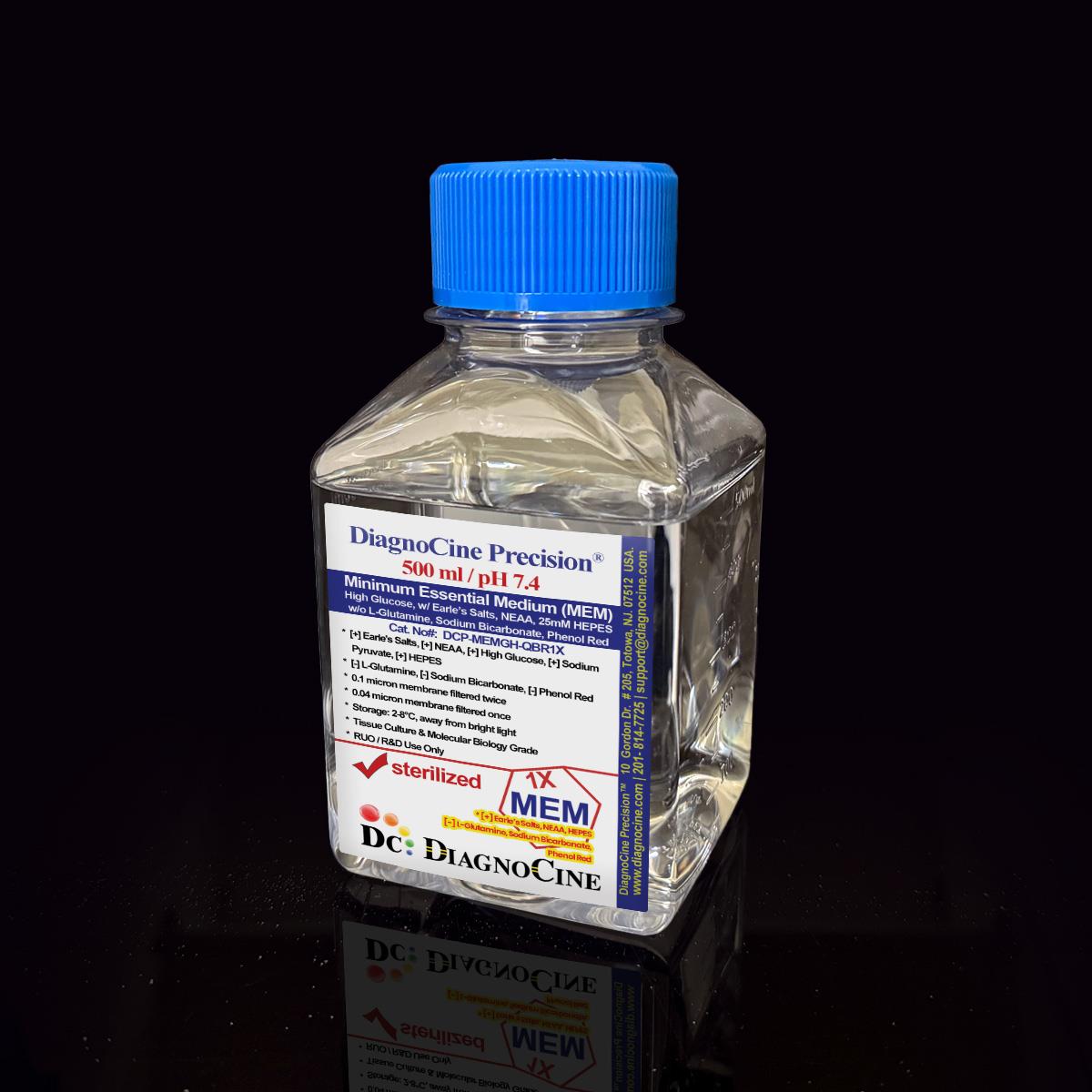
FluxMPS™ Minimum Essential Medium (MEM), High Glucose, NEAA & 25mM HEPES w/o L-Glutamine, Sodium Bicarbonate, Phenol Red: 1X Liquid
FluxMPS™ Minimum Essential Medium (MEM), High Glucose, NEAA & 25mM HEPES w/o L-Glutamine, Sodium Bicarbonate, Phenol Red: 1X Liquid
FluxMPS™ DCP-MEMGH-QBR1X is a Microfluidics Suitable, ultra-filtered MEM High Glucose + NEAA + 25mM HEPES formulation engineered for primary neurons and related primary cell models on organ-on-a-chip (OoC) and microphysiological system (MPS) platforms. A quadruple-stage train (0.1 µm ×2 + 0.04 µm ×2) reaches a 0.04 µm final cut-off, five times finer than the 0.22 µm membranes used for conventional sterile filtration. NEAA is pre-loaded to reduce metabolic burden on primary cells, and 25 mM HEPES (pKa 7.3 at 37°C) provides CO2-independent pH buffering. Formulation: [+] Earle's Salts (Calcium, Magnesium), [+] NEAA, [+] High Glucose (4500 mg/L), [+] Sodium Pyruvate, [+] 25mM HEPES | [-] L-Glutamine, [-] Sodium Bicarbonate, [-] Phenol Red.
- High Glucose (4.5 g/L) supports energy-demanding primary cell types.
- NEAA pre-loaded — reduces metabolic burden and ammonia accumulation from de novo amino acid synthesis.
- 25 mM HEPES (pKa 7.3 at 37°C) — pH-stable without CO2; suited to open-air handling, flow cytometry prep, and atmospheric incubation.
- 0.04 µm final nano-filtration — sub-mycoplasma polishing; < 0.05 EU/mL endotoxin release specification for sensitive primary and hematopoietic cell cultures.
- Quadruple-stage filtration train: 0.1 µm Prefiltration I → 0.04 µm Final filtration I → 0.1 µm Prefiltration II → 0.04 µm Final filtration II.
- Ultrapure Type 1 water (18.2 MΩ·cm), ISO 13485:2016 QMS, ISO Class 5 fill & finish.
- Formulated without L-Glutamine, Sodium Bicarbonate, or Phenol Red — researcher-defined nitrogen source and imaging-clean, autofluorescence-reduced base.
- Media familyMEM High Glucose + NEAA + 25mM HEPES
- Glucose4500 mg/L (4.5 g/L, High Glucose)
- HEPES25 mM (5958 mg/L), pKa 7.3 at 37°C
- NEAAPresent
- Formulation[+] Earle's Salts (Ca, Mg), [+] NEAA, [+] High Glucose, [+] Sodium Pyruvate, [+] 25mM HEPES
[-] L-Glutamine, [-] Sodium Bicarbonate, [-] Phenol Red - AppearancePale yellow, clear solution
- pH (USP <791>)7.4
- Osmolality (USP <785>)235–275 mOsm/kg H2O
- Endotoxin (USP <85>)< 0.05 EU/mL
- Filtration0.1 µm ×2 + 0.04 µm ×2
Engineered for primary cell culture where standard media fails
MEM with Earle's Salts is the primary cell biologist's medium — but conventional 0.22 µm filtered MEM passes mycoplasma, subvisible particulates, and endotoxin that can alter primary cell phenotype. FluxMPS™ addresses these failure modes through validated filtration while preserving the full nutritional profile primary cells depend on.
Microchannel-safe purity
0.04 µm final filtration; USP <788> particulate compliance. Low-particulate primary cell media helps prevent chip channel clogging.
Primary cell–optimized formulation
MEM + Earle's Salts + NEAA: the established base for primary fibroblasts, neurons, epithelial, and vascular cells.
HEPES: CO2-stable pH
25 mM HEPES helps prevent pH drift during open-air suspension handling, flow cytometry prep, and multi-well assay setup outside CO2 incubators.
Low-endotoxin release specification
< 0.05 EU/mL endotoxin release specification, tested by LAL assay every batch. Endotoxin is a known TLR4 agonist; a low release specification helps reduce the risk of LPS-driven fibroblast activation, neuroinflammatory signaling, and epithelial barrier disruption in primary cell assays.
NEAA reduces metabolic burden
Pre-loaded NEAA reduces the de novo synthesis burden on primary cells, supporting viability in low-serum conditions and reducing ammonia accumulation.
Customization on demand
pH, glucose, HEPES concentration, and component modifications available. Contact support@diagnocine.com.
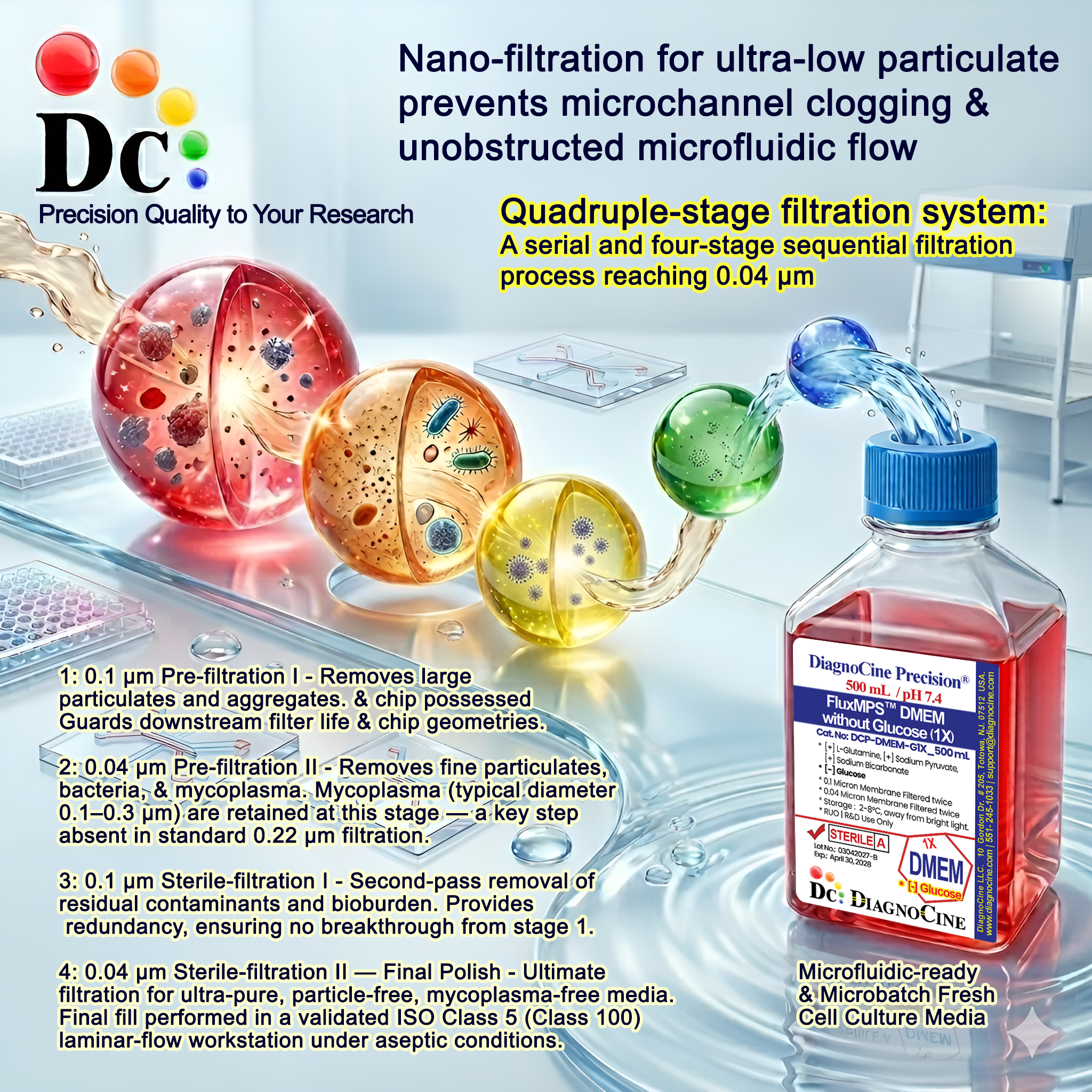
Quadruple-stage filtration system
Four serial filtration passes reaching a final 0.04 µm polish under ISO Class 5 aseptic fill conditions. The train is a repeated prefilter-plus-final-filter pair, run twice: each 0.04 µm final filter has its own dedicated 0.1 µm prefilter.
-
1
0.1 µm Prefiltration I — Large Particulate Removal
Removes large aggregates and cell debris; protects the first 0.04 µm cartridge.
-
2
0.04 µm Final filtration I
First 0.04 µm pass; retains sub-micron particulates and microaggregates that pass a standard 0.22 µm filter.
-
3
0.1 µm Prefiltration II
Second dedicated prefilter, protecting the second 0.04 µm cartridge; mycoplasma-retentive grade (validated with A. laidlawii).
-
4
0.04 µm Final filtration II — Polish
Ultimate sub-mycoplasma polishing filter; ISO Class 5 aseptic fill & finish.
Performance vs. conventional media
© Diagnocine® — DCP-MEMGH-QBR1X
Primary cell models and OoC applications
FluxMPS™ DCP-MEMGH-QBR1X is purpose-built for primary neurons and related primary cell models, with 0.04 µm filtration purity for microfluidic platform compatibility.
Automated Bioreactors & Robotics
An optional 0.01 µm (10 nm) MPS Grade ultra nano-filtered variant of this formulation is available on request for automated bioreactor and robotic handling systems.
- Total Particulate Exclusion: 0.01 µm filtration removes nanoparticulate aggregates below the 0.04 µm cut-off.
- Valve & Sensor Protection: Reduces micro-fouling risk in delicate chip geometries.
- Extended Perfusion Stability: Supports consistent nutrient delivery over long-duration culture.
Inquiry Required: Contact support@diagnocine.com for the 0.01 µm MPS Grade variant.
Neuronal Chips & Brain-on-Chip
MEM + Earle's Salts + NEAA is a widely used base for primary cortical neurons, DRG neurons, and iPSC-derived neuronal networks in compartmentalized chips.
Epithelium-on-Chip
MEM with NEAA supports primary epithelial cells and their barrier integrity in transwell and microfluidic TEER-monitored platforms.
Primary Fibroblast & Stromal Models
MEM with NEAA is a classical base for primary dermal, lung, and cardiac fibroblasts in low-serum or serum-free OoC conditions.
Vascular Cell Culture
Earle's salt ionic balance supports vascular smooth muscle cells and primary endothelial co-culture models on vascular-on-chip platforms.
Organ-on-a-Chip & MPS
0.04 µm filtered MEM helps prevent particulate clogging in sub-100 µm neuronal and epithelial chip microchannels.
Microscopy & Optical Sensing
This ultra-low particulate, phenol red–free formulation reduces phenol red–derived optical interference, benefiting confocal imaging, TEER sensor readings, and biosensor applications on primary cell chips.
Analytical release specifications
Every lot released against the full specification matrix below. CoA: support@diagnocine.com.
| Parameter | Specification |
|---|---|
| Formulation | [+] Earle's Salts (Ca, Mg), [+] NEAA, [+] High Glucose (4500 mg/L), [+] Sodium Pyruvate, [+] 25mM HEPES | [-] L-Glutamine, [-] Sodium Bicarbonate, [-] Phenol Red |
| Appearance | Pale yellow, clear solution |
| Glucose | 4500 mg/L (4.5 g/L, High Glucose) |
| HEPES | 25 mM (5958 mg/L), pKa 7.3 at 37°C |
| NEAA | Present |
| pH USP <791> | 7.4 |
| Osmolality USP <785> | 235–275 mOsm/kg H2O |
| Total ingredients | 35 |
| Parameter | Specification |
|---|---|
| Endotoxin USP <85> BET | < 0.05 EU/mL (batch release specification) |
| Sterility USP <71> | No growth / 14 days |
| Mycoplasma | 0.1 µm mycoplasma-retentive filtration (not tested per lot) |
| Particulate ≥10 µm USP <788> Method 1 | NMT 25/mL |
| Particulate ≥25 µm USP <788> Method 1 | NMT 3/mL |
| Water purity | Type 1, 18.2 MΩ·cm |
| Manufacturing std. | ISO 13485:2016 |
| Fill environment | ISO Class 5 (Class 100) |
| Parameter | Specification |
|---|---|
| Storage temperature | 2–8°C, away from light |
| Freeze-thaw | Do not freeze |
| Shelf life | 12 months from date of manufacture, unopened |
| Shipping condition | Cold pack |
| CO2 requirement | CO2-independent — 25 mM HEPES (pKa 7.3 at 37°C) maintains pH 7.4 without gas supplementation |
| Parameter | Specification |
|---|---|
| Raw material grade | Reagent / cell culture grade |
| Traceability | Full lot traceability per ISO 13485 |
| Manufacturing QMS ISO | ISO 13485:2016 certified |
| UNSPSC | 41116155 — Molecular biology and cell culture growth media (UNv260801) |
| Regulatory alignment | 21 CFR Part 820 (QMSR) aligned |
| Production method | Micro-batch, per-lot QC release |
| Intended use | Research Use Only (RUO) |
Full composition (mg/L)
MEM High Glucose + NEAA + 25mM HEPES: 35 ingredients verified per lot with CAS numbers. NEAA components are listed under AMINO ACIDS. HEPES (25 mM = 5958 mg/L, CAS 7365-45-9) is listed under OTHERS.
| Component | CAS Number | mg/L |
|---|---|---|
| INORGANIC SALTS | ||
| Calcium chloride dihydrate | 10035-04-8 | 265.000 |
| Magnesium sulfate anhydrous | 7487-88-9 | 97.720 |
| Potassium chloride | 7447-40-7 | 400.000 |
| Sodium chloride | 7647-14-5 | 6800.000 |
| Sodium dihydrogen phosphate anhydrous | 7558-80-7 | 122.000 |
| Component | CAS Number | mg/L |
|---|---|---|
| AMINO ACIDS | ||
| Glycine | 56-40-6 | 7.500 |
| L-Alanine | 56-41-7 | 8.900 |
| L-Arginine hydrochloride | 1119-34-2 | 126.000 |
| L-Asparagine monohydrate | 5794-13-8 | 15.000 |
| L-Aspartic acid | 56-84-8 | 13.300 |
| L-Cystine dihydrochloride | 30925-07-6 | 31.300 |
| L-Glutamic acid | 56-86-0 | 14.700 |
| L-Histidine hydrochloride monohydrate | 5934-29-2 | 42.000 |
| L-Isoleucine | 73-32-5 | 52.000 |
| L-Leucine | 61-90-5 | 52.000 |
| L-Lysine hydrochloride | 657-27-2 | 72.500 |
| L-Methionine | 63-68-3 | 15.000 |
| L-Phenylalanine | 63-91-2 | 32.000 |
| L-Proline | 147-85-3 | 11.500 |
| L-Serine | 56-45-1 | 10.500 |
| L-Threonine | 72-19-5 | 48.000 |
| L-Tryptophan | 73-22-3 | 10.000 |
| L-Tyrosine disodium salt dihydrate | 69847-15-0 | 51.900 |
| L-Valine | 72-18-4 | 46.000 |
| Component | CAS Number | mg/L |
|---|---|---|
| VITAMINS | ||
| Choline chloride | 67-48-1 | 1.000 |
| D-Ca-Pantothenate | 137-08-6 | 1.000 |
| Folic acid | 59-30-3 | 1.000 |
| Nicotinamide | 98-92-0 | 1.000 |
| Pyridoxal hydrochloride | 65-22-5 | 1.000 |
| Riboflavin | 83-88-5 | 0.100 |
| Thiamine hydrochloride | 67-03-8 | 1.000 |
| i-Inositol | 87-89-8 | 2.000 |
| OTHERS | ||
| D-Glucose | 50-99-7 | 4500.000 |
| HEPES | 7365-45-9 | 5958.000 |
| Sodium Pyruvate | 113-24-6 | 110.000 |
Manufacturing & compliance
Every FluxMPS™ product is manufactured and released under a multi-layer quality system.
ISO 13485:2016 Quality Management
Manufactured under ISO 13485:2016–certified facilities. Final QA at Diagnocine R&D Center, Totowa, NJ, USA.
Ultrapure Type 1 Water
18.2 MΩ·cm feedwater, controlled for trace metals and organic carbon.
ISO Class 5 Fill & Finish
Aseptic fill in validated ISO Class 5 (Class 100) laminar-flow workstations.
Micro-Batch Precision
Small-batch, per-lot tested — no blending; Certificate of Analysis issued for every lot.
Endotoxin — USP <85> BET
LAL assay; release specification < 0.05 EU/mL per batch.
Particulate — USP <788> Method 1
NMT 25/mL (≥10 µm), NMT 3/mL (≥25 µm), light obscuration.
Osmolality — USP <785>
Target: 235–275 mOsm/kg H2O.
Documentation & CoA
Full CoA with raw-material traceability available for every lot on request.
- Endotoxin — LAL assay, USP <85> Bacterial Endotoxins Test; assay sensitivity 0.005 EU/mL; release specification < 0.05 EU/mL
- pH, osmolality, conductivity, appearance and clarity
- Sterility
How DCP-MEMGH-QBR1X compares
FluxMPS™ DCP-MEMGH-QBR1X vs. conventional 0.22 µm–filtered MEM High Glucose + NEAA formulations.
| Parameter | DCP-MEMGH-QBR1X (FluxMPS™) | Conventional MEM High Glucose (0.22 µm filtered) | Standard DMEM (0.22 µm) |
|---|---|---|---|
| Grade | Microfluidics Suitable (0.04 µm final cut-off) | Not specified | Not specified |
| MEM High Glucose + NEAA + HEPES-only, CO2-free — no L-Glutamine, no Phenol Red; imaging-clean, atmospheric handling | check_circle Yes | cancel No | cancel No |
| Final filtration pore size | 0.04 µm | 0.22 µm | 0.22 µm |
| Number of filtration stages | 4 (Quadruple) | 1 | 1 |
| Mycoplasma-retentive filtration (0.1 µm) | check_circle Yes | cancel No | cancel No |
| Endotoxin (release specification) | FluxMPS™ — < 0.05 EU/mL | Corning classical liquid media — < 0.25 EU/mL Sigma-Aldrich DMEM complete medium — ≤ 2 EU/mL Gibco classical DMEM — Not specified (recorded per lot) |
|
| HEPES (25 mM) included | check_circle Yes | cancel Usually no | cancel No |
| NEAA included | check_circle Yes | Optional add-on | cancel No |
| USP <788> particulate tested | check_circle Yes | cancel No | cancel No |
| Water quality | Type 1, 18.2 MΩ·cm | Purified water | Purified water |
| Manufacturing QMS | ISO 13485:2016 | ISO 9001 or none | ISO 9001 or none |
| Microfluidic channel compatible | check_circle Microfluidics Suitable | cancel Risk of clogging | cancel Risk of clogging |
| Custom formulation available | check_circle Yes | cancel No | cancel No |
Comparison figures from published supplier specifications, accessed 2026-09-02. Suppliers that publish no numeric endotoxin specification are shown as "Not specified".
Frequently asked questions
Common questions about FluxMPS™ DCP-MEMGH-QBR1X.
Supporting literature
Key publications supporting MEM High Glucose + NEAA + 25mM HEPES in primary cell and OoC applications.
- Eagle H. Amino acid metabolism in mammalian cell cultures. Science. 1959;130:432–437. doi:10.1126/science.130.3373.432
- Huh D, et al. Reconstituting organ-level lung functions on a chip. Science. 2010;328:1662–1668. doi:10.1126/science.1188302
- Bhatia SN, Ingber DE. Microfluidic organs-on-chips. Nat Biotechnol. 2014;32:760–772. doi:10.1038/nbt.2989
- Novak R, et al. Robotic fluidic coupling and interrogation of multiple vascularized organ chips. Nat Biomed Eng. 2020;4:407–420. doi:10.1038/s41551-019-0497-x
- Campisi M, et al. 3D self-organized microvascular model of the human blood-brain barrier. Biomaterials. 2018;180:117–129. doi:10.1016/j.biomaterials.2018.07.014
- Jang KJ, et al. Human kidney proximal tubule-on-a-chip. Integr Biol. 2013;5:1119–1129. doi:10.1039/c3ib40049b
- Schimek K, et al. Integrating biological vasculature into a multi-organ-chip microsystem. Lab Chip. 2013;13:3588–3598. doi:10.1039/c3lc50217a
- Luni C, et al. High-efficiency cellular reprogramming with microfluidics. Nat Methods. 2016;13:446–452. doi:10.1038/nmeth.3832
- Sung JH, et al. Microfabricated mammalian organ systems. Lab Chip. 2013;13:1201–1212. doi:10.1039/c3lc41017j