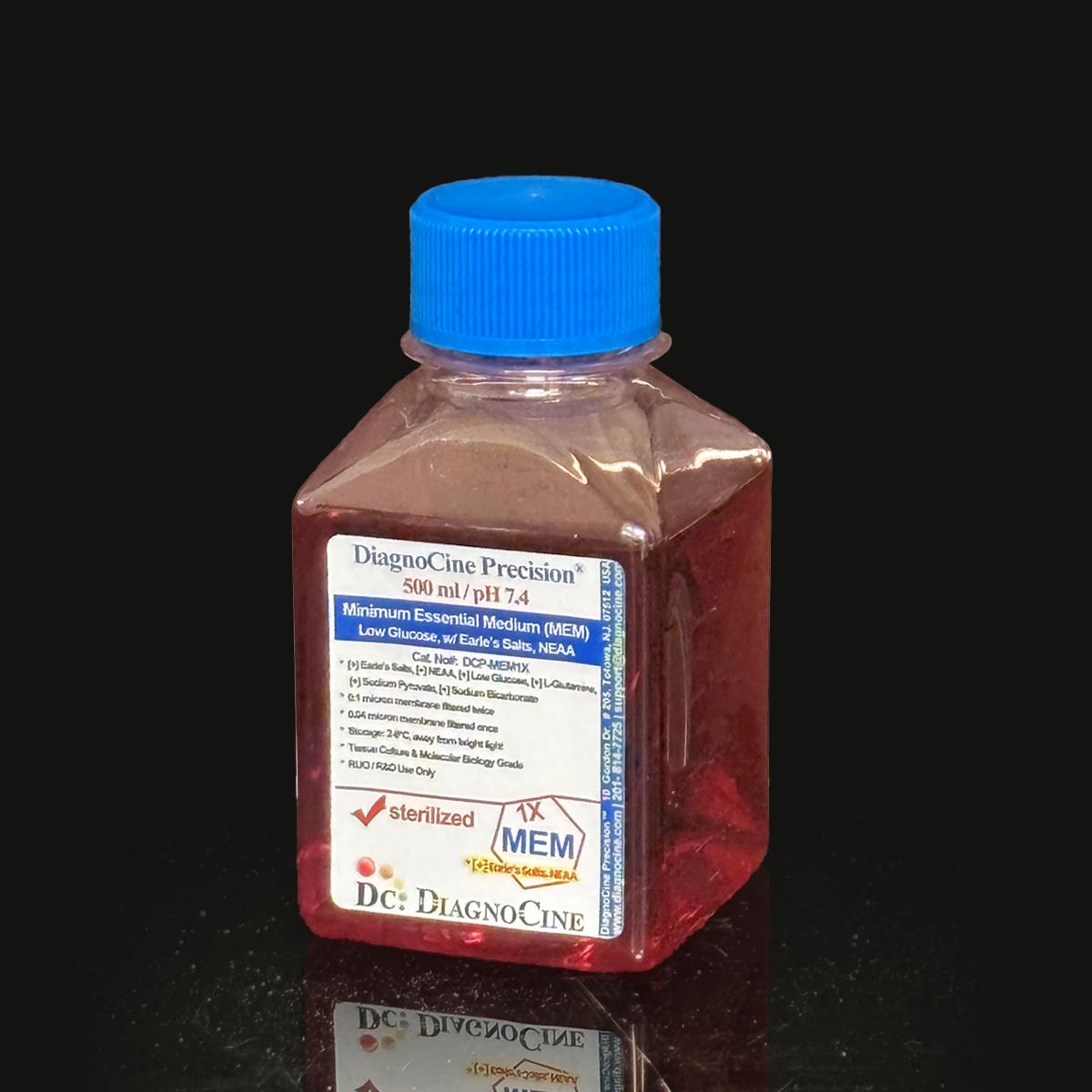
FluxMPS™ Minimum Essential Medium Eagle (MEM) w/ Earle's salts, NEAA: 1X Liquid
FluxMPS™ Minimum Essential Medium Eagle (MEM) w/ Earle's Salts, NEAA, 1X Liquid
FluxMPS™ MEM with Earle's Salts and Non-Essential Amino Acids (NEAA) is a Microfluidics Suitable, ultra-filtered 1X liquid cell culture medium engineered for microphysiological systems (MPS), organ-on-a-chip (OoC), and microfluidic tissue models. Processed through a Quadruple-stage filtration system (0.1 µm ×2 + 0.04 µm ×2) reaching a 0.04 µm final cut-off — five times finer than the 0.22 µm membranes used for conventional filtration — it is released at an endotoxin specification of less than 0.05 EU/mL with sub-mycoplasma-range final filtration for microchannel-safe performance.
- Quadruple-stage filtration train: 0.1 µm prefilter → 0.04 µm final filter → 0.1 µm prefilter → 0.04 µm final filter, reaching a 0.04 µm final cut-off
- Endotoxin release specification: less than 0.05 EU/mL, verified by LAL assay per USP <85>
- Earle's balanced salt formulation with a complete Non-Essential Amino Acid supplement (Gly, L-Ala, L-Asn, L-Asp, L-Glu, L-Pro, L-Ser) for broader cell line support
- Sodium bicarbonate-buffered (2,200 mg/L) with phenol red pH indicator; formulated for a standard 5% CO2 incubator atmosphere
- Manufactured under an ISO 13485:2016 quality management system with a per-batch Certificate of Analysis
- Glucose (1,000 mg/L) and sodium pyruvate (110 mg/L) included for standard monolayer and 3D culture energy metabolism
- pH, sodium bicarbonate level, glucose concentration, HEPES buffering, and NEAA composition available on request
- FormulationL-Glutamine [+] Sodium Bicarbonate [+] Phenol Red [+] Calcium [+] Magnesium [+] Glucose [+] Sodium Pyruvate
- L-Glutamine2 mM (292 mg/L)
- pH (USP <791>)7.4
- Osmolality (USP <785>)~310 ± 15 mOsm/kg
- Endotoxin< 0.05 EU/mL (USP <85>)
- Filtration System0.1 µm ×2 + 0.04 µm ×2 (Quadruple-stage)
- GradeMicrofluidics Suitable (0.04 µm final cut-off)
- Storage2–8°C, protected from light
- Shelf Life12 months from date of manufacture, unopened
- Shipping ConditionCold pack (2–8°C)
Engineered where standard MEM fails
Conventional 0.22 µm-filtered MEM retains subvisible particles, mycoplasma-range contaminants, and endotoxin fragments that can compromise organ-on-a-chip sensors, clog microfluidic channels, and add background to metabolic assay signals. FluxMPS™ MEM with Earle's Salts and NEAA is built against these failure modes with a validated four-stage filtration architecture, delivering a microchannel-safe, ultra-clean medium.[1,2]
Microchannel-Safe Purity
0.04 µm final filtration retains sub-micron particulates and mycoplasma-range organisms, supporting channel patency and USP <788> particulate testing on every lot.
Broadened Cell Line Utility
Earle's balanced salts plus a complete NEAA panel (Gly, L-Ala, L-Asn, L-Asp, L-Glu, L-Pro, L-Ser) support demanding adherent cell lines — HeLa, Vero, MRC-5, BHK-21 — without supplementation lag.
Ultrapure-Grade Water
Formulated with Ultrapure Type 1 water at 18.2 MΩ·cm, controlling trace metals and organic carbon (TOC) for sensitive electrophysiology and biosensor applications.[3]
Low Background for Imaging
Ultra-low particulate baseline supports confocal microscopy, TEER, and optical biosensor measurements with reduced interference from media-derived particulates.
Rich, Stable Nutrient Profile
20-amino-acid formulation (13 essential + 7 non-essential) manufactured in micro-batch format to maximize lot-to-lot consistency and nutrient stability throughout the 12-month shelf life.
Customization on Demand
pH, sodium bicarbonate concentration, HEPES buffering, NEAA composition, calcium, and L-glutamine levels are all adjustable for suspension cultures, low-serum protocols, and specialized OoC designs.
Quadruple-stage filtration system
FluxMPS™ MEM with Earle's Salts and NEAA is filtered through a validated four-stage cascade reaching a 0.04 µm final pore size, engineered for microchannel-safe performance in MPS, organ-on-a-chip, and precision microfluidic perfusion systems.
-
1
0.1 µmPrefiltration I
Removes gross aggregates, large particles, and precipitates that would rapidly blind downstream nano-filters, extending cascade filter life and maximizing throughput.
-
2
0.04 µmFinal filtration I
First 0.04 µm pass; retains fine particulates and mycoplasma-range organisms (0.2–0.3 µm diameter) that a 0.22 µm filter would not capture.
-
3
0.1 µmPrefiltration II
A second, dedicated 0.1 µm prefilter protects the second 0.04 µm cartridge, preserving flow and filtration integrity through the final polish.
-
4
0.04 µmFinal filtration II — Polish
Ultimate 0.04 µm polishing filter immediately before aseptic fill & finish, delivering the lowest achievable particulate count for microfluidic channel safety.
Purity architecture vs. conventional MEM media
A quadruple-stage train (0.1 µm ×2 + 0.04 µm ×2) reaches a 0.04 µm final cut-off, five times finer than the 0.22 µm membranes used for conventional sterile filtration. This finer cut-off is designed to reduce channel-clogging events and support more reliable TEER measurements and live-cell imaging in microfluidic systems.
than conventional 0.22 µm
filtration membranes
(0.1 µm ×2 + 0.04 µm ×2)
per lot, USP <788> tested

© Diagnocine® — DCP-MEM1X
Designed for the most demanding cell culture systems
FluxMPS™ MEM with Earle's Salts and NEAA supports a broad spectrum of research applications, from classical monolayer culture of HeLa and Vero cells to advanced organ-on-a-chip perfusion, iPSC-derived multi-lineage co-cultures, and biosensor-integrated systems. Its ultra-clean purity architecture makes it well suited wherever conventional MEM introduces particle noise or mycoplasma risk.[4,5]
Automated Bioreactors & Robotics
For high-throughput automated perfusion bioreactors and liquid-handling robotics, an optional 0.01 µm (10 nm) ultra-filtered MPS Grade variant of FluxMPS™ MEM with Earle's Salts and NEAA is available. This next-tier grade is engineered for precision perfusion systems where valve and sensor longevity are paramount.
- Total Particulate Exclusion: 10 nm filtration removes nano-aggregates that elude 0.04 µm filters, protecting microvalves and pressure transducers.
- Valve & Sensor Protection: Reduces particle accumulation on solenoid valve seats and optical flow sensors, extending maintenance intervals in continuous-perfusion rigs.
- Extended Perfusion Stability: Reduced bioburden and particulate load support multi-week uninterrupted perfusion runs in closed-loop bioreactor systems.
Inquiry Required: The 0.01 µm (10 nm) MPS Grade variant is a custom/bulk order configuration. Contact support@diagnocine.com to request this grade for your automated system.
Micro Physiological System (MPS) & Chip
Ultra-clean MEM purity is designed to reduce microchannel clogging and signal interference in multi-organ MPS platforms, OoC devices, and microfluidic tissue chips requiring uninterrupted laminar flow.
Tumor Cell Culture & Metabolic Research
Supports HeLa, MCF-7, A549, and MDA-MB-231 monolayer and 3D spheroid culture; NEAA supplementation reduces biosynthetic burden in proliferation and drug-response assays.
Vero & Primary Cell Propagation
Classical MEM backbone suited to Vero cell-based viral propagation, BHK-21 vaccine manufacturing research, and MRC-5 primary fibroblast maintenance requiring Earle's salt balance.
iPSC-Derived Multi-Lineage Models
MEM with NEAA provides the non-essential amino acid baseline for iPSC-derived neuronal, cardiomyocyte, and hepatocyte models in MPS platforms requiring defined nutrient control.
Microscopy & Optical Sensing
Ultra-low particulate background supports confocal microscopy, TEER measurements, and optical biosensor integration in microfluidic culture systems.[6]
Calcium-Free Modified Cultures
MEM can be further modified by removing calcium to facilitate growth of cells in suspension culture, supported by Diagnocine custom formulation services on request.
Complete specification matrix
All parameters are validated per batch prior to release. Certificate of Analysis (CoA) available upon request at support@diagnocine.com.
| Parameter | Specification |
|---|---|
| Formulation | Earle's Salts + NEAA base; L-Glutamine [+] Sodium Bicarbonate [+] Phenol Red [+] Calcium [+] Magnesium [+] Glucose [+] Sodium Pyruvate |
| Appearance | Orangish-red, clear solution |
| pH USP <791> | 7.4 |
| Osmolality USP <785> | ~310 ± 15 mOsm/kg |
| Glucose | 1,000 mg/L (5.56 mM) |
| L-Glutamine | 2 mM (292 mg/L) |
| Sodium Pyruvate | Present (110 mg/L) |
| Phenol Red | Present (11 mg/L) |
| Parameter | Specification |
|---|---|
| Endotoxin USP <85> BET | < 0.05 EU/mL |
| Sterility USP <71> | No growth at 14 days |
| Mycoplasma | 0.1 µm mycoplasma-retentive filtration (not tested per lot) |
| Particulate ≥10 µm USP <788> Method 1 | < 6,000 particles/container |
| Particulate ≥25 µm USP <788> Method 1 | < 600 particles/container |
| Water Purity | Ultrapure Type 1, 18.2 MΩ·cm |
| Manufacturing Std. | ISO 13485:2016 QMS |
| Fill Environment | ISO Class 5 (Class 100) cleanroom |
| Parameter | Specification |
|---|---|
| Storage Temperature | 2–8°C, protected from light |
| Freeze-Thaw | Do not freeze |
| Shelf Life | 12 months from date of manufacture, unopened |
| Shipping Condition | Cold pack (2–8°C) |
| CO2 Requirement | 5% CO2 / 95% air incubation required (sodium bicarbonate-buffered) |
| Parameter | Specification |
|---|---|
| Raw Material Grade | Cell culture / reagent grade, USP / EP reference |
| Traceability | Full lot-level CoA with raw material traceability |
| Manufacturing QMS ISO 13485 | ISO 13485:2016 certified |
| UNSPSC | 41116155 — Molecular biology and cell culture growth media (UNv260801) |
| Regulatory Alignment | 21 CFR Part 820 (QMSR) aligned |
| Production Method | Micro-batch, ISO Class 5 aseptic fill |
| Intended Use | For Research Use Only (RUO) |
Full composition (mg/L)
MEM with Earle's Salts and NEAA: 37 ingredients verified per lot with CAS numbers. The AMINO ACIDS tab includes both essential amino acids (EAA) and Non-Essential Amino Acids (NEAA) as one combined group per the source composition table.
| Component | CAS Number | mg/L |
|---|---|---|
| INORGANIC SALTS | ||
| Calcium Chloride (CaCl2·2H2O) | 10035-04-8 | 265.000 |
| Magnesium Sulfate (MgSO4, anhydrous) | 7487-88-9 | 97.72 |
| Potassium Chloride (KCl) | 7447-40-7 | 400.0 |
| Sodium Bicarbonate (NaHCO3) | 144-55-8 | 2200.0 |
| Sodium Chloride (NaCl) | 7647-14-5 | 6800.0 |
| Sodium Phosphate Monobasic (NaH2PO4·H2O) | 10049-21-5 | 122.0 |
| Component | CAS Number | mg/L |
|---|---|---|
| AMINO ACIDS | ||
| Glycine | 56-40-6 | 7.500 |
| L-Alanine | 56-41-7 | 8.900 |
| L-Arginine hydrochloride | 1119-34-2 | 126.000 |
| L-Asparagine monohydrate | 5794-13-8 | 15.000 |
| L-Aspartic acid | 56-84-8 | 13.300 |
| L-Cystine dihydrochloride | 30925-07-6 | 31.300 |
| L-Glutamic acid | 56-86-0 | 14.700 |
| L-Glutamine | 56-85-9 | 292.0 |
| L-Histidine hydrochloride monohydrate | 5934-29-2 | 42.000 |
| L-Isoleucine | 73-32-5 | 52.000 |
| L-Leucine | 61-90-5 | 52.000 |
| L-Lysine hydrochloride | 657-27-2 | 72.500 |
| L-Methionine | 63-68-3 | 15.000 |
| L-Phenylalanine | 63-91-2 | 32.000 |
| L-Proline | 147-85-3 | 11.500 |
| L-Serine | 56-45-1 | 10.500 |
| L-Threonine | 72-19-5 | 48.000 |
| L-Tryptophan | 73-22-3 | 10.000 |
| L-Tyrosine disodium salt dihydrate | 69847-15-0 | 51.900 |
| L-Valine | 72-18-4 | 46.000 |
| Component | CAS Number | mg/L |
|---|---|---|
| VITAMINS | ||
| Choline chloride | 67-48-1 | 1.000 |
| D-Ca-Pantothenate | 137-08-6 | 1.000 |
| Folic acid | 59-30-3 | 1.000 |
| Nicotinamide | 98-92-0 | 1.000 |
| Pyridoxal hydrochloride | 65-22-5 | 1.000 |
| Riboflavin | 83-88-5 | 0.100 |
| Thiamine hydrochloride | 67-03-8 | 1.000 |
| OTHERS | ||
| i-Inositol | 87-89-8 | 2.000 |
| D-Glucose | 50-99-7 | 1000.000 |
| Phenol red sodium salt | 34487-61-1 | 11.000 |
| Sodium pyruvate | 113-24-6 | 110.000 |
Manufacturing & compliance standards
Every batch of FluxMPS™ MEM with Earle's Salts and NEAA is manufactured and released under a fully validated ISO 13485:2016 quality management system, with documented micro-batch traceability from raw material receipt through final fill & finish.
ISO 13485:2016 Quality Management System
Full-scope QMS covering design control, risk management, supplier qualification, in-process control, and post-market surveillance for every batch of FluxMPS™ media.
Ultrapure Type 1 Water (18.2 MΩ·cm)
All media are formulated with freshly produced Ultrapure Type 1 water at 18.2 MΩ·cm, controlling trace metals and organic carbon (TOC) in the feed water used for formulation.
ISO Class 5 Fill & Finish
Aseptic fill performed in a validated ISO Class 5 (Class 100) unidirectional-flow cleanroom, minimizing bioburden and particulate load prior to final 0.04 µm filtration.
Micro-Batch Precision
Small-batch manufacturing maximizes lot-to-lot consistency, supports tight pH and osmolality windows, and allows custom formulation turnaround for research-specific requirements.
Endotoxin — USP <85> BET
LAL assay performed on every batch prior to release. Release specification: < 0.05 EU/mL. Results are documented in the batch Certificate of Analysis.
Particulate — USP <788> Method 1
Light obscuration particle counting at ≥10 µm and ≥25 µm thresholds is performed per USP <788> Method 1 to confirm compliance with the release specification.
Osmolality — USP <785>
Freezing-point depression osmometry performed per batch. Target: ~310 ± 15 mOsm/kg for physiological relevance in mammalian cell culture.
Documentation — Certificate of Analysis
Full CoA issued per batch including pH, osmolality, endotoxin, sterility, mycoplasma control, and particulate data. Available by request to support@diagnocine.com.
- Endotoxin — LAL assay, USP <85> Bacterial Endotoxins Test; assay sensitivity 0.005 EU/mL; release specification < 0.05 EU/mL
- pH, osmolality, conductivity, appearance and clarity
- Sterility
How FluxMPS™ MEM + NEAA compares
A head-to-head assessment of FluxMPS™ MEM with Earle's Salts and NEAA against conventional 0.22 µm-filtered MEM alternatives commonly used in cell culture laboratories.
| Parameter | FluxMPS™ MEM+NEAA (DCP-MEM1X) |
Conventional MEM+NEAA (0.22 µm filtered) |
Standard MEM (0.22 µm, no NEAA) |
|---|---|---|---|
| Grade | Microfluidics Suitable | Conventional (0.22 µm) | Conventional (0.22 µm) |
| NEAA Supplement | check_circle Full panel (Gly, Ala, Asn, Asp, Glu, Pro, Ser) | check_circle Full panel | cancel Not included |
| Final Filtration Pore Size | 0.04 µm | 0.22 µm | 0.22 µm |
| Number of Filtration Stages | 4 (Quadruple-stage) | 1 | 1 |
| Mycoplasma Barrier Filtration | check_circle 0.04 µm mycoplasma-range filtration | cancel 0.22 µm only | cancel 0.22 µm only |
| Endotoxin (release specification) | FluxMPS™ — < 0.05 EU/mL | Corning classical liquid media — < 0.25 EU/mL Sigma-Aldrich DMEM complete medium — ≤ 2 EU/mL Gibco classical DMEM — Not specified (recorded per lot) |
|
| USP Particulate Compliance | check_circle USP <788> Method 1 per lot | cancel Not routinely tested | cancel Not routinely tested |
| Water Quality | Ultrapure Type 1 (18.2 MΩ·cm) | Purified water | Purified water |
| Manufacturing QMS | check_circle ISO 13485:2016 | Varies | Varies |
| Microfluidic Channel Compatibility | check_circle Microfluidics Suitable | cancel Not validated for chips | cancel Not validated for chips |
| Custom Formulation | check_circle On request | cancel Not available | cancel Not available |
Comparison figures from published supplier specifications, accessed 2026-09-02. Suppliers that publish no numeric endotoxin specification are shown as "Not specified".
Frequently asked questions
Answers to the most common questions about FluxMPS™ MEM with Earle's Salts and NEAA, its filtration, formulation, and compatibility with advanced culture platforms.
Supporting literature
Curated peer-reviewed references supporting the use of Microfluidics Suitable, ultra-filtered media in organ-on-a-chip, microfluidic, and advanced cell culture systems.
- Huh D, Matthews BD, Mammoto A, et al. Reconstituting organ-level lung functions on a chip. Science. 2010;328(5986):1662–1668.doi:10.1126/science.1188302
- Bhatt DL, Bhatt AK, Wiegmann B, et al. Organ-on-a-chip platforms for drug testing: bridging the gap between in vitro and in vivo models. Nat Rev Drug Discov. 2022;21:665–687.doi:10.1038/s41573-022-00486-2
- Ingber DE. Human organs-on-chips for disease modelling, drug development and personalized medicine. Nat Rev Genet. 2022;23:467–491.doi:10.1038/s41576-022-00466-9
- Mak IW, Evaniew N, Ghert M. Lost in translation: animal models and clinical trials in cancer treatment. Am J Transl Res. 2014;6(2):114–118.PMCID: PMC3966166
- Young EWK, Beebe DJ. Fundamentals of microfluidic cell culture in controlled microenvironments. Chem Soc Rev. 2010;39(3):1036–1048.doi:10.1039/b909900j
- Bhatia SN, Ingber DE. Microfluidic organs-on-chips. Nat Biotechnol. 2014;32(8):760–772.doi:10.1038/nbt.2989
- Zhu J, Shyy JY. Endothelial mechanobiology in arterial disease — the role of shear stress and microfluidic models. J Biomech. 2020;109:109–119.doi:10.1016/j.jbiomech.2020.109898
- Prantil-Baun R, Novak R, Das D, et al. Physiologically based pharmacokinetic and pharmacodynamic analysis enabled by microfluidically linked organs-on-chips. Annu Rev Pharmacol Toxicol. 2018;58:37–64.doi:10.1146/annurev-pharmtox-010716-104748
- Eagle H. Amino acid metabolism in mammalian cell cultures. Science. 1959;130(3373):432–437.doi:10.1126/science.130.3373.432
- Pampaloni F, Reynaud EG, Stelzer EHK. The third dimension bridges the gap between cell culture and live tissue. Nat Rev Mol Cell Biol. 2007;8(10):839–845.doi:10.1038/nrm2236