

- Home
- Microfluidic‑ready PBS, 1X (Phosphate Buffered Saline), Sterile, 500ml/1000ml/10 Liter, 0.04um filtered

Microfluidic‑ready PBS, 1X (Phosphate Buffered Saline), Sterile, 500ml/1000ml/10 Liter, 0.04um filtered
FluxMPS™ Microfluidic-ready PBS, 1X (Phosphate Buffered Saline), Sterile, 500ml/1000ml/10 Liter, 0.04um filtered
An MPS-grade, ready-to-use 1X phosphate buffered saline built for microfluidic and organ-on-a-chip (OoC) workflows. Sterilized by filtering the finished buffer TWICE (2X) through 0.04 micron (40nm) membranes in a controlled cleanroom environment—well beyond the industry-standard single-pass 0.22 µm filtration—to keep micro-scale channels clear and cellular microenvironments pristine. Formulated without calcium (CaCl2) or magnesium (MgCl2) for high-efficiency dissociation and rinsing.
- Double-filtered (2X) through 0.04 micron (40nm) membranes in a controlled cleanroom environment
- Ready-to-use 1X concentration; pH 7.4, customizable upon request
- Formulated without CaCl2 and MgCl2 for cell dissociation and rinsing protocols
- Prepared with ASTM 0.05 µS/cm Type 1 Ultrapure Deionized H2O
- Guaranteed free of Protease, DNAse, RNAse, and Endonucleases
- Optimized for Organ-on-a-Chip (OoC), Tissue-on-a-Chip (ToC), Body-on-a-Chip (BoC), and Lab-on-a-Chip (LoC) systems
- Manufactured under ISO 13485:2016 QMS in Totowa, New Jersey, USA
- pH, molarity, and formulation customization available on request
- pH7.4 (customizable upon request)
- Concentration1X (Ready-to-use)
- NaCl137 mM
- KCl2.7 mM
- Phosphate Buffer8 mM Na2HPO4, 2 mM KH2PO4
- Filtration0.04 µm (40nm), double-filtered (2X)
- Water QualityASTM Type 1 Ultrapure DI Water, 0.05 µS/cm
- StorageRoom Temp (short-term) / 4°C (long-term)
- ShippingUsually ships within 24 hours
- GradeTissue Culture & Molecular Biology Grade (RUO)
Engineered where standard buffers fail
Conventional 0.22 µm-filtered PBS is designed to stop bacteria, but it can still pass mycoplasma, large viruses, and sub-micron particulate that accumulate in narrow microfluidic channels, drift pH and ionic balance, and elevate background in sensitive assays. FluxMPS™ PBS is built to a tighter purity standard from the ground up.
Microchannel-safe purity
Double-filtered (2X) through 0.04 micron (40nm) membranes in a controlled cleanroom environment, removing sub-micron particulates that a single 0.22 µm pass allows through.
Precise, stable pH
Ready-to-use 1X formulation at pH 7.4, with customization available on request for protocol-specific requirements.
Ultrapure-grade water
Prepared with ASTM 0.05 µS/cm Type 1 Ultrapure Deionized H2O for a clean, low-background base solution.
Low background for imaging & assays
Minimal particulate load supports high-resolution imaging and nano-scale applications where debris interferes with signal.
Defined, traceable composition
Formulated with NaCl, KCl, Na2HPO4, and KH2PO4 at fixed concentrations, without CaCl2 or MgCl2.
Customization on demand
pH and formulation adjustments available on request — contact support@diagnocine.com.
Dual-pass 0.04 micron (40nm) filtration system
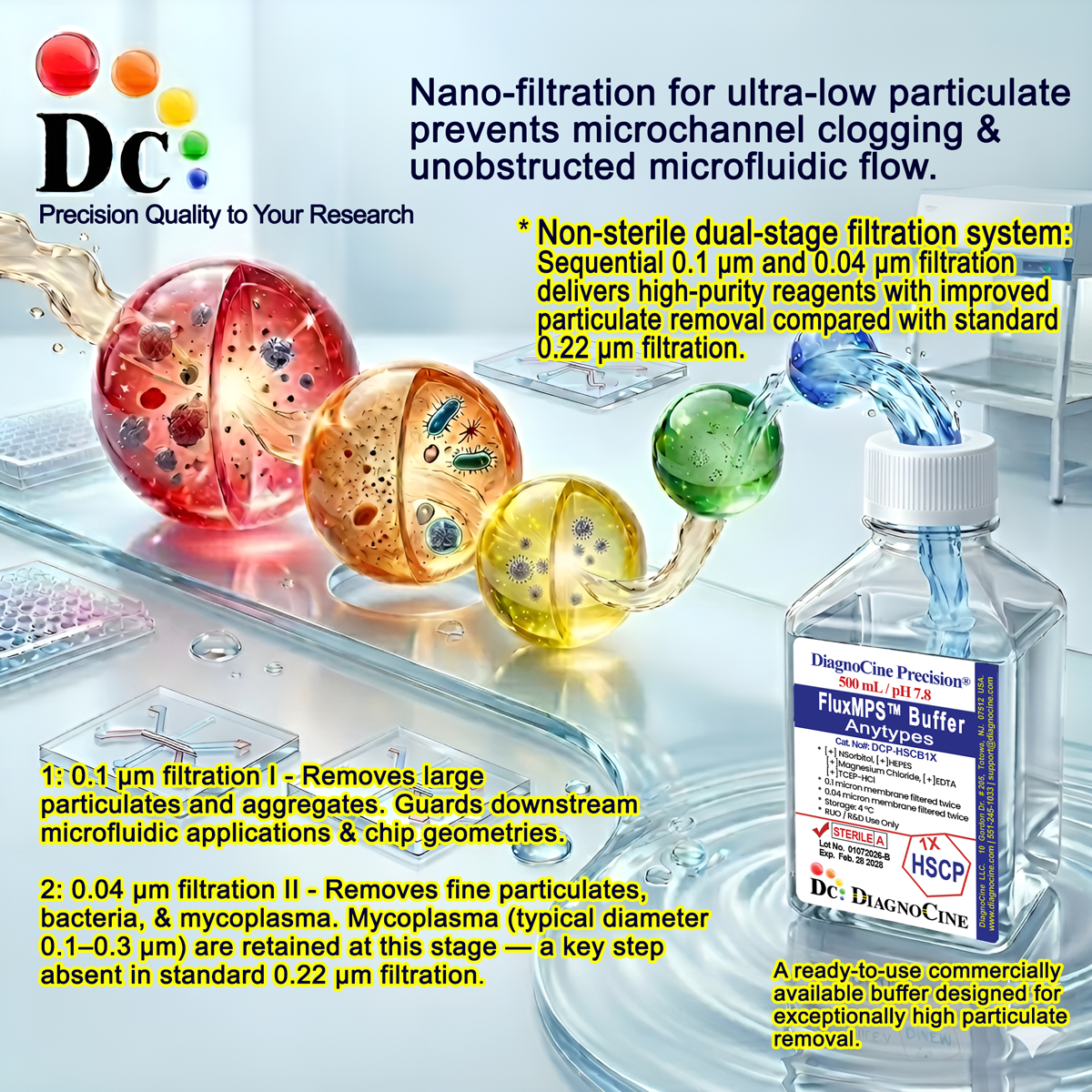
Rather than a single pass through a standard 0.22 µm filter, this PBS is sterilized by filtering the finished buffer twice through 0.04 micron (40nm) membranes in a controlled cleanroom environment, targeting particulates, mycoplasma, and large viruses that a coarser single-pass filter can miss.
-
1
0.04 µm Primary Filtration
First pass through a 0.04 micron (40nm) membrane in a controlled cleanroom environment, removing bacteria, mycoplasma-scale organisms, and sub-micron particulates.
-
2
0.04 µm Final Polish Filtration
Second pass through a fresh 0.04 micron (40nm) membrane for redundant, sterilizing-grade purity beyond standard single-pass 0.22 µm processing.
Performance vs. conventional buffer
Double-pass 0.04 micron (40nm) filtration targets particulates, mycoplasma, and large viruses that can pass through a standard single-pass 0.22 µm filter, supporting cleaner fluidic channels in high-resolution imaging and microfluidic applications.
© Diagnocine® — DCP-PBS1X-EX
Built for microfluidic and cell-based research
This high-precision PBS formulation is designed for fluidic stability and cellular health in micro-scale environments, and supports general cell culture, molecular biology, and tissue processing workflows.
Automated Bioreactors & Robotics
For automated bioreactor and robotic liquid-handling platforms, an optional 0.01 µm (10nm) ultra-filtered variant is available on request for further reduction of particulate load in closed fluidic systems.
- Total Particulate Exclusion: finer filtration for particulate-sensitive automated systems
- Valve & Sensor Protection: reduced particulate load for long-run fluidic hardware
- Extended Perfusion Stability: consistent buffer quality for continuous-flow protocols
Inquiry Required: the 0.01 µm (10nm) ultra-filtered grade is available by request — contact support@diagnocine.com.
Micro Physiological System (MPS) & Chip
Ensures a pristine environment for organoid development, tissue maintenance, and consistent physiological buffering across multi-organ integrated systems.
Wash, Dilution & Cell Counting
Used for washing, transporting, and diluting cells for counting, with a calcium- and magnesium-free formulation to prevent cell clumping and support high-efficiency rinsing before protease treatments.
Molecular Biology Reagent Prep
High-precision dilution of molecular biology reagents, prepared with ASTM 0.05 µS/cm Type 1 Ultrapure Deionized water.
Physiological Buffering
Maintains physiological pH and osmotic pressure for sensitive tissue samples during processing.
Ca2+/Mg2+-Free Rinsing
Formulated without CaCl2 or MgCl2 to prevent cell clumping and ensure high-efficiency rinsing before protease dissociation steps.
High-Resolution Imaging Support
Minimal particulate matter makes this buffer well suited for high-resolution imaging and nano-science applications where debris can interfere with signal.
Physical, chemical, and quality parameters
All values below are as declared for FluxMPS™ DCP-PBS1X-EX.
| Parameter | Specification |
|---|---|
| Formulation | Phosphate-buffered saline (NaCl, KCl, Na2HPO4, KH2PO4); Ca2+/Mg2+-free |
| Appearance | Sterilized liquid, clear, colorless |
| pH | 7.4 (customizable upon request) |
| Concentration | 1X (Ready-to-use) |
| NaCl | 137 mM |
| KCl | 2.7 mM |
| Na2HPO4 | 8 mM |
| KH2PO4 | 2 mM |
| Parameter | Specification |
|---|---|
| Sterility USP <71> | Sterile; double 0.04 µm (40nm) filtered in a controlled cleanroom environment |
| Enzymatic Contaminants | Free of Protease, DNAse, RNAse, and Endonucleases |
| Water Purity | ASTM Type 1 Ultrapure Deionized Water, 0.05 µS/cm |
| Manufacturing Standard ISO 13485 | ISO 13485:2016 certified quality management system |
| Fill Environment | Controlled cleanroom environment |
| Parameter | Specification |
|---|---|
| Storage Temperature | Room Temp (short-term) / 4°C (long-term) |
| Shipping | Usually ships within 24 hours |
| Parameter | Specification |
|---|---|
| Raw Material Grade | Tissue Culture & Molecular Biology Grade (RUO) |
| Manufacturing QMS | ISO 13485:2016 certified |
| Production Site | DiagnoCine Precision facility, Totowa, New Jersey, USA |
| Intended Use | Research Use Only (RUO) |
Full composition
Ready-to-use 1X phosphate-buffered saline, formulated without CaCl2 or MgCl2 and prepared with ASTM 0.05 µS/cm Type 1 Ultrapure Deionized H2O.
| Component | CAS Number | Concentration |
|---|---|---|
| Sodium Chloride (NaCl) | 7647-14-5 | 137 mM |
| Potassium Chloride (KCl) | 7447-40-7 | 2.7 mM |
| Sodium Phosphate Dibasic (Na2HPO4) | 7558-79-4 | 8 mM |
| Potassium Phosphate Monobasic (KH2PO4) | 7778-77-0 | 2 mM |
Manufacturing & compliance
Fully produced, quality tested, and packaged at the DiagnoCine Precision facility in Totowa, New Jersey, USA, under an ISO 13485:2016 certified quality management system.
ISO 13485:2016 QMS
Operations conducted under an ISO 13485:2016 certified quality management system.
Ultrapure Type 1 Water
Prepared using ASTM 0.05 µS/cm Type 1 Ultrapure Deionized H2O.
Controlled Cleanroom Fill
Sterilized and packaged in a controlled cleanroom environment.
Integrated Single-Site Manufacturing
Fully produced, quality tested, and packaged at one DiagnoCine Precision facility.
Enzymatic Contaminants
Guaranteed free of Protease, DNAse, RNAse, and Endonucleases.
Sterility USP <71>
Sterile; double 0.04 µm (40nm) filtered in a controlled cleanroom environment.
Shipping
Usually ships within 24 hours.
Documentation
Certificate of Analysis available on request.
How DCP-PBS1X-EX compares
Most commercial PBS utilizes 0.22 µm (220nm) filtration. Here is how the 0.04 micron (40nm) double-filtered FluxMPS™ PBS compares.
| Feature | DCP-PBS1X-EX (FluxMPS™) | Standard PBS (0.22 µm) |
|---|---|---|
| Pore Size | 0.04 micron (40nm) | 0.22 micron (220nm) |
| Filtration Level | Double-Filtered (2X) | Single-Filtered (1X) |
| Sterility Assurance | Targets smaller mycoplasma and large viruses | Standard bacterial removal |
| Particulate Matter | Minimal; suited for nano-science | May contain sub-micron debris |
| Application Focus | High-resolution imaging & microfluidics | General lab washing |
Frequently asked questions
Common questions about FluxMPS™ DCP-PBS1X-EX.
Supporting literature
Selected literature relevant to phosphate-buffered saline use in microfluidic, organ-on-a-chip, and cell biology applications.
- Bhatia SN, Ingber DE. Microfluidic organs-on-chips. Nat Biotechnol. 2014. doi:10.1038/nbt.2989
- Huh D, Hamilton GA, Ingber DE. From 3D cell culture to organs-on-chips. Trends Cell Biol. 2011. doi:10.1016/j.tcb.2011.09.005
- Sung JH, et al. Recent advances in body-on-a-chip systems. Anal Chem. 2019. doi:10.1021/acs.analchem.8b05293
- Dulbecco R, Vogt M. Plaque formation and isolation of pure lines with poliomyelitis viruses. J Exp Med. 1954. doi:10.1084/jem.99.2.167
- Ho CT, et al. Liver-cell patterning lab chip: mimicking the morphology of liver lobule tissue. Lab Chip. 2013. doi:10.1039/C3LC50402F
- Rasmussen R. Mycoplasma detection and control in cell culture. Methods Mol Biol. 2010. doi:10.1007/978-1-60761-950-5_10
- Halldorsson S, et al. Advantages and challenges of microfluidic cell culture in polydimethylsiloxane devices. Biosens Bioelectron. 2015. doi:10.1016/j.bios.2014.07.029
- van der Meer AD, van den Berg A. Organs-on-chips: breaking the in vitro impasse. Integr Biol. 2012. doi:10.1039/c2ib20108a
- Esch EW, Bahinski A, Huh D. Organs-on-chips at the frontiers of drug discovery. Nat Rev Drug Discov. 2015. doi:10.1038/nrd4539