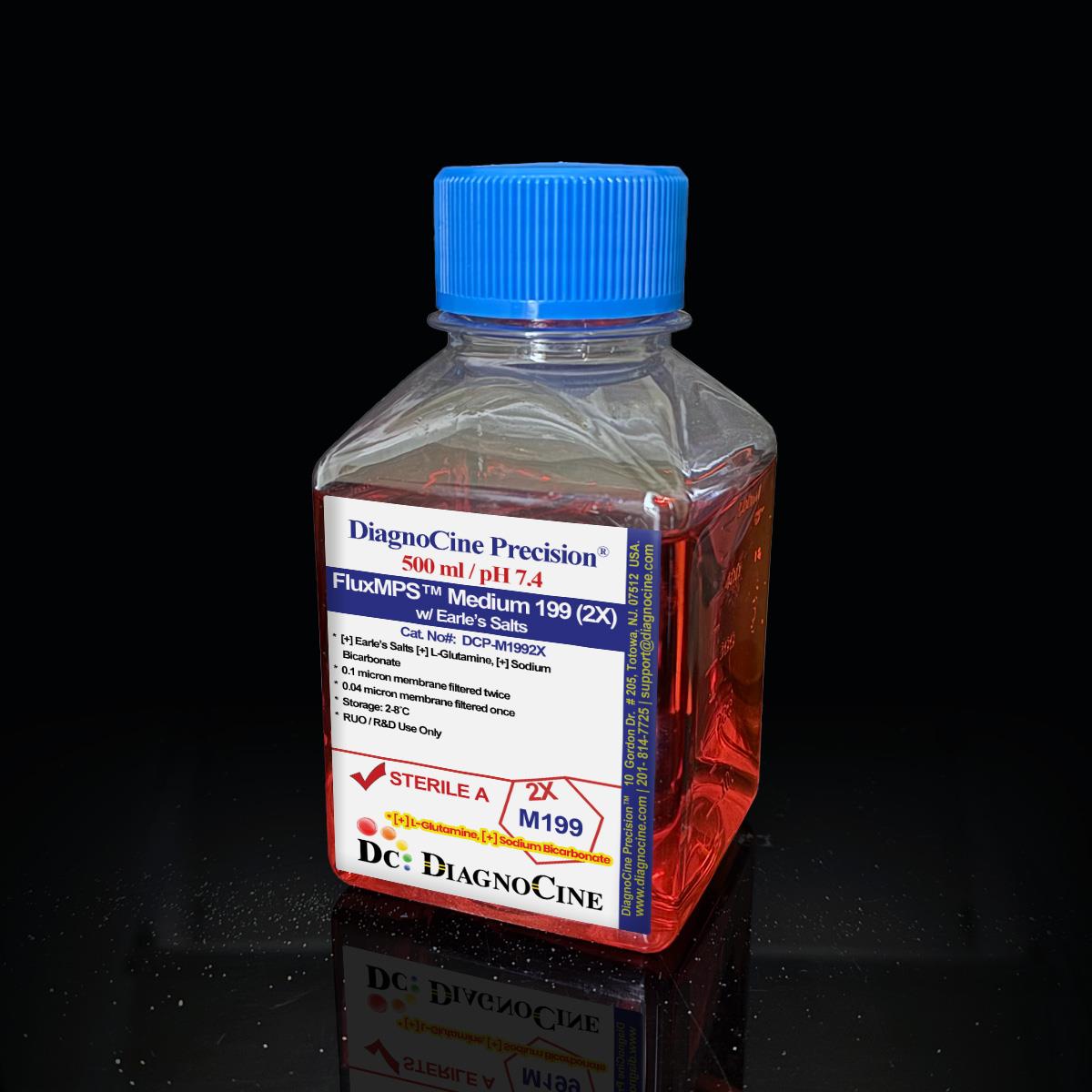
FluxMPS™ Medium 199, Earle's Salts: 2X Liquid
FluxMPS™ Medium 199, Earle's Salts: 2X Liquid
MPS-grade Medium 199 at double (2X) concentration with Earle's salts, ultra-filtered through a quadruple-stage 0.1 µm / 0.04 µm filtration system for organ-on-a-chip (OoC), tissue-chip and microfluidic perfusion work. With a Earle's bicarbonate buffer, it is microchannel-safe and approximately 5× cleaner than conventional 0.22 µm-filtered media by particulate count.
- Quadruple-stage filtration: 0.1 µm membrane filtered twice, 0.04 µm membrane filtered twice
- 0.04 µm nano-filtration final polish acts as a mycoplasma barrier
- Endotoxin < 0.05 EU/mL (USP <85> BET)
- Formulation: [+] Earle's Salts, [+] 2 g/L Glucose, [+] L-Glutamine, [+] Sodium Pyruvate, [+] Sodium Bicarbonate, [+] Phenol Red; [−] HEPES
- Classic Morgan, Morton & Parker (1950) Medium 199 recipe with nucleic-acid precursors, cholesterol and fat-soluble vitamins
- Ultrapure Type 1 water (18.2 MΩ·cm); ISO Class 5 (Class 100) aseptic fill
- 2X concentrate: every component at double strength; dilute 1:1 to 1X working strength before use
- pH, concentration, component additions and nutrient modifications available on request
- Glucose2,000 mg/L
- L-Glutamine200 mg/L
- Sodium Pyruvate0.220 mg/L
- BufferNaHCO₃ 4,400 mg/L
- pH7.4 (± 0.04)
- Endotoxin< 0.05 EU/mL
- Filtration0.1 µm ×2 + 0.04 µm ×2
- Storage2–8 °C, protect from light
- Shelf Life12 months
- Format2X liquid, 500 / 1000 mL
Engineered where standard media fails
Conventional Medium 199 is sterile-filtered once at 0.22 µm. That pore size can pass mycoplasma and leaves subvisible particulates that settle in microchannels, foul membranes and valves, and add noise to optical and electrical readouts in microphysiological systems (MPS).[3,11] FluxMPS™ Medium 199 keeps the original Earle's formulation and removes that failure mode.
Microchannel-safe purity
A 0.04 µm final filter and USP <788> particulate control keep subvisible debris out of chips, tubing and porous membranes.
Total metabolic control
Defined 2 g/L glucose, 200 mg/L L-glutamine and a trace 0.220 mg/L sodium pyruvate give a known carbon-source baseline for metabolic studies.
Ultrapure-grade water
Made with Ultrapure Type 1 water (18.2 MΩ·cm) and released at < 0.05 EU/mL endotoxin by USP <85>.
Low background for imaging
Particle-depleted medium reduces scatter and debris artifacts in confocal imaging and on-chip biosensors.[10]
Rich, stable nutrient profile
62 defined components, including nucleic-acid precursors, cholesterol, Polysorbate 80 and fat-soluble vitamins A, D, E and K, produced in controlled micro-batches.
Customization on demand
pH, concentration, component additions and nutrient modifications (glucose, salts, HEPES) are available — contact support@diagnocine.com.
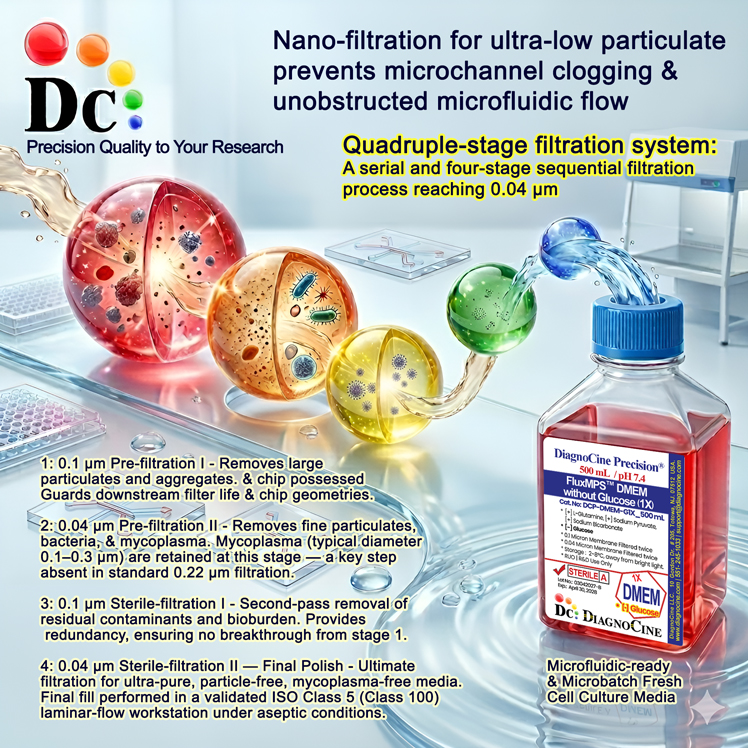
Quadruple-stage filtration system
Every lot of DCP-M1992X is membrane filtered at 0.1 µm twice and 0.04 µm twice — a ready-to-use Medium 199 polished to a 0.04 µm final pore size, a purity level single-pass 0.22 µm media cannot reach.
-
01
0.1 µmPre-filtration I
Removes large particulates and aggregates and extends the life of the downstream filters.
-
02
0.04 µmPre-filtration II
Retains fine particulates, bacteria and mycoplasma.
-
03
0.1 µmSterile-filtration I
Second-pass redundancy that catches anything shed or bypassed upstream.
-
04
0.04 µmSterile-filtration II — Final Polish
Final nano-polish immediately before ISO Class 5 aseptic fill.
Performance vs. conventional media
By particulate count, FluxMPS™ Medium 199 is approximately 5× cleaner than conventional 0.22 µm-filtered Medium 199, lowering clog risk in narrow channels and long perfusion runs.
© Diagnocine® — DCP-M1992X
Where FluxMPS™ Medium 199 fits
Medium 199 was the first nutritionally defined medium, developed by Morgan, Morton and Parker in 1950 for nutritional studies on primary chick embryo fibroblasts in the absence of any additives.[1] Explanted tissue could survive in it without serum, although long-term cultivation of cells required serum supplementation. Medium 199 is formulated with either Hank's salts or Earle's salts; this product uses Earle's salts.[2] Supplemented with serum, it supports growth of a wide variety of cells, and it is presently used for the maintenance of non-transformed cells, vaccine and virus production, and primary explants of epithelial cells.
Automated Bioreactors & Robotics
For automated bioreactors, liquid-handling robots and closed perfusion loops with fine valves and in-line sensors, an optional 10 nm (0.01 µm) ultra-filtered grade of this medium is available.
- Total Particulate Exclusion: 0.01 µm filtration removes virtually all particulates down to the nanometer scale.
- Valve & Sensor Protection: keeps micro-valves, pumps and optical or electrochemical sensors free of deposits.
- Extended Perfusion Stability: supports long, uninterrupted perfusion runs with fewer line changes.
Inquiry Required: the 0.01 µm grade is made on request — email support@diagnocine.com with your catalog number and volume.
Micro Physiological System (MPS) & Chip
Microchannel-safe medium for perfused organ-, tissue- and body-on-a-chip platforms and lab-on-a-chip assays.[3,4,5,6,7]
Warburg Effect & Metabolic Research
A defined glucose baseline (1 g/L at 1X working strength) for glycolysis and metabolic-shift studies in tumor lines, alone or on chip.
iPSC-Derived Models
Base medium for maintenance of differentiated iPSC-derived cells in perfused chip models, with serum or defined supplements.
Endothelial & Primary Cells
Medium 199 is the classic base for human umbilical vein endothelial cell culture and for non-transformed primary cells and epithelial explants.[12]
Metabolic Flux Analysis
Known, low-particulate composition simplifies isotope tracing, respirometry and NMR sample prep.
Microscopy & Optical Sensing
Fewer particles means cleaner fields for confocal imaging, on-chip biosensors and barrier readouts.[10]
Specifications & quality control
Release specifications for DCP-M1992X. Lot-specific values are reported on the Certificate of Analysis.
| Parameter | Specification |
|---|---|
| Formulation | [+] Earle's Salts, [+] 2 g/L Glucose, [+] L-Glutamine, [+] Sodium Pyruvate, [+] Sodium Bicarbonate, [+] Phenol Red; [−] HEPES |
| Appearance | Red |
| pH | 7.4 (± 0.04) USP <791> |
| Osmolality | Measured per lot; reported on CoA USP <785> |
| Glucose | 2,000 mg/L (2 g/L) |
| L-Glutamine | 200 mg/L |
| Sodium Pyruvate | 0.220 mg/L |
| Sodium Bicarbonate | 4,400 mg/L |
| HEPES | Not included |
| Phenol Red | 30 mg/L |
| Parameter | Specification |
|---|---|
| Endotoxin | < 0.05 EU/mL USP <85> BET |
| Sterility | No bacterial or fungal growth after 14 days of incubation USP <71> |
| Mycoplasma | 0.04 µm barrier filtration USP <63> equiv. |
| Particulate ≥10 µm | Meets limits USP <788> M2 |
| Particulate ≥25 µm | Meets limits USP <788> M2 |
| Water purity | Ultrapure Type 1, 18.2 MΩ·cm |
| Manufacturing std. | ISO 13485:2016 ISO |
| Fill environment | ISO Class 5 (Class 100) ISO |
| Parameter | Specification |
|---|---|
| Storage temperature | 2–8 °C, away from bright light |
| Freeze-thaw | Do not freeze |
| Shelf life | 12 months; use before the expiry date on the product label |
| Shipping condition | Ice Pack |
| CO₂ requirement | 5% CO₂ (Earle's salts with 4.4 g/L sodium bicarbonate (2.2 g/L after 1:1 dilution to 1X)) |
| Parameter | Specification |
|---|---|
| Raw material grade | High-purity, cell-culture-tested components |
| Traceability | Lot-traceable; CoA per lot |
| Manufacturing QMS | ISO 13485:2016 ISO |
| Regulatory alignment | 21 CFR Part 820 (cGMP) aligned; ISO 13485-certified and CE-approved facilities |
| Production method | Micro-batch 2X liquid, quadruple-stage filtered |
| Intended use | For Research Use Only (RUO) |
Full composition (mg/L)
This product is Medium 199 at a 2X concentration with Earle's salts, L-glutamine, sodium pyruvate, sodium bicarbonate and Phenol Red. It does not contain HEPES. Users are advised to review the literature for recommendations regarding medium supplementation and physiological growth requirements specific for different cell lines. All 62 components are listed below; values are per-lot release basis. This 2X concentrate contains every component at twice the 1X level; dilute 1:1 (for example with sterile water, a supplement solution, or an agar overlay) to reach 1X working strength before use.
| Component | CAS Number | mg/L |
|---|---|---|
| INORGANIC SALTS | ||
| Calcium chloride dihydrate | 10035-04-8 | 530.000 |
| Ferric nitrate nonahydrate | 7782-61-8 | 1.440 |
| Magnesium sulphate anhydrous | 7487-88-9 | 195.44 |
| Potassium chloride | 7447-40-7 | 800.000 |
| Sodium acetate anhydrous | 127-09-3 | 100.000 |
| Sodium bicarbonate | 144-55-8 | 4400.000 |
| Sodium chloride | 7647-14-5 | 13600.00 |
| Sodium phosphate monobasic | 7558-80-7 | 244.000 |
| Component | CAS Number | mg/L |
|---|---|---|
| AMINO ACIDS | ||
| Glycine | 56-40-6 | 100.000 |
| L-Alanine | 56-41-7 | 50.000 |
| L-Arginine hydrochloride | 1119-34-2 | 140.000 |
| L-Aspartic acid | 56-84-8 | 60.000 |
| L-Cysteine hydrochloride monohydrate | 7048-04-6 | 0.200 |
| L-Cystine dihydrochloride | 30925-07-6 | 52.000 |
| L-Glutamic Acid | 56-86-0 | 134.000 |
| L-Glutamine | 56-85-9 | 200.000 |
| L-Histidine hydrochloride monohydrate | 5934-29-2 | 44.000 |
| L-Hydroxyproline | 51-35-4 | 20.000 |
| L-Isoleucine | 73-32-5 | 40.000 |
| L-Leucine | 61-90-5 | 120.000 |
| L-Lysine hydrochloride | 657-27-2 | 140.00 |
| L-Methionine | 63-68-3 | 30.000 |
| L-Phenylalanine | 63-91-2 | 50.000 |
| L-Proline | 147-85-3 | 80.000 |
| L-Serine | 56-45-1 | 50.000 |
| L-Threonine | 72-19-5 | 60.000 |
| L-Tryptophan | 73-22-3 | 20.000 |
| L-Tyrosine disodium salt | 69847-45-6 | 115.32 |
| L-Valine | 72-18-4 | 50.000 |
| Component | CAS Number | mg/L |
|---|---|---|
| VITAMINS | ||
| Ascorbic acid | 50-81-7 | 0.10 |
| Calciferol | 50-14-6 | 0.200 |
| Choline chloride | 67-48-1 | 1.000 |
| D-Biotin | 58-85-5 | 0.020 |
| D-Ca-Pantothenate | 137-08-6 | 0.020 |
| DL-Tocopherol phosphate Disodium Salt | 60934-46 | 0.020 |
| Folic acid | 59-30-3 | 0.020 |
| Menadione | 58-27-5 | 0.020 |
| Nicotinamide | 98-92-0 | 0.050 |
| Nicotinic acid | 59-67-6 | 0.050 |
| Pyridoxal hydrochloride | 65-22-5 | 0.050 |
| Pyridoxine hydrochloride | 58-56-0 | 0.050 |
| Retinol Acetate | 127-47-9 | 0.280 |
| Riboflavin | 83-88-5 | 0.020 |
| Thiamine hydrochloride | 67-03-8 | 0.020 |
| i-Inositol | 87-89-8 | 0.100 |
| p-Amino benzoic acid (PABA) | 150-13-0 | 0.100 |
| OTHERS | ||
| Adenine sulphate | 321-30-2 | 20.000 |
| Adenosine monophosphate | 61-19-8 | 0.400 |
| Adenosine triphosphate | 56-65-5 | 2.000 |
| Cholesterol | 57-88-5 | 0.400 |
| Deoxyribose | 533-67-5 | 1.000 |
| Glucose | 50-99-7 | 2000.000 |
| Glutathione reduced | 70-18-8 | 0.100 |
| Guanine hydrochloride | 635-39-2 | 0.600 |
| Hypoxanthine | 68-94-0 | 0.708 |
| Phenol Red | 34487-61-1 | 30.000 |
| Polysorbate 80 | 9005-65-6 | 9.800 |
| Ribose | 50-69-1 | 1.000 |
| Sodium Pyruvate | 113-24-6 | 0.220 |
| Thymine | 65-71-4 | 0.600 |
| Uracil | 66-22-8 | 0.600 |
| Xanthine | 69-89-6 | 0.688 |
Manufacturing & compliance
Manufactured under ISO 13485-certified and CE-approved facilities, with every lot released against compendial test methods.
ISO 13485:2016 QMS
Documented, audited quality management system aligned with 21 CFR Part 820 (cGMP).
Ultrapure Type 1 Water
18.2 MΩ·cm water as the formulation base for low ionic and endotoxin background.
ISO Class 5 Fill & Finish
Aseptic filling in an ISO Class 5 (Class 100) environment right after the final 0.04 µm polish.
Micro-Batch Precision
Small, tightly controlled batches for consistent composition and pH from lot to lot.
Endotoxin — USP <85> BET
Released at < 0.05 EU/mL.
Particulate — USP <788> Method 2
Subvisible particles ≥10 µm and ≥25 µm within compendial limits.
Osmolality — USP <785>
Measured per lot and reported on the CoA.
Documentation / CoA
Appearance, pH 7.4 (± 0.04), 14-day sterility, endotoxin and osmolality per lot.
How DCP-M1992X compares
Same Medium 199 chemistry, different purity class. Conventional columns describe typical single-pass 0.22 µm-filtered catalog media.
| Parameter | DCP-M1992X (FluxMPS™) | Conventional Medium 199, Earle's (0.22 µm filtered) | Standard Medium 199, Hanks' (0.22 µm filtered) |
|---|---|---|---|
| Formulation | Complete Earle's Medium 199 (2 g/L glucose, L-glutamine, pyruvate, NaHCO₃); HEPES-free | Earle's salts, bicarbonate-buffered | Hanks' salts, for room-air use |
| Final filtration pore size | 0.04 µm | 0.22 µm | 0.22 µm |
| Number of filtration stages | 4 | 1 | 1 |
| Mycoplasma barrier filtration | check_circle | cancel | cancel |
| Endotoxin specification | < 0.05 EU/mL | Often not specified at this level | Often not specified at this level |
| USP <788> particulate compliance | check_circle | cancel | cancel |
| Ultrapure Type 1 water (18.2 MΩ·cm) | check_circle | Varies | Varies |
| ISO 13485:2016 manufacturing | check_circle | Varies | Varies |
| Microfluidic channel compatibility | check_circle | cancel | cancel |
| Custom formulation | check_circle | cancel | cancel |
Frequently asked questions
Common questions about using DCP-M1992X in microfluidic and conventional culture.
Supporting literature
Peer-reviewed background on Medium 199, organ-on-a-chip culture, buffering and mycoplasma control.
- Morgan JF, Morton HJ, Parker RC. Nutrition of animal cells in tissue culture. I. Initial studies on a synthetic medium. Proc Soc Exp Biol Med. 1950;73(1):1–8. doi:10.3181/00379727-73-17557
- Earle WR, Schilling EL, Stark TH, Straus NP, Brown MF, Shelton E. Production of malignancy in vitro. IV. The mouse fibroblast cultures and changes seen in the living cells. J Natl Cancer Inst. 1943;4(2):165–212. doi:10.1093/jnci/4.2.165
- Bhatia SN, Ingber DE. Microfluidic organs-on-chips. Nat Biotechnol. 2014;32(8):760–772. doi:10.1038/nbt.2989
- Huh D, Matthews BD, Mammoto A, Montoya-Zavala M, Hsin HY, Ingber DE. Reconstituting organ-level lung functions on a chip. Science. 2010;328(5986):1662–1668. doi:10.1126/science.1188302
- Esch EW, Bahinski A, Huh D. Organs-on-chips at the frontiers of drug discovery. Nat Rev Drug Discov. 2015;14(4):248–260. doi:10.1038/nrd4539
- Low LA, Mummery C, Berridge BR, Austin CP, Tagle DA. Organs-on-chips: into the next decade. Nat Rev Drug Discov. 2021;20(5):345–361. doi:10.1038/s41573-020-0079-3
- Leung CM, de Haan P, Ronaldson-Bouchard K, et al. A guide to the organ-on-a-chip. Nat Rev Methods Primers. 2022;2:33. doi:10.1038/s43586-022-00118-6
- Drexler HG, Uphoff CC. Mycoplasma contamination of cell cultures: incidence, sources, effects, detection, elimination, prevention. Cytotechnology. 2002;39(2):75–90. doi:10.1023/A:1022913015916
- Good NE, Winget GD, Winter W, Connolly TN, Izawa S, Singh RMM. Hydrogen ion buffers for biological research. Biochemistry. 1966;5(2):467–477. doi:10.1021/bi00866a011
- Zhang YS, Aleman J, Shin SR, et al. Multisensor-integrated organs-on-chips platform for automated and continual in situ monitoring of drug toxicity. Proc Natl Acad Sci USA. 2017;114(12):E2293–E2302. doi:10.1073/pnas.1612906114
- Halldorsson S, Lucumi E, Gómez-Sjöberg R, Fleming RMT. Advantages and challenges of microfluidic cell culture in polydimethylsiloxane devices. Biosens Bioelectron. 2015;63:218–231. doi:10.1016/j.bios.2014.07.029
- Jaffe EA, Nachman RL, Becker CG, Minick CR. Culture of human endothelial cells derived from umbilical veins. Identification by morphologic and immunologic criteria. J Clin Invest. 1973;52(11):2745–2756. doi:10.1172/JCI107470