

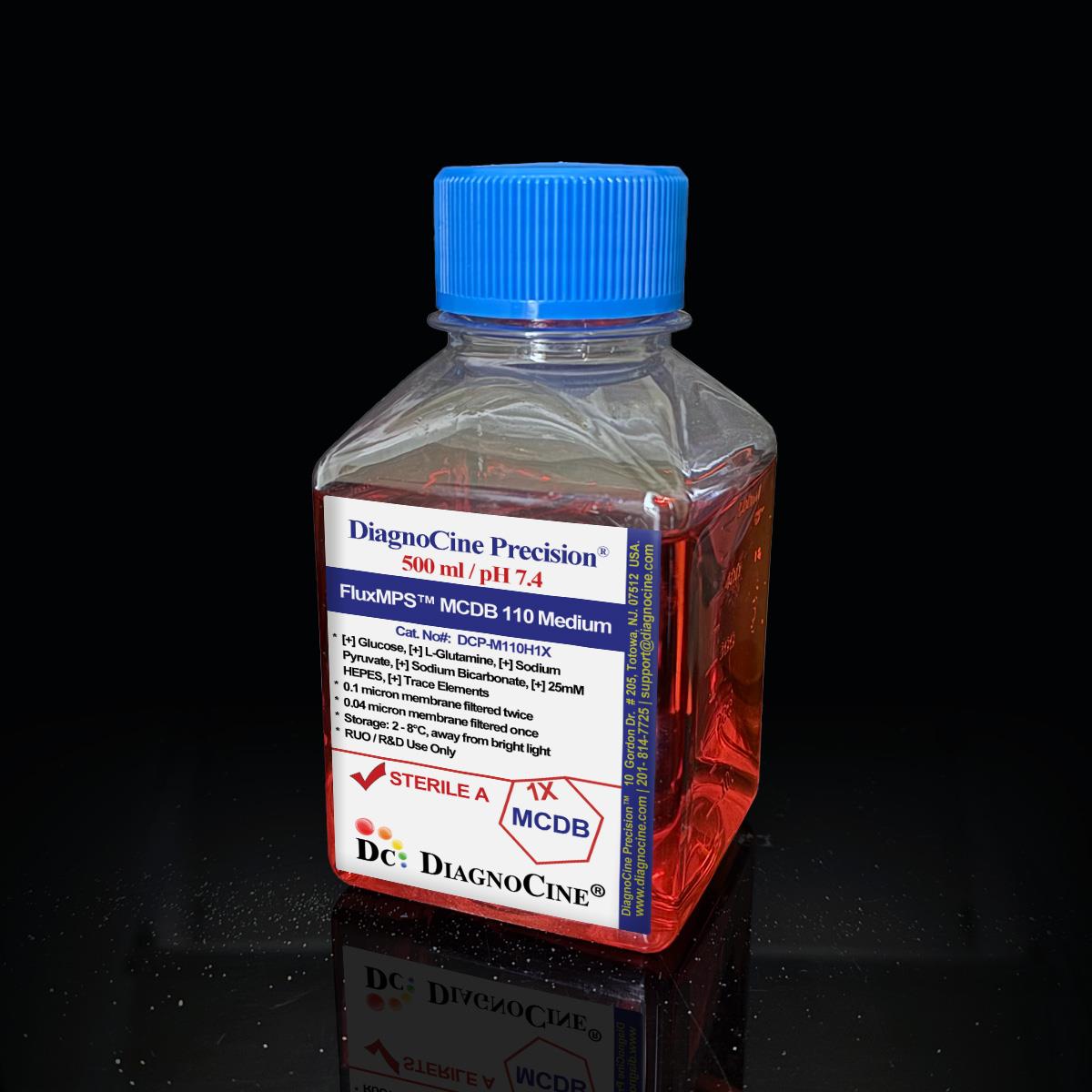
FluxMPS™ MCDB 110 Medium: 1X Liquid
FluxMPS™ MCDB 110 Medium: 1X Liquid
FluxMPS™ DCP-M110H1X is a Microfluidics Suitable, quadruple-stage ultra-filtered (0.1 µm ×2 + 0.04 µm ×2) MCDB 110 formulation engineered for microphysiological systems (MPS), organ-on-a-chip (OoC), and microfluidic diploid-fibroblast models. A quadruple-stage train (0.1 µm ×2 + 0.04 µm ×2) reaches a 0.04 µm final cut-off, five times finer than the 0.22 µm membranes used for conventional sterile filtration. Formulation: [+] 0.720 g/L Glucose, [+] L-Glutamine, [+] Sodium Pyruvate, [+] Sodium Bicarbonate, [+] 25 mM HEPES, [+] Trace Elements. The combined sodium bicarbonate / HEPES buffer system provides added pH stability during bench-top handling; standard CO2 incubation is still recommended for extended culture (see FAQ).
- 0.04 µm final-stage filtration retains particulates below the mycoplasma size range (0.2–0.3 µm), supporting microfluidic channels below 100 µm
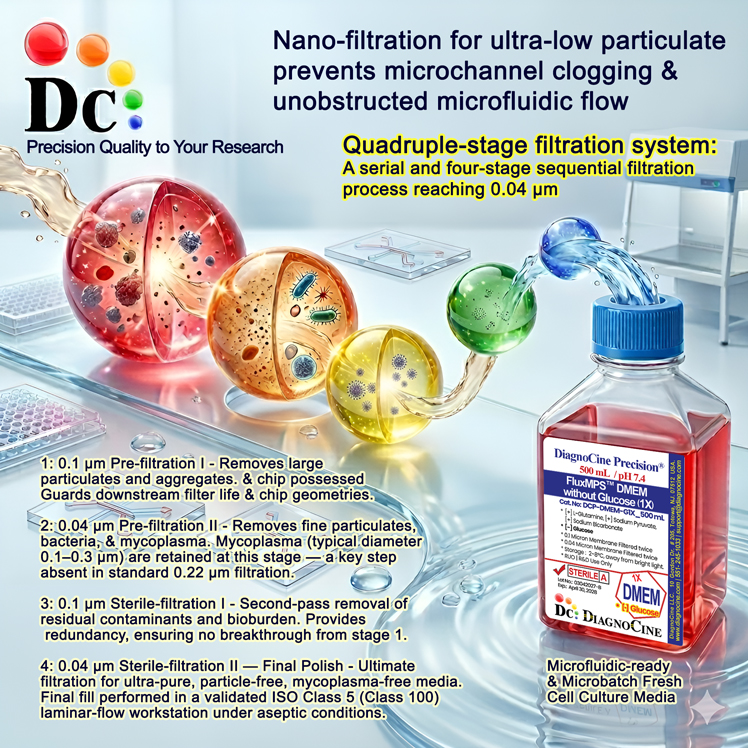
- Quadruple-stage sequential filtration: 0.1 µm Prefiltration I → 0.04 µm Final filtration I → 0.1 µm Prefiltration II → 0.04 µm Final filtration II — Polish
- Endotoxin < 0.05 EU/mL, LAL assay per USP <85> (batch release specification — see Manufacturing & Compliance)
- Formulation: [+] 0.720 g/L Glucose, [+] L-Glutamine, [+] Sodium Pyruvate, [+] Sodium Bicarbonate (1500 mg/L), [+] 25 mM HEPES (5958 mg/L), [+] Trace Elements (Zn, Cu, Mn, Se, V, Mo, Ni, Sn)
- Ultrapure Type 1 water (18.2 MΩ·cm), ISO 13485:2016 quality management system, ISO Class 5 aseptic fill
- Modified trace-element and vitamin concentrations vs. MCDB 105, tailored to diploid fibroblast sub-populations
- Custom pH, salts, and nutrient adjustments available on request — contact support@diagnocine.com
- Formulation[+] L-Glutamine (365.3 mg/L), [+] Sodium Bicarbonate (1500 mg/L), [+] Phenol Red (1.242 mg/L), [+] HEPES (25 mM, 5958 mg/L), [+] Calcium (CaCl₂ · 2H₂O, 147 mg/L), [+] Magnesium (MgSO₄, 120.38 mg/L), [+] Glucose (0.72 g/L), [+] Sodium Pyruvate (110 mg/L), [+] Trace Elements
- AppearanceRed-colored, clear solution (phenol red present)
- pH (USP <791>)7.4
- Osmolality (USP <785>)Contact for specification
- Endotoxin (USP <85>)< 0.05 EU/mL
- Sterility (USP <71>)No growth / 14 days
- Filtration0.1 µm ×2 + 0.04 µm ×2 (Quadruple-stage)
- Total ingredients55 (16 inorganic salts, 20 amino acids, 9 vitamins, 10 others)
- Storage2–8°C, protect from light
- Shelf Life12 months from date of manufacture, unopened
Engineered where standard media fails
Conventional 0.22 µm–filtered media passes mycoplasma-range material, subvisible particulates, and endotoxin-adjacent debris that can foul microfluidic channels and interfere with sensor readouts. FluxMPS™ reduces these failure modes with a validated four-stage sub-0.04 µm filtration train.
Microchannel-safe purity
0.04 µm final-stage filtration substantially reduces subvisible particulate carryover. Release testing follows USP <788> Method 1 (light obscuration) limits, supporting use across a range of microfluidic channel geometries.
Total metabolic control
Defined, per-lot verified concentrations of glutamine, pyruvate, bicarbonate, and HEPES support precise nutrient and buffer control for metabolic studies on diploid fibroblast and related cell models.
Ultrapure-grade water
Ultrapure Type 1 water (18.2 MΩ·cm, ASTM D1193 / ISO 3696) minimizes trace-metal and organic-carbon (TOC) background contributed by process water. The finished medium's ionic profile — governed by its own formulated salts — is what determines TEER and electrophysiology baselines.
Low background for imaging
Quadruple-stage filtration reduces subvisible particulate background relevant to confocal microscopy and biosensor baselines. This formulation contains phenol red (1.242 mg/L); phenol red–free variants are available on request for applications requiring reduced background absorbance.
Rich, stable nutrient profile
55 ingredients verified per lot; micro-batch production with full raw-material traceability.
Customization on demand
pH, glucose, salts, HEPES, and nutrients adjustable per your protocol. Contact support@diagnocine.com.
Quadruple-stage filtration system
Four serial filtration stages reaching a final 0.04 µm polish, run as two dedicated prefilter + final-filter pairs, engineered to reduce subvisible particulate and mycoplasma-range material well below what a single-stage 0.22 µm filter achieves.
-
1
0.1 µm Prefiltration I
Removes large aggregates and particulates; protects the first dedicated 0.04 µm final-filter cartridge.
-
2
0.04 µm Final filtration I — Mycoplasma-retentive polish
Retains material in the mycoplasma size range (0.2–0.3 µm) and fine particulates not addressed by standard 0.22 µm filtration.
-
3
0.1 µm Prefiltration II
Second dedicated prefilter, protecting the second 0.04 µm final-filter cartridge; provides full redundancy for the sterile train.
-
4
0.04 µm Final filtration II — Polish
Ultimate polishing filter; aseptic fill under ISO Class 5 (Class 100) conditions.
Performance vs. conventional media
© Diagnocine® — DCP-M110H1X
Designed for next-generation cell models
FluxMPS™ DCP-M110H1X supports demanding platforms from single-channel microfluidic chips to multi-organ body-on-a-chip systems. This MCDB 110 formulation differs from MCDB 105 in its modified trace-element and vitamin concentrations, developed for specific diploid fibroblast sub-populations, and is well suited to precision fibroblast OoC and 3D skin-on-chip models. The dual buffering system (sodium bicarbonate plus 25 mM HEPES) provides added pH stability during bench-top handling and transfer between chip modules; standard CO2 incubation is still recommended for extended culture.
Automated Bioreactors & Robotics
Optional 0.01 µm (10 nm) ultra-filtered MPS Grade variant available on request for automated bioreactor perfusion and robotic liquid handlers — the six-stage ultra nano-filtered line separate from this Microfluidics Suitable product.
- Total Particulate Exclusion: 10 nm filtration removes nanoparticulate aggregates
- Valve & Sensor Protection: Reduces micro-fouling of solenoid valves and inline optical sensors
- Extended Perfusion Stability: Consistent nutrient delivery over weeks-long culture
Inquiry Required: Contact support@diagnocine.com for the 0.01 µm MPS Grade variant.
Micro Physiological System (MPS) & Chip
Ultra-clean 0.04 µm–filtered media reduces the risk of microchannel clogging in complex multi-organ chip architectures.
CHO & Mammalian Cell Culture
Optimized trace-element and buffer profile suited to CHO, primary, and diploid fibroblast cell culture in low-serum or serum-free conditions.
iPSC-Derived Models
Batch-tested endotoxin specification (< 0.05 EU/mL) and mycoplasma-retentive filtration support sensitive iPSC protocols.
Endothelial & Primary Cells
Reduced-particulate, endotoxin-controlled media for HUVEC monolayer integrity and TEER monitoring.
Metabolic Flux Analysis
Defined formulation provides a consistent background for 13C isotope tracing and NMR-based metabolic flux studies. Not compatible with Agilent Seahorse XF assays, which require bicarbonate-free, phenol red–free medium.
Microscopy & Optical Sensing
Reduced particulate background suited to confocal microscopy and biosensor platforms. Phenol red is present in this formulation (1.242 mg/L); phenol red–free variants are available on request for TEER and absorbance-sensitive assays.
Analytical release specifications
Every lot released against the full specification matrix. CoA: support@diagnocine.com.
| Parameter | Specification |
|---|---|
| Formulation | [+] L-Glutamine (365.3 mg/L), [+] Sodium Bicarbonate (1500 mg/L), [+] Phenol Red (1.242 mg/L), [+] HEPES (25 mM, 5958 mg/L), [+] Calcium (CaCl₂·2H₂O, 147 mg/L), [+] Magnesium (MgSO₄, 120.38 mg/L), [+] Glucose (0.72 g/L), [+] Sodium Pyruvate (110 mg/L), [+] Trace Elements |
| Appearance | Red-colored, clear solution (phenol red present) |
| pH USP <791> | 7.4 |
| Osmolality USP <785> | Contact for specification |
| HEPES | 25 mM (5958 mg/L), pKa 7.3 at 37°C |
| Total ingredients | 55 (16 inorganic salts, 20 amino acids, 9 vitamins, 10 others) |
| Parameter | Specification |
|---|---|
| Endotoxin USP <85> BET | < 0.05 EU/mL (batch release spec.) |
| Sterility USP <71> | No growth / 14 days |
| Mycoplasma | 0.1/0.04 µm mycoplasma-retentive filtration (not tested per lot) |
| Particulate ≥10 µm USP <788> Method 1 | NMT 25/mL |
| Particulate ≥25 µm USP <788> Method 1 | NMT 3/mL |
| Water purity | Ultrapure Type 1, 18.2 MΩ·cm (ASTM D1193 / ISO 3696) |
| Manufacturing std. | ISO 13485:2016 |
| Fill environment | ISO Class 5 (Class 100) |
| Parameter | Specification |
|---|---|
| Storage temperature | 2–8°C, protect from light |
| Freeze-thaw | Do not freeze |
| Shelf life | 12 months from date of manufacture, unopened |
| Shipping condition | Cold pack |
| CO2 requirement | 5% CO2 recommended (consistent with 1500 mg/L sodium bicarbonate); 25 mM HEPES extends bench-top pH stability but does not replace CO2 incubation for extended culture |
| Pack sizes | 500 mL, 1000 mL |
| Parameter | Specification |
|---|---|
| Raw material grade | Reagent / cell culture grade |
| Traceability | Full lot traceability per ISO 13485 |
| Manufacturing QMS ISO | ISO 13485:2016 certified |
| UNSPSC | 41116155 — Molecular biology and cell culture growth media (UNv260801) |
| Regulatory alignment | 21 CFR Part 820 (QMSR) aligned |
| Production method | Micro-batch, per-lot QC release |
| Intended use | Research Use Only (RUO) |
Full composition (mg/L)
55 ingredients verified per lot with CAS numbers for full raw-material traceability. This MCDB 110 formulation contains trace elements (zinc, copper, manganese, selenium, vanadium, molybdenum, nickel, tin) tailored for diploid fibroblast cell culture.
| Component | CAS Number | mg/L |
|---|---|---|
| INORGANIC SALTS | ||
| Ammonium metavanadate | 7803-55-6 | 0.000585 |
| Calcium chloride dihydrate | 10035-04-8 | 147.000 |
| Cupric sulfate pentahydrate | 7758-99-8 | 0.00025 |
| Disodium hydrogen phosphate anhydrous | 7558-79-4 | 425.940 |
| Ferrous sulfate heptahydrate | 7782-63-0 | 0.00139 |
| Magnesium sulfate anhydrous | 7487-88-9 | 120.380 |
| Manganese sulfate | 7785-87-7 | 0.000151 |
| Molybdic acid ammonium tetrahydrate | 12054-85-2 | 0.00124 |
| Nickel chloride | 7718-54-9 | 0.00012 |
| Potassium chloride | 7447-40-7 | 408.270 |
| Sodium bicarbonate | 144-55-8 | 1500.000 |
| Sodium chloride | 7647-14-5 | 6546.000 |
| Sodium metasilicate nonahydrate | 13517-24-3 | 0.142 |
| Sodium selenite | 10102-18-8 | 0.0038 |
| Stannous chloride monohydrate | 10025-69-1 | 0.000113 |
| Zinc sulfate heptahydrate | 7446-20-0 | 0.144 |
| Component | CAS Number | mg/L |
|---|---|---|
| AMINO ACIDS | ||
| Glycine | 56-40-6 | 22.520 |
| L-Alanine | 56-41-7 | 8.910 |
| L-Arginine hydrochloride | 1119-34-2 | 210.700 |
| L-Asparagine monohydrate | 5794-13-8 | 15.000 |
| L-Aspartic acid | 56-84-8 | 13.310 |
| L-Cysteine hydrochloride monohydrate | 7048-04-6 | 8.780 |
| L-Glutamic acid | 56-86-0 | 14.710 |
| L-Glutamine | 56-85-9 | 365.300 |
| L-Histidine hydrochloride monohydrate | 5934-29-2 | 20.970 |
| L-Isoleucine | 73-32-5 | 3.940 |
| L-Leucine | 61-90-5 | 13.120 |
| L-Lysine hydrochloride | 657-27-2 | 36.540 |
| L-Methionine | 63-68-3 | 4.480 |
| L-Phenylalanine | 63-91-2 | 4.960 |
| L-Proline | 147-85-3 | 34.530 |
| L-Serine | 56-45-1 | 10.510 |
| L-Threonine | 72-19-5 | 11.910 |
| L-Tryptophan | 73-22-3 | 2.040 |
| L-Tyrosine disodium salt dihydrate | 69847-15-0 | 7.840 |
| L-Valine | 72-18-4 | 11.720 |
| Component | CAS Number | mg/L |
|---|---|---|
| VITAMINS | ||
| Choline chloride | 67-48-1 | 13.960 |
| D-Biotin | 58-85-5 | 0.007339 |
| D-Ca-Pantothenate | 137-08-6 | 0.238 |
| Folinic acid (Calcium) | 1492-18-8 | 0.000602 |
| Niacinamide | 98-92-0 | 6.110 |
| Pyridoxine hydrochloride | 58-56-0 | 0.0617 |
| Riboflavin | 83-88-5 | 0.113 |
| Thiamine hydrochloride | 67-03-8 | 0.337 |
| Vitamin B12 | 68-19-9 | 0.136 |
| OTHERS | ||
| Adenine hydrochloride | 2922-28-3 | 1.720 |
| D-Glucose | 50-99-7 | 720.640 |
| HEPES buffer | 7365-45-9 | 5958.000 |
| Linoleic acid | 60-33-3 | 0.0028 |
| myo-Inositol | 87-89-8 | 18.020 |
| Phenol red sodium salt | 34487-61-1 | 1.242 |
| Putrescine dihydrochloride | 333-93-7 | 0.000161 |
| Sodium pyruvate | 113-24-6 | 110.000 |
| Thioctic acid | 1077-28-7 | 0.00206 |
| Thymidine | 50-89-5 | 0.0727 |
Manufacturing & compliance
Every FluxMPS™ product is manufactured and released under a rigorous multi-layer quality system spanning raw materials, in-process controls, and final-product testing.
ISO 13485:2016 Quality Management
Manufactured under ISO 13485:2016–certified suppliers. Final QA at Diagnocine R&D Center, Totowa, NJ, USA.
Ultrapure Type 1 Water
18.2 MΩ·cm process water (ASTM D1193 / ISO 3696) minimizes trace-metal and organic-carbon (TOC) background.
ISO Class 5 Fill & Finish
Aseptic fill in validated ISO Class 5 (Class 100) laminar-flow workstations.
Micro-Batch Precision
Small-batch production, full per-lot traceability, Certificate of Analysis for every lot.
Endotoxin — USP <85> BET
LAL assay; batch release specification < 0.05 EU/mL. See batch-level quality control note below.
Particulate — USP <788> Method 1
Light obscuration: ≤25/mL (≥10 µm), ≤3/mL (≥25 µm).
Osmolality — USP <785>
Freezing-point osmometry. Target: Contact for specification.
Documentation & CoA
Full CoA with raw-material traceability available for every lot on request.
- Endotoxin — LAL assay, USP <85> Bacterial Endotoxins Test; assay sensitivity 0.005 EU/mL; release specification < 0.05 EU/mL
- pH, osmolality, conductivity, appearance and clarity
- Sterility
How DCP-M110H1X compares
FluxMPS™ DCP-M110H1X vs. conventional 0.22 µm–filtered MCDB 110 formulations.
| Parameter | DCP-M110H1X (FluxMPS™) | Conventional MCDB 110 (0.22 µm filtered) |
Standard Alt. (0.22 µm filtered) |
|---|---|---|---|
| Grade | Microfluidics Suitable | Not specified | Not specified |
| MCDB 110 with trace elements and 25 mM HEPES — dual buffering optimized for diploid fibroblast OoC | check_circle Yes | cancel No | cancel No |
| Final filtration pore size | 0.04 µm | 0.22 µm | 0.22 µm |
| Number of filtration stages | 4 (Quadruple) | 1 | 1 |
| Mycoplasma-retentive filtration | check_circle Yes (0.1/0.04 µm, not tested per lot) | cancel No | cancel No |
| Endotoxin (release specification) | FluxMPS™ — < 0.05 EU/mL | Corning classical liquid media — < 0.25 EU/mL Sigma-Aldrich DMEM complete medium — ≤ 2 EU/mL Gibco classical DMEM — Not specified (recorded per lot) |
|
| USP <788> particulate tested (Method 1) | check_circle Yes | cancel No | cancel No |
| Water quality | Type 1, 18.2 MΩ·cm | Purified water | Purified water |
| Manufacturing QMS | ISO 13485:2016 | ISO 9001 or none | ISO 9001 or none |
| Microfluidic channel compatible | check_circle Yes | cancel Risk of clogging | cancel Risk of clogging |
| Custom formulation | check_circle Available | cancel Fixed | cancel Fixed |
Comparison figures from published supplier specifications, accessed 2026-09-02. Suppliers that publish no numeric endotoxin specification are shown as "Not specified".
Frequently asked questions
Common questions about FluxMPS™ DCP-M110H1X.
Supporting literature
Key peer-reviewed publications supporting Microfluidics Suitable, ultra-filtered media in organ-on-a-chip and microfluidic research.
- Huh D, et al. Reconstituting organ-level lung functions on a chip. Science. 2010;328:1662–1668. doi:10.1126/science.1188302
- Bhatia SN, Ingber DE. Microfluidic organs-on-chips. Nat Biotechnol. 2014;32:760–772. doi:10.1038/nbt.2989
- Ham RG. Clonal growth of mammalian cells in a chemically defined, synthetic medium. Proc Natl Acad Sci USA. 1965;53:288–293. doi:10.1073/pnas.53.2.288
- Novak R, et al. Robotic fluidic coupling and interrogation of multiple vascularized organ chips. Nat Biomed Eng. 2020;4:407–420. doi:10.1038/s41551-019-0497-x
- Jang KJ, et al. Human kidney proximal tubule-on-a-chip for drug transport and nephrotoxicity assessment. Integr Biol. 2013;5:1119–1129. doi:10.1039/c3ib40049b
- Schimek K, et al. Integrating biological vasculature into a multi-organ-chip microsystem. Lab Chip. 2013;13:3588–3598. doi:10.1039/c3lc50217a
- Luni C, et al. High-efficiency cellular reprogramming with microfluidics. Nat Methods. 2016;13:446–452. doi:10.1038/nmeth.3832
- Sung JH, et al. Microfabricated mammalian organ systems and their integration into models of whole animals and humans. Lab Chip. 2013;13:1201–1212. doi:10.1039/c3lc41017j
