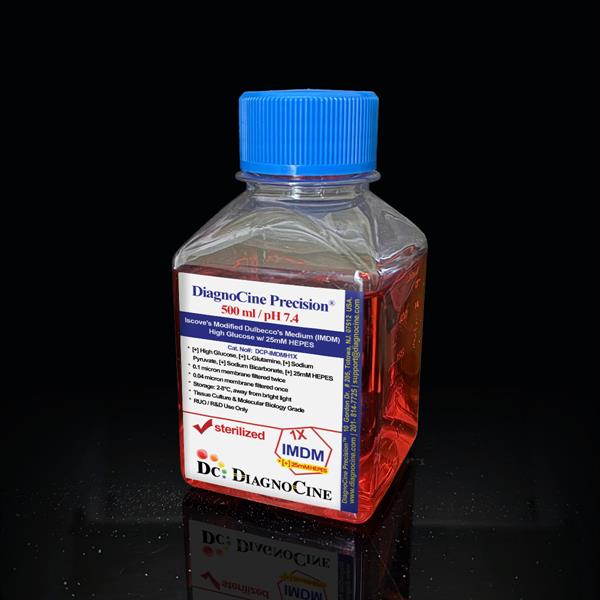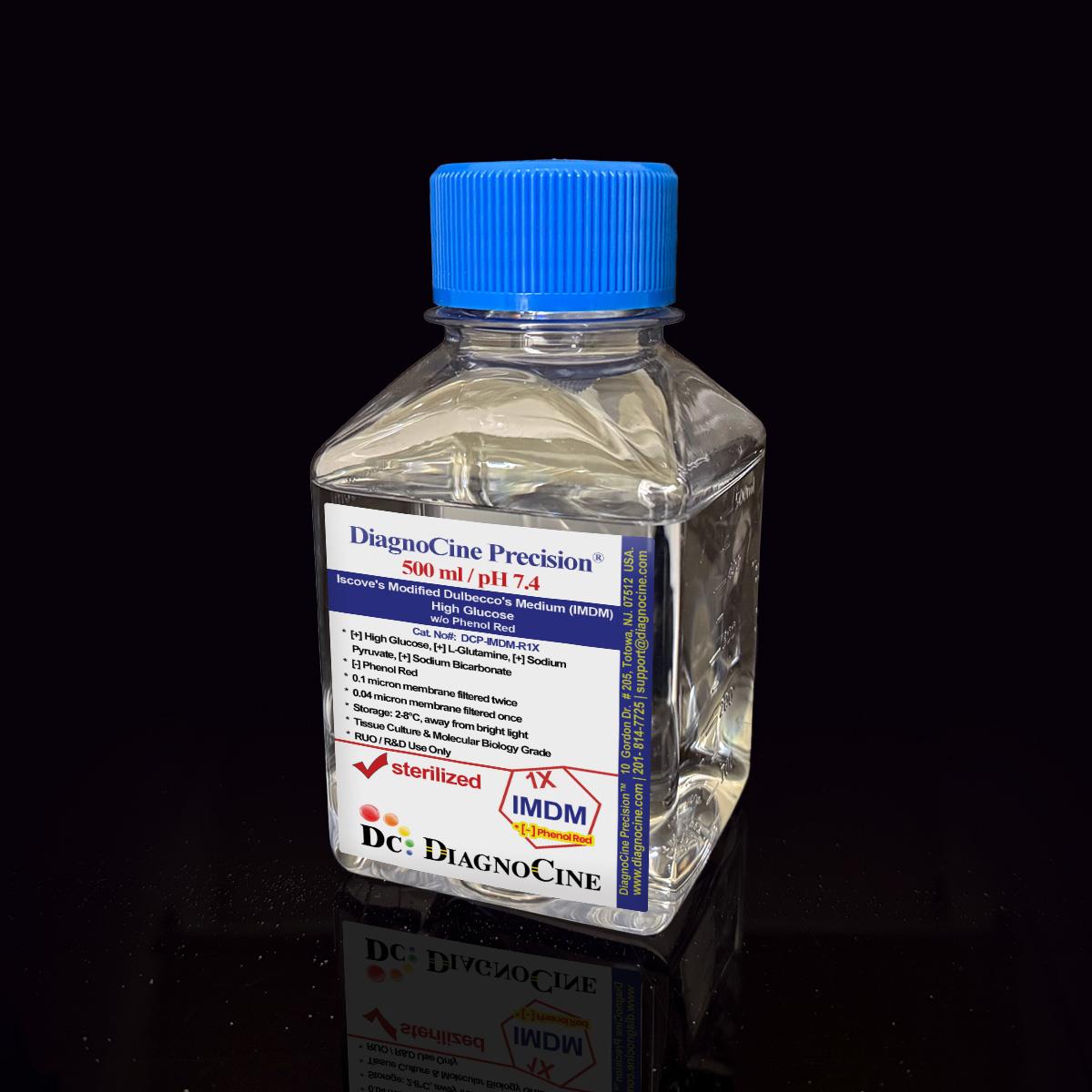
FluxMPS™ Iscove's Modified Dulbecco's Medium (IMDM) High Glucose w/o Phenol Red : 1X Liquid
FluxMPS™ Iscove's Modified Dulbecco's Medium (IMDM) High Glucose w/o Phenol Red : 1X Liquid
Microfluidics Suitable, quadruple-stage ultra-filtered (0.1 µm ×2 + 0.04 µm ×2) high-glucose Iscove's Modified Dulbecco's Medium (IMDM), phenol red-free, engineered for microphysiological systems (MPS) and microfluidic channels. A quadruple-stage train (0.1 µm ×2 + 0.04 µm ×2) reaches a 0.04 µm final cut-off, five times finer than the 0.22 µm membranes used for conventional sterile filtration.
- Iscove's Modified Dulbecco's Medium (IMDM), high-glucose (4500.000 mg/L), phenol red-free formulation suited to optical and estrogen-sensitive assays
- Quadruple-stage filtration train (0.1 µm ×2 + 0.04 µm ×2) for microchannel-safe, ultra-low-particulate media
- Endotoxin release specification < 0.05 EU/mL (USP <85> BET), controlled per manufacturing batch with Certificate of Analysis
- Enriched amino-acid and vitamin profile with sodium selenite and potassium nitrate, supporting high-density, rapidly proliferating cultures
- L-Glutamine (584.000 mg/L) and sodium pyruvate (110.000 mg/L) included; sodium bicarbonate-buffered (3024.000 mg/L NaHCO3), 8-10% CO2 recommended
- Manufactured under an ISO 13485:2016 quality management system with full lot traceability
- Formulated with Ultrapure Type 1 water (18.2 MΩ·cm) to minimize trace-metal and organic carbon contribution
- pH, glucose concentration, salts, HEPES, and nutrient composition available on request — contact support@diagnocine.com
- Glucose4500.000 mg/L
- L-Glutamine584.000 mg/L
- Sodium Pyruvate110.000 mg/L
- pH (USP <791>)7.4
- Osmolality (USP <785>)210 - 250 mOsm/kg H2O
- Endotoxin< 0.05 EU/mL
- FiltrationQuadruple-stage (0.1 µm ×2 + 0.04 µm ×2)
- Storage2 - 8 °C, protected from light
- Shelf Life12 months from date of manufacture, unopened
- ShippingCold-pack
Engineered where standard 0.22 µm media fails
Conventional 0.22 µm-filtered media can carry subvisible particulates and mycoplasma-scale contaminants (the smallest known mycoplasma species measure approximately 0.2 - 0.3 µm) that accumulate in microfluidic channels, corrupt biosensor signals, and shorten perfusion runs. FluxMPS™ IMDM, High Glucose w/o Phenol Red is re-engineered for these microphysiological systems.[1,2]
Microchannel-safe purity
A 0.04 µm final-polish filter targets subvisible particulates per USP <788> Method 1 (light obscuration), reducing the microchannel accumulation and clogging that can degrade organ-on-a-chip experiments.
Total metabolic control
A defined, user-tunable carbon-source and nutrient backbone supports Warburg-effect and metabolic-flux studies where standard serum-rich media confound the readout.
Ultrapure-grade water
Formulated with Ultrapure Type 1 water (18.2 MΩ·cm) to minimize trace-metal and organic carbon (TOC) contribution to the finished medium.
Low background for imaging
Ultra-low-particulate fluid reduces optical scatter for confocal microscopy, biosensors, and TEER measurements. This formulation contains riboflavin, which contributes its own baseline fluorescence; the purity benefit here is particulate reduction, not autofluorescence elimination.
Rich, stable nutrient profile
IMDM's enriched amino-acid and vitamin profile, sodium selenite, and sodium pyruvate are released on a micro-batch basis for lot-to-lot consistency.
Customization on demand
pH, glucose, salts, HEPES, and nutrient composition can be adjusted on request — contact support@diagnocine.com.
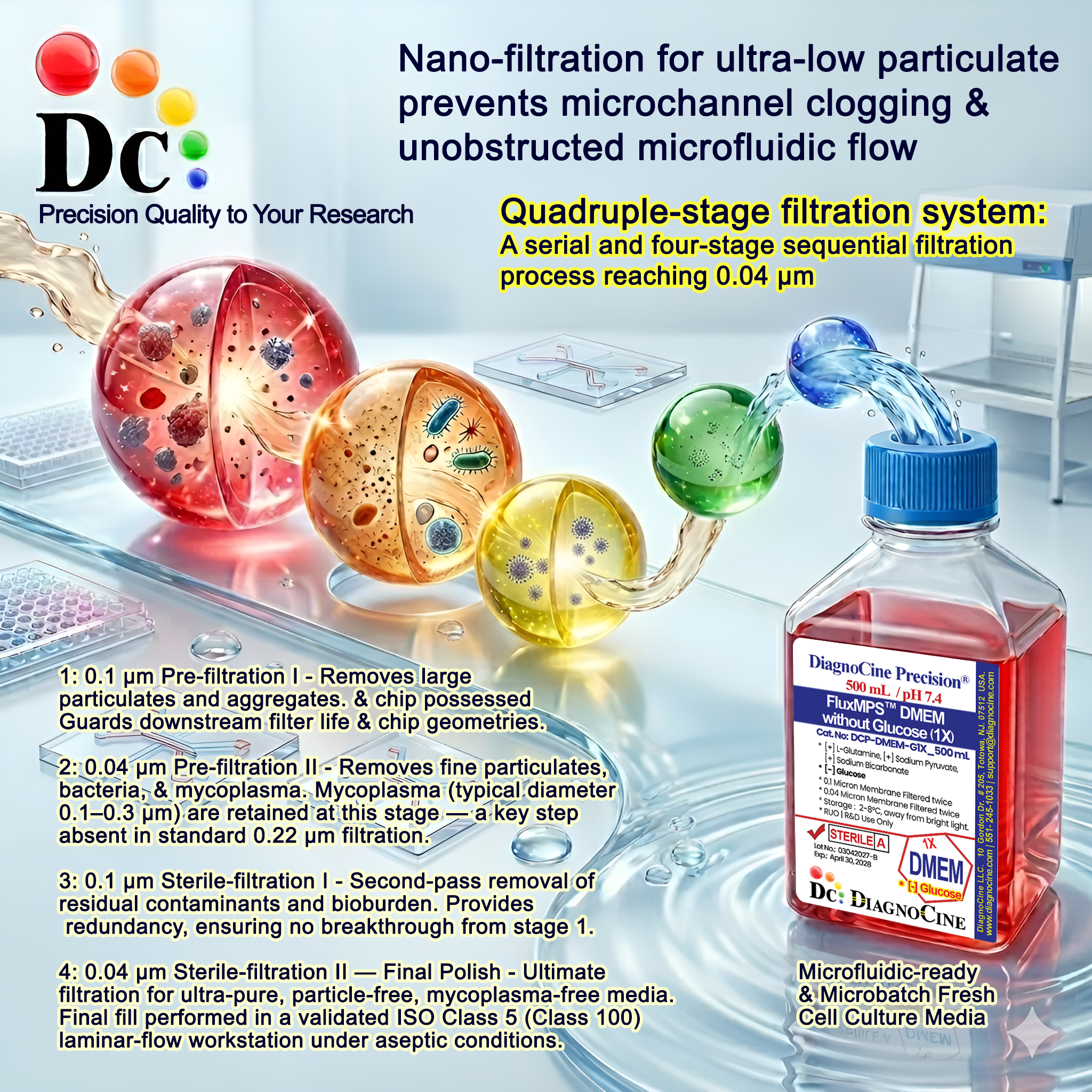
Quadruple-stage filtration system
The FluxMPS™ purity architecture is built around a four-stage membrane train (0.1 µm ×2 + 0.04 µm ×2), positioning DCP-IMDM-R1X as a ready-to-use, ultra-clean medium for microfluidic and organ-on-a-chip work, exceeding the particulate control achievable with conventional 0.22 µm filtration alone.[2,3]
-
1
0.1 µmPrefiltration I
Large particulate and aggregate removal that extends downstream filter life and protects the first 0.04 µm cartridge.
-
2
0.04 µmFinal filtration I
First 0.04 µm pass; retains sub-micron particulates and microaggregates that pass a 0.22 µm filter.
-
3
0.1 µmPrefiltration II
Second dedicated prefilter, protecting the second 0.04 µm cartridge and providing redundancy in the train.
-
4
0.04 µmFinal filtration II — Polish
Ultimate polishing filter, filled under an ISO Class 5 (Class 100) aseptic environment.
Performance vs. conventional media
© Diagnocine® — DCP-IMDM-R1X
Built for microphysiological & organ-on-a-chip research
IMDM, High Glucose w/o Phenol Red supports rapidly proliferating, high-density cultures — from erythroid progenitors, macrophages, and B/T lymphocytes to hybridomas — and is well suited to perfused MPS, metabolic, and imaging applications.[1,4]
Automated Bioreactors & Robotics
For automated bioreactors and robotic perfusion platforms, an optional 10 nm (0.01 µm) ultra-filtered MPS Grade variant is available to push particulate exclusion beyond the standard 0.04 µm Microfluidics Suitable polish.
- Total particulate exclusion for narrow microchannels and high-resolution optics
- Valve & sensor protection across long unattended runs
- Extended perfusion stability for multi-week organ-on-a-chip experiments
Inquiry Required: the optional MPS Grade 0.01 µm (10 nm) variant is made to order — contact support@diagnocine.com to request it.
Micro Physiological System (MPS) & Chip
Ultra-low-particulate fluid for perfused chips and barrier models.
Warburg Effect & Metabolic Research
Defined carbon-source backbone for tumor-metabolism studies.
iPSC-Derived Models
Consistent nutrient profile for differentiated iPSC cultures.
Endothelial & Primary Cells
Low-background medium for vessel-on-chip and primary cells.
Metabolic Flux Analysis
Clean baseline for tracer and respirometry workflows. This bicarbonate-buffered formulation is not compatible with Agilent Seahorse XF assays, which require bicarbonate-free, phenol red-free medium.
Microscopy & Optical Sensing
Low-particulate medium for long-term imaging and sensing.
Technical specifications
Representative specifications for DCP-IMDM-R1X. Values are confirmed per lot on the Certificate of Analysis.
| Parameter | Specification |
|---|---|
| Formulation | IMDM 1X liquid; contains L-Glutamine, Sodium Bicarbonate, Calcium, Magnesium, Glucose, Sodium Pyruvate; without Phenol Red |
| Appearance | Colorless, clear solution |
| pH USP <791> | 7.4 |
| Osmolality USP <785> | 210 - 250 mOsm/kg H2O |
| Glucose | 4500.000 mg/L |
| L-Glutamine | 584.000 mg/L |
| Sodium Pyruvate | 110.000 mg/L |
| Phenol Red | Not added |
| Parameter | Specification |
|---|---|
| Endotoxin USP <85> BET | < 0.05 EU/mL (batch release specification — see § Quality Assurance) |
| Sterility USP <71> | Filtered in a sterile environment. No bacterial or fungal growth observed after 14 days of incubation per USP specification. |
| Mycoplasma | 0.04 µm final filtration (mycoplasma-retentive; not tested per lot) |
| Particulate ≥10 µm USP <788> | Meets USP <788> Method 1 limits |
| Particulate ≥25 µm USP <788> | Meets USP <788> Method 1 limits |
| Water purity | Ultrapure Type 1 (18.2 MΩ·cm) |
| Manufacturing std. ISO | ISO 13485:2016; 21 CFR Part 820 (QMSR) aligned |
| Fill environment | ISO Class 5 (Class 100) aseptic |
| Parameter | Specification |
|---|---|
| Storage temperature | 2 - 8 °C, away from bright light |
| Freeze-thaw | Avoid repeated freeze-thaw |
| Shelf life | 12 months from date of manufacture, unopened |
| Shipping condition | Cold-pack |
| CO2 requirement | 8 - 10% CO2 recommended (sodium bicarbonate-buffered; consistent with 3024.000 mg/L NaHCO3 at pH 7.4) |
| Parameter | Specification |
|---|---|
| Raw material grade | Cell-culture grade, traceable lots |
| Traceability | Full lot traceability with CoA |
| Manufacturing QMS | ISO 13485:2016 certified facility |
| UNSPSC | 41116155 — Molecular biology and cell culture growth media (UNv260801) |
| Regulatory alignment | 21 CFR Part 820 (QMSR) aligned; For Research Use Only (RUO) |
| Production method | Micro-batch, ISO Class 5 fill & finish |
| Intended use | For Research Use Only (RUO) |
Full composition (mg/L)
Complete defined formulation of DCP-IMDM-R1X, released on a per-lot basis. Total: 40 components across 4 categories (Inorganic Salts, Amino Acids, Vitamins, Others).
| Component | CAS Number | mg/L |
|---|---|---|
| INORGANIC SALTS | ||
| Calcium chloride dihydrate | 10035-04-8 | 219.000 |
| Magnesium sulfate anhydrous | 7487-88-9 | 97.720 |
| Potassium chloride | 7447-40-7 | 330.000 |
| Potassium nitrate | 7757-79-1 | 0.076 |
| Sodium bicarbonate | 144-55-8 | 3024.000 |
| Sodium chloride | 7647-14-5 | 4505.000 |
| Sodium dihydrogen phosphate anhydrous | 7558-80-7 | 109.000 |
| Sodium selenite | 10102-18-8 | 0.0173 |
| Component | CAS Number | mg/L |
|---|---|---|
| AMINO ACIDS | ||
| Glycine | 56-40-6 | 30.000 |
| L-Alanine | 56-41-7 | 25.000 |
| L-Arginine hydrochloride | 1119-34-2 | 84.000 |
| L-Asparagine | 70-47-3 | 25.000 |
| L-Aspartic acid | 56-84-8 | 30.000 |
| L-Cystine dihydrochloride | 30925-07-6 | 91.240 |
| L-Glutamic acid | 56-86-0 | 75.000 |
| L-Glutamine | 56-85-9 | 584.000 |
| L-Histidine hydrochloride monohydrate | 5934-29-2 | 42.000 |
| L-Isoleucine | 73-32-5 | 104.800 |
| L-Leucine | 61-90-5 | 104.800 |
| L-Lysine hydrochloride | 657-27-2 | 146.200 |
| L-Methionine | 63-68-3 | 30.000 |
| L-Phenylalanine | 63-91-2 | 66.000 |
| L-Proline | 147-85-3 | 40.000 |
| L-Serine | 56-45-1 | 42.000 |
| L-Threonine | 72-19-5 | 95.200 |
| L-Tryptophan | 73-22-3 | 16.000 |
| L-Tyrosine disodium salt | 69847-45-6 | 104.200 |
| L-Valine | 72-18-4 | 93.600 |
| Component | CAS Number | mg/L |
|---|---|---|
| VITAMINS | ||
| Choline chloride | 67-48-1 | 4.000 |
| D-Biotin | 58-85-5 | 0.013 |
| D-Ca-Pantothenate | 137-08-6 | 4.000 |
| Folic acid | 59-30-3 | 4.000 |
| Nicotinamide | 98-92-0 | 4.000 |
| Pyridoxal hydrochloride | 65-22-5 | 4.000 |
| Riboflavin | 83-88-5 | 0.400 |
| Thiamine hydrochloride | 67-03-8 | 4.000 |
| Vitamin B12 | 68-19-9 | 0.013 |
| i-Inositol | 87-89-8 | 7.200 |
| OTHERS | ||
| D-Glucose | 50-99-7 | 4500.000 |
| Sodium pyruvate | 113-24-6 | 110.000 |
Manufacturing & compliance
All final packaging, quality assurance, and testing for DCP-IMDM-R1X are completed at the Diagnocine R&D and Quality Testing Center; customization and assembly are performed at Diagnocine Precision, Totowa, New Jersey, USA.
ISO 13485:2016 QMS
Manufactured under an ISO 13485:2016 quality management system, 21 CFR Part 820 (QMSR) aligned.
Ultrapure Type 1 Water
Formulated with 18.2 MΩ·cm Ultrapure Type 1 water for low trace-metal and organic carbon (TOC) content.
ISO Class 5 Fill & Finish
Final 0.04 µm polish and aseptic fill performed in an ISO Class 5 (Class 100) environment.
Micro-Batch Precision
Micro-batch production with per-lot release testing for lot-to-lot consistency and traceability.
Endotoxin USP <85> BET
Bacterial endotoxin testing (LAL assay) to a < 0.05 EU/mL release specification, controlled per batch.
Particulate USP <788> Method 1
Subvisible particulate matter controlled to USP <788> Method 1 (light obscuration) limits.
Osmolality USP <785>
Osmolality verified per lot within the specified range.
Documentation / CoA
A Certificate of Analysis accompanies every lot with measured QC values.
- Endotoxin — LAL assay, USP <85> Bacterial Endotoxins Test; assay sensitivity 0.005 EU/mL; release specification < 0.05 EU/mL
- pH, osmolality, conductivity, appearance and clarity
- Sterility
How DCP-IMDM-R1X compares
DCP-IMDM-R1X versus conventional 0.22 µm-filtered IMDM and a standard 0.22 µm-filtered DMEM-class alternative.
| Parameter | DCP-IMDM-R1X (FluxMPS™) | Conventional IMDM (0.22 µm) | Standard DMEM-class (0.22 µm) |
|---|---|---|---|
| Grade | Microfluidics Suitable | Standard 0.22 µm grade | Standard 0.22 µm grade |
| Formulation enrichment | Iscove-enriched amino acids/vitamins + selenium, potassium nitrate | IMDM base | DMEM base |
| Final filtration pore size | 0.04 µm (40 nm) | 0.22 µm | 0.22 µm |
| Number of filtration stages | 4 (0.1 µm ×2 + 0.04 µm ×2) | 1 | 1 |
| Mycoplasma barrier filtration | check_circle | cancel | cancel |
| Endotoxin (release specification) | < 0.05 EU/mL | Corning classical liquid media — < 0.25 EU/mL Sigma-Aldrich DMEM complete medium — ≤ 2 EU/mL Gibco classical DMEM — Not specified (recorded per lot) |
|
| USP <788> particulate compliance | check_circle | cancel | cancel |
| Water quality | Ultrapure Type 1 (18.2 MΩ·cm) | Type 1/2 | Type 1/2 |
| Manufacturing QMS | ISO 13485:2016 | Varies | Varies |
| Microfluidic channel compatibility | check_circle | Limited | Limited |
| Custom formulation | check_circle | Limited | Limited |
Comparison figures from published supplier specifications, accessed 2026-09-02. Suppliers that publish no numeric endotoxin specification are shown as "Not specified".
Frequently asked questions
Common questions about DCP-IMDM-R1X for microphysiological and standard cell-culture workflows.
Supporting literature
Peer-reviewed literature supporting the use of enriched, ultra-filtered media in microphysiological and metabolic research.
- Bhatia SN, Ingber DE. Microfluidic organs-on-chips. Nat Biotechnol. 2014;32(8):760-772.doi:10.1038/nbt.2989
- Ronaldson-Bouchard K, Vunjak-Novakovic G. Organs-on-a-Chip: A Fast Track for Engineered Human Tissues in Drug Development. Cell Stem Cell. 2018;22(3):310-324.doi:10.1016/j.stem.2018.02.011
- Halldorsson S, et al. Advantages and challenges of microfluidic cell culture in polydimethylsiloxane devices. Biosens Bioelectron. 2015;63:218-231.doi:10.1016/j.bios.2014.07.029
- Iscove NN, Melchers F. Complete replacement of serum by albumin, transferrin, and soybean lipid in cultures of lipopolysaccharide-reactive B lymphocytes. J Exp Med. 1978;147(3):923-933.doi:10.1084/jem.147.3.923
- Vander Heiden MG, Cantley LC, Thompson CB. Understanding the Warburg effect: the metabolic requirements of cell proliferation. Science. 2009;324(5930):1029-1033.doi:10.1126/science.1160809
- Nikolaev M, et al. Homeostatic mini-intestines through scaffold-guided organoid morphogenesis. Nature. 2020;585(7826):574-578.doi:10.1038/s41586-020-2724-8
- Drexler HG, Uphoff CC. Mycoplasma contamination of cell cultures: Incidence, sources, effects, detection, elimination, prevention. Cytotechnology. 2002;39(2):75-90.doi:10.1023/A:1022913015916
- Booth R, Kim H. Characterization of a microfluidic in vitro model of the blood-brain barrier. Lab Chip. 2012;12(10):1784-1792.doi:10.1039/c2lc40094d
- Whitesides GM. The origins and the future of microfluidics. Nature. 2006;442(7101):368-373.doi:10.1038/nature05058
- Low LA, Mummery C, Berridge BR, et al. Organs-on-chips: into the next decade. Nat Rev Drug Discov. 2021;20(5):345-361.doi:10.1038/s41573-020-0079-3