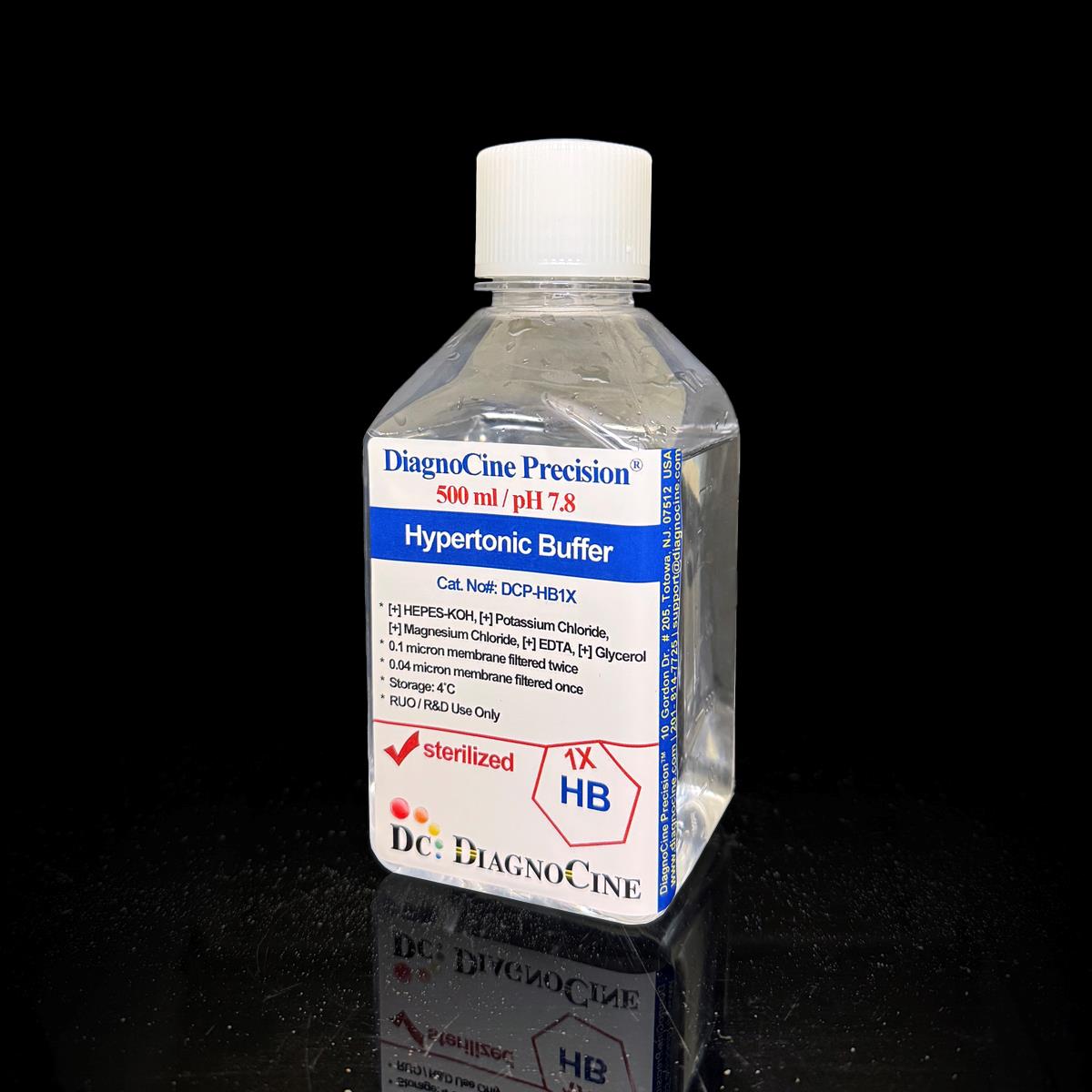
Hypertonic Buffer
FluxMPS™ Hypertonic Buffer
FluxMPS™ Hypertonic Buffer is an MPS-grade, high-salt extraction buffer formulated with HEPES-KOH, potassium chloride, magnesium chloride, EDTA, and glycerol at a stable pH of 7.8. Quadruple-stage membrane filtration (0.1 µm membrane twice, 0.04 µm membrane twice) delivers ultra-low particulate purity suited to nuclear protein extraction, cell lysis, and microfluidic / organ-on-a-chip workflows.
- Filtered 0.1 µm membrane twice and 0.04 µm membrane twice for ultra-low particulate purity
- 0.42 M potassium chloride provides the high-salt environment for nuclear protein extraction
- 50 mM HEPES-KOH maintains a stable pH of 7.8 for protein structure and function
- 0.1 mM EDTA chelates metal ions to inhibit metal-dependent enzymatic degradation
- 20% glycerol stabilizes proteins against denaturation during extraction and storage
- Tested free of DNase and RNase activity after 18-hour incubation at room temperature
- Manufactured in ISO 13485-certified, CE-approved facilities
- Custom concentrations, pH, tracking dyes, and modifications available on request
- pH7.8
- Potassium Chloride0.42 M
- HEPES-KOH50 mM
- Magnesium Chloride5 mM
- EDTA0.1 mM
- Glycerol20%
- Filtration0.1 µm x2 + 0.04 µm x2
- Storage4°C
- Shelf Life1 year
- Format500 mL, sterile
Engineered where standard extraction buffers fail
Conventional 0.22 µm-filtered buffers can leave behind subvisible particulates, drift in pH and ionic strength between lots, and carry bioburden into downstream nuclear extraction, lysis, and microfluidic workflows. FluxMPS™ Hypertonic Buffer is built to remove those failure modes at the formulation and filtration level.
Microchannel-safe purity
Quadruple-stage 0.1 µm / 0.04 µm membrane filtration reduces particulate load that can otherwise foul microfluidic channels and valves.
Precise, stable pH
HEPES-KOH buffering holds pH at 7.8, preserving nuclear protein structure and function throughout extraction.
Ultrapure-grade water
Formulated with Ultrapure Type 1 water (18.2 MΩ·cm) consistent with USP <85> water quality expectations.
Low background for downstream assays
DNase- and RNase-free QC supports clean downstream nucleic acid and protein analysis without background interference.
Defined, traceable composition
HEPES-KOH, potassium chloride, magnesium chloride, EDTA, and glycerol are each formulated to a defined, disclosed concentration.
Customization on demand
Alternative concentrations, pH, tracking dyes, and other modifications can be formulated on request.
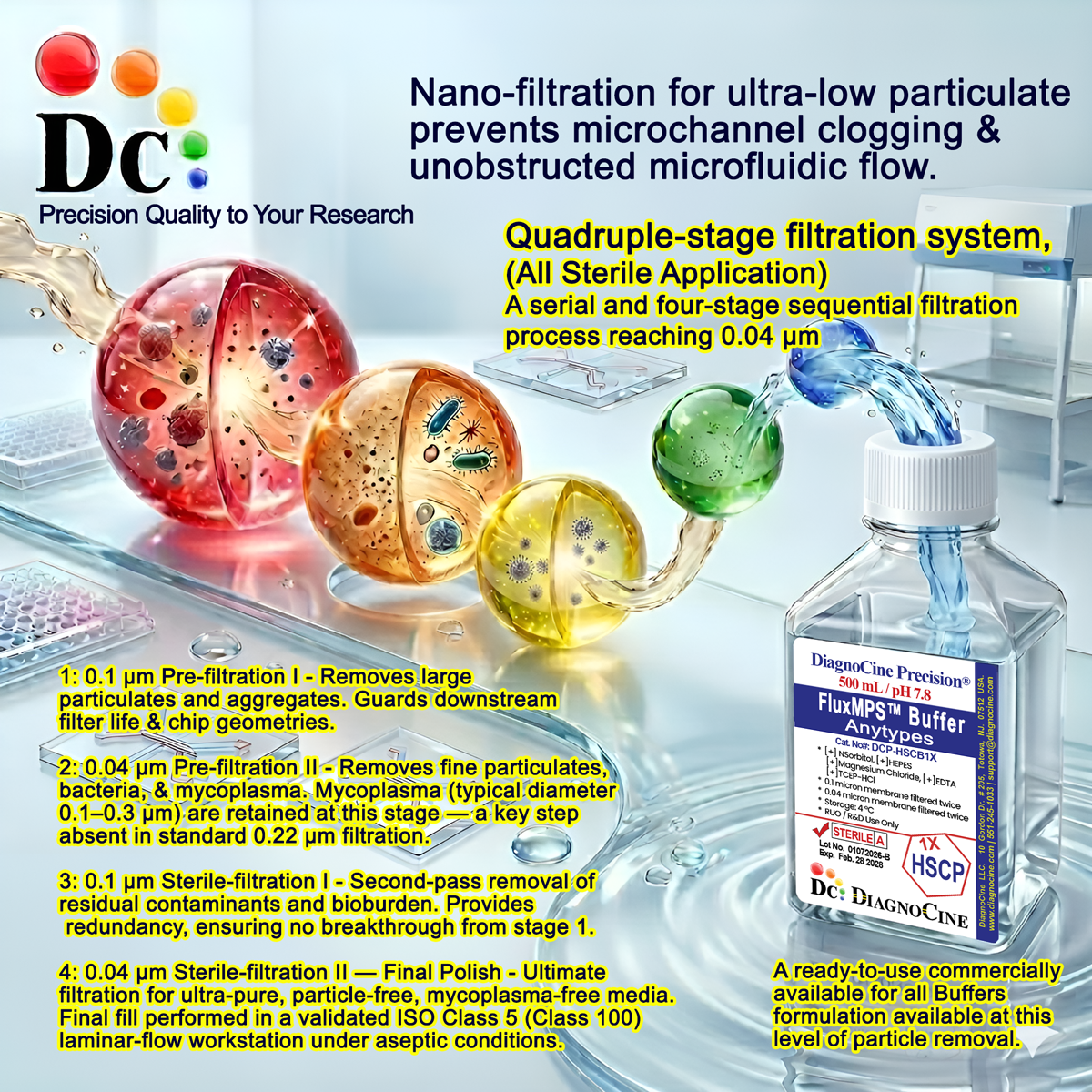
Quadruple-stage filtration system
Hypertonic Buffer is sterile-filtered through a 0.1 µm membrane twice and a 0.04 µm membrane twice, providing sequential particulate and bioburden reduction ahead of aseptic fill.
-
1
0.1 µm Pre-filtration I
Initial 0.1 µm membrane pass removes large particulates and aggregates, extending the service life of downstream filtration membranes.
-
2
0.04 µm Pre-filtration II
0.04 µm membrane pass retains fine particulates and bioburden ahead of final sterile filtration.
-
3
0.1 µm Sterile-filtration I
Second 0.1 µm membrane pass provides redundant particulate and bioburden reduction.
-
4
0.04 µm Sterile-filtration II — Final Polish
Final 0.04 µm membrane pass polishes the buffer in an ISO Class 5 (Class 100) aseptic fill environment prior to sterile packaging.
Performance vs. conventional buffer
Sequential 0.1 µm and 0.04 µm membrane filtration, each applied twice, removes finer particulates than a single 0.22 µm pass used in conventional buffer preparation. Mycoplasma organisms are typically about 0.2 microns in diameter, larger than the final 0.04 µm pore, supporting mycoplasma contamination prevention.
© Diagnocine® — DCP-HB1X
Where Hypertonic Buffer performs
The high-salt, HEPES-KOH-buffered formulation is optimized for nuclear protein extraction, cell disruption workflows, and protein stabilization across research and microfluidic platforms.
Automated Bioreactors & Robotics
For automated perfusion bioreactors and robotic liquid handling, an optional 0.01 µm (10 nm) ultra-filtered variant of this buffer can be formulated to further protect fine-bore tubing, valves, and sensors.
- Total Particulate Exclusion: sub-10 nm filtration for the most particulate-sensitive systems
- Valve & Sensor Protection: reduces the risk of fine particulate fouling in automated fluidics
- Extended Perfusion Stability: supports longer unattended run times in closed-loop systems
Inquiry Required: the 0.01 µm ultra-filtered grade is available on request — contact support@diagnocine.com.
Micro Physiological System (MPS) & Chip
Quadruple-filtered, low-particulate buffer suited for microphysiological system and organ-on-a-chip fluidics.
Nuclear Protein Extraction & Lysis
The 0.42 M potassium chloride and HEPES-KOH formulation extracts nuclear proteins after cell lysis and cytoplasmic/nuclear fractionation.
iPSC-Derived Model Handling
Supports nuclear extraction workflows in iPSC-derived neuronal, cardiac, and hepatic model systems.
Endothelial & Primary Cell Perfusion
Ultra-filtered composition is compatible with perfusion-adjacent handling of endothelial and primary cell cultures.
ELISA, Blotting & Blocking
Glycerol-stabilized, DNase/RNase-free formulation supports clean nuclear extract preparation for downstream immunoassays.
Microscopy & Optical Sensing
Low-particulate, low-background buffer chemistry is compatible with optical and biosensor-based readouts.
Specifications at a glance
Formulation, purity, and handling parameters for FluxMPS™ Hypertonic Buffer, DCP-HB1X.
| Parameter | Specification |
|---|---|
| Formulation / Composition | HEPES-KOH 50 mM; Potassium Chloride 0.42 M; Magnesium Chloride 5 mM; EDTA 0.1 mM; Glycerol 20% |
| Appearance | Clear solution |
| pH USP <791> | 7.8 |
| Parameter | Specification |
|---|---|
| Sterility USP <71> | Filtered 0.1 µm membrane twice and 0.04 µm membrane twice in a sterile environment |
| DNase Activity | None detected after 18 hours incubation with plasmid DNA at room temperature |
| RNase Activity | None detected after 18 hours incubation with ribosomal RNA at room temperature |
| Water Quality | Ultrapure Type 1 water (18.2 MΩ·cm) |
| Manufacturing Standard ISO 13485 | ISO 13485-certified, CE-approved facilities |
| Fill Environment | ISO Class 5 (Class 100) aseptic fill |
| Parameter | Specification |
|---|---|
| Storage Temperature | 4°C |
| Shelf Life | 1 year |
| Parameter | Specification |
|---|---|
| Raw Material Grade | ISO 13485-certified, CE-approved supplier facilities (DiagnoCine Precision) |
| Traceability | Final packaging, QA, and testing at DiagnoCine R&D and Quality Testing Center; customization and assembly at DiagnoCine Precision, Totowa, New Jersey, USA |
| Manufacturing QMS ISO 13485:2016 | ISO 13485:2016 |
| Regulatory Alignment | CE-approved |
| Production Method | Sterile-filtered, 0.1 µm membrane twice and 0.04 µm membrane twice |
| Intended Use | Research Use Only (RUO) |
Full composition
Hypertonic Buffer is a HEPES-KOH-buffered, high-salt formulation released against the concentrations below.
| Component | CAS Number | Concentration |
|---|---|---|
| HEPES-KOH | 7365-45-9 | 50 mM |
| Potassium Chloride | 7447-40-7 | 0.42 M |
| Magnesium Chloride | 7786-30-3 | 5 mM |
| EDTA | 60-00-4 | 0.1 mM |
| Glycerol | 56-81-5 | 20% |
Manufacturing & compliance
Hypertonic Buffer is manufactured, filled, and tested under a controlled quality system.
ISO 13485:2016 QMS
Manufactured under ISO 13485-certified, CE-approved supplier facilities.
Ultrapure Type 1 Water
Formulated with Ultrapure Type 1 water (18.2 MΩ·cm).
ISO Class 5 Fill & Finish
Final 0.04 µm sterile filtration and fill performed in an ISO Class 5 (Class 100) environment.
Micro-Batch Precision
Final packaging, QA, and testing performed at the DiagnoCine R&D and Quality Testing Center; customization completed at DiagnoCine Precision, Totowa, New Jersey, USA.
DNase Activity
None detected after 18 hours incubation of plasmid DNA at room temperature.
RNase Activity
None detected after 18 hours incubation of ribosomal RNA at room temperature.
Sterility USP <71>
Filtered 0.1 µm membrane twice and 0.04 µm membrane twice in a sterile environment.
Documentation / CoA
Certificate of Analysis available on request.
How DCP-HB1X compares
FluxMPS™ Hypertonic Buffer against conventional 0.22 µm-filtered buffer and a standard alternative.
| Parameter | DCP-HB1X (FluxMPS™) | Conventional (0.22 µm filtered) | Standard alternative (0.22 µm filtered) |
|---|---|---|---|
| High-salt formulation for nuclear protein extraction | check_circle | cancel | cancel |
| Final filtration pore size | 0.04 µm | 0.22 µm | 0.22 µm |
| Number of filtration stages | 4 | 1 | 1 |
| Water quality | Ultrapure Type 1 (18.2 MΩ·cm) | Standard purified water | Standard purified water |
| Manufacturing QMS | ISO 13485:2016 | Not specified | Not specified |
| Microfluidic channel compatibility | check_circle | cancel | cancel |
| DNase/RNase-free verification | check_circle | cancel | cancel |
| Custom formulation available | check_circle | cancel | cancel |
Frequently asked questions
Common questions about FluxMPS™ Hypertonic Buffer, DCP-HB1X.
Supporting literature
Background literature relevant to hypertonic extraction buffers, HEPES-based buffering, and microfluidic / organ-on-a-chip applications.
- Dignam JD, Lebovitz RM, Roeder RG. Accurate transcription initiation by RNA polymerase II in a soluble extract from isolated mammalian nuclei. doi:10.1093/nar/11.5.1475
- Good NE, Winget GD, Winter W, et al. Hydrogen ion buffers for biological research. Biochemistry. doi:10.1021/bi00866a011
- Ferreira KN, Kissil JL. Nuclear protein extraction methods in cell biology research. doi:10.1385/1-59259-891-6:001
- Bhatia SN, Ingber DE. Microfluidic organs-on-chips. Nat Biotechnol. doi:10.1038/nbt.2989
- Zhang B, Radisic M. Organ-on-a-chip devices advance to market. Lab Chip. doi:10.1039/C6LC01554A
- Rasmussen HP, Bordier CC. Chelating agents in protein extraction and stabilization. doi:10.1016/0003-2697(81)90281-5
- Timasheff SN. Protein stabilization by glycerol and other cosolvents. Biochemistry. doi:10.1021/bi00483a001
- Rottem S, Barile MF. Beware of mycoplasma contamination in cell cultures. Trends Biotechnol. doi:10.1016/0167-7799(93)90059-N
- United States Pharmacopeia. USP <71> Sterility Tests. doi:10.31003/USP.NF.M99910