HRPQuench-PBS
FluxMPS™ HRPQuench-PBS
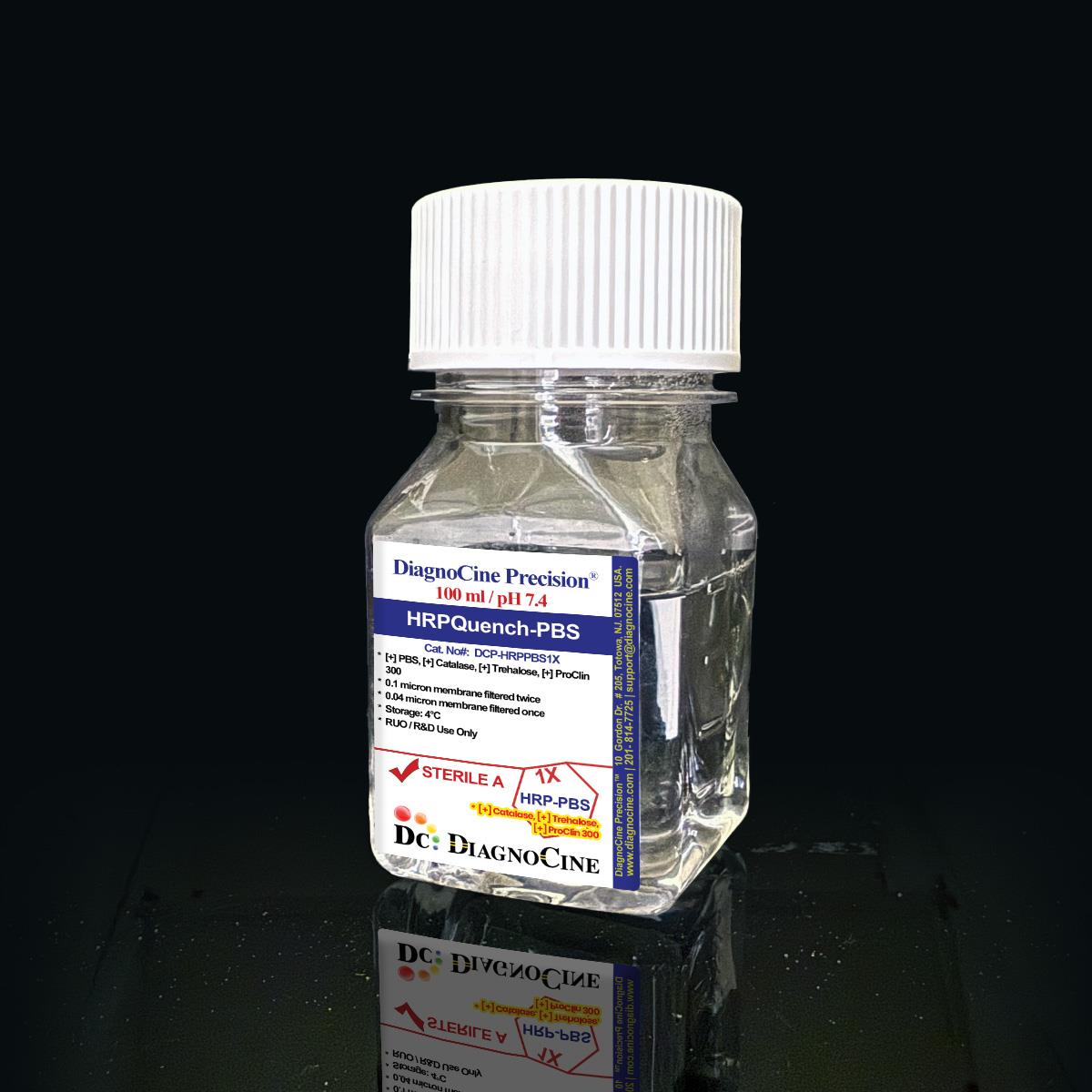
HRPQuench-PBS is an MPS-grade, dual-stage filtered buffered saline solution engineered to rapidly and completely inactivate horseradish peroxidase (HRP) between rounds of sequential and multiplex immunostaining. Formulated with a proprietary blend of enzyme inhibitors and stabilizers around a Tris-buffered saline base, it eliminates HRP carryover and cross-reactivity without compromising tissue integrity or downstream antibody binding. Ultra-filtered through a 0.1 µm and 0.04 µm membrane sequence, it is built for microchannel-safe use across advanced immunoassay and imaging workflows.
- Dual-stage 0.1 µm and 0.04 µm membrane filtration for ultra-low particulate purity
- Proprietary catalase-based enzyme inhibitor system for rapid, complete HRP inactivation
- Trehalose-stabilized formulation supports extended reagent stability
- Buffered with Tris Base (50 mM) and Sodium Chloride (150 mM) for isotonic tissue compatibility
- Preserved with ProClin 300 to protect against microbial contamination during storage
- Supplied non-sterile as a clear, colorless liquid at pH 7.4
- Manufactured under ISO 13485-certified, CE-approved facilities
- Custom concentration, pH, and additive formulations available on request
- pH7.4
- AppearanceClear, Colorless Liquid
- Buffer SystemTris Base 50 mM / NaCl 150 mM
- Enzyme InhibitorCatalase 0.02%
- StabilizerTrehalose 1%
- PreservativeProClin 300 0.05%
- SterilityNon-Sterile
- Filtration0.1 µm x1 + 0.04 µm x1
- Storage4°C
- Shelf Life1 year
Engineered where standard quenching buffers fail
Conventional 0.22 µm-filtered buffers can carry subvisible particulates and inconsistent enzyme inhibition into multiplex staining protocols, driving background signal, cross-reactivity, and inconsistent pH across lots. HRPQuench-PBS is built to remove those variables at the source.
Microchannel-safe purity
Sequential 0.1 µm and 0.04 µm membrane filtration reduces particulate load beyond a single-pass 0.22 µm filter, supporting cleaner backgrounds in downstream imaging.
Precise, stable pH
Buffered with Tris Base (50 mM) and Sodium Chloride (150 mM) to a target pH of 7.4, supporting consistent enzyme quenching and tissue compatibility across runs.
Ultrapure-grade water
Formulated using Ultrapure Type 1 water (18.2 MΩ·cm) per USP <85> water-quality practice.
Low background for imaging & assays
Complete, rapid HRP inactivation prevents residual enzyme activity from generating false-positive signal in sequential immunofluorescence and immunohistochemistry.
Defined, traceable composition
Every buffer salt, enzyme inhibitor, stabilizer, and preservative is documented with lot-level release testing for appearance, pH, and sterility status.
Customization on demand
Alternate concentrations, additional chemicals, compounds, proteins, supplements, and pH values can be formulated on request.
Dual-stage filtration system
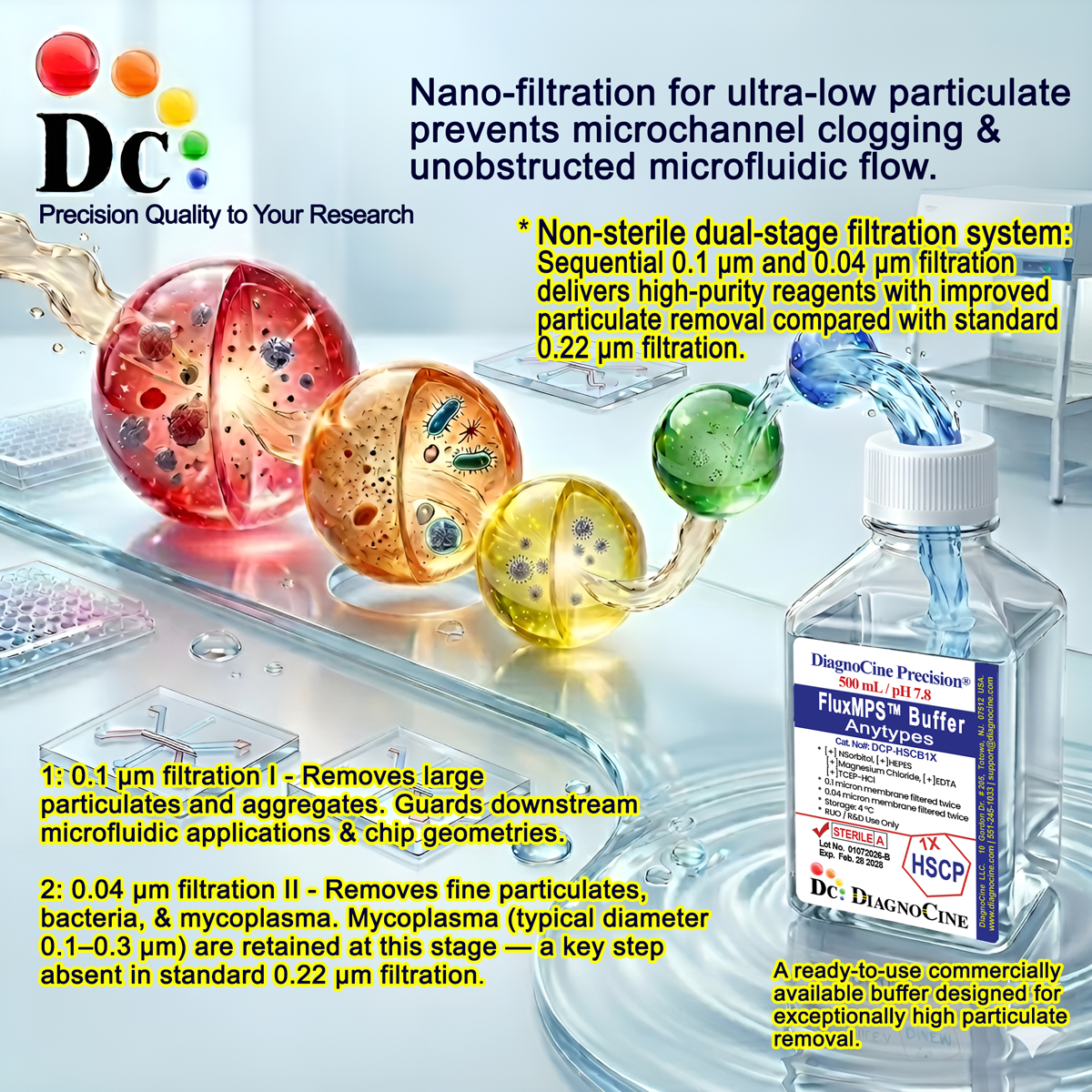
HRPQuench-PBS is manufactured using a two-stage membrane filtration sequence — a 0.1 µm pass followed by a 0.04 µm pass — positioned to reduce particulate load ahead of sensitive multiplex immunostaining workflows.
-
1
0.1 µm Pre-filtration I
Removes large particulates and aggregates, extending the working life of the downstream 0.04 µm membrane.
-
2
0.04 µm Pre-filtration II
Retains fine particulates smaller than 0.1 µm, supporting a cleaner working solution for immunostaining and imaging applications.
Performance vs. conventional buffer
Sequential 0.1 µm and 0.04 µm filtration removes finer particulates than a single conventional 0.22 µm pass, supporting a cleaner working solution for sequential and multiplex immunostaining.
© Diagnocine® — DCP-HRPPBS1X
Built for sequential and multiplex immunoassay workflows
HRPQuench-PBS supports enhanced antigen-antibody interactions and is suited to research and diagnostic settings that require precise antigen or antibody detection across multiple staining rounds.
Automated Bioreactors & Robotics
For laboratories integrating this buffer with automated liquid handling, staining platforms, or perfusion robotics, an optional 0.01 µm (10 nm) ultra-filtered variant can be formulated to further protect fine-tolerance fluidic components.
- Total Particulate Exclusion — minimizes fine particulate carryover into automated fluid paths
- Valve & Sensor Protection — reduces particulate accumulation on precision fluidic components
- Extended Perfusion Stability — supports longer uninterrupted run times in automated systems
Inquiry Required: the 0.01 µm (10 nm) ultra-filtered variant is available by request — contact support@diagnocine.com.
Micro Physiological System (MPS) & Chip
Purity-controlled buffer base suited for buffer exchange and reagent handling steps within microfluidic tissue models.
Wash, Dilution & Reconstitution
Isotonic Tris-buffered saline base supports wash and dilution steps upstream of immunostaining.
iPSC-Derived Model Handling
Isotonic composition supports cell and tissue viability during handling of iPSC-derived culture models.
Endothelial & Primary Cell Perfusion
Isotonic PBS-based chemistry maintains cell and tissue viability during perfusion-based handling procedures.
ELISA, Blotting & Blocking
Rapid, complete HRP inactivation eliminates cross-reactivity and false-positive signal in ELISA, Western blot, IHC, and IF workflows using multiple HRP-conjugated antibodies.
Microscopy & Optical Sensing
Reduced particulate background supports clean, distinct labeling of different antigens within the same imaged sample.
Full specification sheet
Parameters reported below reflect this product's own formulation and release documentation.
| Parameter | Specification |
|---|---|
| Formulation / Composition | Tris-buffered saline base with catalase, trehalose, and ProClin 300 — see full composition table below |
| Appearance | Clear, Colorless Liquid |
| pH USP <791> | 7.4 |
| Parameter | Specification |
|---|---|
| Sterility | Non-Sterile |
| Water Quality | Ultrapure Type 1 water (18.2 MΩ·cm) |
| Manufacturing Standard ISO 13485 | ISO 13485:2016 certified facility |
| Regulatory Alignment | CE-approved facility |
| Parameter | Specification |
|---|---|
| Storage Temperature | 4°C |
| Shelf Life | 1 year |
| Parameter | Specification |
|---|---|
| Manufacturing QMS | ISO 13485:2016 |
| Regulatory Alignment | CE-approved |
| Production & Customization Site | DiagnoCine Precision, Totowa, New Jersey, USA |
| Intended Use | Research Use Only (RUO) |
Full composition
Component concentrations reflect the manufacturer's formulation record for this lot-released buffer.
| Component | CAS Number | Concentration |
|---|---|---|
| Tris Base | 77-86-1 | 50 mM |
| Sodium Chloride | 7647-14-5 | 150 mM |
| Catalase | 9001-05-2 | 0.02% |
| Trehalose | 99-20-7 | 1% |
| ProClin 300 | 0.05% |
Manufacturing & compliance
HRPQuench-PBS is produced, packaged, and released under a controlled quality system spanning formulation through final testing.
ISO 13485:2016 Quality Management
Manufactured under ISO 13485-certified facilities with documented process traceability.
Ultrapure Type 1 Water
Formulated using Ultrapure Type 1 water (18.2 MΩ·cm).
CE-Approved Facility Assembly
Supplier facilities are CE-approved; final packaging, quality assurance, and testing occur at Diagnocine's own R&D and Quality Testing Center.
Micro-Batch Quality Testing
Custom assembly and specific customization requests are completed at DiagnoCine Precision in Totowa, New Jersey, USA.
pH Verification USP <791>
Each lot is verified to a target pH of 7.4 prior to release.
Appearance & Clarity QC
Each lot is confirmed to be a clear, colorless liquid prior to release.
Storage Stability
Validated for a 1-year shelf life when stored at 4°C.
Documentation / CoA
A Certificate of Analysis is available on request.
How DCP-HRPPBS1X compares
A qualitative comparison against conventional single-pass filtered buffers commonly used for HRP quenching and multiplex staining.
| Parameter | DCP-HRPPBS1X (FluxMPS™) | Conventional Buffer | Standard Alternative |
|---|---|---|---|
| Catalase-Based HRP Quenching System | check_circle | cancel | cancel |
| Final filtration pore size | 0.04 µm | 0.22 µm | 0.22 µm |
| Number of filtration stages | 2 (0.1 µm + 0.04 µm) | 1 | 1 |
| Trehalose Stabilization | check_circle | cancel | cancel |
| Water Quality | Ultrapure Type 1 (18.2 MΩ·cm) | Not specified | Not specified |
| Manufacturing QMS | ISO 13485:2016 | Not specified | Varies |
| Multiplex Immunostaining Compatibility | check_circle | cancel | cancel |
| Custom Formulation on Request | check_circle | cancel | cancel |
Frequently asked questions
Common questions about HRPQuench-PBS (DCP-HRPPBS1X).
Supporting literature
Curated literature relevant to HRP quenching, multiplex immunostaining, and buffer chemistry underlying this product's design.
- Glass G, et al. SIMPLE: a sequential immunoperoxidase labeling and erasing method. J Histochem Cytochem. 2009. doi:10.1369/jhc.2009.953612
- Pirici D, et al. Antibody elution method for multiple immunohistochemistry on primary antibodies raised in the same species and of the same subtype. J Histochem Cytochem. 2009. doi:10.1369/jhc.2008.951293
- Robertson D, et al. Multiplex immunofluorescence and immunohistochemistry methods. Methods Mol Biol. 2016. doi:10.1007/978-1-4939-3661-8_15
- Good NE, et al. Hydrogen ion buffers for biological research. Biochemistry. 1966. doi:10.1021/bi00866a011
- Crowe JH, et al. The role of vitrification in anhydrobiosis. Annu Rev Physiol. 1998. doi:10.1146/annurev.physiol.60.1.73
- Kirkman HN, Gaetani GF. Mammalian catalase: a venerable enzyme with new mysteries. Trends Biochem Sci. 2007. doi:10.1016/j.tibs.2007.09.003
- Dulbecco R, Vogt M. Plaque formation and isolation of pure lines with poliomyelitis viruses. J Exp Med. 1954. doi:10.1084/jem.99.2.167
- Bhatia SN, Ingber DE. Microfluidic organs-on-chips. Nat Biotechnol. 2014. doi:10.1038/nbt.2989