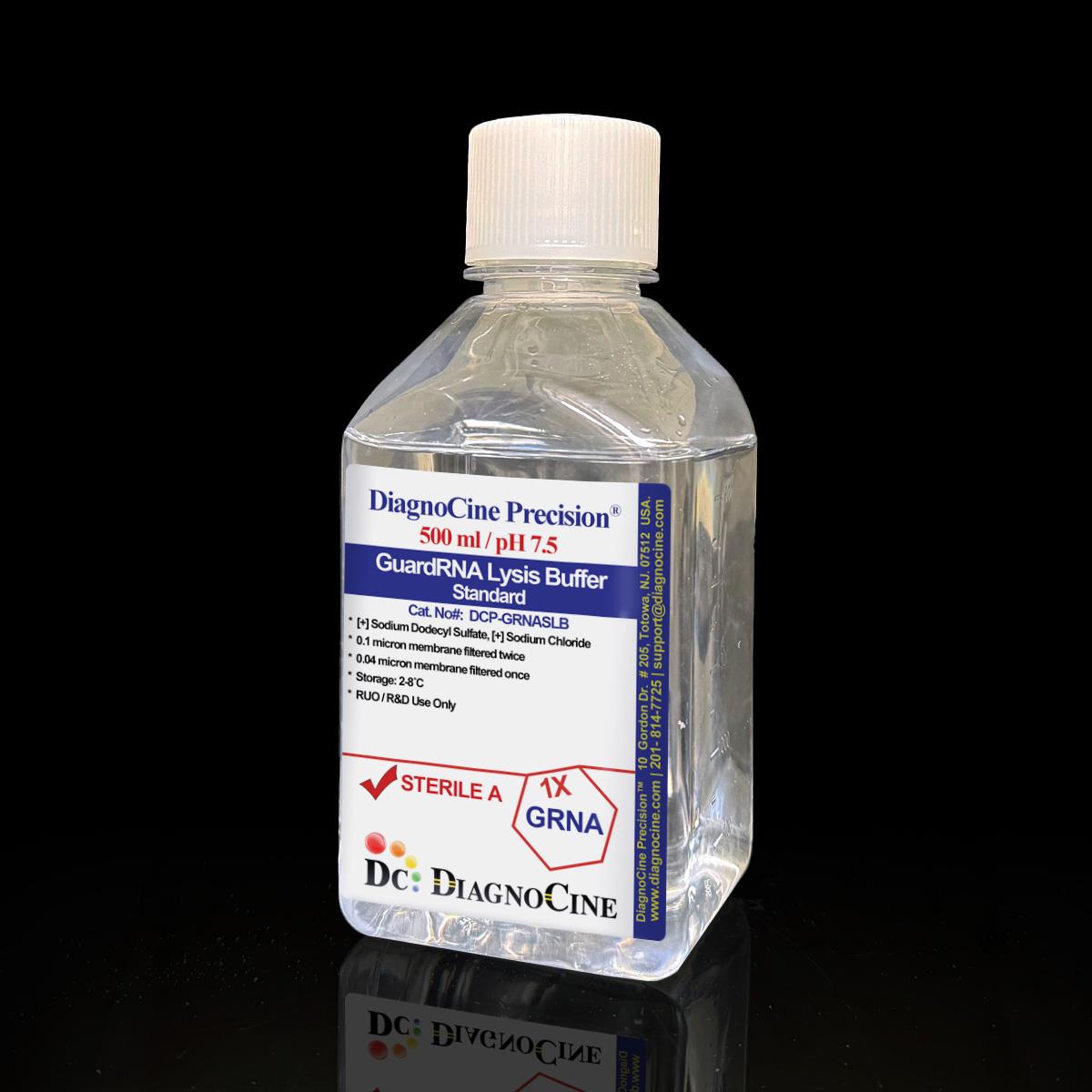
UltraClean GuardRNA Standard Lysis Buffer
FluxMPS™ UltraClean GuardRNA Standard Lysis Buffer
An MPS-grade, RNase-safe lysis reagent formulated with a strong anionic detergent and high ionic strength to disrupt cells while preserving RNA integrity for downstream purification. Quadruple-stage 0.1 µm and 0.04 µm ultra-filtration delivers microchannel-safe purity for manual, automated, and microfluidic RNA workflows.
- Quadruple-stage purity: filtered 0.1-micron membrane twice and 0.04-micron membrane twice
- RNase-safe formulation rapidly inactivates endogenous RNases to preserve true expression profiles
- pH 7.5, formulated with 4% (w/v) SDS and 0.5 M NaCl for efficient cell and tissue disruption
- Manufactured with ultrapure, nuclease-free water
- Compatible with column-, bead-, and precipitation-based RNA cleanup, including microfluidic and organ-on-a-chip sample prep
- Custom concentrations, additives, and pH available on request
- pH7.5
- SDS Concentration4% (w/v)
- NaCl Concentration0.5 M
- AppearanceColorless, clear solution
- SterilitySterile
- Filtration0.1 µm x2 + 0.04 µm x2
- Water QualityUltrapure, nuclease-free
- Storage2–8°C
- Freeze-ThawDo not freeze
- Shelf Life12 months
Engineered where standard lysis buffers fail
Conventional single-pass, coarsely filtered lysis reagents can carry subvisible particulates, residual nucleases, and inconsistent ionic strength into an RNA prep — degrading transcript integrity and introducing background into sensitive downstream assays. FluxMPS™ GuardRNA is manufactured to remove these failure points at the source.
Microchannel-safe purity
Quadruple-stage 0.1 µm and 0.04 µm filtration minimizes particulates that can foul microfluidic channels, valves, and automated liquid handlers.
Precise, stable formulation
Defined SDS (4% w/v) and NaCl (0.5 M) content at pH 7.5 delivers consistent, reproducible lysis and RNase inactivation lot to lot.
Ultrapure-grade water
Formulated with ultrapure, nuclease-free water to reduce the risk of adventitious nuclease or contaminant carry-over into RNA preps.
Low background for downstream assays
Clean, particulate-controlled formulation supports high-yield, high-quality RNA recovery for RNA-Seq, qPCR, and RT-PCR workflows.
Defined, traceable composition
Ingredients are molecular biology-grade, formulated at controlled concentration, and manufactured under ISO 13485-certified quality systems.
Customization on demand
Alternate concentrations, pH, and additional chemicals, compounds, proteins, or supplements are available on request.
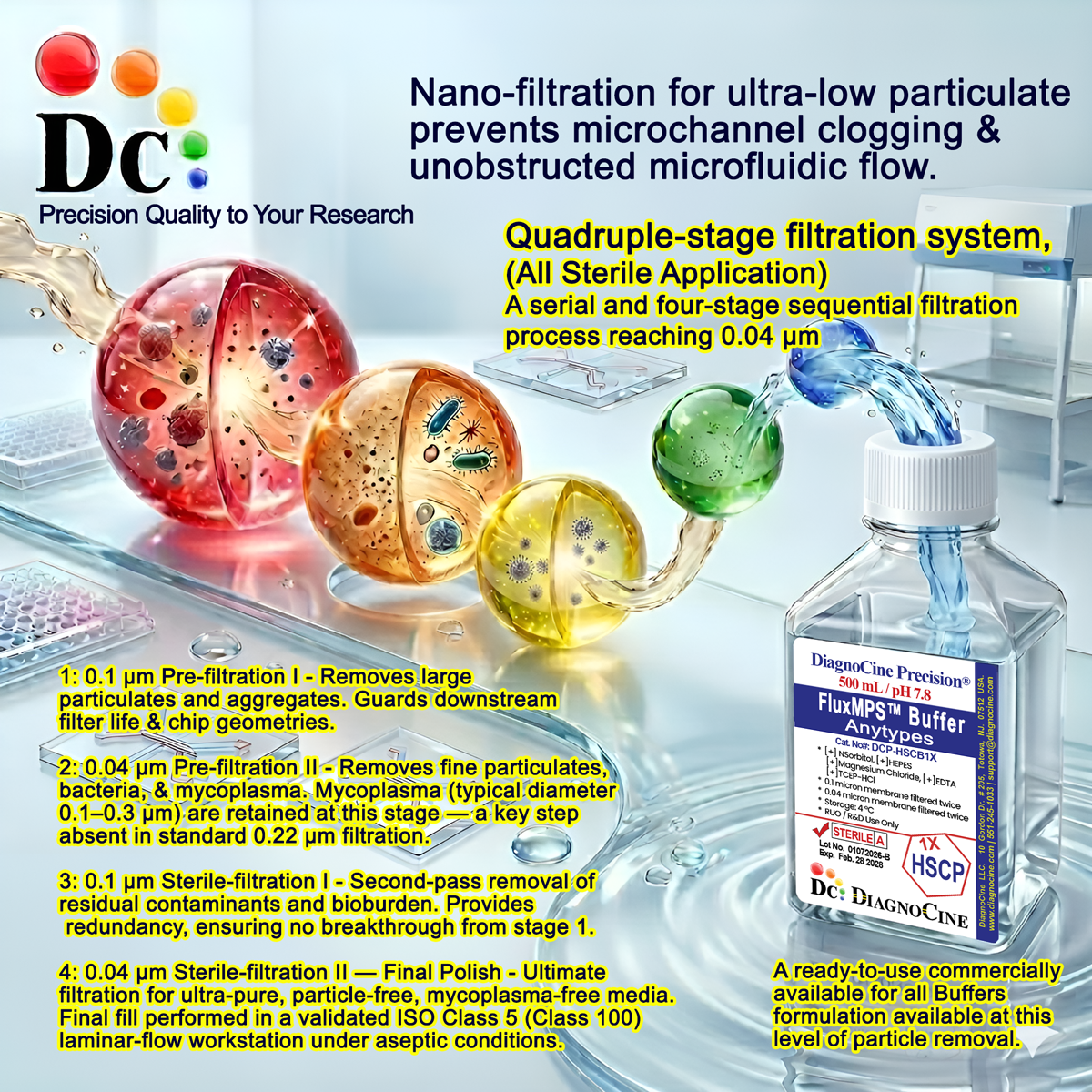
Quadruple-stage filtration system
Every lot of GuardRNA Standard Lysis Buffer is filtered 0.1-micron membrane twice and 0.04-micron membrane twice, sequentially removing coarse and fine particulates before final sterile fill.
-
1
0.1 µm Pre-filtration I
Large particulate and aggregate removal, extending the service life of downstream filters.
-
2
0.04 µm Pre-filtration II
Retention of fine particulates and bioburden ahead of the final filtration pass.
-
3
0.1 µm Sterile-filtration I
Second-pass redundancy through a 0.1 micron membrane ahead of final polish.
-
4
0.04 µm Sterile-filtration II — Final Polish
Final 0.04 micron polish helps prevent mycoplasma contamination; the smallest mycoplasma type is about 0.2 microns, well above this pore size.
Performance vs. conventional buffer
Sequential 0.1 µm and 0.04 µm filtration, applied twice each, removes finer particulates than a single conventional 0.22 µm pass, supporting cleaner RNA lysis reagent for sensitive downstream applications.
© Diagnocine® — DCP-GRNASLB
Where GuardRNA Standard Lysis Buffer is used
A ready-to-use, phenol-free lysis reagent supporting the front end of RNA extraction, purification, and molecular biology workflows across manual, high-throughput, and microfluidic platforms.
Automated Bioreactors & Robotics
For automated liquid handlers and robotic extraction platforms, an optional 0.01 µm (10 nm) ultra-filtered variant is available on request to further protect valves and sensors during continuous operation.
- Total Particulate Exclusion: further reduction of subvisible particulate load
- Valve & Sensor Protection: reduced risk of microfluidic hardware fouling
- Extended Perfusion Stability: supports longer unattended run times
Inquiry Required: contact support@diagnocine.com to request the 0.01 µm ultra-filtered grade.
Micro Physiological System (MPS) & Chip
Suitable as a lysis reagent for on-chip cell disruption and RNA recovery in microfluidic and organ-on-a-chip formats.
Wash, Dilution & Reconstitution
Primary lysis step for column-, bead-, or organic-extraction-based RNA isolation workflows across sample types.
iPSC-Derived Model Handling
Efficient disruption of iPSC-derived cell models for total RNA recovery and downstream transcript profiling.
Endothelial & Primary Cell Perfusion
RNase-safe lysis of cultured endothelial and primary cells for RNA-Seq, qPCR, and RT-PCR sample preparation.
ELISA, Blotting & Blocking
Compatible as a front-end lysis reagent when parallel protein and RNA workflows are run from the same sample set.
Microscopy & Optical Sensing
Supports RNA recovery from imaged cell cultures for correlative gene expression analysis.
Physical, chemical, and quality parameters
Measured and declared values for UltraClean GuardRNA Standard Lysis Buffer, Cat. No. DCP-GRNASLB.
| Parameter | Specification |
|---|---|
| Formulation | Anionic detergent (SDS) and high ionic strength salt lysis buffer |
| Appearance | Colorless, clear solution; free of visible particulates |
| pH | 7.5 |
| Sodium Dodecyl Sulfate (SDS) Concentration | 4% (w/v) |
| Sodium Chloride (NaCl) Concentration | 0.5 M |
| Water Quality | Ultrapure, nuclease-free |
| Parameter | Specification |
|---|---|
| Sterility USP | Sterile |
| Filtration System | 0.1 µm membrane twice and 0.04 µm membrane twice |
| Water Purity | Ultrapure, nuclease-free |
| Manufacturing Standard ISO | ISO 13485-certified, CE-approved facilities |
| Parameter | Specification |
|---|---|
| Storage Temperature | 2–8°C |
| Freeze-Thaw | Do not freeze |
| Shelf Life | 12 months |
| Parameter | Specification |
|---|---|
| Raw Material Grade | Molecular biology-grade components |
| Manufacturing QMS ISO | ISO 13485-certified facilities |
| Regulatory Alignment | CE-approved facilities |
| Production & QA Location | Final packaging, quality assurance, and customization performed at DiagnoCine Precision, Totowa, New Jersey, USA |
| Intended Use | Research Use Only (RUO) |
Full composition
GuardRNA Standard Lysis Buffer is manufactured to the exact component and concentration specifications below.
| Component | CAS Number | Concentration |
|---|---|---|
| Sodium Dodecyl Sulfate (SDS) | 151-21-3 | 4% (w/v) |
| Sodium Chloride (NaCl) | 7647-14-5 | 0.5 M |
| Water (H2O), Ultrapure, nuclease-free | 7732-18-5 | To volume |
Manufacturing & compliance
GuardRNA Standard Lysis Buffer is manufactured, filtered, filled, and quality-tested under controlled, certified processes.
ISO 13485:2016 QMS
Manufactured under ISO 13485-certified and CE-approved facilities (suppliers of DiagnoCine Precision).
Ultrapure, Nuclease-Free Water
Formulated with ultrapure, nuclease-free water to help preserve RNA integrity from lysis through purification.
Quadruple-Stage Filtration
Filter-sterilized with 0.1-micron and 0.04-micron filtration, each applied twice, to help prevent mycoplasma contamination.
Traceable, Micro-Batch Precision
Final packaging, quality assurance, and testing performed at the DiagnoCine R&D and Quality Testing Center.
Sterility
Sterile, filter-sterilized formulation intended to prevent mycoplasma and adventitious contamination.
Custom Assembly
Specific customization requests and assembly are accomplished at DiagnoCine Precision in Totowa, New Jersey, USA.
Molecular Biology-Grade Raw Materials
Manufactured from molecular biology-grade components to minimize particulates, microbes, and adventitious nucleases.
Documentation
Certificate of Analysis available on request — contact support@diagnocine.com.
How DCP-GRNASLB compares
A side-by-side view of GuardRNA Standard Lysis Buffer versus conventional single-pass filtered lysis reagents.
| Parameter | DCP-GRNASLB (FluxMPS™) | Conventional (0.22 µm filtered buffer) | Standard alternative (0.22 µm filtered buffer) |
|---|---|---|---|
| RNase Inactivation Formulation | check_circle | cancel | cancel |
| Final Filtration Pore Size | 0.04 µm | 0.22 µm | 0.22 µm |
| Number of Filtration Stages | 4 | 1 | 1 |
| Water Quality | Ultrapure, nuclease-free | Standard laboratory grade | Standard laboratory grade |
| Manufacturing QMS | check_circle ISO 13485:2016 | cancel | cancel |
| Microfluidic / OoC Channel Compatibility | check_circle | cancel | cancel |
| Custom Formulation Available | check_circle | cancel | cancel |
Frequently asked questions
Common questions about UltraClean GuardRNA Standard Lysis Buffer.
Supporting literature
Curated literature relevant to SDS-based lysis, RNase inactivation, and microfluidic sample preparation.
- Chomczynski P, Sacchi N. The single-step method of RNA isolation by acid guanidinium thiocyanate-phenol-chloroform extraction: twenty-something years on. doi:10.1038/nprot.2006.83
- Rio DC, Ares M, Hannon GJ, Nilsen TW. Purification of RNA using TRIzol (TRI Reagent). doi:10.1101/pdb.prot5439
- Farrell RE. RNA Methodologies: Laboratory Guide for Isolation and Characterization. doi:10.1016/C2009-0-64145-7
- Bhat AA, et al. Considerations for RNA integrity preservation in cell and tissue lysis. doi:10.3390/genes12030367
- Huh D, et al. Reconstituting organ-level lung functions on a chip. doi:10.1126/science.1188302
- Bhatia SN, Ingber DE. Microfluidic organs-on-chips. doi:10.1038/nbt.2989
- Low LA, et al. Organs-on-chips: into the next decade. doi:10.1038/s41573-020-0079-3
- Sambrook J, Russell DW. Molecular Cloning: A Laboratory Manual, RNA isolation chapters. doi:10.1101/pdb.top133
- Bustin SA, et al. The MIQE guidelines: minimum information for publication of quantitative real-time PCR experiments. doi:10.1373/clinchem.2008.112797
- Fleige S, Pfaffl MW. RNA integrity and the effect on the real-time qRT-PCR performance. doi:10.1016/j.mam.2005.12.007