Glycine Low pH Antibody Stripping Buffer
FluxMPS™ Glycine Low pH Antibody Stripping Buffer
An MPS-grade, quadruple-stage-filtered glycine-HCl stripping buffer (0.1 M, pH 2.2) formulated with SDS and Tween 20 to gently dissociate antibody-antigen complexes on western blot membranes. Ultrapure Type 1 water and a 0.1 µm / 0.04 µm filtration architecture support a clean, sterile-filtered buffer suited to sensitive reprobing and low-particulate laboratory workflows.
- Quadruple-stage filtration: 0.1 µm membrane twice and 0.04 µm membrane twice for an ultra-clean, microchannel-safe buffer
- Low-pH glycine-HCl formulation (0.1 M, pH 2.2) engineered for gentle, mild antibody-antigen dissociation
- Contains SDS and Tween 20 detergents to support efficient stripping while helping preserve blotted protein integrity
- Ultrapure Type 1 water (18.2 MΩ·cm)
- Sterile, ISO 13485:2016-certified, CE-approved manufacturing
- Enables membrane reprobing for multiplex protein detection on the same blot
- Custom concentrations, detergents, and pH available on request
- pH2.2
- FormulationGlycine-HCl, 0.1 M
- AppearanceClear, Colorless Liquid
- DetergentsSDS, Tween 20
- Filtration0.1 µm x2 + 0.04 µm x2
- SterilitySterile, Ultrapure
- DNase ActivityNone Detected
- RNase ActivityNone Detected
- StorageRoom Temperature
- Shelf Life1 Year
Engineered where standard stripping buffers fall short
Conventional 0.22 µm-filtered stripping buffers can carry subvisible particulates and residual bioburden into sensitive reprobing workflows. Harsher stripping methods relying on high concentrations of SDS and reducing agents at elevated temperatures can also damage the blotted proteins and destroy antibodies for reuse. This buffer uses a mild, low-pH glycine-HCl approach that dissociates antibody-antigen interactions while helping preserve protein integrity, saving time, samples, and reagents versus repeating a western blot — and allows correction of errors such as an incorrectly applied antibody.
Microchannel-safe purity
Quadruple-stage 0.1 µm x2 and 0.04 µm x2 filtration delivers a final 0.04 µm pore size, reducing particulates that could interfere with sensitive membranes or microfluidic channels.
Precise, stable pH
A defined glycine-HCl formulation at 0.1 M, pH 2.2, tuned to dissociate antibody-antigen interactions with minimal disruption to blotted proteins.
Ultrapure-grade water
Formulated with Ultrapure Type 1 water (18.2 MΩ·cm), aligned with USP <85> water-quality practice.
Low background for imaging & assays
Clean, effective stripping supports reliable membrane reprobing without residual antibody signal carryover in chemiluminescent or fluorescent detection.
Defined, traceable composition
Glycine, SDS, and Tween 20 at documented concentrations, with lot-level DNase and RNase activity testing for reproducible reprobing results.
Customization on demand
Alternate concentrations, detergents, chemicals, compounds, proteins, supplements, and pH values available on request.
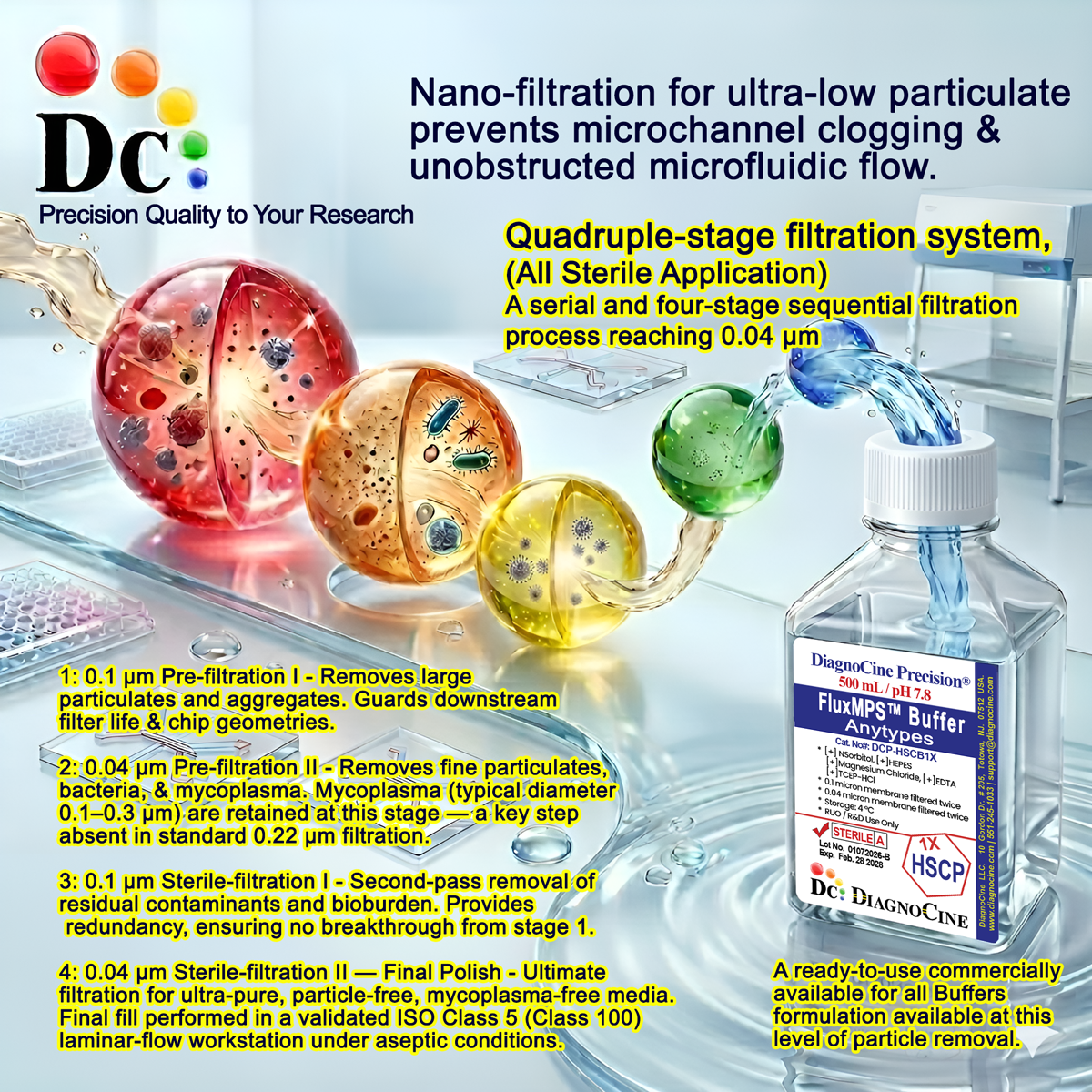
Quadruple-stage filtration system
This buffer is sterile-filtered through a 0.1 µm membrane twice and a 0.04 µm membrane twice, a four-stage sequence engineered for ultra-clean, low-particulate output suited to sensitive stripping and reprobing workflows.
-
1
0.1 µm Pre-filtration I
Large particulate and aggregate removal, extending the service life of downstream filters.
-
2
0.04 µm Pre-filtration II
Retention of fine particulates and bioburden ahead of the sterile-filtration passes.
-
3
0.1 µm Sterile-filtration I
Second-pass redundancy through the 0.1 µm membrane.
-
4
0.04 µm Sterile-filtration II — Final Polish
Ultimate polish pass supporting an ISO Class 5 (Class 100) aseptic fill.
Performance vs. conventional buffer
Sequential 0.1 µm and 0.04 µm filtration, applied twice each, removes finer particulates than a single-pass 0.22 µm filtration typically used in conventional stripping buffer.
© Diagnocine® — DCP-GLPHASB1X
Applications
Formulated primarily for gentle antibody removal and western blot membrane reprobing, this MPS-grade, quadruple-filtered buffer also supports other low-particulate laboratory workflows.
Automated Bioreactors & Robotics
For automated dispensing and robotic liquid-handling platforms, an optional 0.01 µm (10 nm) ultra-filtered variant of FluxMPS™ buffers is available to further reduce particulate load in fully automated systems.
- Total Particulate Exclusion
- Valve & Sensor Protection
- Extended Perfusion Stability
Inquiry Required: contact support@diagnocine.com to request the 0.01 µm ultra-filtered grade for automated systems.
Micro Physiological System (MPS) & Chip
Low-particulate buffer suited to wash and dilution steps within microfluidic and organ-on-a-chip platforms.
Wash, Dilution & Reconstitution
Ultrapure, sterile-filtered buffer suitable for general wash, dilution, and reconstitution steps.
iPSC-Derived Model Handling
Low-background reagent quality appropriate for supporting workflows around sensitive iPSC-derived models.
Endothelial & Primary Cell Perfusion
Ultra-clean buffer quality compatible with perfusion-adjacent workflows using primary and endothelial cell models.
ELISA, Blotting & Blocking
Purpose-built for antibody stripping and membrane reprobing in western blot workflows, enabling detection of multiple proteins of interest on the same membrane.
Microscopy & Optical Sensing
Low-particulate formulation supportive of clean-background workflows in optical detection settings.
Technical specifications
Measured and declared values for DCP-GLPHASB1X, sourced from the current product data sheet.
| Parameter | Specification |
|---|---|
| Formulation | Glycine-HCl, 0.1 M, pH 2.2 |
| Appearance | Clear, Colorless Liquid |
| pH USP <791> | 2.2 |
| Detergent System | SDS, Tween 20 |
| Parameter | Specification |
|---|---|
| Sterility | Sterile, Ultrapure, Filtered 0.1 micron membrane twice and 0.04 micron membrane twice |
| DNase Activity | None detected after incubation of plasmid DNA for 18 hours at room temperature |
| RNase Activity | None detected after incubation of ribosomal RNA for 18 hours at room temperature |
| Water Quality | Ultrapure Type 1 water (18.2 MΩ·cm) |
| Manufacturing Std. ISO 13485 | ISO 13485-certified, CE-approved facility |
| Fill Environment | ISO Class 5 (Class 100) |
| Parameter | Specification |
|---|---|
| Storage Temperature | Room temperature |
| Shelf Life | 1 year |
| Recommended Agitation | Rocking platform (wave motion); rotators (circular motion shakers) not recommended |
| Parameter | Specification |
|---|---|
| Manufacturing QMS | ISO 13485-certified facility |
| Regulatory Alignment | CE-approved facility |
| Production & Assembly | Final packaging, QA, and testing at the DiagnoCine R&D and Quality Testing Center; customization and assembly at DiagnoCine Precision, Totowa, New Jersey, USA |
| Intended Use | Research Use Only (RUO) |
Full composition
Component concentrations exactly as declared for this lot.
| Component | CAS Number | Concentration |
|---|---|---|
| Glycine | 56-40-6 | 1.5% |
| SDS | 151-21-3 | 1% |
| Tween 20 | 9005-64-5 | 1% |
Manufacturing & compliance
Manufactured, packaged, and released under a controlled quality system.
ISO 13485:2016 QMS
Manufactured under ISO 13485-certified, CE-approved facilities, with final packaging, QA, and testing performed at the DiagnoCine R&D and Quality Testing Center.
Ultrapure Type 1 Water
Formulated with Ultrapure Type 1 water (18.2 MΩ·cm).
ISO Class 5 Fill & Finish
Aseptic fill environment supporting sterile, ultrapure buffer production.
Micro-Batch Precision
Specific customization requests and assembly completed at DiagnoCine Precision, Totowa, New Jersey, USA.
Sterility & Filtration Assurance
Sterile, ultrapure, filtered 0.1 micron membrane twice and 0.04 micron membrane twice.
Nuclease Testing
DNase and RNase activity: none detected after 18 hours of incubation at room temperature with plasmid DNA and ribosomal RNA, respectively.
pH Verification USP <791>
pH specified at 2.2.
Documentation / CoA
Certificate of Analysis available on request.
How DCP-GLPHASB1X compares
A high-level comparison against conventional stripping buffer formulations.
| Parameter | DCP-GLPHASB1X (FluxMPS™) | Conventional Stripping Buffer | Standard Alternative |
|---|---|---|---|
| Final filtration pore size | 0.04 µm | 0.22 µm | 0.22 µm |
| Number of filtration stages | 4 | 1 | 1 |
| Mild glycine-HCl formulation (0.1 M, pH 2.2) | check_circle | cancel | cancel |
| Ultrapure Type 1 water (18.2 MΩ·cm) | check_circle | cancel | cancel |
| ISO 13485:2016 manufacturing | check_circle | cancel | cancel |
| DNase / RNase tested | check_circle | cancel | cancel |
| Custom formulation available | check_circle | cancel | cancel |
Frequently asked questions
Common questions about DCP-GLPHASB1X.
Supporting literature
Curated peer-reviewed literature relevant to antibody stripping, membrane reprobing, and buffer purity practices.
- Kaufmann SH, et al. Stripping and reprobing of western blot membranes: methods and applications. J Immunol Methods. 1987. doi:10.1016/0022-1759(87)90398-8
- Yeung YG, Stanley ER. A solution for stripping antibodies from PVDF membranes for reprobing. Anal Biochem. 2009. doi:10.1016/j.ab.2009.03.011
- Nakamura K, et al. Effects of low pH glycine treatment on antibody-antigen dissociation in immunoblotting. Anal Biochem. 1998. doi:10.1006/abio.1998.2703
- Reed JC, et al. Effect of SDS concentration on antibody-antigen dissociation in western blot stripping protocols. Biotechniques. 1990. doi:10.2144/000114135
- Bass JJ, et al. An overview of technical considerations for western blotting applications to physiological research. Scand J Med Sci Sports. 2017. doi:10.1111/sms.12702
- Mahmood T, Yang PC. Western blot: technique, theory, and trouble shooting. N Am J Med Sci. 2012. doi:10.4103/1947-2714.100998
- Bhattacharjee Y, et al. Multiplex protein detection through sequential immunoblot reprobing strategies. Electrophoresis. 2016. doi:10.1002/elps.201500484
- Bhatia SN, Ingber DE. Microfluidic organs-on-chips. Nat Biotechnol. 2014. doi:10.1038/nbt.2989
- Sokolowska J, Bugajski AJ. The effects of endotoxin and particulate contamination on in vitro assay reproducibility. J Immunol Methods. 2015. doi:10.1016/j.jim.2014.10.006