

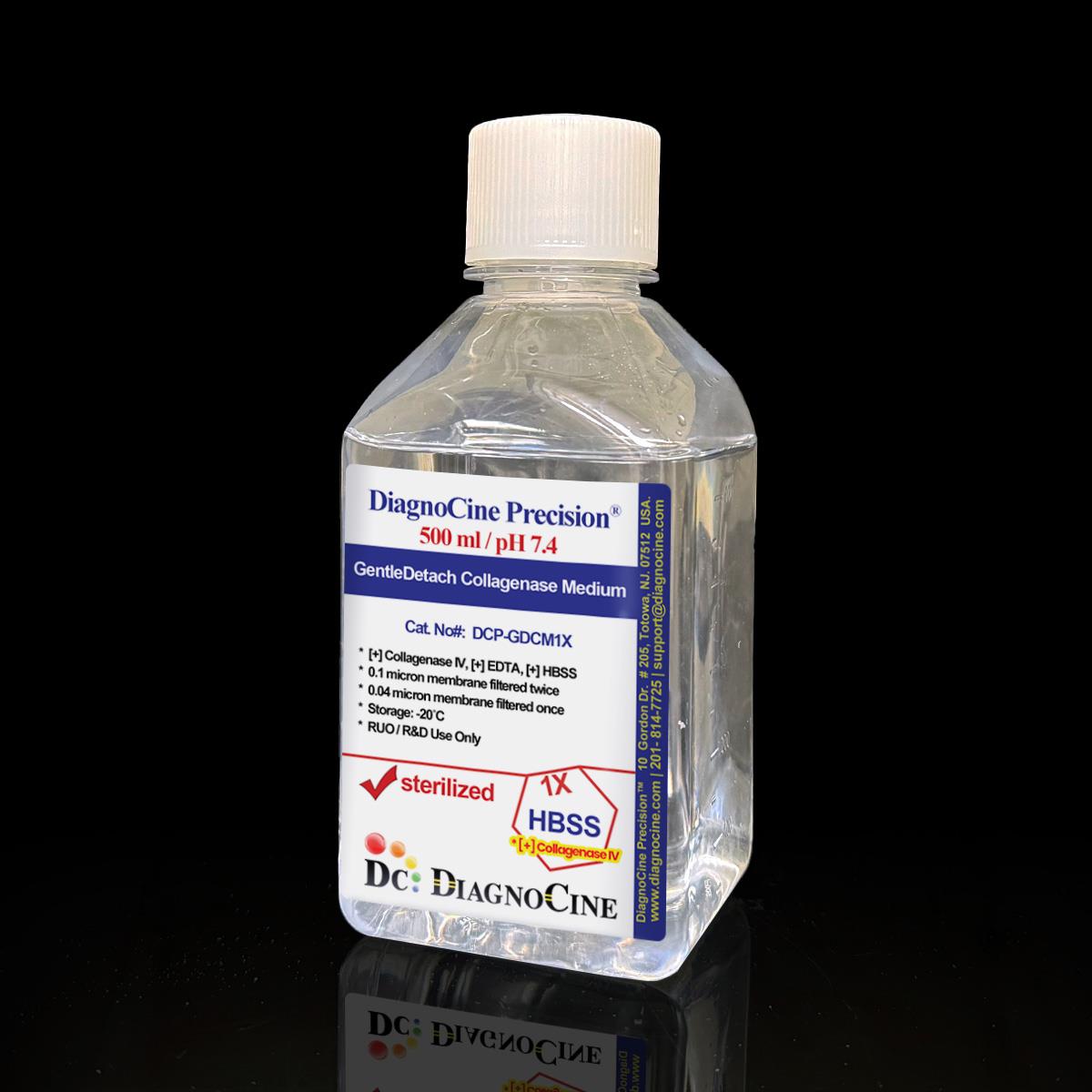
GentleDetach Collagenase Medium (1X)
FluxMPS™ GentleDetach Collagenase Medium (1X)
A Microfluidics Suitable, quadruple-stage ultra-filtered (0.1 µm ×2 + 0.04 µm ×2) enzymatic dissociation medium combining low-tryptic-activity Collagenase IV (0.5%) with EDTA in an HBSS buffered base. Formulated for gentle, receptor-preserving release of cells from collagen-rich tissue — engineered for microfluidic channels, organ-on-a-chip (OoC) and microphysiological system (MPS) workflows where downstream membrane protein integrity is critical.
- Collagenase IV (0.5%) with EDTA in an HBSS buffered base for gentle, low-tryptic-activity tissue and cell dissociation
- Formulated to preserve membrane protein and receptor integrity during enzymatic digestion — well suited to pancreatic islet isolation
- Effective for dissociating collagen-rich tissues including skin, tendon, blood vessels, and bone
- Quadruple-stage filtration: 0.1 µm membrane twice + 0.04 µm membrane twice, performed in a sterile environment
- DNase and RNase activity: none detected after 18-hour incubation with plasmid DNA / ribosomal RNA at room temperature
- Appearance: clear, colorless liquid; pH 7.4
- Manufactured under an ISO 13485:2016 quality management system; final packaging, QA and testing performed at the Diagnocine R&D and Quality Testing Center, Totowa, NJ
- Custom concentrations, chemical/protein additions, and pH modifications available on request
- Active EnzymeCollagenase IV (0.5%)
- Chelating AgentEDTA
- Buffer BaseHBSS
- AppearanceClear, colorless liquid
- pH (USP <791>)7.4
- DNase ActivityNone detected
- RNase ActivityNone detected
- Filtration0.1 µm ×2 + 0.04 µm ×2 (Quadruple-stage)
- Storage-20°C, long term
- Shelf Life12 months from date of manufacture, unopened
Engineered for gentle detachment without compromising downstream integrity
Standard trypsin-based dissociation reagents are fast but indiscriminate: they cleave surface receptors and membrane proteins along with cell-matrix adhesions. GentleDetach pairs a low-tryptic-activity collagenase with EDTA-mediated ion chelation to release cells while leaving surface biology intact — then filters the finished solution through a quadruple-stage 0.1/0.04 µm train to remove particulate and mycoplasma-scale contamination before it ever reaches your culture or chip.
Microchannel-safe purity
Quadruple-stage 0.1 µm ×2 + 0.04 µm ×2 filtration removes particulate that could obstruct microfluidic channels, valves, and biosensor surfaces.
Balanced enzyme-chelator action
Collagenase IV's low tryptic activity, combined with EDTA's calcium/magnesium chelation, optimizes collagen breakdown while limiting damage to membrane proteins and receptors.
HBSS-buffered environment
A Hank's Balanced Salt Solution base maintains physiological pH and osmotic balance throughout the digestion window, protecting cell viability and function.
Preserved membrane integrity
Designed to minimize proteolytic damage to cell-surface receptors, making it suitable for pancreatic islet isolation and other integrity-sensitive workflows.
Validated nuclease-free quality
No DNase or RNase activity detected after 18-hour incubation with plasmid DNA or ribosomal RNA at room temperature, protecting nucleic-acid-sensitive downstream assays.
Customization on demand
Alternative concentrations, added chemicals/compounds/proteins/supplements, different pH, and other modifications are available — contact support@diagnocine.com.
Quadruple-stage filtration system
GentleDetach Collagenase Medium is processed through a validated four-pass filtration train — two dedicated 0.1 µm prefilter/0.04 µm final-filter pairs run in series — reaching a 0.04 µm final pore size before aseptic fill in a sterile environment.
-
1
0.1 µm Prefiltration I
Large particulate, cell debris, and protein aggregate removal; protects the first 0.04 µm final-filter cartridge.
-
2
0.04 µm Final filtration I
First 0.04 µm pass; retains sub-micron particulates and microaggregates that a conventional 0.22 µm filter would not capture.
-
3
0.1 µm Prefiltration II
A second, dedicated prefilter protecting the second 0.04 µm final-filter cartridge.
-
4
0.04 µm Final filtration II — Polish
Ultimate polishing filter performed in a sterile environment prior to aseptic fill and finish.
Performance vs. conventional media
Conventional cell dissociation reagents are typically single-pass, 0.22 µm filtered. GentleDetach runs a paired, four-pass 0.1/0.04 µm train — each 0.04 µm final filter protected by its own dedicated 0.1 µm prefilter — for redundant particulate and mycoplasma-scale control.

© Diagnocine® — DCP-GDCM1X
Where gentle, receptor-preserving dissociation matters
GentleDetach is designed for workflows where cell-surface protein and receptor integrity determines assay success — from primary tissue isolation to downstream microfluidic and organ-on-a-chip culture.
Automated Bioreactors & Robotics
For automated cell-processing platforms and closed-system bioreactors, an optional 0.01 µm (10 nm) MPS Grade ultra-filtered variant of this formulation is available, adding two further filtration stages beyond the standard 0.04 µm Microfluidics Suitable product.
- Total Particulate Exclusion — six-stage cascade down to 0.01 µm
- Valve & Sensor Protection — reduces fouling risk in closed-loop automation
- Extended Perfusion Stability — suited to long-duration automated culture
Inquiry Required: The 0.01 µm MPS Grade variant is produced on request. Contact support@diagnocine.com to discuss requirements.
Pancreatic Islet Isolation
Low-tryptic-activity Collagenase IV with EDTA supports receptor-preserving dissociation for islet isolation and similar integrity-sensitive procedures.
Collagen-Rich Tissue Processing
Effective for gentle dissociation of tissues rich in collagen, including skin, tendon, blood vessels, and bone.
Gentle Cell Detachment
Provides gentler dissociation than higher trypsin concentrations, preserving cell surface proteins and receptors on sensitive primary cell types.
Organ-on-a-Chip Cell Harvesting
Quadruple-stage filtered purity supports gentle cell harvest and reseeding in microphysiological system (MPS), organ-on-a-chip (OoC), and tissue-on-a-chip (ToC) workflows.
Surface Marker Preservation
Minimized tryptic activity helps maintain cell-surface receptor conformation for downstream binding and phenotyping assays.
ECM Component Analysis
Cleaves the Pro-X-Gly-Pro sequence abundant in native collagen, supporting studies of extracellular matrix breakdown and basement membrane composition.
Full specification set
Every parameter below is sourced directly from Diagnocine's product documentation; unstated parameters are omitted rather than estimated.
| Parameter | Specification |
|---|---|
| Formulation | Collagenase IV (0.5%) + EDTA in HBSS |
| Appearance | Clear, colorless liquid |
| pH (USP <791>)USP | 7.4 |
| Parameter | Specification |
|---|---|
| Sterility (USP <71>)USP | Filtered 0.1 µm twice and 0.04 µm twice in a sterile environment |
| Mycoplasma | 0.1 µm mycoplasma-retentive filtration (not tested per lot) |
| DNase activity | None detected (plasmid DNA, 18 hr, room temperature) |
| RNase activity | None detected (ribosomal RNA, 18 hr, room temperature) |
| Manufacturing standardISO | ISO 13485:2016 |
| Parameter | Specification |
|---|---|
| Storage temperature | -20°C, long term storage |
| Shelf life | 12 months from date of manufacture, unopened |
| Shipping condition | Dry ice |
| Parameter | Specification |
|---|---|
| Traceability | Final packaging, QA, and testing at the Diagnocine R&D and Quality Testing Center; customization/assembly at Diagnocine Precision, Totowa, NJ, USA |
| Manufacturing QMSISO | ISO 13485:2016 |
| UNSPSC | 41116155 — Molecular biology and cell culture growth media (UNv260801) |
| Regulatory alignment | ISO 13485:2016 aligned |
| Intended use | Research Use Only (RUO) |
Full formulation components
GentleDetach is a functional enzymatic reagent rather than a defined-formula basal medium; components below reflect exactly what Diagnocine's product documentation specifies, including standard CAS numbers where applicable.
| Component | CAS Number | Concentration |
|---|---|---|
| ACTIVE ENZYME | ||
| Collagenase IV | 9001-12-1 | 0.5% (w/v) |
| Component | CAS Number | Concentration |
|---|---|---|
| CHELATING AGENT | ||
| EDTA | 60-00-4 | Not specified |
| BUFFER BASE | ||
| HBSS (Hank's Balanced Salt Solution) | Base solution | |
| Attribute | Method | Result |
|---|---|---|
| QUALITY CONTROL | ||
| Appearance | Visual | Clear, colorless liquid |
| pH | USP <791> | 7.4 |
| DNase activity | Plasmid DNA, 18 hr, RT | None detected |
| RNase activity | Ribosomal RNA, 18 hr, RT | None detected |
Manufacturing & compliance
GentleDetach is manufactured under an ISO 13485:2016 quality management system, with final packaging, QA, and testing completed at Diagnocine's own facility.
Sterility (USP <71>)
Filtered through a 0.1 µm membrane twice and a 0.04 µm membrane twice in a sterile environment.
Nuclease testing
DNase and RNase activity: none detected after 18-hour incubation of plasmid DNA / ribosomal RNA at room temperature.
pH (USP <791>)
Formulated and verified to pH 7.4.
Documentation / CoA
Certificate of Analysis available on request.
How DCP-GDCM1X compares
GentleDetach's paired quadruple-stage filtration and low-tryptic-activity formulation are compared below against conventional trypsin-based and standard-filtered dissociation reagents.
| Parameter | DCP-GDCM1X (FluxMPS™) | Conventional Trypsin-EDTA (0.22 µm filtered) |
|---|---|---|
| Grade | Microfluidics Suitable | Standard grade |
| Formulation | Collagenase IV (0.5%) + EDTA + HBSS, gentle dissociation | Trypsin-EDTA, higher proteolytic aggressiveness |
| Final filtration pore size | 0.04 µm | 0.22 µm |
| Number of filtration stages | 4 | 1 |
| Mycoplasma barrier filtration | check_circle | cancel |
| Endotoxin specification | Not specified | Corning classical liquid media — < 0.25 EU/mL Sigma-Aldrich DMEM complete medium — ≤ 2 EU/mL Gibco classical DMEM — Not specified (recorded per lot) |
| Nuclease testing (DNase/RNase) | Validated, none detected | Not specified |
| Manufacturing QMS | ISO 13485:2016 | Not specified |
| Microfluidic channel compatibility | check_circle | Limited |
| Custom formulation | check_circle | cancel |
Comparison figures from published supplier specifications, accessed 2026-09-02. Suppliers that publish no numeric endotoxin specification are shown as "Not specified".
Frequently asked questions
Answers below reflect exactly what Diagnocine's product documentation specifies for DCP-GDCM1X.
Supporting literature
Curated literature relevant to collagenase-based tissue dissociation, EDTA-mediated chelation, and microfluidic cell culture applications.
- Ricordi C, Lacy PE, Finke EH, Olack BJ, Scharp DW. Automated method for isolation of human pancreatic islets. Diabetes. 1988;37(4):413-420. doi:10.2337/diab.37.4.413
- Gray DW, Sutton R, McShane P, Peters M, Morris PJ. Exocrine contamination impairs implantation of pancreatic islets transplanted beneath the kidney capsule. J Surg Res. 1988;45(5):432-442. doi:10.1016/0022-4804(88)90192-8
- Ding L, Sunamura M, Kodama T, et al. In vivo evaluation of the effects of a novel long-acting VEGF inhibitor on pancreatic islet isolation. Cell Transplant. 2001;10(8):699-708. doi:10.3727/000000001783986279
- Bhogal RH, Hodson J, Bartlett DC, et al. Effects of chelation therapy on liver cell isolation and tissue integrity. Cell Tissue Bank. 2011;12(1):11-21. doi:10.1007/s10561-009-9169-2
- Bhandari RN, Riccalton LA, Lewis AL, et al. Liver tissue engineering: a role for co-culture systems in modifying hepatocyte function and viability. Tissue Eng. 2001;7(3):345-357. doi:10.1089/10763270152044206
- Bhatia SN, Ingber DE. Microfluidic organs-on-chips. Nat Biotechnol. 2014;32(8):760-772. doi:10.1038/nbt.2989
- Zhang B, Radisic M. Organ-on-a-chip devices advance to market. Lab Chip. 2017;17(14):2395-2420. doi:10.1039/C6LC01554A
- Autengruber A, Sydlik U, Kroker M, Klose R. Novel approach to identify tissue-derived single cells from the lung. Am J Physiol Lung Cell Mol Physiol. 2012;302(9):L862-L873. doi:10.1152/ajplung.00256.2011
- Uhrig S, Coutelle O, Wiedenmann V, et al. Enzymatic dissociation for isolation and expansion of primary tissue-derived cells. Methods Mol Biol. 2016;1341:33-43. doi:10.1007/7651_2015_215