GenNext™ Shin-RamDA-seq™ Single Cell Stranded Kit (96 Rxns)
Strand-specific, full-length total RNA-seq library preparation from single cells or trace RNA using the RIKEN-developed RT-RamDA™ method.
Cat No.
TYB-RML-101
UNSPSC Code
12352200
Packaging
96 Rxns
Storage Temperature
-20 °C
Description
GenNext™ Shin-RamDA-seq™ Single Cell Stranded Kit is an improved version of the GenNext™ RamDA-seq™ Single Cell Kit, and is a kit for preparing libraries for next-generation sequencing (NGS) from single cell or trace RNA. Obtained libraries could be applied to subsequent strand specific RNA-seq analysis. By using this kit, you can prepare NGS libraries that cover the full length of RNA and also perform strand analysis.
This is a kit using RT-RamDA™ (Reverse Transcription with Random Displacement Amplification) method developed by RIKEN. RT-RamDA™ is a novel cDNA amplification method utilizing the strand displacement activity of reverse-transcriptase. This kit can detect not only poly(A) RNA but also non-poly(A) with high sensitivity by using random primer or NSR primer*.
Additionally, Shin-RamDA-seq™ incorporates further reduction of rRNA and preservation of strand information, enabling more accurate RNA-Seq analysis.
* NSR primer is abbreviation for Not so random primer. * Shin-RamDA-seq™ is an abbreviation for "Stranded High-Sensitivity Random Displacement Amplification sequencing". * Shin-RamDA-seq™, RamDA-seq™ and RT-RamDA™ are a trademark of RIKEN, Institute of Physical and Chemical Research
Features
Compatible with single cell or trace RNA
cDNA can be prepared from 1-100 cells or 10pg-1ng total RNA.
Capable of full length RNA analysis
Long-chain RNA and splicing variants can be accurately analyzed.
Capable of analyzing total RNA
This kit can be used for non-poly(A)RNA (lncRNA, pre-mRNA, circRNA, etc.) and degraded RNA(ex. FFPE-derived RNA).
Accurate analysis is made possible by preserving strand information
Antisense and overlapping genes can be found and clearly distinguished.
Support for library preparation
Library preparation reagents support all steps from cDNA synthesis to library construction. (Magnetic beads for purification and index kit are required separately.)
Explore the RamDA-seq™ Kit Family
Both kits use the RIKEN-developed RT-RamDA™ method for full-length total RNA-seq from 1-100 cells or 10 pg-1 ng total RNA. Choose the kit by the output your workflow needs.
Stranded NGS LibrariesImproved Version
GenNext™ Shin-RamDA-seq™ Single Cell Stranded Kit
Prepares NGS libraries that cover the full length of RNA and also perform strand analysis.
Strand information preserved — antisense and overlapping genes clearly distinguished
Further reduction of rRNA for more accurate RNA-Seq analysis
Reagents for all steps from cDNA synthesis to library construction (index kit and magnetic beads required separately)
Non-poly(A) RNA and degraded RNA, including FFPE-derived RNA
*Do not store mixed solution.
*RamDA Cell Lysis Kit [Code No. RMD-301] is not compatible with this product.
Option
The following products are useful for depletion of human or mouse rRNA. (NSR Primer sold separately.)
NSR Primer Set for human
Component
TYB-NSR-101
Toyobo Code No. NSR-101
1st NSR Primer Mix for human
54 μL
2nd NSR Primer Mix for human
275 μL
NSR Primer Set for mouse
Component
TYB-NSR-102
Toyobo Code No. NSR-102
1st NSR Primer Mix for mouse
54 μL
2nd NSR Primer Mix for mouse
275 μL
REQUIRED MATERIALS NOT INCLUDED
Thermocycler
Index kit
(Recommend) IDT for Illumina – TruSeq DNA UD Indexes v2 (96 Indexes,96 Samples), (Illumina, Inc. Cat. no. 20040870)
SPRI (Solid Phase Reversible Immobilization) paramagnetic beads
Agencourt™ AMPure™ XP Beads (Beckman Coulter, Cat. no. A63880 or A63881)
TE Buffer pH 8.0 (10 mM Tris-HCl,1mM EDTA)
10 mM Tris-HCl pH 8.0
Magnetic rack/stand for magnetic bead separation
80% Ethanol (freshly prepared)
Storage Conditions
Storage Condition
Store at -20 °C
Handling
Do not store mixed solution.
Application Data
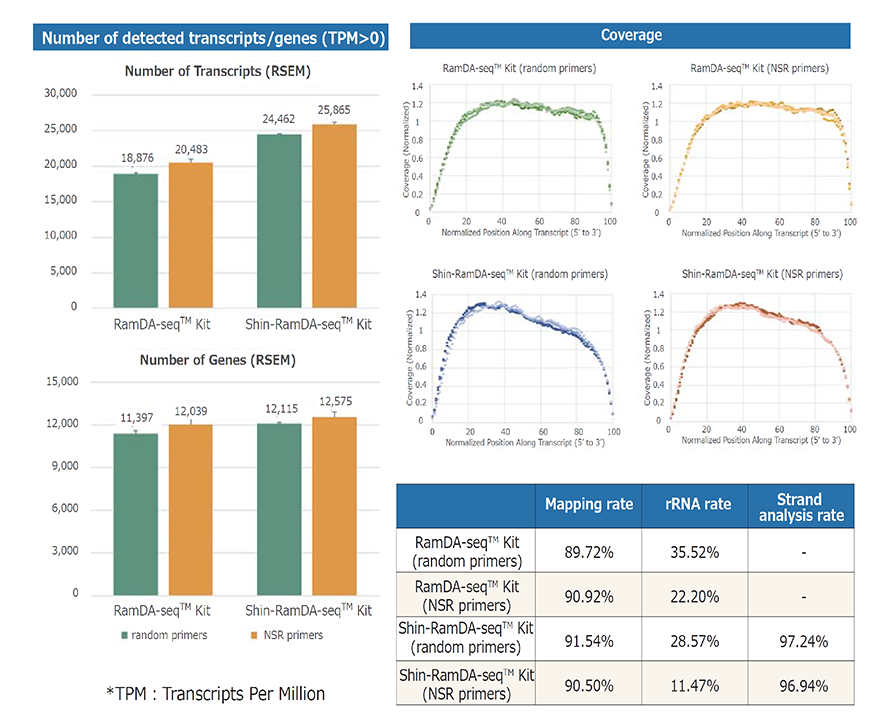
Example 1. Analysis of NIH3T3 cells (Shin-RamDA-seq™ Kit vs. RamDA-seq™ Kit)
NGS libraries were prepared from single cell quantity extracts from mouse-derived NIH3T3 cell and subjected to RNA-Seq analysis. The number of detected transcripts/genes, average coverage, mapping rate, rRNA rate, and strand analysis rate were analyzed. Illumina's MiSeq™ was used for RNA-Seq.
The Shin-RamDA-seq™ Kit demonstrated a high strand analysis rate and preserved RNA direction information. Optimizing Shin-RamDA-seq™ Kit reagent composition resulted in lower rRNA contamination than that of the RamDA-seq™ Kit, and the number of detected genes was higher than was obtained using a RamDA-seq™ Kit. The use of NSR primers reduced rRNA contamination and increased the number of genes detected.
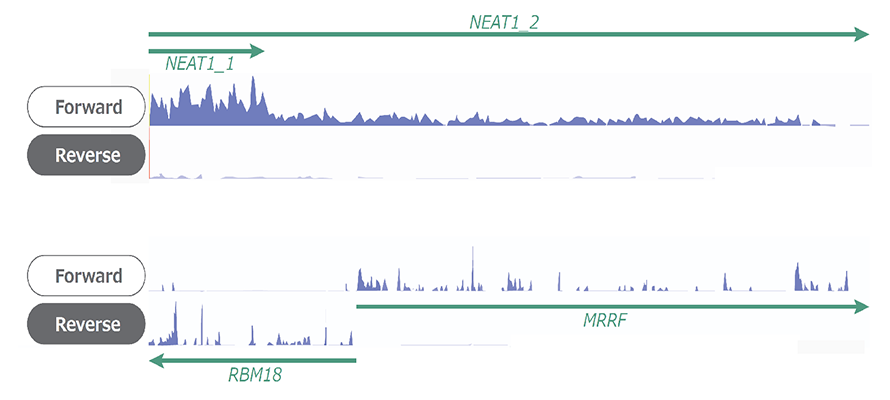
Example 2. Read coverage using Shin-RamDA-seq™ Kit
NGS libraries were prepared from single cell quantity extracts from the K562 human leukemia cell line, and RNA-seq analysis was performed. Coverage was confirmed using Millefy*. Single-cell analysis using a Shin-RamDA-seq™ Kit confirmed full-length coverage of NEAT1_2 with 20 kb lengths and allowed isoform analysis of NEAT1_1 and NEAT1_2. Preservation of strand information enabled precise analysis of MRRF and RBM18, which are known to be transcribed in opposite direction.
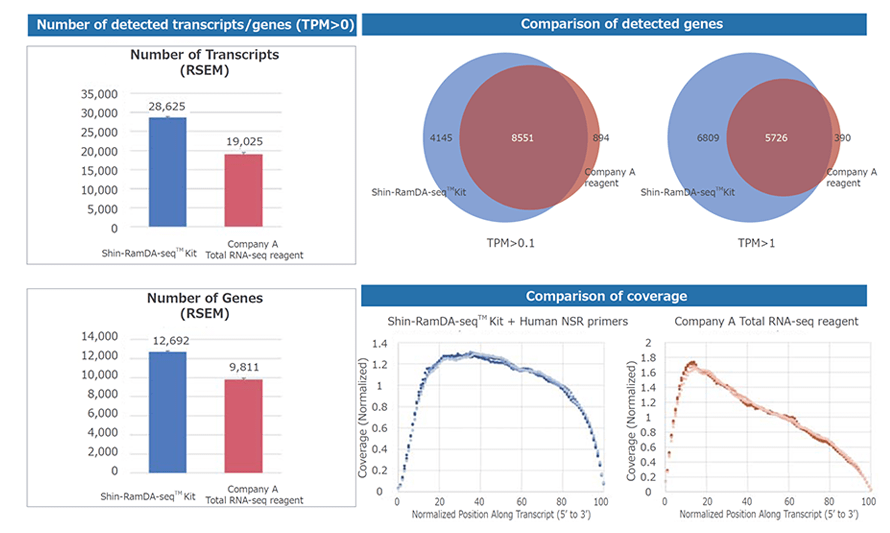
Example 3. Analysis of K562 cells (Comparison of Shin-RamDA-seq™ and another company's reagent)
Using a Shin-RamDA-seq™ Kit or another company's Total RNA-seq reagent, NGS libraries were prepared from single cell quantities of human K562 cell RNA extractions. NGS analysis was performed using Illumina's MiSeq™.
Numbers of detected transcripts/genes and coverage were compared with another company's reagent. The Shin-RamDA-seq™ Kit showed a higher number of detected transcripts/genes, and the Shin-RamDA-seq™ Kit provided more unbiased results in terms of coverage.
Example 4. Analysis of FFPE sample
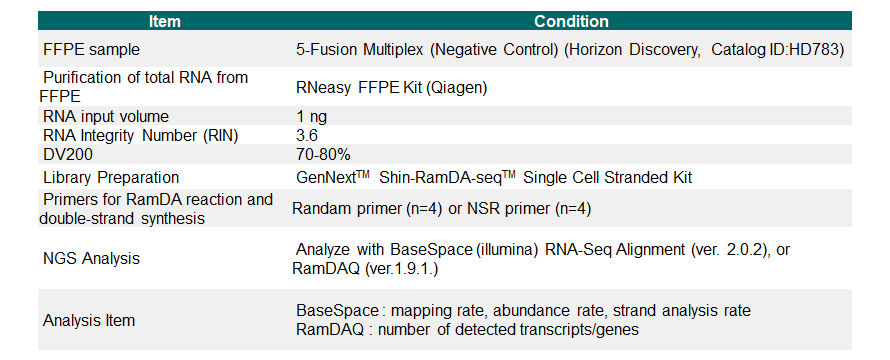
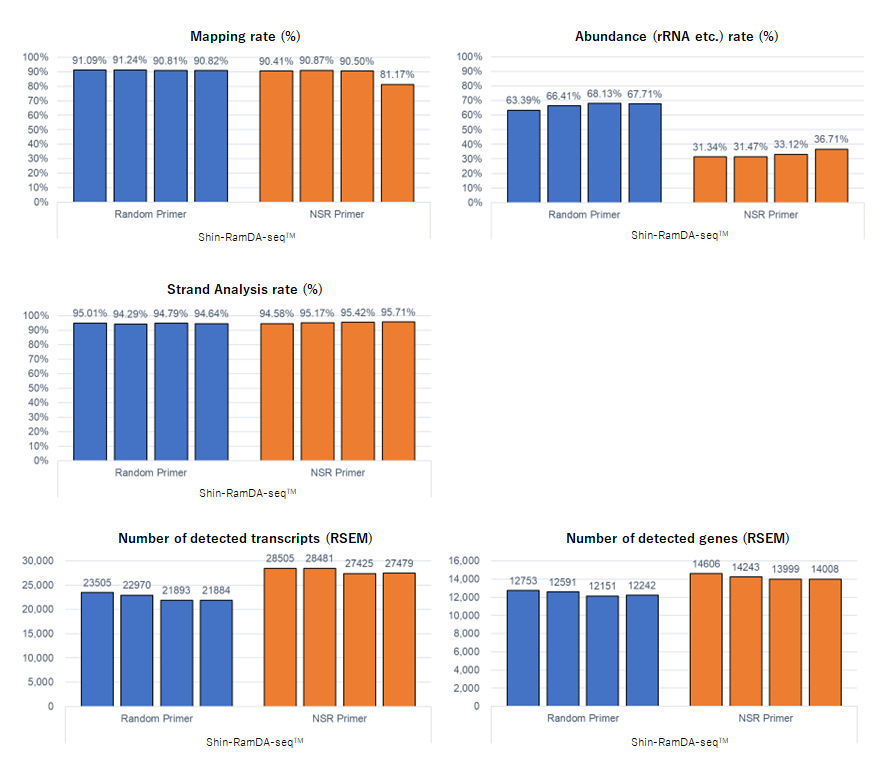
From 1ng of FFPE-derived RNA, library preparation was performed using the GenNext™ Shin-RamDA-seq™ Single Cell Stranded Kit [Code No. RML-101], and RNA-Seq was performed. Illumina MiSeq™ was used for RNA-Seq. The preparation and analysis conditions for FFPE and RNA-Seq are as follows.
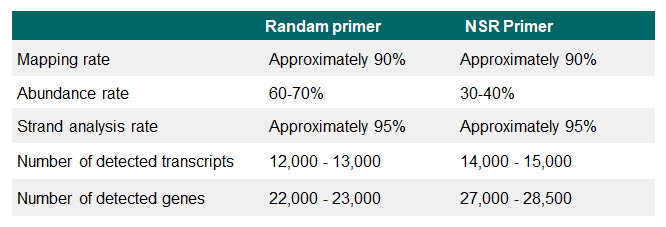
Each analysis resulted in the detection of over 10,000 genes by using the GenNext™ Shin-RamDA-seq™ Single Cell Stranded Kit. Furthermore, by using the NSR primer [Code No. NSR-101], which is a random primer designed to exclude sequences that perfectly match the 18S and 28S RNA genes, the detection of rRNA was suppressed, allowing for more accurate analysis.
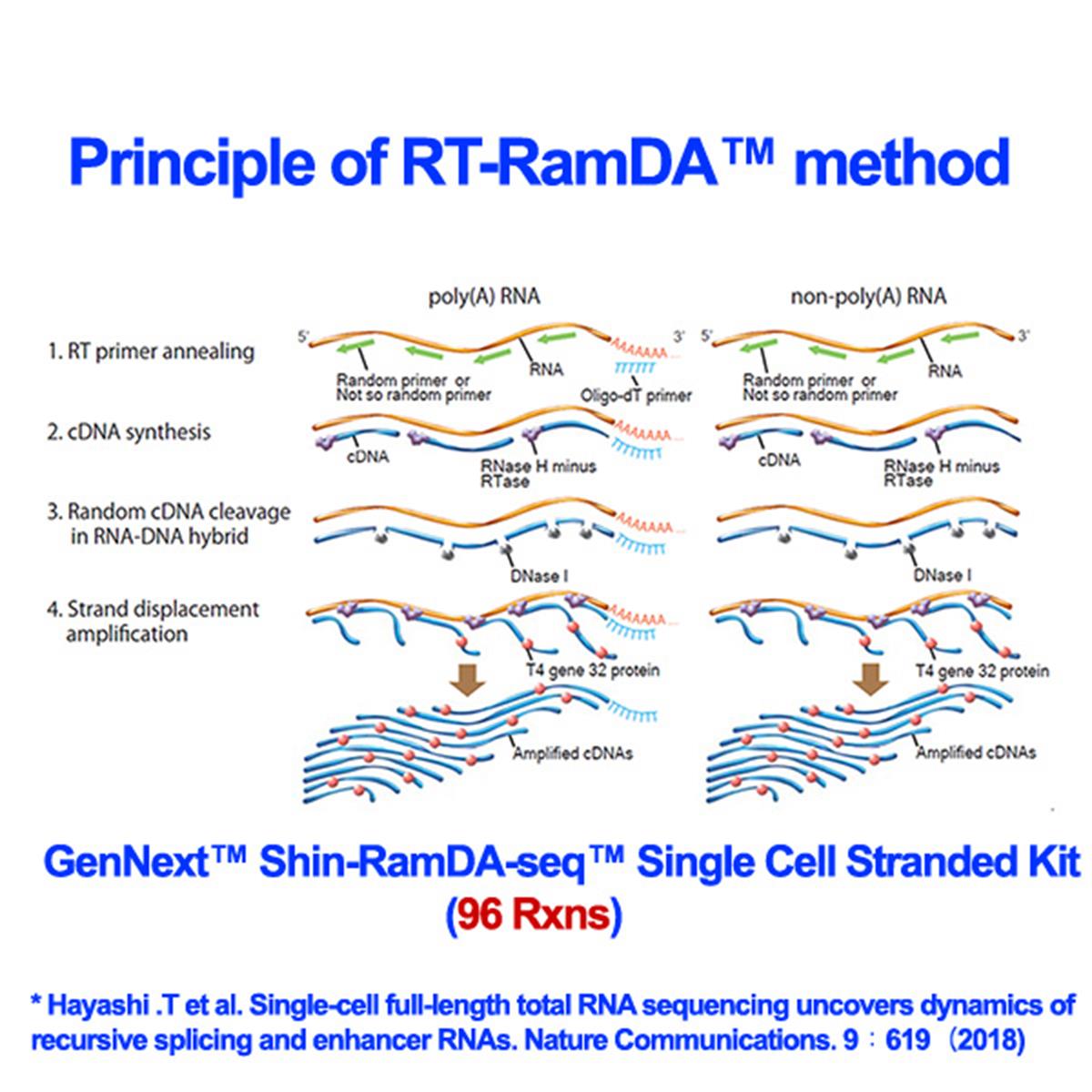
Principle of RT-RamDA™ method
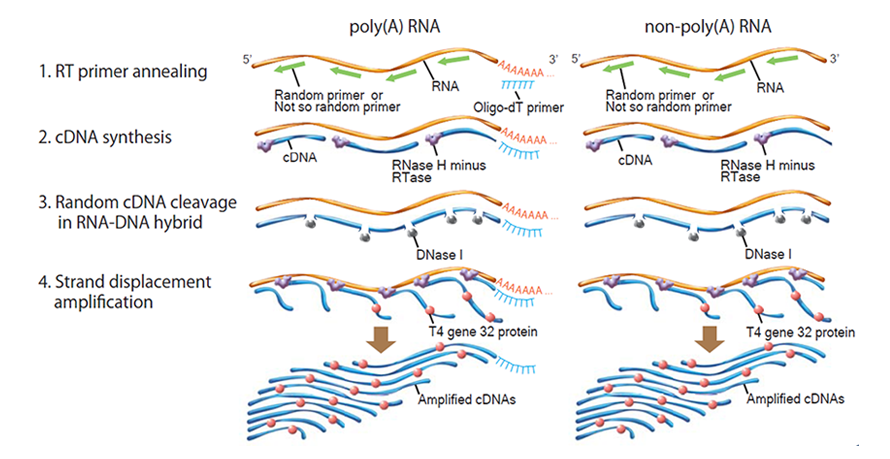
RT-RamDA™ is an abbreviation for "Reverse Transcription with Random Displacement Amplification" developed by Omics AI Research Team, Advanced General Intelligence for Science Program (AGIS), TRIP Headquarters, RIKEN. It is a new cDNA amplification method that applies the strand substitution activity of reverse transcriptase, and it is possible to prepare cDNA not only from poly (A) RNA but also from non-poly (A) -derived RNA for using random primer.
Unlike conventional method using Oligo-dT primer, cDNA for full-length total RNA-seq can be synthesized by RT-RamDA™ method.
In addition, because cDNA is amplified at the same time as it is synthesized, RT-RamDA™ method does not require amplification adaptors and PCR amplification step, and it reduces the biases caused by PCR amplification.
Hayashi T. et al. Single-cell full-length total RNA sequencing uncovers dynamics of recursive splicing and enhancer RNAs. Nature Communications. 9:619 (2018)
Publications
Powered by Bioz
Bioz AI Summary:
The GenNext RamDA seq Single Cell Kit from Toyobo has been instrumental in a variety of advanced research applications. This kit has enabled high-throughput sequencing and detailed gene expression profile analysis in studies involving gastrointestinal tract samples, S-phase progression, iPSC-derived neurons, and S. mutans under different conditions. It facilitated the preparation of high-quality RNA libraries for single-cell RNA sequencing (scRNA-seq) in tendon cells and lymphatic endothelial cells (LECs), revealing insights into tendon development, metastasis, and cellular heterogeneity in osteoarthritis. The kit's cDNA synthesis capability was crucial for detecting fusion genes in plasma, analyzing viral transcriptomes, and studying the evolution and spread of SARS-CoV-2. Additionally, it supported the analysis of small extracellular vesicles (sEVs) and the role of PIEZO1 in tendon function. The GenNext RamDA seq Single Cell Kit has proven effective in integrating glycan and RNA analysis in single cells, contributing to the comprehensive understanding of gene expression in various biological contexts.
Bioz Signature Insights
Toyobo's GenNext RamDA seq Single Cell Kit has emerged as a pivotal tool in the realm of single-cell RNA sequencing, facilitating groundbreaking research in diverse biological contexts. This innovative kit has been prominently featured in high-impact journals, underscoring its significance in advancing our understanding of gene expression in tendon development, metastasis, and cellular heterogeneity in osteoarthritis. Its robust cDNA synthesis capability has been instrumental in detecting fusion genes, analyzing viral transcriptomes, and studying the evolution and spread of SARS-CoV-2.
Cited Since
2021
Top Journal
Nature communications
Top Journals
Nature communications · IF 15.7
Science translational medicine · IF 14.6
JCI insight · IF 6.1