

FluxMPS™, TCA Protein Precipitation Kit
FluxMPS™ TCA Protein Precipitation Kit
A complete, plant-optimized five-solution kit for TCA/acetone precipitation of total proteins. Includes a pre-formulated TCA/acetone precipitation solution, an acetone wash solution, a Tris–SDS–EDTA plant extraction buffer, a 4× SDS sample buffer, and a separate 1 M DTT solution — formulated for clean, concentrated protein pellets ready for SDS-PAGE and 2-DE.
- Designed specifically for leaves, roots, seeds, and soft stems, including phenolic- and pigment-rich samples that are challenging with generic kits.
- Uses a pre-formulated TCA/acetone solution and cold acetone washes to precipitate proteins quickly in microcentrifuge tubes.
- Produces pellets that resolubilize readily in SDS sample buffer for 1D SDS-PAGE or in urea/thiourea-based buffers for 2-DE, suitable for downstream analysis of plant proteomes.
- Compatible with Coomassie- and silver-stained SDS-PAGE, 2-DE, western blotting, and many enzyme activity or immunoblot workflows after resolubilization.
- Reagents are 0.1 µm filtered for ultra-low particulate purity exceeding standard 0.22 µm single-pass filtration.
- Prepared with Ultrapure Type 1 water (18.2 MΩ·cm).
- Customizable formulation available upon request.
- pH (Solution C)7.5
- pH (Solution D)6.8
- AppearanceClear Solution
- Filtration0.1µm
- Shelf Life1 year
- Storage (Sol. A)-20°C
- Storage (Sol. B)-20°C
- Storage (Sol. C)2-8°C
- Storage (Sol. D)2-8°C
- Storage (Sol. E)-20°C
Engineered where standard precipitation kits fail
Standard laboratory reagents filtered only at 0.22 µm leave sub-micron particulates and aggregates that interfere with sensitive downstream applications. The FluxMPS™ TCA Protein Precipitation Kit is manufactured under ISO 13485 quality systems with 0.1 µm ultra-filtration and is purpose-built for the challenges of plant tissue, including phenolic- and pigment-rich samples.
Ultra-filtered reagent purity
Reagents are filtered to 0.1 µm, removing finer particulates than a single 0.22 µm pass for cleaner precipitation and downstream results.
Complete TCA/acetone workflow
Pre-formulated TCA/acetone for rapid protein precipitation with cold acetone washes that remove pigments, lipids, and salts.
Plant extraction buffer
Tris–SDS–EDTA extraction buffer (Solution C) handles cell walls, polyphenols, and plant-specific interfering metabolites.
SDS sample buffer included
4× SDS sample buffer (non-reducing) with a separate 1 M DTT solution for flexible preparation of reduced or non-reduced samples.
SDS-PAGE & 2-DE ready
Produces pellets that resolubilize readily for 1D SDS-PAGE, 2-DE, western blotting, and comparative proteomics.
Customization on demand
Customizable kit formulation available upon request — contact support@diagnocine.com.
Single-stage 0.1 µm filtration
Kit reagents pass through a single 0.1 µm filtration stage, removing finer particulates than a single 0.22 µm pass for consistent, low-background protein precipitation.
-
1
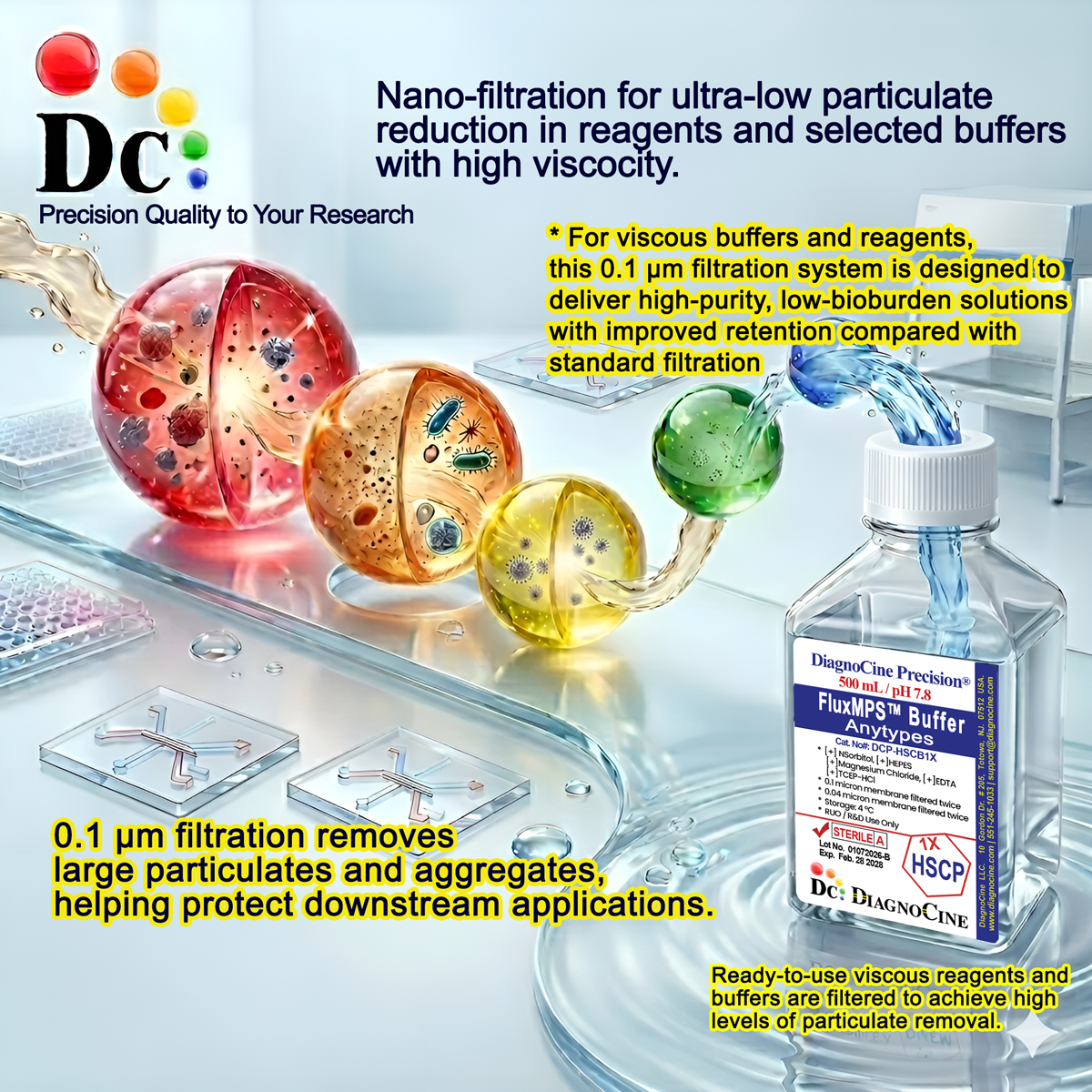
0.1 µm filtration
Removes large particulates, aggregates, and bacteria. Primary guard providing baseline purity exceeding standard 0.22 µm filtration.
Performance vs. conventional reagents
Standard 0.22 µm single-pass filtration leaves particles in the 0.12–0.22 µm range. A 0.1 µm filtration pass removes finer particulates than a single 0.22 µm pass for cleaner results and higher reproducibility.
Validated applications
Purpose-built for total protein recovery from challenging plant tissues and downstream analysis of plant proteomes.
1D SDS-PAGE & Western Blotting
Preparation of total plant protein extracts for 1D SDS-PAGE separation and downstream western blotting.
2-DE Analysis of Plant Proteomes
Clean, concentrated pellets resolubilize in urea/thiourea-based rehydration buffers for isoelectric focusing and 2-DE.
Enzyme Assays & Immunoprecipitation
Clean, concentrated extracts (after appropriate resolubilization) support enzyme activity assays and immunoprecipitation workflows.
Comparative Proteomics
Consistent extraction across tissues and treatments supports comparative proteomics studies of plant material.
Plant Tissue Extraction
Suitable for fresh or frozen leaves, roots, stems, seeds, and other soft plant tissues, including phenolic- and pigment-rich samples.
Coomassie & Silver Staining
Compatible with Coomassie- and silver-stained SDS-PAGE for sensitive downstream protein detection.
Workflow overview
- Homogenize plant tissue in liquid nitrogen and extract proteins with Plant Extraction Buffer plus protease inhibitors and DTT.
- Clarify extract by centrifugation and transfer the supernatant.
- Mix extract 1:1 with TCA/acetone and incubate on ice or at -20°C for 30-60 minutes to precipitate proteins.
- Pellet proteins by centrifugation and remove the supernatant.
- Wash the pellet 1-2 times with cold 80% acetone containing freshly added DTT to remove pigments, lipids, salts, and residual TCA.
- Air-dry the pellet briefly, then resolubilize in 1× SDS sample buffer for SDS-PAGE or in user-prepared 2-DE rehydration buffer for IEF.
Detailed specifications
Measured and declared values for the TCA Protein Precipitation Kit and its five component solutions.
| Parameter | Specification |
|---|---|
| Formulation / Composition | Five-solution TCA/acetone protein precipitation system (Solutions A-E) |
| Appearance | Clear Solution |
| pH (Solution C, Extraction Buffer) | 7.5 |
| pH (Solution D, SDS Sample Buffer) | 6.8 |
| Parameter | Specification |
|---|---|
| Filtration USP <788> | 0.1µm |
| Water Quality | Ultrapure Type 1 water (18.2 MΩ·cm) |
| Manufacturing Standard ISO 13485 | ISO 13485:2016 |
| Parameter | Specification |
|---|---|
| Storage – Solution A | -20°C |
| Storage – Solution B | -20°C |
| Storage – Solution C | 2-8°C |
| Storage – Solution D | 2-8°C |
| Storage – Solution E | -20°C |
| Shelf Life (all solutions) | 1 year |
| Parameter | Specification |
|---|---|
| Manufacturing Location | DiagnoCine Precision, Totowa, NJ, USA |
| Manufacturing QMS | ISO 13485:2016 certified |
| Regulatory Alignment | ISO 13485:2016 |
| Intended Use | Research Use Only (RUO) |
Full composition
Component-level formulation for each of the five kit solutions, grouped as supplied.
| Component | CAS Number | Concentration |
|---|---|---|
| SOLUTION A (30 mL) — 20% TCA IN ACETONE | ||
| Trichloroacetic acid (TCA) | 76-03-9 | 4% |
| Acetone | 67-64-1 | 80% |
| SOLUTION B (100 mL) — 80% ACETONE WASH SOLUTION | ||
| Acetone | 67-64-1 | 80% |
| Ultrapure water | 7732-18-5 | 20% |
| Component | CAS Number | Concentration |
|---|---|---|
| SOLUTION C (30 mL) — PLANT EXTRACTION BUFFER (TRIS-SDS-EDTA) | ||
| Tris-HCl | 1185-53-1 | 50 mM |
| SDS | 151-21-3 | 2% |
| EDTA | 60-00-4 | 2 mM |
| Sodium Chloride | 7647-14-5 | 100 mM |
| Glycerol | 56-81-5 | 10% |
| Component | CAS Number | Concentration |
|---|---|---|
| SOLUTION D (1 mL) — 4X SDS SAMPLE BUFFER (NON-REDUCING) | ||
| Tris-HCl | 1185-53-1 | 250 mM |
| SDS | 151-21-3 | 8% |
| Bromophenol Blue | 115-39-9 | 0.02% |
| Glycerol | 56-81-5 | 40% |
| SOLUTION E (2 X 0.5 mL) — 1 M DTT SOLUTION (FROZEN) | ||
| DTT solution | 3483-12-3 | 1 M |
Manufacturing & compliance
Every kit component is manufactured, filtered, and documented under ISO 13485-certified quality systems.
ISO 13485:2016 Certified
Manufactured under certified QMS with full traceability and lot documentation.
Made in USA
All manufacturing, QA testing, and final assembly at DiagnoCine Precision, Totowa, NJ.
Ultrapure Type 1 Water
Formulated with Ultrapure Type 1 water (18.2 MΩ·cm).
0.1 µm Filtration
Single-stage 0.1 µm filtration exceeds standard 0.22 µm single-pass purity.
Endotoxin Control (USP <85>)
Manufacturing practices follow USP <85> Bacterial Endotoxins Test guidance for kit reagents.
Particulate Control (USP <788>)
Reagents are 0.1 µm filtered in line with USP <788> particulate testing principles.
pH Verification (USP <791>)
Solution C and Solution D pH values (7.5 and 6.8, respectively) are verified per USP <791> principles.
Documentation / CoA
Certificate of Analysis available for each lot upon request.
How DCP-TCAK compares
A structural comparison against conventional single-reagent precipitation approaches.
| Parameter | DCP-TCAK (FluxMPS™) | Conventional TCA Reagent | Standard Alternative |
|---|---|---|---|
| Complete precipitation workflow (5 solutions) | check_circle | cancel | cancel |
| Final filtration pore size | 0.1 µm | 0.22 µm | 0.22 µm |
| Plant-specific extraction buffer included | check_circle | cancel | cancel |
| SDS sample buffer + separate DTT included | check_circle | cancel | cancel |
| Manufacturing QMS | ISO 13485:2016 | Not specified | Not specified |
| Ultrapure Type 1 water | check_circle | cancel | cancel |
| Custom formulation available | check_circle | cancel | cancel |
| Made in USA | check_circle | cancel | cancel |
Frequently asked questions
Common questions about the TCA Protein Precipitation Kit.
Supporting literature
Peer-reviewed literature supporting TCA/acetone precipitation and plant proteomics workflows.
Citations
- Damerval C, De Vienne D, Zivy M, Thiellement H. Technical improvements in two-dimensional electrophoresis increase the level of genetic variation detected in wheat-seedling proteins. Electrophoresis. 1986;7(1):52-54.
- Mechin V, Damerval C, Zivy M. Total protein extraction with TCA-acetone. Methods Mol Biol. 2007;355:1-8.
- Wang W, Vignani R, Scali M, Cresti M. A universal and rapid protocol for protein extraction from recalcitrant plant tissues. Electrophoresis. 2006;27(13):2782-2786.
Supporting Literature
- Wessel D, Flugge UI. A method for the quantitative recovery of protein in dilute solution in the presence of detergents and lipids. Anal Biochem. 1984;138(1):141-143. doi:10.1016/0003-2697(84)90782-6
- Isaacson T, Damasceno CM, Saravanan RS, et al. Sample extraction techniques for enhanced proteomic analysis of plant tissues. Nat Protoc. 2006;1(2):769-774. doi:10.1038/nprot.2006.102
- Carpentier SC, Witters E, Laukens K, Deckers P, Swennen R, Panis B. Preparation of protein extracts from recalcitrant plant tissues: an evaluation of different methods for two-dimensional gel electrophoresis analysis. Proteomics. 2005;5(10):2497-2507. doi:10.1002/pmic.200401222
- Gorg A, Weiss W, Dunn MJ. Current two-dimensional electrophoresis technology for proteomics. Proteomics. 2004;4(12):3665-3685. doi:10.1002/pmic.200401031
- Rabilloud T, Chevallet M, Luche S, Lelong C. Two-dimensional gel electrophoresis in proteomics: past, present and future. J Proteomics. 2010;73(11):2064-2077. doi:10.1016/j.jprot.2010.05.016