FluxMPS™, Protein Storage Buffer
FluxMPS™ Protein Storage Buffer
DCP-PSB1X pairs an MPS-grade Tris-buffered saline base with 10% glycerol cryoprotection and 2 mM TCEP-HCl reduction for short- and medium-term storage of purified proteins and protein complexes. A separate 100X broad-spectrum protease inhibitor cocktail (DMSO-based) is supplied alongside the base buffer and is intended to be added fresh immediately before use, preserving maximal inhibitor activity at the point of use while extending the shelf life of the base buffer itself.
- Tris base (50 mM) provides a mild, widely compatible environment for many proteins.
- Glycerol (10%) helps prevent aggregation and denaturation during cooling, freezing, and thawing.
- TCEP-HCl (2 mM) offers a robust, oxidation-resistant reducing agent, avoiding the odor and instability of DTT at this pH.
- Separate 100X protease inhibitor cocktail supplied for fresh addition to reach 1x concentration immediately before use.
- Ultrapure Type 1 water (18.2 MΩ·cm) forms the aqueous base of both solutions.
- Customizable formulation available upon request.
- pH7.5 (Solution A)
- AppearanceClear Solution
- Filtration0.1µm×2 + 0.04µm×2
- Kit Components2 (base buffer + protease inhibitor cocktail)
- Storage — Solution A2-8°C, avoid repeated freeze-thaw cycles
- Storage — Solution B-80°C (long term), avoid repeated freeze-thaw cycles
- Shelf Life1 year
- Water QualityUltrapure Type 1 (18.2 MΩ·cm)
- Manufacturing StandardISO 13485:2016
- CustomizationAvailable upon request
Engineered where standard reagents fail
Standard laboratory buffers filtered at 0.22 µm leave sub-micron particulates and aggregates that interfere with sensitive protein storage and downstream microfluidic applications. Protein Storage Buffer is manufactured under ISO 13485 quality systems with a multi-stage ultra-filtration train to eliminate these failure modes.
Glycerol cryoprotection
10% glycerol protects proteins from aggregation and denaturation during cooling, freezing, and thawing.
TCEP-HCl reducing agent
2 mM TCEP-HCl maintains a stable, odorless reducing environment that preserves cysteine residues, avoiding the instability of DTT at this pH.
Tris/NaCl physiological base
50 mM Tris and 150 mM NaCl provide a mild, widely compatible environment for stored proteins.
Protease inhibitor cocktail
A separate 100X cocktail (AEBSF·HCl, Aprotinin, Bestatin, E-64, Leupeptin, Pepstatin A) is added fresh for maximum inhibitor activity.
Microchannel-safe purity
Sequential 0.1µm and 0.04µm filtration delivers an ultra-clean base buffer suitable for microfluidic channels and organ-on-a-chip perfusion loops.
Customization on demand
pH, salt composition, glycerol content, and reducing agent can be tailored to your protein storage protocol on request.
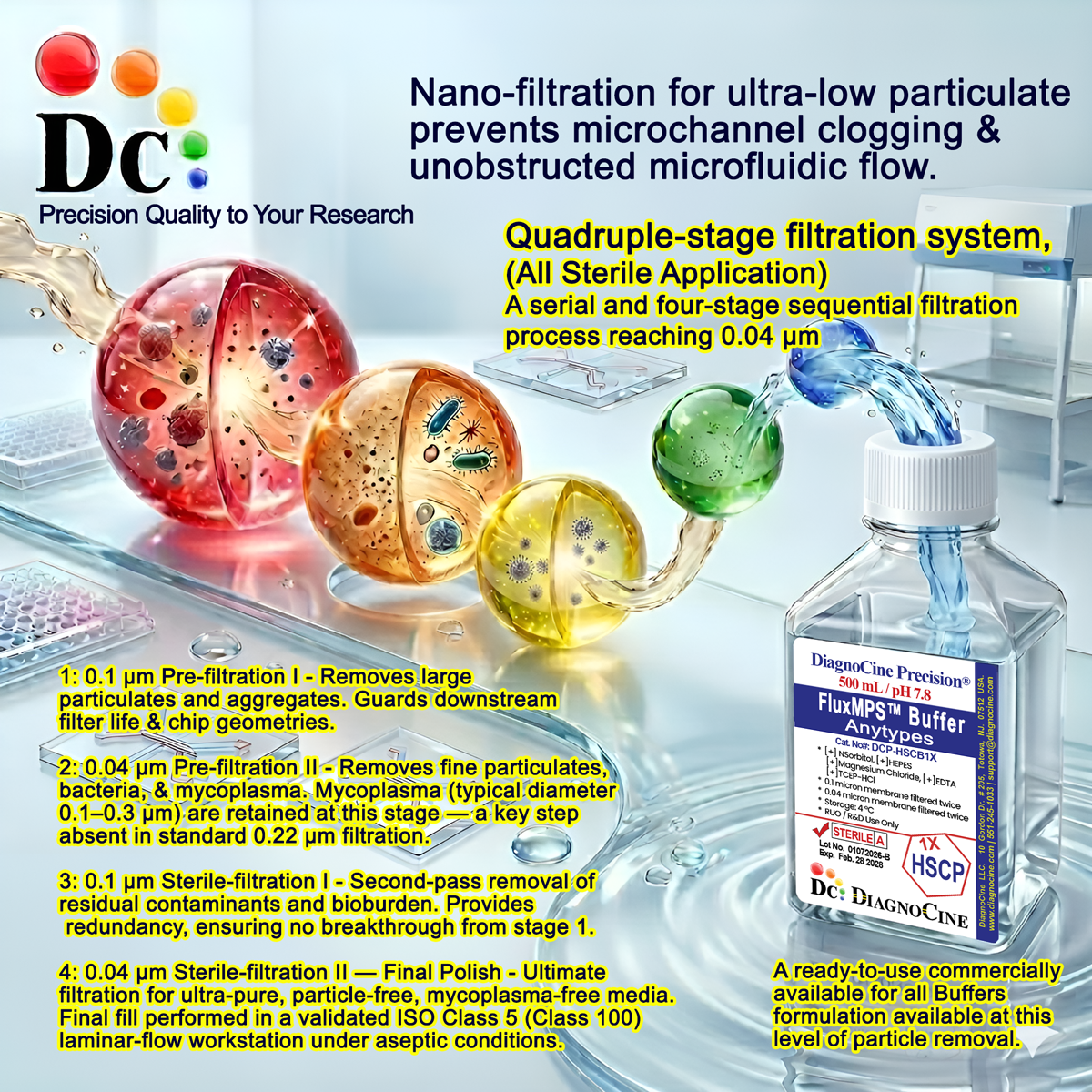
Quadruple-stage filtration system
Solution A is processed through a quadruple-stage filtration train — 0.1 µm membrane filtration twice and 0.04 µm membrane filtration twice — delivering ultra-low particulate purity for sensitive protein storage and downstream microfluidic workflows.
-
1
0.1 µm Pre-filtration I
Removes large particulates and aggregates, extending the working life of downstream filters.
-
2
0.04 µm Pre-filtration II
Retains fine particulates and reduces bioburden ahead of final polishing.
-
3
0.1 µm Sterile-filtration I
Second-pass redundancy through a 0.1 µm membrane for consistent lot-to-lot purity.
-
4
0.04 µm Sterile-filtration II — Final Polish
Ultimate polish immediately prior to fill, minimizing particulate and bioburden carryover.
Performance vs. conventional buffer
Standard single-pass 0.22 µm filtration leaves particulates in the 0.1–0.22 µm range untouched. Sequential 0.1 µm and 0.04 µm filtration removes finer particulates than a single 0.22 µm pass, supporting cleaner handling of purified proteins and downstream microfluidic sample paths.
Validated applications
Protein Storage Buffer supports storage and handling of purified proteins across research workflows, from bench purification to microfluidic and organ-on-a-chip sample handling.
Automated Bioreactors & Robotics
An optional 0.01 µm (10 nm) ultra-filtered variant of the base buffer is available for automated bioreactor and robotic liquid-handling platforms that demand the strictest particulate exclusion for valves, sensors, and perfusion lines.
- Total Particulate Exclusion: Minimizes subvisible particulate load entering automated fluid paths.
- Valve & Sensor Protection: Reduces fouling risk in precision dosing and sensing hardware.
- Extended Perfusion Stability: Supports longer unattended run times in closed microfluidic loops.
Inquiry Required: Contact support@diagnocine.com to request the 0.01 µm ultra-filtered grade.
Micro Physiological System (MPS) & Chip
Stabilizes purified proteins used as reagents or supplements within microfluidic and organ-on-a-chip sample paths.
Purified Protein & Fraction Storage
Stores purified recombinant proteins, protein complexes, or concentrated fractions from purification workflows prior to further processing or analysis.
iPSC-Derived Model Handling
Compatible base chemistry for stabilizing purified protein reagents used alongside iPSC-derived cell models.
Endothelial & Primary Cell Perfusion
Supports storage of purified proteins used in perfusion-based endothelial and primary cell culture studies.
SDS-PAGE, Western Blot & Analytical Assays
Compatible with SDS-PAGE, Western blotting, and analytical assays that tolerate Tris, NaCl, glycerol, TCEP, and protease inhibitors; TCEP and protease inhibitors may interfere with some enzymatic assays, so desalting or dialysis is recommended if needed.
Microscopy & Optical Sensing Sample Handling
Low-particulate base chemistry supports handling of purified protein reagents in confocal and biosensor workflows.
Detailed product specifications
Measured and declared parameters for DCP-PSB1X Solution A and Solution B, as provided by Diagnocine.
| Parameter | Specification |
|---|---|
| Formulation | Tris/NaCl/glycerol/TCEP-HCl base buffer with separate 100X protease inhibitor cocktail |
| Appearance | Clear Solution |
| pH | 7.5 (Solution A) |
| Parameter | Specification |
|---|---|
| Filtration System USP | 0.1µm×2 + 0.04µm×2 (Quadruple-stage) |
| Water Quality | Ultrapure Type 1 water (18.2 MΩ·cm) |
| Parameter | Specification |
|---|---|
| Storage — Solution A | 2-8°C, avoid repeated freeze-thaw cycles |
| Storage — Solution B | -80°C (long term), avoid repeated freeze-thaw cycles |
| Shelf Life | 1 year |
| Parameter | Specification |
|---|---|
| Manufacturing QMS ISO | ISO 13485:2016 |
| Manufacturing Location | Totowa, NJ, USA |
| Intended Use | Research Use Only (RUO) |
| Customization | Formulation customizable upon request |
Full composition
Component listing for Solution A (base buffer) and Solution B (100X protease inhibitor cocktail), per Diagnocine lot release.
| Component | CAS Number | Concentration |
|---|---|---|
| Tris base | 77-86-1 | 50 mM |
| Sodium Chloride | 7647-14-5 | 150 mM |
| Glycerol | 56-81-5 | 10% |
| TCEP-HCl | 51805-45-9 | 2 mM |
| Component | CAS Number | Concentration |
|---|---|---|
| AEBSF·HCl | 30827-99-7 | 10 mM |
| Aprotinin | 9087-70-1 | 80 µM |
| Bestatin | 58970-76-6 | 5 mM |
| E-64 | 66701-25-5 | 100 µM |
| Leupeptin | 103476-89-7 | 1 mM |
| Pepstatin A | 26305-03-3 | 0.1 mM |
Manufacturing & compliance
Protein Storage Buffer is manufactured under a certified quality management system with full lot traceability.
ISO 13485:2016 QMS
Manufactured under certified QMS with full traceability and lot documentation.
Ultrapure Type 1 Water
Solutions are formulated using 18.2 MΩ·cm Type 1 water.
ISO Class 5 Fill & Finish
Final fill performed under controlled aseptic conditions to minimize contamination risk.
Micro-Batch Precision
Solution A and Solution B are manufactured and released as a matched two-part kit.
Made in USA
All manufacturing, QA testing, and final assembly performed at DiagnoCine Precision, Totowa, NJ.
Filtration Documentation
Quadruple-stage filtration (0.1µm×2 + 0.04µm×2) of Solution A is documented per lot.
Freeze-Thaw Guidance
Aliquoting into small volumes before freezing at -20°C is recommended to minimize repeated freeze-thaw cycles.
Documentation / CoA
Lot-specific documentation is available on request.
How DCP-PSB1X compares
A structural comparison of DCP-PSB1X against a lab-prepared buffer and a standard commercial alternative.
| Parameter | DCP-PSB1X (FluxMPS™) | Lab-prepared buffer | Standard commercial alternative |
|---|---|---|---|
| Final filtration pore size | 0.04 µm | Not typically filtered | 0.22 µm |
| Number of filtration stages | 4 | 0 | 1 |
| Protease inhibitor cocktail included separately | check_circle | cancel | cancel |
| Glycerol cryoprotection formulated in | check_circle | cancel | check_circle |
| TCEP-HCl (odor-free reducing agent) | check_circle | cancel | cancel |
| Ultrapure Type 1 water base | check_circle | cancel | cancel |
| ISO 13485:2016 manufacturing | check_circle | cancel | cancel |
| Custom formulation available | check_circle | check_circle | cancel |
Frequently asked questions
Common questions about handling and storing DCP-PSB1X.
Supporting literature
Citations and curated literature relevant to protein storage buffer chemistry.
Citations
- Wingfield PT. Protein precipitation using ammonium sulfate. Curr Protoc Protein Sci. 2001;Appendix 3:Appendix 3F.
- Carpenter JF, Manning MC, Randolph TW. Long-term storage of proteins. Curr Protoc Protein Sci. 2002;27(1):4.6.1-4.6.6. doi:10.1002/0471140864.ps0406s27
Supporting Literature
- Han JC, Han GY. A procedure for quantitative determination of tris(2-carboxyethyl)phosphine, an odorless reducing agent more stable and effective than dithiothreitol. Anal Biochem. 1994;220(1):5-10. doi:10.1006/abio.1994.1290
- Getz EB, Xiao M, Chakrabarty T, Cooke R, Selvin PR. A comparison between the sulfhydryl reductants tris(2-carboxyethyl)phosphine and dithiothreitol for use in protein biochemistry. Anal Biochem. 1999;273(1):73-80. doi:10.1006/abio.1999.4203
- Vagenende V, Yap MG, Trout BL. Mechanisms of protein stabilization and prevention of protein aggregation by glycerol. Biochemistry. 2009;48(46):11084-11096. doi:10.1021/bi900649t
- Bhatnagar BS, Bogner RH, Pikal MJ. Protein stability during freezing: separation of stresses and mechanisms of protein stabilization. Pharm Dev Technol. 2007;12(5):505-523. doi:10.1080/10837450701481157
- Powers JC, Asgian JL, Ekici OD, James KE. Irreversible inhibitors of serine, cysteine, and threonine proteases. Chem Rev. 2002;102(12):4639-4750. doi:10.1021/cr010182v
- Jain NK, Roy I. Effect of trehalose on protein structure. Protein Sci. 2009;18(1):24-36. doi:10.1002/pro.3
- Duffy DC, McDonald JC, Schueller OJ, Whitesides GM. Rapid prototyping of microfluidic systems in poly(dimethylsiloxane). Anal Chem. 1998;70(23):4974-4984. doi:10.1021/ac980656z
- Salvesen G, Nagase H. Inhibition of proteolytic enzymes. In: Beynon R, Bond JS, eds. Proteolytic Enzymes: A Practical Approach. Oxford University Press; 2001.