FluxMPS™ Penicillin-Streptomycin (10,000 U/mL)
FluxMPS™ Penicillin-Streptomycin (10,000 U/mL)
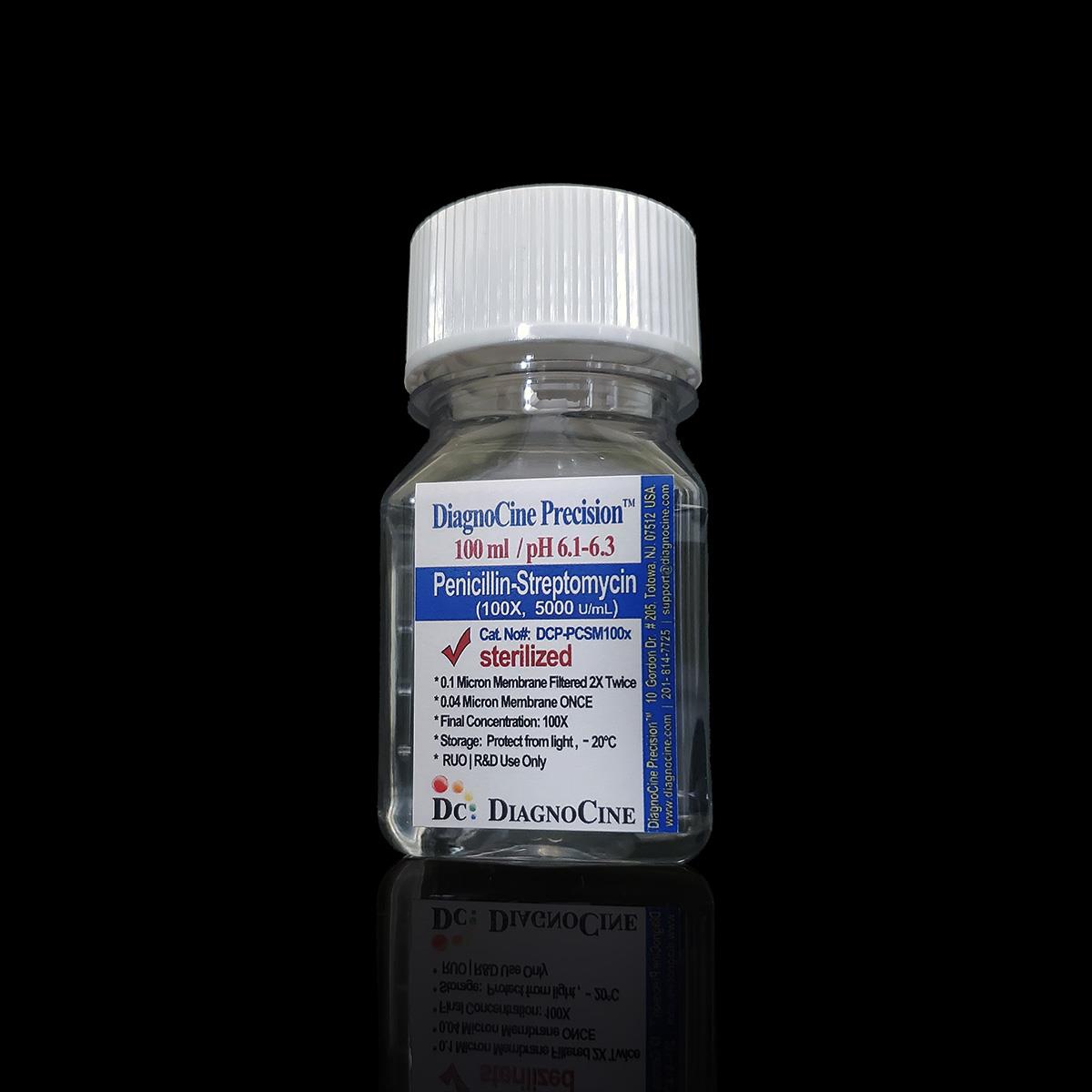
DCP-PCSM100X is a Microfluidics Suitable, quadruple-stage ultra-filtered (0.1 µm ×2 + 0.04 µm ×2) 100X liquid antibiotic concentrate supplying 10,000 U/mL penicillin and 10,000 µg/mL streptomycin. It is formulated as a bacterial-contamination-control supplement for mammalian and insect cell culture media, sterile-filtered to a 0.04 µm final cut-off for compatibility with microfluidic channels and organ-on-a-chip (OoC) perfusion systems.
- 100X concentrate: 10,000 U/mL penicillin + 10,000 µg/mL streptomycin; add at typical working concentrations of 50-100 U/mL penicillin and 50-100 µg/mL streptomycin
- Sterile-filtered through a quadruple-stage 0.1 µm ×2 + 0.04 µm ×2 filtration train
- Dual-mechanism, broad-spectrum activity against most Gram-positive and Gram-negative contaminants (bacterial cell-wall synthesis inhibition + 30S ribosomal subunit binding)
- Validated for use in mammalian and insect cell culture systems
- Liquid, ready-to-add format; store at -20°C, protect from light, avoid repeated freeze-thaw cycles
- 12-month shelf life from date of manufacture, unopened
- Manufactured under an ISO 13485:2016 quality management system
- Custom concentrations, pH, and additive formulations available on request — contact support@diagnocine.com
- Concentration100X
- Penicillin10,000 U/mL
- Streptomycin10,000 µg/mL
- Working Concentration50-100 U/mL / 50-100 µg/mL
- Culture TypeMammalian & Insect Cell Culture
- ApplicationPrevention of Cell Culture Contamination
- FiltrationQuadruple-stage (0.1 µm ×2 + 0.04 µm ×2)
- Storage-20°C; protect from light
- Shelf Life12 months from date of manufacture, unopened
- ShippingDry Ice
Engineered where standard antibiotic supplements fall short
Conventional 0.22 µm-filtered antibiotic solutions can carry sub-micron particulates and mycoplasma-scale organisms into sensitive microfluidic and organ-on-a-chip (OoC) systems. DCP-PCSM100X is processed through Diagnocine's quadruple-stage filtration train to reduce that risk while delivering reliable, broad-spectrum contamination control.
Microchannel-safe purity
A 0.1 µm + 0.04 µm prefilter/final-filter pair, run twice in series, reduces sub-micron particulate load before the antibiotic concentrate reaches a microfluidic channel.
Broad-spectrum contamination control
Penicillin and streptomycin act on complementary bacterial targets, giving coverage against most Gram-positive and Gram-negative contaminants commonly introduced during routine culture handling.
Dual mechanism of action
Penicillin inactivates penicillin-binding proteins and disrupts bacterial cell-wall synthesis; streptomycin binds the bacterial 30S ribosomal subunit and halts protein synthesis, regardless of division state.[1]
Validated across culture systems
Formulated for use as a supplement in mammalian and insect cell culture media, including primary cells and T-cell culture systems.
Rigorous batch processing
Each batch is sterile-filtered through the quadruple-stage train and manufactured under an ISO 13485:2016 quality management system prior to release.
Customization on demand
Alternate concentrations, pH, or the addition of other chemicals, compounds, proteins, or supplements can be produced on request.
Quadruple-stage filtration system
DCP-PCSM100X is processed through a validated four-pass filtration train — two dedicated prefilter/final-filter pairs run in series — reaching a 0.04 µm final pore size before aseptic fill.
- 1
0.1 µm Prefiltration I
Removes large particulate and protein aggregate load, protecting the first 0.04 µm final-filter cartridge.
- 2
0.04 µm Final filtration I
First 0.04 µm pass; retains sub-micron particulates that pass a conventional 0.22 µm filter.
- 3
0.1 µm Prefiltration II
A second, dedicated prefilter protecting the second 0.04 µm final-filter cartridge.
- 4
0.04 µm Final filtration II — Polish
Ultimate polishing filter prior to aseptic fill and finish.
Filtration architecture
The train is a repeated prefilter + final-filter pair, not a single descending cascade: each 0.04 µm final filter has its own dedicated 0.1 µm prefilter, and the sequence runs twice in series for full redundancy.

© Diagnocine® — DCP-PCSM100X
Where DCP-PCSM100X is used
As a supplement added to complete cell culture media, DCP-PCSM100X controls bacterial contamination across a range of mammalian and insect cell culture systems — while requiring the same caution any Pen/Strep supplement demands regarding off-target cellular effects.
Automated Bioreactors & Robotics
For closed-loop automated bioreactor and liquid-handling robotics platforms, Diagnocine also offers an optional 0.01 µm (10 nm) ultra nano-filtered MPS Grade variant of this antibiotic concentrate, engineered for systems where sub-40 nm particulate exclusion protects narrow-bore tubing, valves, and inline sensors.
- Total Particulate Exclusion — six-stage cascade down to a 0.01 µm final cut-off
- Valve & Sensor Protection — reduced fouling risk in automated perfusion hardware
- Extended Perfusion Stability — supports longer unattended run times
Inquiry Required: the 0.01 µm MPS Grade variant is produced on request — contact support@diagnocine.com to discuss requirements.
Mammalian & Insect Cell Systems
General-purpose bacterial contamination control for routine mammalian and insect cell culture maintenance.
T-Cell & Primary Cell Culture
Used to help control contamination risk in primary cell and T-cell culture workflows.
Use With Caution — Differentiation Studies
Antibiotics can affect proliferation and differentiation potential in stem cell cultures; monitor for confounding effects before adopting for definitive differentiation studies.
Melanoma & Cancer Cell Lines
Reported to moderately stimulate melanogenic enzymes (dopa oxidase, tyrosine hydroxylase) in melanoma cultures over 24-48 hours; account for this in pigmentation-related endpoints.
Keratinocyte & 3D Skin Models
Can reduce proliferation of normal human epidermal keratinocytes (NHEK) and hinder full epidermal differentiation in 3D skin models; use judiciously in these systems.
Gene Expression & Chromatin Studies
Genome-wide studies in human HepG2 liver cells report Pen/Strep-induced changes in gene expression and chromatin landscape across drug-response, insulin-response, fatty-acid metabolism, apoptosis, cell-growth, and unfolded-protein-response pathways.[1]
Formulation, safety, and logistics parameters
Specifications reflect data provided in Diagnocine's source formulation record. Parameters not stated in that record (endotoxin, osmolality, CO₂ requirement, mycoplasma testing, sodium bicarbonate) are intentionally omitted rather than estimated.
| Parameter | Specification |
|---|---|
| Active Ingredient 1 | Penicillin, 10,000 U/mL |
| Active Ingredient 2 | Streptomycin, 10,000 µg/mL |
| Concentration | 100X |
| Working Concentration | 50-100 U/mL penicillin / 50-100 µg/mL streptomycin |
| Form | Liquid |
| Product Type | Antibiotic supplement |
| Parameter | Specification |
|---|---|
| Sterility | Sterile-filtered Filtration-based |
| Filtration System | Quadruple-stage: 0.1 µm ×2 + 0.04 µm ×2 |
| Culture Type | Mammalian Cell Culture, Insect Cell Culture |
| Application | Prevention of cell culture bacterial contamination |
| Parameter | Specification |
|---|---|
| Storage Temperature | -20°C |
| Light Protection | Protect from light |
| Freeze-Thaw | Repeated freezing and thawing should be avoided |
| Shelf Life | 12 months from date of manufacture, unopened |
| Shipping Condition | Dry ice |
| Parameter | Specification |
|---|---|
| Manufacturing QMS | ISO 13485:2016 |
| UNSPSC | 41116155 — Molecular biology and cell culture growth media (UNv260801) |
| Regulatory Alignment | Research Use Only (RUO) |
| Grade | Microfluidics Suitable (0.04 µm final cut-off) |
| Intended Use | Research Use Only. Not for clinical, diagnostic, or therapeutic use in humans |
Full composition
DCP-PCSM100X is a two-component antibiotic concentrate rather than a multi-salt basal medium; its active ingredients, formulation details, and recommended working concentrations are summarized below.
| Component | CAS Number | Concentration |
|---|---|---|
| Penicillin G (sodium salt) | 69-57-8 | 10,000 U/mL |
| Streptomycin sulfate | 3810-74-0 | 10,000 µg/mL |
| Attribute | CAS Number | Value |
|---|---|---|
| Concentration (stock) | — | 100X |
| Form | — | Liquid |
| Culture Type Compatibility | — | Mammalian Cell Culture, Insect Cell Culture |
| Product Type | — | Antibiotics |
| Component | CAS Number | Typical Working Concentration |
|---|---|---|
| Penicillin | 69-57-8 | 50-100 U/mL |
| Streptomycin | 3810-74-0 | 50-100 µg/mL |
Manufacturing & batch quality control
DCP-PCSM100X is manufactured under Diagnocine's ISO 13485:2016 quality management system, with quadruple-stage filtration and per-batch release testing applied prior to shipment.
Sterility
Sterile-filtered via the quadruple-stage 0.1 µm ×2 + 0.04 µm ×2 process described above.
Filtration Process
Two dedicated prefilter (0.1 µm) + final-filter (0.04 µm) pairs run in series.
Storage Stability
Store at -20°C, protect from light; repeated freeze-thaw cycles should be avoided to preserve potency.
Documentation / CoA
A Certificate of Analysis documenting lot number and manufacture date is available on request.
How DCP-PCSM100X compares
Comparison against conventional single-stage 0.22 µm-filtered Pen/Strep antibiotic supplements commonly used in cell culture.
| Parameter | DCP-PCSM100X (FluxMPS™) | Conventional Pen/Strep (0.22 µm filtered) | Standard Antibiotic-Antimycotic Solution (0.22 µm filtered) |
|---|---|---|---|
| Grade | Microfluidics Suitable | Standard grade | Standard grade |
| Filtration stages | 4 (0.1 µm ×2 + 0.04 µm ×2) | 1 (0.22 µm single-stage) | 1 (0.22 µm single-stage) |
| Final filtration pore size | 0.04 µm | 0.22 µm | 0.22 µm |
| Antimicrobial spectrum | Penicillin + Streptomycin (broad-spectrum Gram+/Gram-) | Penicillin + Streptomycin | Penicillin + Streptomycin + Amphotericin B |
| Endotoxin (release specification) | Not specified for this product | Corning classical liquid media — < 0.25 EU/mL Sigma-Aldrich DMEM complete medium — ≤ 2 EU/mL Gibco classical DMEM — Not specified (recorded per lot) |
|
| Manufacturing QMS | ISO 13485:2016 | Not specified | Not specified |
| Culture type compatibility | Mammalian & Insect Cell Culture | Mammalian | Mammalian |
| Custom formulation | check_circle | cancel | cancel |
Comparison figures from published supplier specifications, accessed 2026-09-02. Suppliers that publish no numeric endotoxin specification are shown as "Not specified".
Frequently asked questions
Common questions about using DCP-PCSM100X in cell culture and microfluidic workflows.
Supporting literature
Citations and curated literature relevant to antibiotic use in cell culture, mycoplasma control, and microfluidic/organ-on-a-chip applications.
Citations
- Ryu AH, Eckalbar WL, Kreimer A, Yosef N, Ahituv N. Use antibiotics in cell culture with caution: genome-wide identification of antibiotic-induced changes in gene expression and regulation. Sci Rep. 2017;7(1):7533. doi:10.1038/s41598-017-07757-w
Supporting Literature
- Uphoff CC, Drexler HG. Detection of Mycoplasma in cell cultures. Curr Protoc Mol Biol. 2014;106:24.4.1-24.4.14. doi:10.1002/0471142727.mb2404s106
- Nims RW, Price PJ. Best practices for detecting and mitigating mycoplasma contamination in cell culture. J Vis Exp. 2017. doi:10.3791/57127
- Low LA, Mummery C, Berridge BR, Austin CP, Tagle DA. Organs-on-chips: into the next decade. Nat Rev Drug Discov. 2021;20(5):345-361. doi:10.1038/s41573-020-0079-3
- Zhang B, Radisic M. Organ-on-a-chip devices advance to market. Lab Chip. 2017;17(14):2395-2420. doi:10.1039/c6lc01554a
- Huh D, Matthews BD, Mammoto A, Montoya-Zavala M, Hsin HY, Ingber DE. Reconstituting organ-level lung functions on a chip. Science. 2010;328(5986):1662-1668. doi:10.1126/science.1188302
- Bhatia SN, Ingber DE. Microfluidic organs-on-chips. Nat Biotechnol. 2014;32(8):760-772. doi:10.1038/nbt.2989
- Skardal A, Shupe T, Atala A. Organoid-on-a-chip and body-on-a-chip systems for drug screening and disease modeling. Drug Discov Today. 2016;21(9):1399-1411. doi:10.1016/j.drudis.2016.07.003
- Coecke S, Balls M, Bowe G, et al. Guidance on good cell culture practice: a report of the second ECVAM task force. Altern Lab Anim. 2005;33(3):261-287. doi:10.1177/026119290503300313
- Freshney RI. Culture of Animal Cells: A Manual of Basic Technique and Specialized Applications. 7th ed. Hoboken, NJ: Wiley; 2016.