

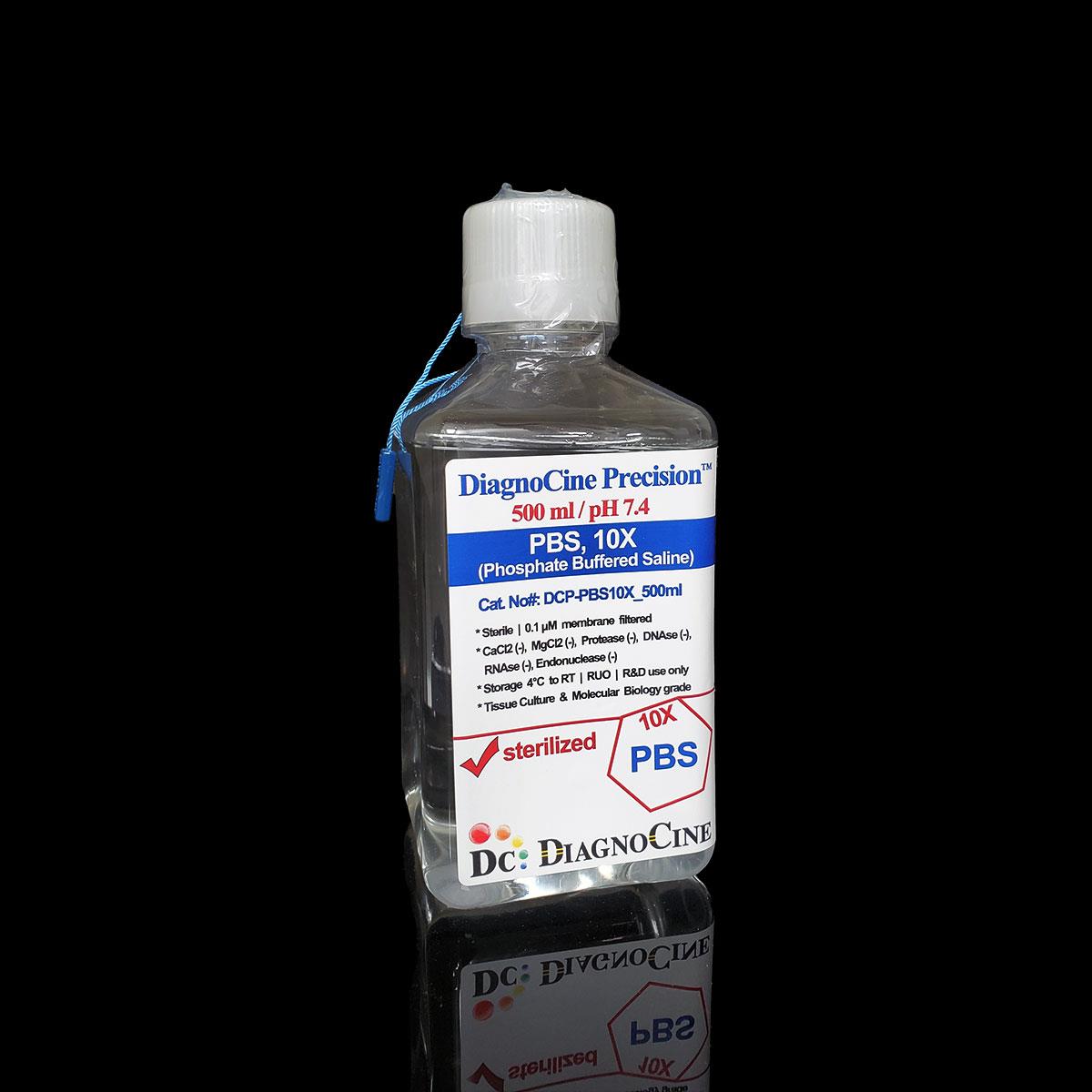
FluxMPS™ PBS, 10X (Phosphate Buffered Saline), Sterile
FluxMPS™ PBS, 10X (Phosphate Buffered Saline), Sterile
An MPS-grade, calcium- and magnesium-free phosphate buffered saline concentrate delivering precise, stable pH 7.4 and defined ionic strength across every dilution. Ultra-filtered through a quadruple-stage filtration architecture — 0.1 µm membrane filtered twice and 0.04 µm membrane filtered twice — and manufactured with ultrapure Type 1 water for microchannel-safe use across organ-on-a-chip and microfluidic workflows.
- Quadruple-stage filtration (0.1 µm membrane filtered twice and 0.04 µm membrane filtered twice) for microchannel-safe purity
- Endotoxin < 0.05 EU/mL by USP <85> Bacterial Endotoxin Test
- Precise pH 7.4 with defined 10X ionic strength (1370 mM NaCl, 27 mM KCl, 80 mM Na₂HPO₄, 20 mM KH₂PO₄)
- Ultrapure Type 1 water (18.2 MΩ·cm), ASTM 0.05 µS/cm
- ISO Class 5 (Class 100) aseptic fill and finish
- Calcium- and magnesium-free; protease-, DNase-, RNase-, and endonuclease-free
- Microchannel-compatible for OoC, ToC, BoC, and LoC platforms
- pH, molarity/concentration (1X–5X), and additive customization available on request
- pH7.4
- Molarity / Concentration10X
- Ionic Strength~1497 mM total salts
- OsmolalitySee Certificate of Analysis
- Endotoxin< 0.05 EU/mL
- SterilityUSP <71> compliant
- Filtration0.1 µm x2 + 0.04 µm x2, quadruple-stage
- StorageRT; 4°C for long-term
- Shelf Life24 months
- ShippingAmbient
Engineered where standard buffers fail
Conventional 0.22 µm-filtered saline buffers leave behind subvisible particulates that accumulate in microchannels, drift in pH and ionic strength between lots, and carry endotoxin loads that raise assay background. FluxMPS™ PBS, 10X is formulated and filtered specifically to eliminate these failure modes for microfluidic and organ-on-a-chip (OoC) research.
Microchannel-safe purity
0.1 µm final-stage membrane filtration reduces subvisible particulate counts per USP <788>, protecting narrow microfluidic channels and chip geometries from occlusion.
Precise, stable pH
Defined 10X molarity (1370 mM NaCl, 27 mM KCl, 80 mM Na₂HPO₄, 20 mM KH₂PO₄) delivers consistent pH 7.4 and buffering capacity lot to lot.
Ultrapure-grade water
Formulated with ASTM 0.05 µS/cm Type 1 ultrapure, deionized water per USP <85> water-quality expectations.
Low background for imaging & assays
Calcium- and magnesium-free formulation with no added dyes minimizes background interference for confocal imaging, biosensor arrays, and fluorescence/luminescence assays.
Defined, traceable composition
Lot-released, protease-, DNase-, RNase-, and endonuclease-free saline-phosphate composition with controlled ionic strength for reproducible washing and dilution.
Customization on demand
pH, molarity/concentration (1X, 2X, 4X, 5X), and additive content — including chemicals, detergents, inhibitors, and proteins — available on request.
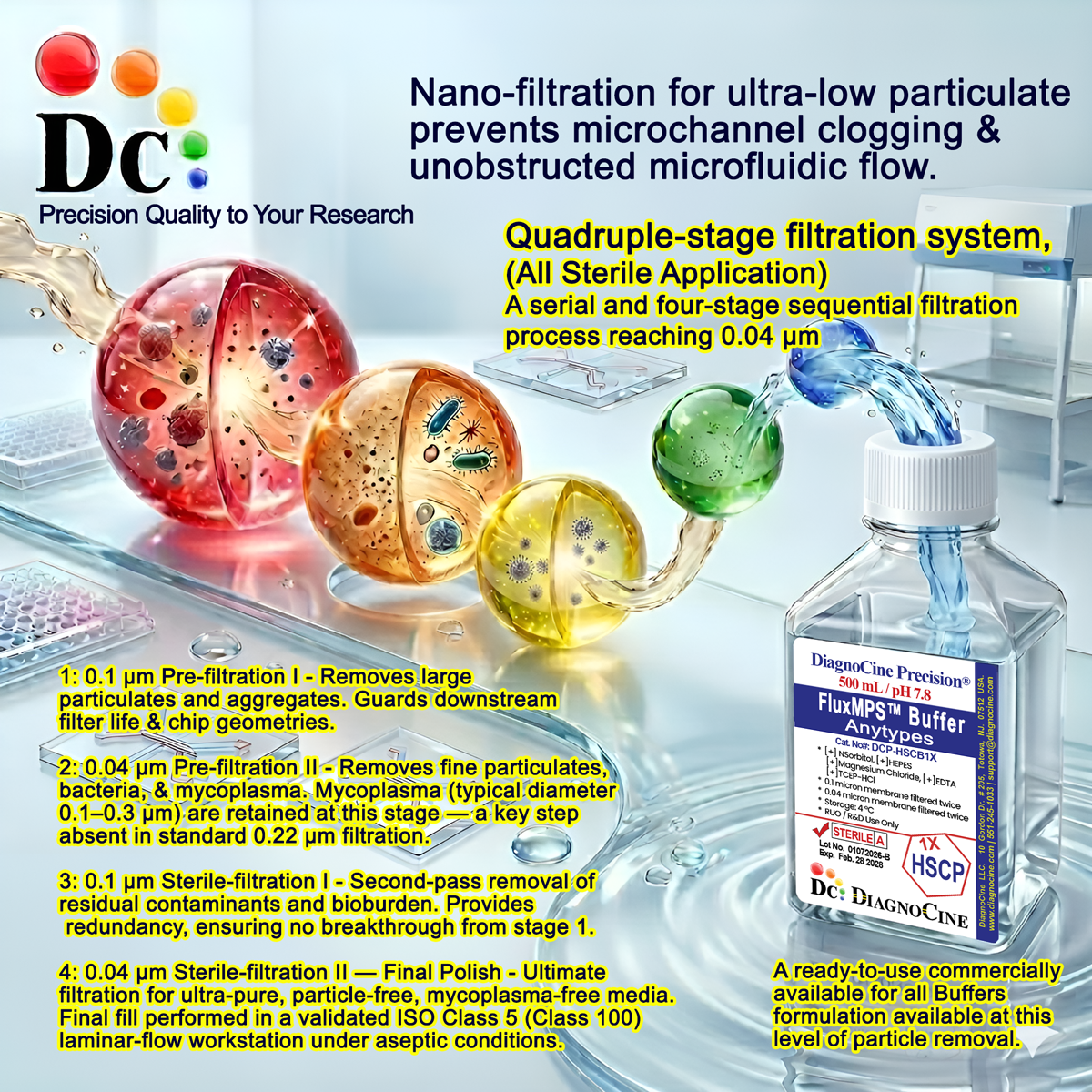
Quadruple-stage filtration system
DCP-PBS10X is sterilized by a serial, four-stage sequential filtration process reaching 0.04 µm — the 0.1 µm membrane pass is performed twice and the 0.04 µm membrane pass is performed twice, all in a clean, controlled environment. This architecture removes large particulates and aggregates, retains fine particulates, bacteria, and mycoplasma-scale contaminants, and applies redundant second passes for ultra-pure, particle-free final polish.
-
01
0.1 µmPre-filtration I
Large particulate and aggregate removal via 0.1 µm membrane filtration, guarding downstream filter life and chip geometries.
-
02
0.04 µmPre-filtration II
Fine particulate, bacteria, and mycoplasma retention. Mycoplasma (typical diameter 0.1–0.3 µm) are retained at this stage — a key step absent in standard 0.22 µm filtration.
-
03
0.1 µmSterile-filtration I
Second-pass removal of residual contaminants and bioburden, providing redundancy and ensuring no breakthrough from Stage 1.
-
04
0.04 µmSterile-filtration II — Final Polish
Ultimate filtration for ultra-pure, particle-free, mycoplasma-free buffer. Final fill performed in a validated ISO Class 5 (Class 100) laminar-flow workstation under aseptic conditions.
Performance vs. conventional buffer
Standard laboratory PBS is typically filtered once through a 0.22 µm membrane. DCP-PBS10X applies a serial four-stage process — 0.1 µm membrane filtered twice and 0.04 µm membrane filtered twice — for substantially improved particulate and bioburden retention relative to single-pass 0.22 µm filtration.
© Diagnocine® — DCP-PBS10X
Built for microphysiological systems research
DCP-PBS10X supports the full range of buffer needs across microfluidic, organ-on-a-chip, and traditional cell culture workflows, from chip priming and rinsing to dilution of stock reagents.
Automated Bioreactors & Robotics
For automated, closed-loop bioreactor and liquid-handling robotics platforms, an optional 0.01 µm (10 nm) ultra-filtered variant of DCP-PBS10X is available on request, engineered to further protect microvalves, sensors, and long-duration perfusion lines from particulate fouling.
- Total Particulate Exclusion — sub-0.01 µm polish minimizes fine particulate carryover
- Valve & Sensor Protection — reduces fouling risk in automated microvalves and inline sensors
- Extended Perfusion Stability — supports longer unattended run times in closed perfusion loops
Inquiry Required: the 0.01 µm ultra-filtered grade is produced to order — contact support@diagnocine.com to request this configuration.
Micro Physiological System (MPS) & Chip Priming
Rinse and prime microfluidic chip channels prior to seeding or perfusion.
Wash, Dilution & Reconstitution
Dilute the 10X concentrate to 1X for washing, rinsing, and reconstitution of cells, tissue, and reagents.
iPSC-Derived Model Handling
Calcium/magnesium-free formulation supports gentle handling steps ahead of dissociation of iPSC-derived models.
Endothelial & Primary Cell Perfusion
Used to rinse and buffer endothelial and primary cell perfusion systems ahead of assay setup.
ELISA, Blotting & Blocking
Serves as a wash and dilution buffer base for ELISA, western blotting, IHC, and IF protocols.
Microscopy & Optical Sensing
Low-background, dye-free formulation is compatible with confocal microscopy and on-chip biosensor readouts.
Full specification summary
Key physical, chemical, purity, and regulatory parameters for DCP-PBS10X.
| Parameter | Specification |
|---|---|
| Formulation / Composition | NaCl, KCl, Na₂HPO₄, KH₂PO₄ USP |
| Appearance | Sterilized liquid, clear, colorless |
| pH (USP <791>) | 7.4 USP <791> |
| Osmolality (USP <785>) | Standard FluxMPS™ spec — confirm on request USP <785> |
| Molarity / Concentration | 10X |
| Conductivity / Ionic strength | ~1497 mM total salt content at 10X |
| Buffering range (pKa) | Phosphate buffering, pKa2 ~7.2 |
| Target ion concentration | 1370 mM Na?, 27 mM K?, phosphate-buffered |
| Parameter | Specification |
|---|---|
| Endotoxin (USP <85> BET) | < 0.05 EU/mL USP <85> |
| Sterility (USP <71>) | Quadruple-stage — 0.1 µm membrane filtered twice, 0.04 µm membrane filtered twice USP <71> |
| Particulate ≥10 µm (USP <788>) | Meets USP <788> Method 2 limits USP <788> |
| Particulate ≥25 µm (USP <788>) | Meets USP <788> Method 2 limits USP <788> |
| Water purity | ASTM 0.05 µS/cm Type 1 ultrapure, deionized |
| Manufacturing std. | ISO 13485:2016 ISO |
| Fill environment | Controlled clean environment |
| Parameter | Specification |
|---|---|
| Storage temperature | Room temperature; 4°C recommended for long-term storage |
| Freeze-thaw | Not recommended; store as directed above |
| Shelf life | 24 months |
| Shipping condition | Ambient |
| pH stability / re-equilibration note | Allow to equilibrate to room temperature before use; mix gently before dilution |
| Parameter | Specification |
|---|---|
| Raw material grade | Tissue culture & molecular biology grade |
| Traceability | Lot-released with Certificate of Analysis |
| Manufacturing QMS | ISO 13485:2016 ISO |
| Regulatory alignment | CE-approved facilities; 21 CFR Part 820 (cGMP) aligned |
| Production method | Manufactured, packaged, and QC-tested at DiagnoCine Precision, Totowa, NJ, USA |
| Intended use | Research Use Only (RUO) |
Full composition
All components below are expressed at 10X concentration exactly as released per lot; dilute to 1X for standard use. This is a single-group formulation with no source-defined sub-categories.
| Component | CAS Number | Concentration |
|---|---|---|
| Buffer Components | ||
| Sodium Chloride (NaCl) | 7647-14-5 | 1370 mM |
| Potassium Chloride (KCl) | 7447-40-7 | 27 mM |
| Sodium Phosphate dibasic (Na₂HPO₄) | 7558-79-4 | 80 mM |
| Potassium Phosphate monobasic (KH₂PO₄) | 7778-77-0 | 20 mM |
Manufacturing & compliance
DCP-PBS10X is manufactured, packaged, and quality-tested under a controlled, certified quality system.
ISO 13485:2016 QMS
Manufactured under ISO 13485-certified and CE-approved facilities.
Ultrapure Type 1 Water
Formulated with ASTM 0.05 µS/cm Type 1 ultrapure, deionized water.
Controlled Clean-Environment Fill
Dual-pass 0.1 µm membrane filtration performed in a clean, controlled environment.
Micro-Batch Precision
Final packaging, QA, and testing performed at the DiagnoCine R&D and Quality Testing Center, Totowa, NJ.
Endotoxin — USP <85> BET
Endotoxin specification < 0.05 EU/mL, verified by Bacterial Endotoxin Test.
Particulate — USP <788> Method 2
Subvisible particulate counts assessed against USP <788> Method 2 thresholds.
Osmolality — USP <785>
Osmolality confirmed per lot in accordance with USP <785>.
Documentation / CoA
Certificate of Analysis available per lot upon request.
How DCP-PBS10X compares
DCP-PBS10X against conventional 0.22 µm-filtered PBS and a standard commercial alternative.
| Parameter | DCP-PBS10X (FluxMPS™) | Conventional 0.22 µm PBS | Standard Alternative (0.22 µm filtered) |
|---|---|---|---|
| Defined 10X molarity / tight pH control | check_circle | cancel | cancel |
| Final filtration pore size | 0.04 µm (final polish pass) | 0.22 µm | 0.22 µm |
| Number of filtration stages | 4 (0.1 µm x2 + 0.04 µm x2) | 1 (single-pass) | 1 (single-pass) |
| Endotoxin specification | < 0.05 EU/mL | Not typically specified | Varies by lot |
| USP particulate compliance | check_circle | cancel | cancel |
| Water quality | ASTM 0.05 µS/cm Type 1 ultrapure | Standard purified water | Standard purified water |
| Manufacturing QMS | ISO 13485:2016 | Not typically certified | Varies |
| Microfluidic channel compatibility | check_circle | cancel | cancel |
| pH / ionic-strength reproducibility | check_circle | cancel | cancel |
| Custom formulation | check_circle | cancel | cancel |
Frequently asked questions
Common questions about DCP-PBS10X formulation, filtration, and customization.
Supporting literature
Curated peer-reviewed references relevant to PBS buffer chemistry, microfluidic perfusion, and organ-on-a-chip applications.
- Bhatia, S. N. & Ingber, D. E. Microfluidic organs-on-chips. Nat. Biotechnol. 32, 760–772 (2014). doi:10.1038/nbt.2989
- Halldorsson, S. et al. Advantages and challenges of microfluidic cell culture in polydimethylsiloxane devices. Biosens. Bioelectron. 63, 218–231 (2015). doi:10.1016/j.bios.2014.07.029
- Good, N. E. et al. Hydrogen ion buffers for biological research. Biochemistry 5, 467–477 (1966). doi:10.1021/bi00866a011
- Ferrell, N. et al. Vascular access buffer perfusion and ionic strength effects on endothelial cell monolayers. Ann. Biomed. Eng. 40, 1362–1373 (2012). doi:10.1007/s10439-011-0503-2
- Malda, J. et al. Of mice, men and elephants: the relation between endotoxin biology and applications of cell-based technologies. Cytotherapy 21, 249–259 (2019). doi:10.1016/j.jcyt.2019.01.001
- Low, L. A. et al. Organs-on-chips: into the next decade. Nat. Rev. Drug Discov. 20, 345–361 (2021). doi:10.1038/s41573-020-0079-3
- United States Pharmacopeia. USP <788> Particulate Matter in Injections, Method 2 (Light Obscuration). USP-NF (2023). doi:10.31003/USPNF_M99715_02_01
- Weber, E. J. et al. Application of a microfluidic kidney chip for evaluation of drug-induced nephrotoxicity. Sci. Rep. 8, 4941 (2018). doi:10.1038/s41598-018-23327-6
It is good. The price is also good!
Jaemin *****
PBS 10x
It is good. The price is also good!
We usually use Gibco products, but from now on we plan to use DiagnoCine products.