FluxMPS™, NBT Plant Tissue ROS Detection Kit
FluxMPS™ NBT Plant Tissue ROS Detection Kit
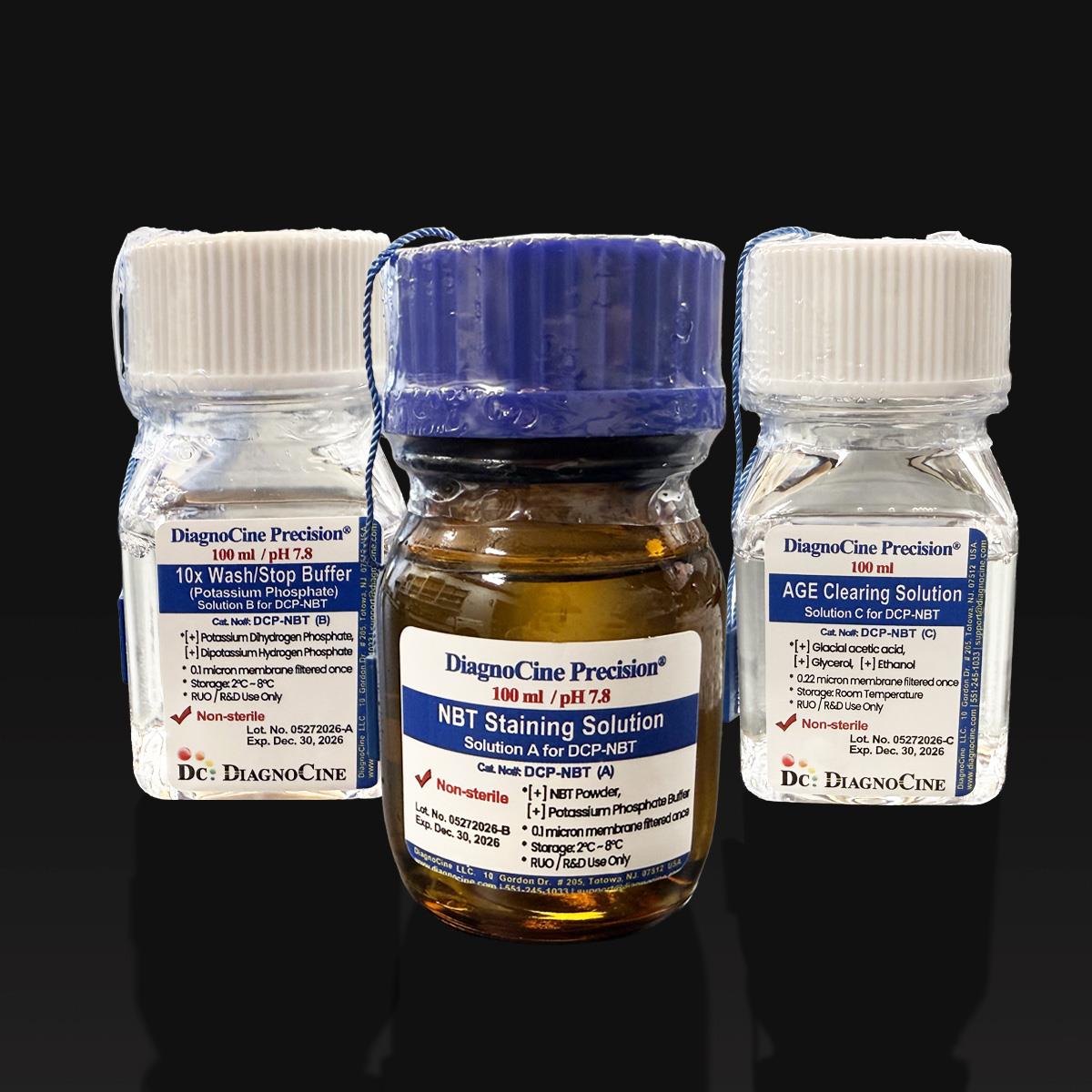
A ready-to-use, three-part histochemical staining kit for rapid detection of superoxide (O2-) accumulation in plant tissues. The kit pairs an MPS-grade 0.05% NBT staining solution in 10 mM potassium phosphate buffer (pH 7.8) with a 10x potassium phosphate wash/stop buffer and an AGE chlorophyll-clearing solution, manufactured under ISO 13485:2016 quality systems for consistent, reproducible results.
- Complete 3-part kit: NBT Staining Solution, 10x Wash/Stop Buffer, and AGE Clearing Solution
- Ready-to-use NBT staining solution — no weighing or pH-adjusting needed
- Potassium phosphate-based system optimized for plant tissues (pH 7.8)
- Included AGE clearing solution (acetic acid:glycerol:ethanol, 1:1:3) for efficient chlorophyll removal
- Suitable for Arabidopsis, crop leaves, roots, and other small plant tissues
- Ideal for stress assays, teaching labs, and routine ROS screening
- Ultrapure Type 1 water (18.2 MΩ·cm) used in all aqueous solutions
- Customizable formulation available upon request
- pH7.8 (Solutions A & B)
- AppearanceSolution A: yellow; Solutions B & C: clear
- Filtration0.1 µm (Solutions A & B), 0.22 µm (Solution C)
- Kit Format3 solutions, 100 mL each
- Storage2-8 °C (A & B); Room Temperature (C)
- Shelf Life6 months
- Buffer SystemPotassium phosphate (A & B)
- Detection TargetSuperoxide (O2-)
- Clearing RatioAcetic acid:glycerol:ethanol = 1:1:3
- Intended UseResearch & teaching use only
Engineered for consistent, publication-quality ROS staining
Homemade NBT stains and unfiltered laboratory-grade reagents introduce lot-to-lot variability, pH drift, and particulate that create staining artifacts and inconsistent formazan development. NBT Plant Tissue ROS Detection Kit is manufactured under ISO 13485 quality systems with defined, filtered components for reproducible results.
Ultra-filtered staining reagents
0.1 µm filtration of the NBT Staining Solution and Wash/Stop Buffer minimizes particulate that can create staining artifacts.
Precise, stable pH 7.8
Potassium phosphate buffer system holds pH at 7.8 for consistent, reproducible formazan formation across replicates.
Ultrapure Type 1 water
18.2 MΩ·cm water used in aqueous solutions reduces trace-metal interference with the NBT redox reaction.
High-contrast imaging
AGE clearing solution (acetic acid:glycerol:ethanol, 1:1:3) removes chlorophyll for clear visualization of blue formazan deposits.
Defined, traceable composition
Lot-released NBT powder, buffer salts, and clearing reagents at fixed concentrations for every batch.
Customization on demand
NBT concentration, buffer molarity, pH, and clearing ratio can be adjusted — contact support@diagnocine.com.
Single-stage 0.1 µm filtration
The NBT Staining Solution and Wash/Stop Buffer (Solutions A & B) are processed through a single 0.1 µm membrane pass, exceeding the particulate control of standard 0.22 µm-filtered reagents.
-
1
0.1 µm filtration
Removes large particulates, aggregates, and bacteria from Solutions A and B, providing baseline purity beyond standard 0.22 µm filtration.
Performance vs. conventional reagents
Standard 0.22 µm single-pass filtration leaves particles in the 0.12-0.22 µm range. The 0.1 µm final filter used for Solutions A and B is 2.2× finer than 0.22 µm, removing these contaminants for cleaner staining results and higher reproducibility.
Validated applications
NBT Plant Tissue ROS Detection Kit supports histochemical superoxide detection across a range of plant stress-response and teaching workflows.
Automated Liquid Handling & High-Throughput Screening
For labs adopting automated dispensing or robotic pipetting platforms, an optional 0.01 µm (10 nm) ultra-filtered variant of the NBT Staining Solution and Wash/Stop Buffer is available to reduce the risk of particulate accumulation in narrow-bore tubing and dispensing tips.
- Reduced clogging risk in automated pipetting tips
- More consistent dispensing volumes
- Compatibility with robotic liquid handling platforms
Inquiry Required: the 0.01 µm ultra-filtered grade is available upon request — contact support@diagnocine.com.
Monitoring oxidative stress responses
Superoxide accumulation in leaves and roots under light, drought, salt, chemical, or pathogen stress.
Blue formazan detection
Visualization of superoxide (O2-) accumulation as insoluble blue formazan deposits.
Genotype & treatment comparison
Comparing ROS levels between treatments, genotypes, or conditions for ag/biotech R&D screens.
Teaching & research laboratories
Ready-to-use format ideal for teaching labs, routine ROS screening, and undergraduate coursework.
Chlorophyll clearing for imaging
AGE clearing solution removes chlorophyll for high-contrast visualization of formazan deposits.
Combined ROS profiling with DAB
Pairing NBT (superoxide) with DAB (H2O2) staining for complementary ROS characterization.
Protocol overview
- Preparation: Equilibrate NBT Staining Solution to room temperature in the dark; dilute 10x Wash/Stop Buffer 1:10 with distilled water.
- Staining: Immerse tissues in NBT Staining Solution (e.g., 2-3 mL per well); optional gentle vacuum infiltration; incubate in the dark at room temperature until blue formazan deposits are clearly visible.
- Washing/stopping: Remove NBT solution and wash tissues 3-4 times in 1x Wash/Stop Buffer.
- Clearing: Transfer tissues to AGE Clearing Solution and incubate at room temperature (or gently warmed) until chlorophyll is sufficiently removed.
- Imaging & analysis: Visualize blue formazan staining by bright-field microscopy or flatbed/scanner imaging; compare intensity and distribution between treatments, genotypes, or conditions.
Detailed specifications
Measured and declared values for the NBT Plant Tissue ROS Detection Kit and its three component solutions.
| Parameter | Specification |
|---|---|
| Kit Format | Three solutions (A, B, C), 100 mL each |
| pH (Solutions A & B) | 7.8 |
| Appearance | Solution A: yellow; Solutions B & C: clear |
| Solution A Composition | NBT Powder 0.05%; Potassium Phosphate Buffer 10 mM |
| Solution B Composition | Potassium Dihydrogen Phosphate 0.021 M; Dipotassium Hydrogen Phosphate 0.079 M |
| Solution C Formulation | Glacial Acetic Acid:Glycerol:Ethanol = 1:1:3 (v/v/v) |
| Parameter | Specification |
|---|---|
| Filtration (Solutions A & B) | 0.1 µm membrane ISO 13485 |
| Filtration (Solution C) | 0.22 µm membrane |
| Water Quality | Ultrapure Type 1 water, 18.2 MΩ·cm |
| Manufacturing Standard | ISO 13485:2016 |
| Handling Hazard (Solution C) | Flammable and corrosive (ethanol and acetic acid); use in a ventilated area |
| Handling Hazard (NBT) | Irritant — avoid inhalation, ingestion, and skin/eye contact |
| Parameter | Specification |
|---|---|
| Storage (Solutions A & B) | 2-8 °C |
| Storage (Solution C) | Room Temperature |
| Shelf Life (all solutions) | 6 months |
| Wash/Stop Buffer Working Dilution | Dilute 10x stock 1:10 with distilled water before use |
| Staining Incubation | Room temperature, in the dark, until formazan deposits are visible |
| Parameter | Specification |
|---|---|
| Manufacturing Site | DiagnoCine Precision, Totowa, NJ, USA |
| Manufacturing QMS | ISO 13485:2016 certified |
| Regulatory Alignment | Research Use Only (RUO) |
| Intended Use | Not for use in diagnostic procedures |
Full composition
Each of the three kit solutions is manufactured to a fixed, lot-released composition.
Solution A — NBT Staining Solution (100 mL), stored at 2-8 °C, shelf life 6 months.
| Component | CAS Number | Concentration |
|---|---|---|
| NBT Powder (Nitro Blue Tetrazolium Chloride) | 298-83-9 | 0.05% |
| Potassium Phosphate Buffer | 10 mM |
Solution B — 10x Wash/Stop Buffer, Potassium Phosphate (100 mL), stored at 2-8 °C, shelf life 6 months.
| Component | CAS Number | Concentration |
|---|---|---|
| Potassium Dihydrogen Phosphate | 7778-77-0 | 0.021 M |
| Dipotassium Hydrogen Phosphate | 7758-11-4 | 0.079 M |
Solution C — AGE Clearing Solution (100 mL), Room Temperature storage, shelf life 6 months.
| Component | CAS Number | Concentration |
|---|---|---|
| Glacial Acetic Acid | 64-19-7 | 20% |
| Glycerol | 56-81-5 | 20% |
| Ethanol | 64-17-5 | 60% |
Manufacturing & compliance
Manufactured under a certified quality management system with full lot traceability.
ISO 13485:2016 Certified
Manufactured under certified QMS with full traceability and lot documentation.
Ultrapure Type 1 Water
18.2 MΩ·cm water used in the aqueous NBT staining and wash/stop solutions.
Micro-Batch Precision
Each solution manufactured to fixed component concentrations for lot-to-lot consistency.
Made in USA
All manufacturing, QA testing, and final assembly at DiagnoCine Precision, Totowa, NJ.
0.1 µm Membrane Filtration
Applied to the NBT Staining Solution and Wash/Stop Buffer (Solutions A & B).
0.22 µm Membrane Filtration
Applied to the AGE Clearing Solution (Solution C).
Certificate of Analysis
Lot-specific CoA documentation available on request.
Lot Traceability
Full raw-material and manufacturing traceability under ISO 13485:2016.
How DCP-NBT compares
A qualitative comparison against conventional NBT staining approaches.
| Parameter | DCP-NBT (FluxMPS™) | Conventional Homemade NBT Stain | Standard Commercial ROS Kit |
|---|---|---|---|
| Ready-to-use, pre-formulated solutions | check_circle | cancel | check_circle |
| Defined pH 7.8 potassium phosphate buffer | check_circle | cancel | check_circle |
| Included AGE chlorophyll-clearing solution | check_circle | cancel | cancel |
| 0.1 µm filtered staining/wash solutions | check_circle | cancel | cancel |
| ISO 13485:2016 manufacturing | check_circle | cancel | check_circle |
| Lot-defined composition with CoA availability | check_circle | cancel | check_circle |
| Customizable formulation on request | check_circle | cancel | cancel |
Frequently asked questions
Common questions about the NBT Plant Tissue ROS Detection Kit.
Supporting literature
Citations and supporting literature relevant to NBT-based superoxide histochemistry in plant tissues.
Citations
- Jabs T, Dietrich RA, Dangl JL. Initiation of runaway cell death in an Arabidopsis mutant by extracellular superoxide.[1] Science. 1996;273(5283):1853-1856. doi:10.1126/science.273.5283.1853
- Fryer MJ, Oxborough K, Mullineaux PM, Baker NR. Imaging of photo-oxidative stress responses in leaves. J Exp Bot. 2002;53(372):1249-1254. doi:10.1093/jxb/53.372.1249
- Kumar D, Yusuf MA, Singh P, et al. Histochemical detection of superoxide and H2O2 accumulation in Brassica juncea seedlings.[3] Bio-protocol. 2014;4(8):e1108. doi:10.21769/BioProtoc.1108
Supporting Literature
- Thordal-Christensen H, Zhang Z, Wei Y, Collinge DB. Subcellular localization of H2O2 in plants during the barley-powdery mildew interaction. Plant J. 1997;11(6):1187-1194. doi:10.1046/j.1365-313X.1997.11061187.x
- Doke N. Involvement of superoxide anion generation in the hypersensitive response of potato tuber tissues to Phytophthora infestans. Physiol Plant Pathol. 1983;23(3):345-357. doi:10.1016/0048-4059(83)90019-X
- Bindschedler LV, Minibayeva F, Gardner SL, Gerrish C, Davies DR, Bolwell GP. Early signalling events in the apoplastic oxidative burst in suspension cultured French bean cells. New Phytol. 2001;151(1):185-194. doi:10.1046/j.1469-8137.2001.00170.x
- Mittler R, Vanderauwera S, Gollery M, Van Breusegem F. Reactive oxygen gene network of plants. Trends Plant Sci. 2004;9(10):490-498. doi:10.1016/j.tplants.2004.08.009
- Torres MA, Jones JD, Dangl JL. Reactive oxygen species signaling in response to pathogens. Plant Physiol. 2006;141(2):373-378. doi:10.1104/pp.106.079467