

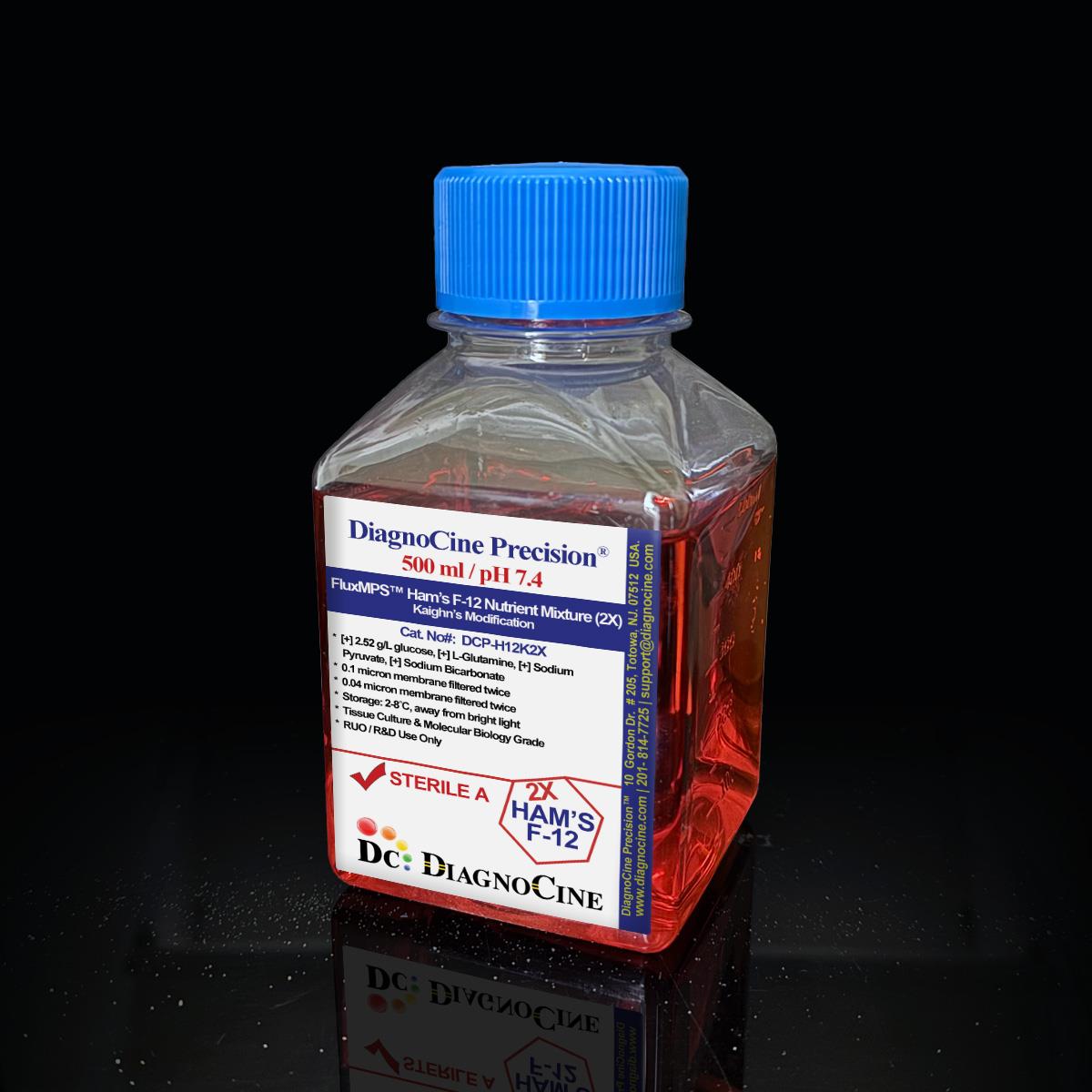
FluxMPS™ Ham's F-12K (Kaighn's) Medium: 2X Liquid
FluxMPS™ Ham's F-12K (Kaighn's) Medium: 2X Liquid
Double-strength (2X) Ham's F-12K (Kaighn's) — 2.52 g/L glucose in the concentrate, 1.26 g/L at 1X — for hepatocyte, A549, PC-3 and CHO-K1 culture, epithelial and cancer-cell biology and semisolid or hydrogel media, ultra-filtered through a quadruple-stage 0.1 µm / 0.04 µm filtration system. With a sodium bicarbonate buffer, it is approximately 5× cleaner than conventional 0.22 µm-filtered media by particulate count.
- 2X concentrate: mix with an equal volume of a compatible solution or matrix for a final 1X medium
- Kaighn's modification: increased amino acids and sodium pyruvate versus F-12, an adjusted salt composition, plus putrescine, hypoxanthine and thymidine
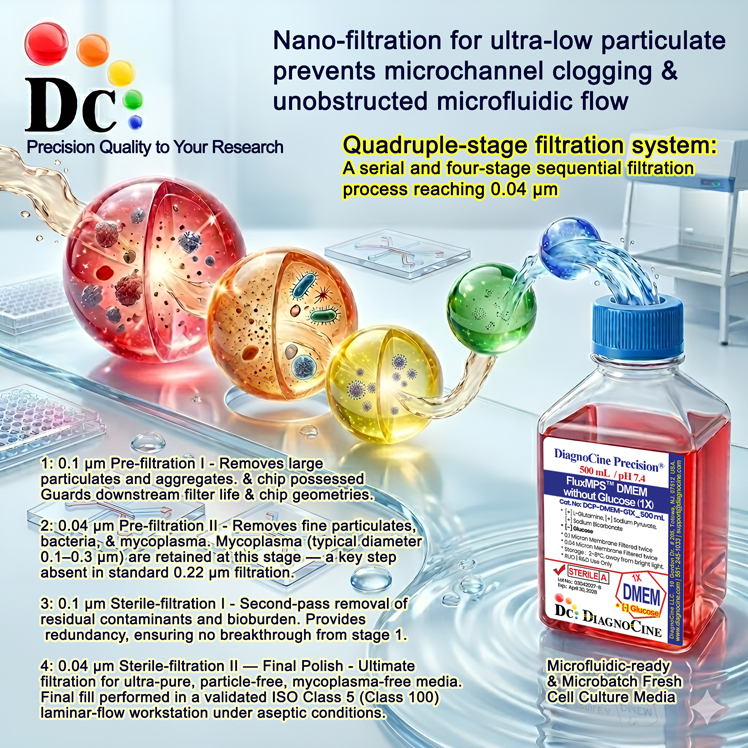
- Quadruple-stage filtration: 0.1 µm membrane filtered twice, 0.04 µm membrane filtered twice
- 0.04 µm nano-filtration final polish acts as a mycoplasma barrier
- Endotoxin < 0.05 EU/mL (USP <85> BET)
- Formulation: [+] 2.52 g/L Glucose, [+] L-Glutamine, [+] Sodium Pyruvate, [+] Sodium Bicarbonate, [+] Phenol Red; [−] HEPES
- Ultrapure Type 1 water (18.2 MΩ·cm); ISO Class 5 (Class 100) aseptic fill in Totowa, NJ
- Custom formulations available — pH, glucose, HEPES, salts, and nutrient composition on request
- D-Glucose2,520 mg/L
- L-Glutamine584 mg/L
- Sodium Pyruvate440 mg/L
- BufferNaHCO₃ 5,000 mg/L
- Phenol Red6 mg/L
- AppearanceRed
- pH7.4 (± 0.04)
- Endotoxin< 0.05 EU/mL
- Filtration0.1 µm ×2 + 0.04 µm ×2
- Format2X liquid, 500 mL
Engineered where standard media fails
Conventional Ham's F-12 is sterile-filtered once at 0.22 µm. That pore size can pass mycoplasma and leaves subvisible particulates that settle in microchannels, foul membranes and hydrogels, and add noise to optical readouts.[11,12] FluxMPS™ Ham's F-12 keeps Ham's formulation and removes that failure mode.
Microchannel-safe purity
A 0.04 µm final filter and USP <788> particulate control keep subvisible debris out of chips, tubing, membranes and matrices.
Total metabolic control
Defined 2,520 mg/L D-glucose, 584 mg/L L-glutamine and 440 mg/L sodium pyruvate in the 2X (half that at 1X).
Ultrapure-grade water
Made with Ultrapure Type 1 water (18.2 MΩ·cm) and released at < 0.05 EU/mL endotoxin by USP <85>.
Low background for imaging
Particle-depleted medium reduces scatter and debris artifacts in colony counting, confocal imaging and on-chip sensing.
Matrix-ready 2X strength
48 components at double strength, so agar, hydrogels, supplements or treatment solutions can be added 1:1 without diluting the medium below 1X.
Customization on demand
pH, glucose, HEPES, salts, and nutrient composition on request — contact support@diagnocine.com.
Quadruple-stage filtration system
Every lot of DCP-H12K2X is membrane filtered at 0.1 µm twice and 0.04 µm twice — a ready-to-dilute 2X Ham's F-12 polished to a 0.04 µm final pore size, a purity level single-pass 0.22 µm media cannot reach.
-
01
0.1 µmPre-filtration I
Removes large particulates and aggregates and extends the life of the downstream filters.
-
02
0.04 µmPre-filtration II
Retains fine particulates, bacteria and mycoplasma.
-
03
0.1 µmSterile-filtration I
Second-pass redundancy that catches anything shed or bypassed upstream.
-
04
0.04 µmSterile-filtration II — Final Polish
Final nano-polish immediately before ISO Class 5 aseptic fill.
Performance vs. conventional media
By particulate count, FluxMPS™ Ham's F-12 is approximately 5× cleaner than conventional 0.22 µm-filtered media, lowering clog risk in narrow channels and long perfusion runs.
© Diagnocine® — DCP-H12K2X
Where FluxMPS™ F-12K fits
Ham’s F-12K Nutrient Mixture, Kaighn’s Modification, is an enriched modification of Ham’s F-12 for mammalian-cell research, with increased concentrations of selected amino acids and sodium pyruvate and an adjusted inorganic-salt composition.[1,2] The basal formulation supplies vitamins, glucose, trace elements, and additional nutrients, including putrescine, hypoxanthine, and thymidine. With appropriate cell-specific supplementation, F-12K supports selected primary-cell and established cell-line research systems, including hepatocyte cultures and laboratory models such as A549, PC-3, and CHO-K1.[2,3,5] It is not a complete growth medium for every cell type: serum, defined supplements, or growth factors may be required, depending on the experimental system.
Kaighn’s modification is a distinct basal formulation, not a synonym for double-strength F-12. Its normal working concentration is still designated 1X.
Ham’s F-12K Nutrient Mixture, Kaighn’s Modification, 2X, is a double-strength preparation of the corresponding 1X F-12K formulation, intended for dilution during preparation of customized in vitro research culture systems. Its intended function is to compensate for dilution when an equal volume of a compatible aqueous component is incorporated, following the general concentrated-medium principle used in semisolid culture preparation.[4] Provided the other solution contributes none of the F-12K ingredients and the combined volumes are additive, equal volumes of 2X medium and that solution yield those basal ingredients at 1X. This describes dilution arithmetic—not evidence that a particular 2X F-12K product is stable or suitable for a given cell line.
It is useful for:
- Selected hepatocyte culture research
- Epithelial and cancer-cell biology
- CHO-K1 laboratory cell culture
- Cell-metabolism and nutrient-response studies
- Reduced-serum or defined-supplement development
- Semisolid or hydrogel-medium development
Automated Bioreactors & Robotics
For automated bioreactors, liquid-handling robots and closed perfusion loops with fine valves and in-line sensors, an optional 10 nm (0.01 µm) ultra-filtered grade of this medium is available.
- Total Particulate Exclusion: 0.01 µm filtration removes virtually all particulates down to the nanometer scale.
- Valve & Sensor Protection: keeps micro-valves, pumps and optical or electrochemical sensors free of deposits.
- Extended Perfusion Stability: supports long, uninterrupted perfusion runs with fewer line changes.
Inquiry Required: the 0.01 µm grade is made on request — email support@diagnocine.com with your catalog number and volume.
A549 & PC-3 Models
A widely used basal medium for A549 lung and PC-3 prostate carcinoma lines when supplemented with serum.[2,3]
CHO-K1 Culture
An enriched F-12 base for CHO-K1 and other Chinese hamster ovary laboratory cell culture.[1,5]
Hepatocyte & Metabolism Studies
Supports selected hepatocyte cultures and cell-metabolism and nutrient-response studies with appropriate supplementation.
Reduced-Serum & Semisolid Media
A double-strength base for reduced-serum or defined-supplement development and for semisolid or hydrogel media.[4]
Organ-on-a-Chip & MPS
Microchannel-safe medium for perfused organ-, tissue- and body-on-a-chip platforms.[8,9,10]
Microscopy & Optical Sensing
Fewer particles means cleaner fields for colony counting, confocal imaging and on-chip biosensors.
Specifications & quality control
Release specifications for DCP-H12K2X. Lot-specific values are reported on the Certificate of Analysis.
| Parameter | Specification |
|---|---|
| Formulation | [+] 2.52 g/L Glucose, [+] L-Glutamine, [+] Sodium Pyruvate, [+] Sodium Bicarbonate, [+] Phenol Red; [−] HEPES |
| Concentration | 2X (dilute 1:1 to 1X) |
| Appearance | Red |
| pH | 7.4 (± 0.04) USP <791> |
| Osmolality | Measured per lot; reported on CoA USP <785> |
| D-Glucose | 2,520 mg/L (2.52 g/L; 1.26 g/L at 1X) |
| L-Glutamine | 584 mg/L |
| Sodium Pyruvate | 440 mg/L |
| Sodium Bicarbonate | 5,000 mg/L |
| Phenol Red | 6 mg/L |
| HEPES | Not included |
| Parameter | Specification |
|---|---|
| Endotoxin | < 0.05 EU/mL USP <85> BET |
| Sterility | No bacterial or fungal growth after 14 days of incubation USP <71> |
| Mycoplasma | 0.04 µm barrier filtration USP <63> equiv. |
| Particulate ≥10 µm | Meets limits USP <788> M2 |
| Particulate ≥25 µm | Meets limits USP <788> M2 |
| Water purity | Ultrapure Type 1, 18.2 MΩ·cm |
| Manufacturing std. | ISO 13485:2016 ISO |
| Fill environment | ISO Class 5 (Class 100) ISO |
| Parameter | Specification |
|---|---|
| Storage temperature | 2–8 °C, protected from light |
| Freeze-thaw | Do not freeze |
| Shelf life | 12 months; use before the expiry date on the product label |
| Shipping condition | Ice Pack |
| CO₂ requirement | CO₂-controlled incubator after dilution to 1X; sodium bicarbonate 5,000 mg/L in the 2X, 2,500 mg/L at 1X (classically equilibrated with 10% CO₂; many protocols use 5%) |
| Parameter | Specification |
|---|---|
| Raw material grade | High-purity, cell-culture-tested components |
| Traceability | Lot-traceable; CoA per lot |
| Manufacturing QMS | ISO 13485:2016 ISO |
| Regulatory alignment | 21 CFR Part 820 (cGMP) aligned |
| Production method | Micro-batch 2X liquid, quadruple-stage filtered; aseptic fill and finish in Totowa, NJ |
| Intended use | For Research Use Only (RUO) |
Full composition (mg/L)
DCP-H12K2X is 2X Ham's F-12K (Kaighn's) with 2.52 g/L glucose, L-glutamine, sodium pyruvate, sodium bicarbonate and Phenol Red. It does not contain HEPES. Users are advised to review the literature for recommendations regarding medium supplementation and physiological growth requirements specific for different cell lines. All 48 components are listed below at 2X strength; values are per-lot release basis and are halved after 1:1 dilution.
| Component | CAS Number | mg/L |
|---|---|---|
| INORGANIC SALTS | ||
| Calcium chloride anhydrous | 10043-52-4 | 204.000 |
| Copper sulfate pentahydrate | 7758-99-8 | 0.0050 |
| Iron sulfate heptahydrate | 7782-63-0 | 1.668 |
| Magnesium chloride anhydrous | 7786-30-3 | 99.400 |
| Magnesium sulfate | 7487-88-9 | 384.000 |
| Potassium chloride | 7447-40-7 | 570.000 |
| Sodium bicarbonate | 144-55-8 | 5000.000 |
| Sodium chloride | 7647-14-5 | 15060.000 |
| Dibasic sodium phosphate anhydrous | 7558-79-4 | 231.000 |
| Sodium dihydrogen phosphate monobasic anhydrous | 7558-80-7 | 118.000 |
| Zinc sulfate heptahydrate | 7446-20-0 | 0.288 |
| Component | CAS Number | mg/L |
|---|---|---|
| AMINO ACIDS | ||
| Glycine | 56-40-6 | 30.000 |
| L-Alanine | 56-41-7 | 36.000 |
| L-Arginine hydrochloride | 1119-34-2 | 844.000 |
| L-Asparagine monohydrate | 5794-13-8 | 60.040 |
| L-Aspartic acid | 56-84-8 | 53.200 |
| L-Cysteine hydrochloride monohydrate | 7048-04-6 | 140.480 |
| L-Glutamic acid | 56-86-0 | 58.800 |
| L-Glutamine | 56-85-9 | 584.000 |
| L-Histidine hydrochloride monohydrate | 5934-29-2 | 84.000 |
| L-Isoleucine | 73-32-5 | 15.760 |
| L-Leucine | 61-90-5 | 52.400 |
| L-Lysine hydrochloride | 657-27-2 | 146.000 |
| L-Methionine | 63-68-3 | 17.920 |
| L-Phenylalanine | 63-91-2 | 19.840 |
| L-Proline | 147-85-3 | 138.000 |
| L-Serine | 56-45-1 | 42.000 |
| L-Threonine | 72-19-5 | 47.600 |
| L-Tryptophan | 73-22-3 | 8.160 |
| L-Tyrosine disodium salt dihydrate | 122666-87-4 | 31.120 |
| L-Valine | 72-18-4 | 46.800 |
| Component | CAS Number | mg/L |
|---|---|---|
| VITAMINS | ||
| Biotin | 58-85-5 | 0.146 |
| Choline chloride | 67-48-1 | 27.92 |
| D-Ca-Pantothenate | 137-08-6 | 0.960 |
| Folic acid | 59-30-3 | 2.640 |
| Nicotinamide | 98-92-0 | 0.074 |
| Pyridoxine hydrochloride | 58-56-0 | 0.124 |
| Riboflavin | 83-88-5 | 0.076 |
| Thiamine hydrochloride | 67-03-8 | 0.680 |
| Vitamin B12 | 68-19-9 | 2.720 |
| i-Inositol | 87-89-8 | 36.000 |
| OTHERS | ||
| D-Glucose | 50-99-7 | 2520.000 |
| Hypoxanthine sodium | 45738-97-4 | 9.540 |
| Lipoic acid | 1077-28-7 | 0.420 |
| Phenol Red | 34487-61-1 | 6.000 |
| Putrescine dihydrochloride | 333-93-7 | 0.644 |
| Sodium pyruvate | 113-24-6 | 440.000 |
| Thymidine | 50-89-5 | 1.460 |
Manufacturing & compliance
Manufactured under an ISO 13485:2016 quality management system; aseptic fill and finish in Totowa, NJ, with every lot released against compendial test methods.
ISO 13485:2016 QMS
Documented, audited quality management system aligned with 21 CFR Part 820 (cGMP).
Ultrapure Type 1 Water
18.2 MΩ·cm water as the formulation base for low ionic and endotoxin background.
ISO Class 5 Fill & Finish
Aseptic filling in an ISO Class 5 (Class 100) environment in Totowa, NJ, right after the final 0.04 µm polish.
Micro-Batch Precision
Small, tightly controlled batches for consistent composition and pH from lot to lot.
Endotoxin — USP <85> BET
Released at < 0.05 EU/mL.
Particulate — USP <788> Method 2
Subvisible particles ≥10 µm and ≥25 µm within compendial limits.
Osmolality — USP <785>
Measured per lot and reported on the CoA.
Documentation / CoA
Appearance, pH 7.4 (± 0.04), 14-day sterility, endotoxin and osmolality per lot.
How DCP-H12K2X compares
Same Ham's F-12 chemistry, different purity class. Conventional columns describe typical single-pass 0.22 µm-filtered catalog media.
| Parameter | DCP-H12K2X (FluxMPS™) | Conventional F-12K, 1X (0.22 µm filtered) | Conventional 2X Ham's F-12 (0.22 µm filtered) |
|---|---|---|---|
| Formulation | 2X Ham's F-12K (Kaighn's); complete formulation | 1X F-12K, ready to use | Double-strength, for semisolid culture |
| Final filtration pore size | 0.04 µm | 0.22 µm | 0.22 µm |
| Number of filtration stages | 4 | 1 | 1 |
| Mycoplasma barrier filtration | check_circle | cancel | cancel |
| Endotoxin specification | < 0.05 EU/mL | Often not specified at this level | Often not specified at this level |
| USP <788> particulate compliance | check_circle | cancel | cancel |
| Ultrapure Type 1 water (18.2 MΩ·cm) | check_circle | Varies | Varies |
| ISO 13485:2016 manufacturing | check_circle | Varies | Varies |
| Microfluidic channel compatibility | check_circle | cancel | cancel |
| Custom formulation | check_circle | cancel | cancel |
Frequently asked questions
Common questions about using DCP-H12K2X for semisolid, 3D, microfluidic and conventional culture.
Supporting literature
Peer-reviewed background on Ham's F-12 and F-12K, A549, PC-3 and CHO culture, soft-agar culture, Phenol Red, organ-on-a-chip culture and mycoplasma control.
- Ham RG. Clonal growth of mammalian cells in a chemically defined, synthetic medium. Proc Natl Acad Sci USA. 1965;53(2):288–293. doi:10.1073/pnas.53.2.288
- Kaighn ME, Narayan KS, Ohnuki Y, Lechner JF, Jones LW. Establishment and characterization of a human prostatic carcinoma cell line (PC-3). Invest Urol. 1979;17(1):16–23.
- Giard DJ, Aaronson SA, Todaro GJ, et al. In vitro cultivation of human tumors: establishment of cell lines derived from a series of solid tumors. J Natl Cancer Inst. 1973;51(5):1417–1423.
- Borowicz S, Van Scoyk M, Avasarala S, et al. The soft agar colony formation assay. J Vis Exp. 2014;(92):e51998. doi:10.3791/51998
- Tjio JH, Puck TT. Genetics of somatic mammalian cells. II. Chromosomal constitution of cells in tissue culture. J Exp Med. 1958;108(2):259–268. doi:10.1084/jem.108.2.259
- Morton HJ. A survey of commercially available tissue culture media. In Vitro. 1970;6(2):89–108. doi:10.1007/BF02616111
- Berthois Y, Katzenellenbogen JA, Katzenellenbogen BS. Phenol red in tissue culture media is a weak estrogen: implications concerning the study of estrogen-responsive cells in culture. Proc Natl Acad Sci USA. 1986;83(8):2496–2500. doi:10.1073/pnas.83.8.2496
- Bhatia SN, Ingber DE. Microfluidic organs-on-chips. Nat Biotechnol. 2014;32(8):760–772. doi:10.1038/nbt.2989
- Low LA, Mummery C, Berridge BR, Austin CP, Tagle DA. Organs-on-chips: into the next decade. Nat Rev Drug Discov. 2021;20(5):345–361. doi:10.1038/s41573-020-0079-3
- Leung CM, de Haan P, Ronaldson-Bouchard K, et al. A guide to the organ-on-a-chip. Nat Rev Methods Primers. 2022;2:33. doi:10.1038/s43586-022-00118-6
- Drexler HG, Uphoff CC. Mycoplasma contamination of cell cultures: incidence, sources, effects, detection, elimination, prevention. Cytotechnology. 2002;39(2):75–90. doi:10.1023/A:1022913015916
- Halldorsson S, Lucumi E, Gómez-Sjöberg R, Fleming RMT. Advantages and challenges of microfluidic cell culture in polydimethylsiloxane devices. Biosens Bioelectron. 2015;63:218–231. doi:10.1016/j.bios.2014.07.029