FluxMPS™ Gln Gold
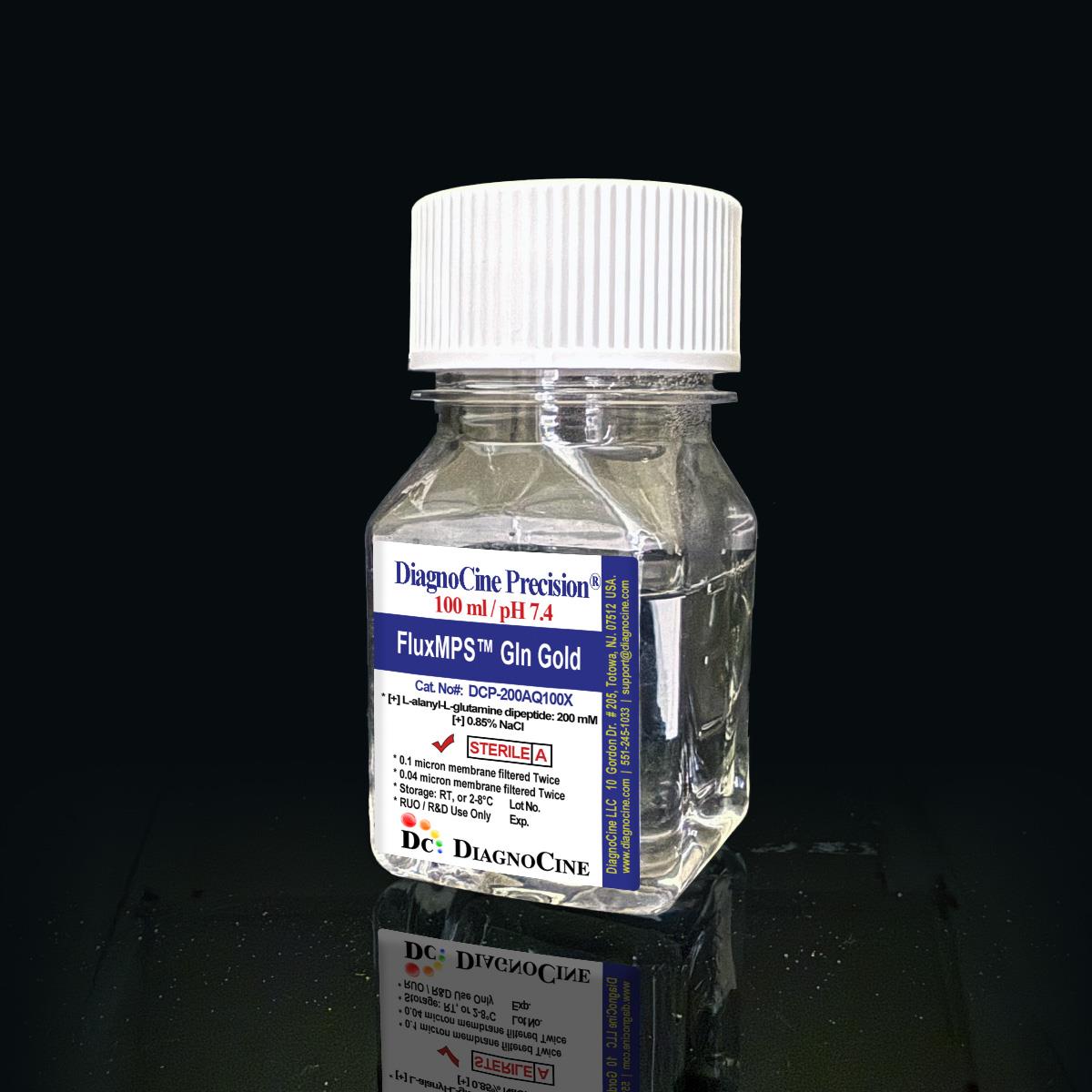
FluxMPS™ Gln Gold — L-Alanyl-L-Glutamine Solution 200 mM, 100X Liquid
FluxMPS™ Gln Gold is a Microfluidics Suitable, quadruple-stage ultra-filtered (0.1 µm ×2 + 0.04 µm ×2) 200 mM L-alanyl-L-glutamine dipeptide solution supplied as a stable, ready-to-add 100X liquid supplement for adherent and suspension mammalian cell culture — delivering the metabolic benefits of L-glutamine without the thermal instability and ammonia byproduct build-up associated with the free amino acid.
- 200 mM L-alanyl-L-glutamine dipeptide in 0.85% NaCl carrier, supplied as a 100X liquid concentrate
- Minimizes toxic ammonia build-up compared to free L-glutamine supplementation
- Improves cell viability and growth relative to standard L-glutamine
- Remains stable across a wide temperature range — room temperature, 2-8°C, -5 to -30°C, and even 37°C for a week or more
- Quadruple-stage filtration (0.1 µm ×2 + 0.04 µm ×2) for microchannel-safe, ultra-clean delivery
- Suitable for adherent and suspension culture of mammalian cells, with no adaptation required
- Manufactured under an ISO 13485-certified quality system; final QC, packaging and customization completed at Diagnocine, Totowa, NJ
- Custom concentrations, pH, and additional components available on request
- Format100X Liquid Concentrate
- Active compoundL-Alanyl-L-Glutamine Dipeptide
- Concentration200 mM
- Carrier0.85% NaCl
- AppearanceClear solution
- Filtration0.1 µm ×2 + 0.04 µm ×2 (Quadruple-stage)
- Mycoplasma control0.1 µm mycoplasma-retentive filtration
- StorageRoom-temperature stable (also 2-8°C or -5 to -30°C)
- Shelf Life24 months from date of manufacture, unopened
- ShippingRoom temperature (RT)
Engineered for stable, low-ammonia glutamine delivery
Free L-glutamine degrades in solution, releasing ammonia that accumulates in culture and suppresses growth. FluxMPS™ Gln Gold replaces it with a heat-stable dipeptide, filtered to a microchannel-safe standard for use in conventional and microfluidic culture systems alike.
Microchannel-safe purity
Quadruple-stage filtration (0.1 µm ×2 + 0.04 µm ×2) removes particulates and mycoplasma-scale contaminants before the solution ever reaches your channel or bioreactor.
Stable glutamine delivery
The alanyl-glutamine dipeptide bond resists the spontaneous cyclization that degrades free L-glutamine in solution, preserving nutrient availability over the full shelf life.
Broad temperature stability
Remains fully functional at room temperature, 2-8°C, or -5 to -30°C, and is even stable at 37°C for a week or more — simplifying storage and handling versus free glutamine.
Reduced ammonia accumulation
Minimizes the toxic ammonia build-up associated with free L-glutamine breakdown, supporting improved cell viability and growth in extended cultures.
Clear, assay-ready solution
Supplied as a clear solution that is visually verifiable prior to use, supporting straightforward quality checks at the bench.
Customization on demand
Alternate concentrations, pH, or the addition of chemicals, compounds, proteins, or supplements are available — contact support@diagnocine.com.
Quadruple-stage filtration system
FluxMPS™ Gln Gold is processed through a validated four-pass filtration train — two dedicated prefilter/final-filter pairs — reaching a 0.04 µm final pore size before aseptic fill.
-
1
0.1 µm Prefiltration I
Removes large particulates and protein aggregates, protecting the first 0.04 µm cartridge.
-
2
0.04 µm Final filtration I
First 0.04 µm pass, retaining sub-micron particulates and microaggregates that pass a conventional 0.22 µm filter.
-
3
0.1 µm Prefiltration II
A second dedicated prefilter, protecting the second 0.04 µm cartridge.
-
4
0.04 µm Final filtration II — Polish
Ultimate polishing filter prior to aseptic fill & finish.
Performance vs. conventional media
The paired 0.1 µm / 0.04 µm train runs twice in series, giving full redundancy against particulate and microbial ingress relative to a single-pass 0.22 µm filtration process.

© Diagnocine® — DCP-200AQ100X
Where a stable glutamine source matters
As a dipeptide substitute for free L-glutamine, FluxMPS™ Gln Gold supports extended, low-ammonia culture across conventional vessels and microfluidic/organ-on-a-chip platforms.
Automated Bioreactors & Robotics
For fully automated perfusion bioreactors and robotic liquid-handling platforms, an optional 0.01 µm (10 nm) ultra-filtered MPS Grade variant of this supplement is available, engineered to further reduce valve and sensor fouling in continuous-run systems.
- Total Particulate Exclusion — minimizes microaggregate load on downstream sensors
- Valve & Sensor Protection — reduces fouling risk in automated dosing lines
- Extended Perfusion Stability — supports long-duration unattended runs
Inquiry Required: the 0.01 µm MPS Grade variant is produced to order — contact support@diagnocine.com to request this specification.
Micro Physiological System (MPS) & Chip
Provides a low-ammonia glutamine source for perfused microfluidic culture without the metabolite drift seen with free L-glutamine.
Warburg Effect & Metabolic Research
A stable glutamine feed supports glutaminolysis studies without confounding ammonia accumulation in extended cancer cell culture.
iPSC-Derived Models
Supports long-term feeding schedules for sensitive iPSC-derived lineages where glutamine degradation byproducts are a known stressor.
Endothelial & Primary Cells
Reduces ammonia stress during extended culture of primary and endothelial cell types sensitive to metabolic byproducts.
Metabolic Flux Analysis
A dipeptide-based glutamine source with predictable release kinetics for tracer and flux studies.
Microscopy & Optical Sensing
Supplied as a clear solution compatible with long-term imaging workflows where consistent nutrient supplementation is required.
Full technical profile
Every specification below is sourced directly from validated product data. Parameters not established for this supplement (endotoxin, osmolality, CO2 requirement, sodium bicarbonate) are intentionally omitted rather than estimated.
| Parameter | Specification |
|---|---|
| Formulation | L-Alanyl-L-Glutamine dipeptide, 200 mM, in 0.85% NaCl |
| Appearance | Clear solution |
| Concentration | 200 mM (100X concentrate) |
| Carrier / dissolvent | 0.85% NaCl |
| Product form | Liquid |
| Parameter | Specification |
|---|---|
| Sterility | Filtered in a sterile environment USP <71>-aligned |
| Mycoplasma control | 0.1 µm mycoplasma-retentive filtration (not tested per lot) |
| Filtration System | Quadruple-stage, 0.1 µm ×2 + 0.04 µm ×2 |
| Manufacturing standard | ISO 13485-certified ISO 13485:2016 |
| Parameter | Specification |
|---|---|
| Storage | Room-temperature stable; also stable at 2-8°C or -5 to -30°C; stable at 37°C for a week or more |
| Shelf life | 24 months from date of manufacture, unopened |
| Shipping condition | Room temperature (RT) |
| Expiry | Use before the expiry date given on the product label |
| Parameter | Specification |
|---|---|
| UNSPSC | 41116155 — Molecular biology and cell culture growth media (UNv260801) |
| Regulatory alignment | ISO 13485-certified suppliers (Suppliers of Diagnocine Precision) |
| Manufacturing location | Final QC, packaging and customization: Diagnocine, Totowa, New Jersey, USA |
| Intended use | Research Use Only (RUO) |
Full composition (mg/L)
FluxMPS™ Gln Gold is a two-component supplement: an active dipeptide and its saline carrier, supplied as a 100X concentrate. Total: 2 active components. mg/L values below are calculated from the stated molar and w/v concentrations.
| Component | CAS Number | mg/L |
|---|---|---|
| INORGANIC SALTS | ||
| Sodium Chloride (0.85% w/v carrier) | 7647-14-5 | 8500 |
| Component | CAS Number | mg/L |
|---|---|---|
| AMINO ACIDS | ||
| L-Alanyl-L-Glutamine (dipeptide, 200 mM) | 39537-23-0 | 43444 |
| Component | CAS Number | mg/L |
|---|---|---|
| VITAMINS | ||
| No vitamin components in this formulation | ||
| OTHERS | ||
| No additional components in this formulation | ||
Manufacturing & compliance
FluxMPS™ Gln Gold is manufactured, tested and finished under a documented quality management system.
ISO 13485 QMS
Manufactured under an ISO 13485-certified quality management system (Suppliers of Diagnocine Precision).
Quadruple-stage filtration
Validated 0.1 µm ×2 + 0.04 µm ×2 filtration train applied prior to fill.
Final QC & customization in Totowa, NJ
All final packaging, quality assurance and testing are completed at the Diagnocine R&D and Quality Testing Center. Customization requests and assembly are accomplished at Diagnocine Precision, Totowa, New Jersey, USA.
Per-batch appearance & sterility verification
Each batch is verified as a clear solution filtered in a sterile environment prior to release.
Sterility assurance
Filtered in a sterile environment through the quadruple-stage 0.04 µm filtration train.
Mycoplasma control
0.1 µm mycoplasma-retentive filtration (not tested per lot).
Appearance & visual QC
Verified as a clear solution at time of release.
Documentation
Certificate of Analysis (CoA) available on request.
How DCP-200AQ100X compares
FluxMPS™ Gln Gold versus free L-glutamine supplementation and standard-grade filtered alternatives.
| Parameter | DCP-200AQ100X (FluxMPS™) | Conventional free L-glutamine | Standard alternative (0.22 µm filtered) |
|---|---|---|---|
| Grade | Microfluidics Suitable | Standard grade | Standard grade |
| Distinctive formulation | 200 mM L-alanyl-L-glutamine dipeptide (ammonia-reducing) | Free L-glutamine, prone to spontaneous degradation | Free L-glutamine, prone to spontaneous degradation |
| Final filtration pore size | 0.04 µm | Not specified | 0.22 µm |
| Number of filtration stages | 4 (Quadruple-stage) | Not specified | 1 (single-stage) |
| Mycoplasma barrier filtration | check_circle | cancel | cancel |
| Thermal stability range | RT, 2-8°C, -5 to -30°C, and 37°C (1 week) | Typically frozen storage only | Typically frozen storage only |
| Manufacturing QMS | ISO 13485:2016 | Not specified | Not specified |
| Microfluidic channel compatibility | check_circle | cancel | cancel |
| Custom formulation | check_circle | cancel | cancel |
Frequently asked questions
Common questions about FluxMPS™ Gln Gold (DCP-200AQ100X).
Supporting literature
Curated literature on glutamine dipeptide supplementation, ammonia toxicity in cell culture, and microphysiological system nutrient requirements.
- Christie, A. & Butler, M. Growth and metabolism of a murine hybridoma in cultures containing glutamine-based dipeptides. doi:10.1002/jcp.1041650313
- Ozturk, S.S. & Palsson, B.O. Effect of ammonia and lactate on hybridoma growth, metabolism, and antibody production. doi:10.1002/bit.260390906
- Roth, E. Nonnutritive effects of glutamine. doi:10.1093/jn/138.10.2025S
- Bray, M.-A. et al. Metabolic engineering considerations for organ-on-a-chip systems. doi:10.1002/biot.201600110
- Curi, R. et al. Molecular mechanisms of glutamine action. doi:10.1002/jcp.20339
- Huh, D. et al. Reconstituting organ-level lung functions on a chip. doi:10.1126/science.1188302
- Newsholme, P. et al. Glutamine and glutamate as vital metabolites. doi:10.1590/S0100-879X2003000900002
- Wurm, F.M. Production of recombinant protein therapeutics in cultivated mammalian cells. doi:10.1038/nbt1026
- Zhang, B. & Radisic, M. Organ-on-a-chip devices advance to market. doi:10.1039/C6LC01554A