

- Home
- FluxMPS™ Glasgow's Minimum Essential Medium (GMEM), High Glucose with Tryptose Phosphate Broth: 2X Liquid
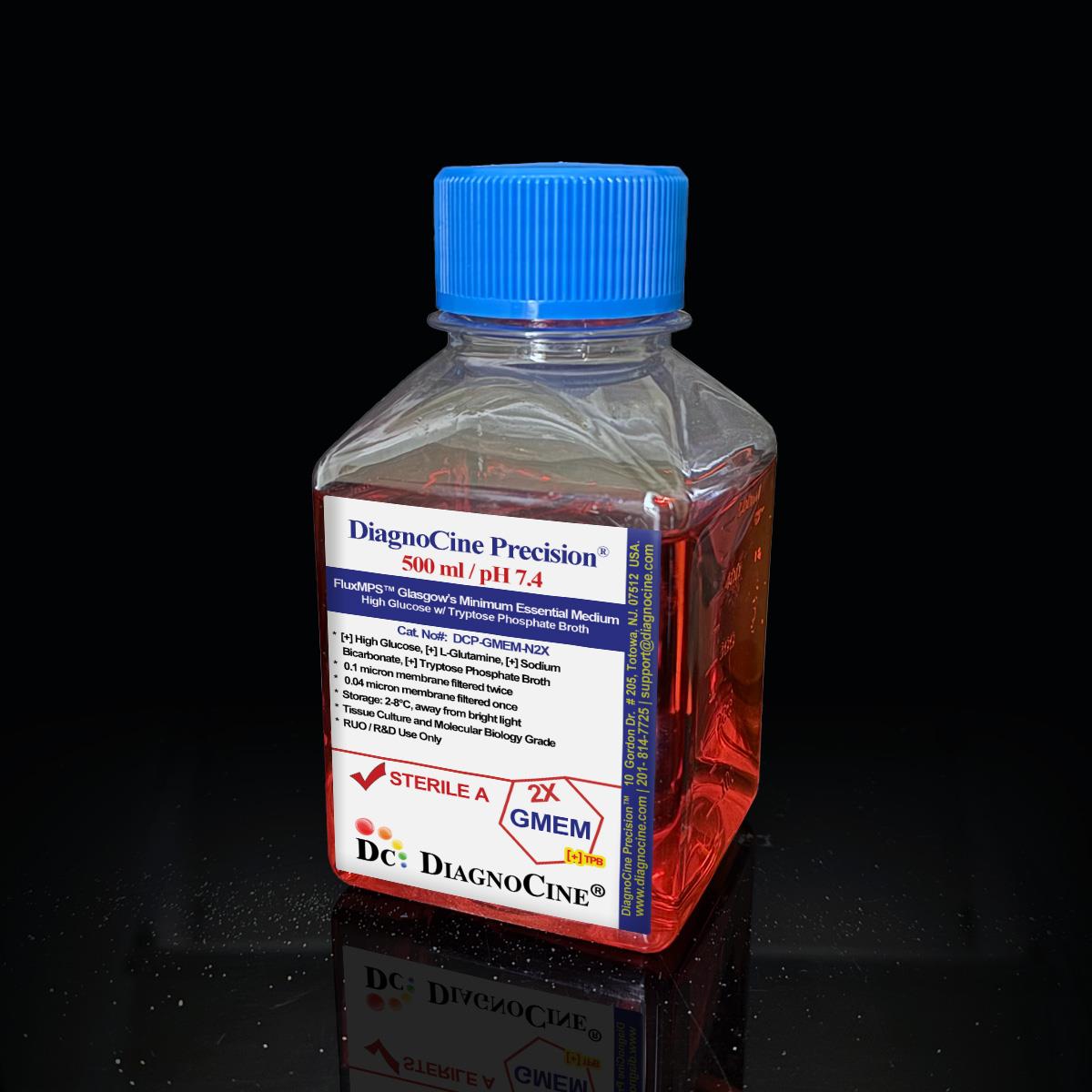
FluxMPS™ Glasgow's Minimum Essential Medium (GMEM), High Glucose with Tryptose Phosphate Broth: 2X Liquid
FluxMPS™ Glasgow's Minimum Essential Medium (GMEM), High Glucose with Tryptose Phosphate Broth (TPB): 2X Liquid
Double-strength (2X) GMEM High Glucose — 9.0 g/L glucose in the concentrate, 4.5 g/L at 1X, with tryptose phosphate broth (TPB) and no separately added NEAA — for BHK-21, kidney-cell, cell-growth and soft-agar research, ultra-filtered through a quadruple-stage 0.1 µm / 0.04 µm filtration system. With a sodium bicarbonate buffer, it is approximately 5× cleaner than conventional 0.22 µm-filtered media by particulate count.
- 2X concentrate: mix with an equal volume of melted agar or agarose, or another compatible solution, for a final 1X medium
- Tryptose phosphate broth included: 5.9 g/L in the 2X, 2.95 g/L at 1X (equivalent to 10% TPB); no separately added NEAA
- Quadruple-stage filtration: 0.1 µm membrane filtered twice, 0.04 µm membrane filtered twice
- 0.04 µm nano-filtration final polish acts as a mycoplasma barrier
- Endotoxin < 0.05 EU/mL (USP <85> BET)
- Formulation: [+] 9.0 g/L Glucose, [+] L-Glutamine, [+] Sodium Bicarbonate, [+] Phenol Red, [+] Tryptose Phosphate Broth; [−] HEPES, [−] NEAA
- Ultrapure Type 1 water (18.2 MΩ·cm); ISO Class 5 (Class 100) aseptic fill in Totowa, NJ
- Custom formulations available — pH, glucose, HEPES, salts, and nutrient composition on request
- D-Glucose9,000 mg/L
- L-Glutamine584 mg/L
- Sodium PyruvateNot included
- BufferNaHCO₃ 5,500 mg/L
- Phenol Red30 mg/L
- AppearanceRed
- pH7.4 (± 0.04)
- Endotoxin< 0.05 EU/mL
- Filtration0.1 µm ×2 + 0.04 µm ×2
- Format2X liquid, 500 mL
Engineered where standard media fails
Conventional GMEM is sterile-filtered once at 0.22 µm. That pore size can pass mycoplasma and leaves subvisible particulates that settle in microchannels, foul membranes and hydrogels, and add noise to optical readouts.[11,12] FluxMPS™ GMEM keeps the Glasgow formulation and removes that failure mode.
Microchannel-safe purity
A 0.04 µm final filter and USP <788> particulate control keep subvisible debris out of chips, tubing, membranes and matrices.
Total metabolic control
Defined 9,000 mg/L D-glucose, 584 mg/L L-glutamine and no sodium pyruvate in the 2X (half that at 1X).
Ultrapure-grade water
Made with Ultrapure Type 1 water (18.2 MΩ·cm) and released at < 0.05 EU/mL endotoxin by USP <85>.
Low background for imaging
Particle-depleted medium reduces scatter and debris artifacts in colony counting, confocal imaging and on-chip sensing.
Matrix-ready 2X strength
31 components at double strength, so melted agar, agarose, supplements or cells can be added 1:1 without diluting the medium below 1X.
Customization on demand
pH, glucose, HEPES, salts, and nutrient composition on request — contact support@diagnocine.com.
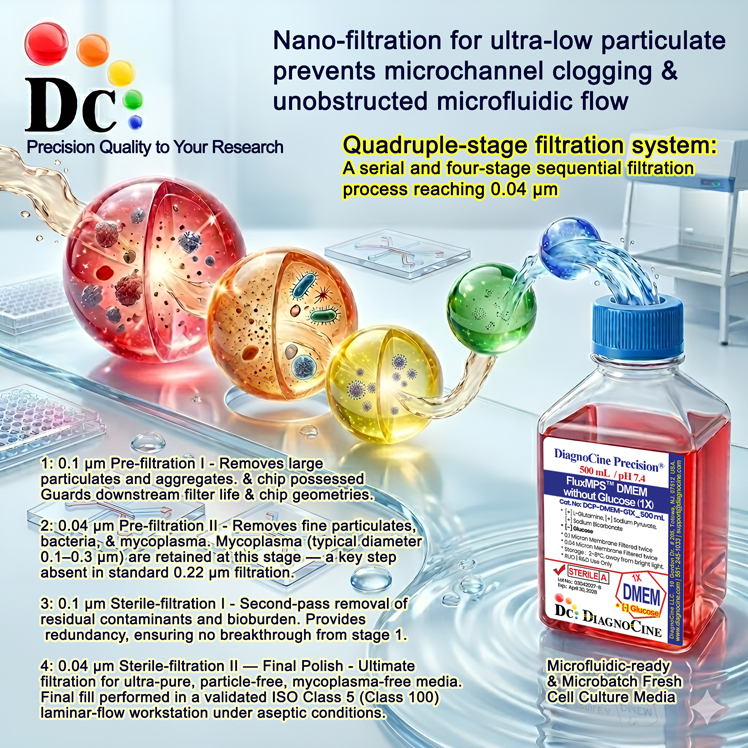
Quadruple-stage filtration system
Every lot of DCP-GMEM-N2X is membrane filtered at 0.1 µm twice and 0.04 µm twice — a ready-to-dilute 2X GMEM polished to a 0.04 µm final pore size, a purity level single-pass 0.22 µm media cannot reach.
-
01
0.1 µmPre-filtration I
Removes large particulates and aggregates and extends the life of the downstream filters.
-
02
0.04 µmPre-filtration II
Retains fine particulates, bacteria and mycoplasma.
-
03
0.1 µmSterile-filtration I
Second-pass redundancy that catches anything shed or bypassed upstream.
-
04
0.04 µmSterile-filtration II — Final Polish
Final nano-polish immediately before ISO Class 5 aseptic fill.
Performance vs. conventional media
By particulate count, FluxMPS™ GMEM is approximately 5× cleaner than conventional 0.22 µm-filtered media, lowering clog risk in narrow channels and long perfusion runs.
© Diagnocine® — DCP-GMEM-N2X
Where FluxMPS™ GMEM fits
Glasgow’s Minimum Essential Medium (GMEM) With Tryptose Phosphate Broth and Without Added Non-Essential Amino Acids is a nutrient-enriched basal medium intended for in vitro mammalian-cell research. GMEM is a modification of Basal Medium Eagle that provides elevated amino-acid and vitamin concentrations and is historically associated with BHK-21 and other kidney-derived research cell lines.[1,2,3] The included TPB supplies casein-derived peptides, amino-acid-based nutrients, dextrose, sodium chloride, and phosphate buffering components, while the formulation contains no separately added defined NEAA mixture.
The medium may be used as a starting point for cell-growth, genetic-competence, supplementation, and nutrient-response studies where TPB is desired but a defined NEAA supplement is intentionally excluded. Cell-line-specific supplementation and performance validation remain necessary. GMEM containing L-glutamine but no TPB is commercially directed to be supplemented with 100 mL TPB per liter, supporting 10% TPB as a conventional completed formulation. Because TPB is a complex animal-derived protein hydrolysate, this formulation should not be described as chemically defined, protein-free, peptide-free, or animal-origin-free. TPB’s tryptose component is produced by enzymatic hydrolysis of milk casein.[5]
Glasgow’s Minimum Essential Medium 2X With Tryptose Phosphate Broth and Without Added Non-Essential Amino Acids is a double-strength concentrate intended for research workflows in which the medium is diluted with an equal volume of a compatible solution. After validated 1:1 dilution, the final preparation is designed to provide the corresponding GMEM/TPB formulation at 1X strength (2.95 g/L TPB, equivalent to 10% TPB), without a separately added defined NEAA mixture.
The 2X format is intended primarily for dilution compensation in semisolid or matrix-containing research systems, including agar- or agarose-based culture preparations. Established soft-agar protocols mix equal volumes of 2X basal medium and agar or agarose to obtain 1X medium in the final gel.[4] Formulation-specific verification of solubility, pH, osmolality, sterility, stability, and biological performance is required for each research system.
Why TPB without NEAA?
This formulation separates two experimental choices: TPB is present for complex nutritional support, while a separately defined NEAA supplement is absent. TPB contributes amino acids, short peptides, dextrose, salts, and survival-supporting nutrients, and is commonly used to supplement GMEM for BHK-21 growth. Excluding the defined NEAA mixture may be useful when researchers want to compare TPB-derived nutritional support with or without controlled NEAA addition. However, it is not appropriate to call this an NEAA-depletion medium, because TPB can contribute amino acids that overlap functionally with the omitted defined supplement.
It is useful for:
- BHK-21 cell-line research
- Kidney-derived cell-line research
- Cell-growth and viability studies
- Genetic-competence research
- TPB supplementation studies
- Defined-NEAA add-back studies
- Media-comparison studies
- Soft-agar and semisolid culture research
- Customized research-medium development
Automated Bioreactors & Robotics
For automated bioreactors, liquid-handling robots and closed perfusion loops with fine valves and in-line sensors, an optional 10 nm (0.01 µm) ultra-filtered grade of this medium is available.
- Total Particulate Exclusion: 0.01 µm filtration removes virtually all particulates down to the nanometer scale.
- Valve & Sensor Protection: keeps micro-valves, pumps and optical or electrochemical sensors free of deposits.
- Extended Perfusion Stability: supports long, uninterrupted perfusion runs with fewer line changes.
Inquiry Required: the 0.01 µm grade is made on request — email support@diagnocine.com with your catalog number and volume.
Soft-Agar Colony Assays
Mix 1:1 with molten agar or agarose for anchorage-independent growth assays at 1X medium strength.[4]
BHK-21 & Kidney-Derived Cells
TPB-supplemented GMEM is the classic medium for BHK-21 clone 13 and other kidney-derived research cell lines.[1,3]
Genetic-Competence Studies
Macpherson and Stoker developed GMEM to study genetic factors affecting cell competence in hamster cell clones.[1]
TPB & NEAA Comparisons
TPB is included and no defined NEAA mixture is added, so you can compare TPB-derived support with or without controlled NEAA addition.[5]
Organ-on-a-Chip & MPS
Microchannel-safe medium for perfused organ-, tissue- and body-on-a-chip platforms.[8,9,10]
Microscopy & Optical Sensing
Fewer particles means cleaner fields for colony counting, confocal imaging and on-chip biosensors.
Specifications & quality control
Release specifications for DCP-GMEM-N2X. Lot-specific values are reported on the Certificate of Analysis.
| Parameter | Specification |
|---|---|
| Formulation | [+] 9.0 g/L Glucose, [+] L-Glutamine, [+] Sodium Bicarbonate, [+] Phenol Red, [+] Tryptose Phosphate Broth; [−] HEPES, [−] NEAA |
| Concentration | 2X (dilute 1:1 to 1X) |
| Appearance | Red |
| pH | 7.4 (± 0.04) USP <791> |
| Osmolality | Measured per lot; reported on CoA USP <785> |
| D-Glucose | 9,000 mg/L (9.0 g/L; 4.5 g/L at 1X) |
| L-Glutamine | 584 mg/L |
| Sodium Pyruvate | Not included |
| Sodium Bicarbonate | 5,500 mg/L |
| Phenol Red | 30 mg/L |
| HEPES | Not included |
| NEAA | Not included (no separately added mixture) |
| Tryptose phosphate broth | 5,900 mg/L (2.95 g/L at 1X; equivalent to 10% TPB) |
| Parameter | Specification |
|---|---|
| Endotoxin | < 0.05 EU/mL USP <85> BET |
| Sterility | No bacterial or fungal growth after 14 days of incubation USP <71> |
| Mycoplasma | 0.04 µm barrier filtration USP <63> equiv. |
| Particulate ≥10 µm | Meets limits USP <788> M2 |
| Particulate ≥25 µm | Meets limits USP <788> M2 |
| Water purity | Ultrapure Type 1, 18.2 MΩ·cm |
| Manufacturing std. | ISO 13485:2016 ISO |
| Fill environment | ISO Class 5 (Class 100) ISO |
| Parameter | Specification |
|---|---|
| Storage temperature | 2–8 °C, protected from light |
| Freeze-thaw | Do not freeze |
| Shelf life | 12 months; use before the expiry date on the product label |
| Shipping condition | Ice Pack |
| CO₂ requirement | CO₂-controlled incubator (5–10% CO₂) after dilution to 1X; sodium bicarbonate 5,500 mg/L in the 2X, 2,750 mg/L at 1X |
| Parameter | Specification |
|---|---|
| Raw material grade | High-purity, cell-culture-tested components |
| Traceability | Lot-traceable; CoA per lot |
| Manufacturing QMS | ISO 13485:2016 ISO |
| Regulatory alignment | 21 CFR Part 820 (cGMP) aligned |
| Production method | Micro-batch 2X liquid, quadruple-stage filtered; aseptic fill and finish in Totowa, NJ |
| Intended use | For Research Use Only (RUO) |
Full composition (mg/L)
DCP-GMEM-N2X is 2X GMEM High Glucose with 9.0 g/L glucose, L-glutamine, sodium bicarbonate, Phenol Red and tryptose phosphate broth (TPB). It does not contain HEPES nor a separately added NEAA mixture. Users are advised to review the literature for recommendations regarding medium supplementation and physiological growth requirements specific for different cell lines. All 31 components are listed below at 2X strength; values are per-lot release basis and are halved after 1:1 dilution.
| Component | CAS Number | mg/L |
|---|---|---|
| INORGANIC SALTS | ||
| Calcium chloride dihydrate | 10035-04-8 | 530.000 |
| Ferric nitrate nonahydrate | 7782-61-8 | 0.200 |
| Magnesium sulphate anhydrous | 7487-88-9 | 195.440 |
| Potassium chloride | 7447-40-7 | 800.000 |
| Sodium bicarbonate | 144-55-8 | 5500.000 |
| Sodium chloride | 7647-14-5 | 12800.000 |
| Sodium dihydrogen phosphate anhydrous | 7558-80-7 | 218.000 |
| Component | CAS Number | mg/L |
|---|---|---|
| AMINO ACIDS | ||
| L-Arginine hydrochloride | 1119-34-2 | 84.000 |
| L-Cystine | 56-89-3 | 48.000 |
| L-Glutamine | 56-85-9 | 584.000 |
| L-Histidine hydrochloride | 5934-29-2 | 42.000 |
| L-Isoleucine | 73-32-5 | 104.800 |
| L-Leucine | 61-90-5 | 104.800 |
| L-Lysine hydrochloride | 657-27-2 | 146.200 |
| L-Methionine | 63-68-3 | 30.000 |
| L-Phenylalanine | 63-91-2 | 66.000 |
| L-Threonine | 72-19-5 | 95.200 |
| L-Tryptophan | 73-22-3 | 16.000 |
| L-Tyrosine disodium salt | 69847-45-6 | 104.000 |
| L-Valine | 72-18-4 | 93.600 |
| Component | CAS Number | mg/L |
|---|---|---|
| VITAMINS | ||
| Choline chloride | 67-48-1 | 4.000 |
| D-Ca-Pantothenate | 137-08-6 | 4.000 |
| Folic acid | 59-30-3 | 4.000 |
| Nicotinamide | 98-92-0 | 4.000 |
| Pyridoxal hydrochloride | 65-22-5 | 4.000 |
| Riboflavin | 83-88-5 | 0.400 |
| Thiamine hydrochloride | 67-03-8 | 4.000 |
| i-Inositol | 87-89-8 | 7.200 |
| OTHERS | ||
| D-Glucose | 50-99-7 | 9000.000 |
| Phenol Red | 34487-61-1 | 30.000 |
| Tryptose Phosphate Broth | N/A | 5900.000 |
Manufacturing & compliance
Manufactured under an ISO 13485:2016 quality management system; aseptic fill and finish in Totowa, NJ, with every lot released against compendial test methods.
ISO 13485:2016 QMS
Documented, audited quality management system aligned with 21 CFR Part 820 (cGMP).
Ultrapure Type 1 Water
18.2 MΩ·cm water as the formulation base for low ionic and endotoxin background.
ISO Class 5 Fill & Finish
Aseptic filling in an ISO Class 5 (Class 100) environment in Totowa, NJ, right after the final 0.04 µm polish.
Micro-Batch Precision
Small, tightly controlled batches for consistent composition and pH from lot to lot.
Endotoxin — USP <85> BET
Released at < 0.05 EU/mL.
Particulate — USP <788> Method 2
Subvisible particles ≥10 µm and ≥25 µm within compendial limits.
Osmolality — USP <785>
Measured per lot and reported on the CoA.
Documentation / CoA
Appearance, pH 7.4 (± 0.04), 14-day sterility, endotoxin and osmolality per lot.
How DCP-GMEM-N2X compares
Same GMEM chemistry, different purity class. Conventional columns describe typical single-pass 0.22 µm-filtered catalog media.
| Parameter | DCP-GMEM-N2X (FluxMPS™) | Conventional GMEM High Glucose, 1X (0.22 µm filtered) | Conventional 2X GMEM (0.22 µm filtered) |
|---|---|---|---|
| Formulation | 2X GMEM High Glucose + TPB; free of HEPES and NEAA | 1X GMEM + 10% TPB, ready to use | Double-strength, for semisolid culture |
| Final filtration pore size | 0.04 µm | 0.22 µm | 0.22 µm |
| Number of filtration stages | 4 | 1 | 1 |
| Mycoplasma barrier filtration | check_circle | cancel | cancel |
| Endotoxin specification | < 0.05 EU/mL | Often not specified at this level | Often not specified at this level |
| USP <788> particulate compliance | check_circle | cancel | cancel |
| Ultrapure Type 1 water (18.2 MΩ·cm) | check_circle | Varies | Varies |
| ISO 13485:2016 manufacturing | check_circle | Varies | Varies |
| Microfluidic channel compatibility | check_circle | cancel | cancel |
| Custom formulation | check_circle | cancel | cancel |
Frequently asked questions
Common questions about using DCP-GMEM-N2X for semisolid, 3D, microfluidic and conventional culture.
Supporting literature
Peer-reviewed background on GMEM and BHK-21 cells, tryptose phosphate broth, soft-agar culture, HEPES buffering, Phenol Red, organ-on-a-chip culture and mycoplasma control.
- Macpherson I, Stoker M. Polyoma transformation of hamster cell clones—an investigation of genetic factors affecting cell competence. Virology. 1962;16(2):147–151. doi:10.1016/0042-6822(62)90290-8
- Eagle H. Nutrition needs of mammalian cells in tissue culture. Science. 1955;122(3168):501–504. doi:10.1126/science.122.3168.501
- Stoker M, Macpherson I. Syrian hamster fibroblast cell line BHK21 and its derivatives. Nature. 1964;203:1355–1357. doi:10.1038/2031355a0
- Borowicz S, Van Scoyk M, Avasarala S, et al. The soft agar colony formation assay. J Vis Exp. 2014;(92):e51998. doi:10.3791/51998
- Ginsberg HS, Gold E, Jordan WS Jr. Tryptose phosphate broth as supplementary factor for maintenance of HeLa cell tissue cultures. Proc Soc Exp Biol Med. 1955;89(1):66–70. doi:10.3181/00379727-89-21718
- Good NE, Winget GD, Winter W, Connolly TN, Izawa S, Singh RMM. Hydrogen ion buffers for biological research. Biochemistry. 1966;5(2):467–477. doi:10.1021/bi00866a011
- Berthois Y, Katzenellenbogen JA, Katzenellenbogen BS. Phenol red in tissue culture media is a weak estrogen: implications concerning the study of estrogen-responsive cells in culture. Proc Natl Acad Sci USA. 1986;83(8):2496–2500. doi:10.1073/pnas.83.8.2496
- Bhatia SN, Ingber DE. Microfluidic organs-on-chips. Nat Biotechnol. 2014;32(8):760–772. doi:10.1038/nbt.2989
- Low LA, Mummery C, Berridge BR, Austin CP, Tagle DA. Organs-on-chips: into the next decade. Nat Rev Drug Discov. 2021;20(5):345–361. doi:10.1038/s41573-020-0079-3
- Leung CM, de Haan P, Ronaldson-Bouchard K, et al. A guide to the organ-on-a-chip. Nat Rev Methods Primers. 2022;2:33. doi:10.1038/s43586-022-00118-6
- Drexler HG, Uphoff CC. Mycoplasma contamination of cell cultures: incidence, sources, effects, detection, elimination, prevention. Cytotechnology. 2002;39(2):75–90. doi:10.1023/A:1022913015916
- Halldorsson S, Lucumi E, Gómez-Sjöberg R, Fleming RMT. Advantages and challenges of microfluidic cell culture in polydimethylsiloxane devices. Biosens Bioelectron. 2015;63:218–231. doi:10.1016/j.bios.2014.07.029