


FluxMPS™, CTAB DNA Extraction Buffer
FluxMPS™ CTAB DNA Extraction Buffer
A molecular biology-grade CTAB DNA Extraction Buffer optimized for high-yield isolation of genomic DNA from polysaccharide- and polyphenol-rich plant tissues and fungi. Based on the well-established CTAB method, this buffer effectively removes PCR inhibitors, including polysaccharides and secondary metabolites, ensuring high-quality DNA suitable for downstream applications such as PCR, qPCR, sequencing, and restriction digestion. Formulated with TCEP-HCl as a stable, non-volatile reducing agent for efficient protein reduction, along with EDTA for nuclease inhibition and Tris buffer for pH stability.
- 4-stage filtration process (0.1 µm → 0.04 µm, followed by sterile 0.1 µm → 0.04 µm)
- CTAB and high salt enable rapid disruption of cell membranes and solubilization of nucleic acids, supporting high DNA yields even from tough or lignified tissues.
- TCEP ensures complete protein lysis even without fresh additives.
- Tris buffer maintains pH 8.0 for DNA stability, and EDTA chelates divalent cations to inhibit nucleases, preserving DNA quality throughout the extraction process.
- Suitable for leaves, seeds, roots, woody tissue, and stress-exposed plant material, making it useful for research, breeding, ecology, and diagnostic workflows.
- Ultrapure Type 1 water (18.2 MΩ·cm)
- ISO Class 5 laminar-flow fill & finish
- Customizable formulation available upon request
- pH8.0
- AppearanceClear Solution
- Filtration0.1µm×2 + 0.04µm×2
- Storage2-8 °C
- Shelf Life1 year
Engineered for maximum purity & performance
Standard laboratory reagents filtered at 0.22 µm leave sub-micron particulates, mycoplasma, and aggregates that interfere with sensitive downstream applications. FluxMPS™ CTAB DNA Extraction Buffer is manufactured under ISO 13485 quality systems with multi-stage ultra-filtration to eliminate these failure modes.
CTAB + high-salt formulation
2% CTAB with 1.4 M NaCl efficiently disrupts cell membranes, solubilizes nucleic acids, and selectively removes polysaccharides—even from tough, lignified tissues.
TCEP-HCl stability
2 mM TCEP-HCl provides robust disulfide bond reduction without volatile thiols, ensuring consistent lysis across experiments without fresh reagent addition.
PVP-40 polyphenol binding
1% PVP-40 complexes polyphenolic compounds that cause DNA browning and downstream PCR inhibition, critical for phenolic-rich plant species.
Broad tissue compatibility
Validated for leaves, seeds, roots, woody tissue, and stress-exposed plant material for research, breeding, ecology, and diagnostic workflows.
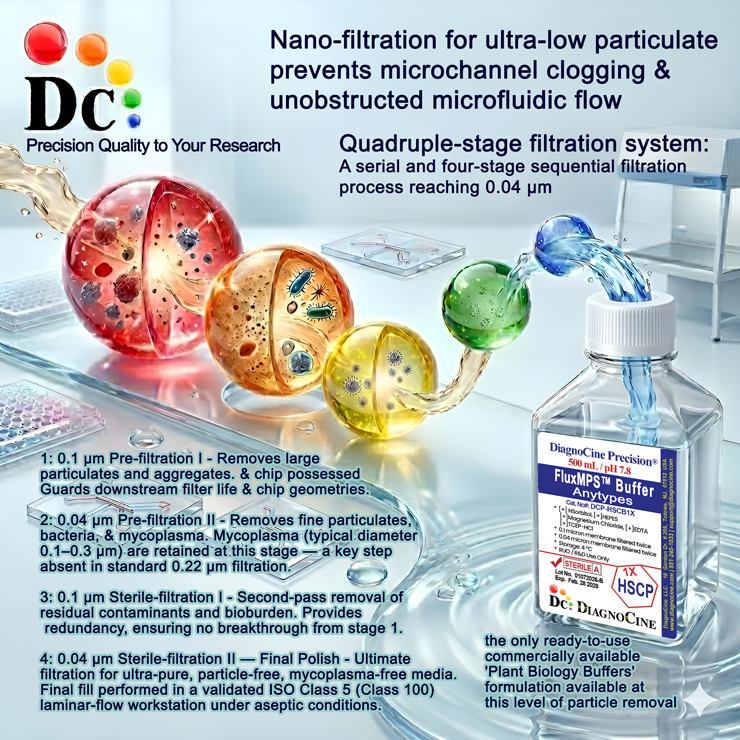
Quadruple-stage filtration system
A serial four-stage sequential filtration process reaching 0.04 µm—the only commercially available buffer at this level of particle removal.
-
1
0.1 µm Pre-filtration I
Removes large particulates and aggregates. Primary guard to extend downstream filter lifetime.
-
2
0.04 µm Pre-filtration II
Removes fine particulates, bacteria, and mycoplasma (0.1–0.3 µm)—a key step absent in standard 0.22 µm filtration.
-
3
0.1 µm Sterile-filtration I
Second-pass removal of residual contaminants and bioburden with full redundancy.
-
4
0.04 µm Sterile-filtration II — Final Polish
Ultimate filtration for particle-free, mycoplasma-free product. Final fill in validated ISO Class 5 laminar-flow workstation.
Performance vs. conventional reagents
Standard 0.22 µm single-pass filtration leaves particles in the 0.05–0.22 µm range. FluxMPS™ removes these contaminants for cleaner results and higher reproducibility.
Validated applications
- Genomic DNA extraction from a wide range of plant species.
- PCR, qPCR, and genotyping assays (e.g., marker analysis, barcoding).
- Preparation of DNA for Sanger or next-generation sequencing.
- DNA isolation for restriction digestion, cloning, and library construction.
Protocol & usage instructions
- For low-phenolic tissues (leaves, roots, seeds):
- Prewarm buffer to 55–60°C
- Add 100 mg ground tissue per 1 mL buffer
- Incubate 30–60 min at 60°C
- Proceed with chloroform extraction
- For phenolic-rich tissues (woody, medicinal plants):
- Prewarm buffer to 55–60°C
- Add 2% (v/v) β-mercaptoethanol fresh (20 µL/mL)
- Add tissue and proceed as above
Composition & specifications
| Component |
|---|
| CTAB |
| Tris base |
| EDTA |
| Sodium Chloride |
| PVP-40 |
| TCEP-HCl |
Quality assurance & logistics
ISO 13485:2016 Certified
Manufactured under certified QMS with full traceability and lot documentation.
Made in USA
All manufacturing, QA testing, and final assembly at DiagnoCine Precision, Totowa, NJ.
Supporting literature
- Doyle JJ, Doyle JL. A rapid DNA isolation procedure for small quantities of fresh leaf tissue. Phytochem Bull. 1987;19:11-15.
- Porebski S, Bailey LG, Baum BR. Modification of a CTAB DNA extraction protocol for plants containing high polysaccharide and polyphenol components. Plant Mol Biol Rep. 1997;15(1):8-15.
- Allen GC, Flores-Vergara MA, Krasynanski S, et al. A modified protocol for rapid DNA isolation from plant tissues using cetyltrimethylammonium bromide. Nat Protoc. 2006;1(5):2320-2325.