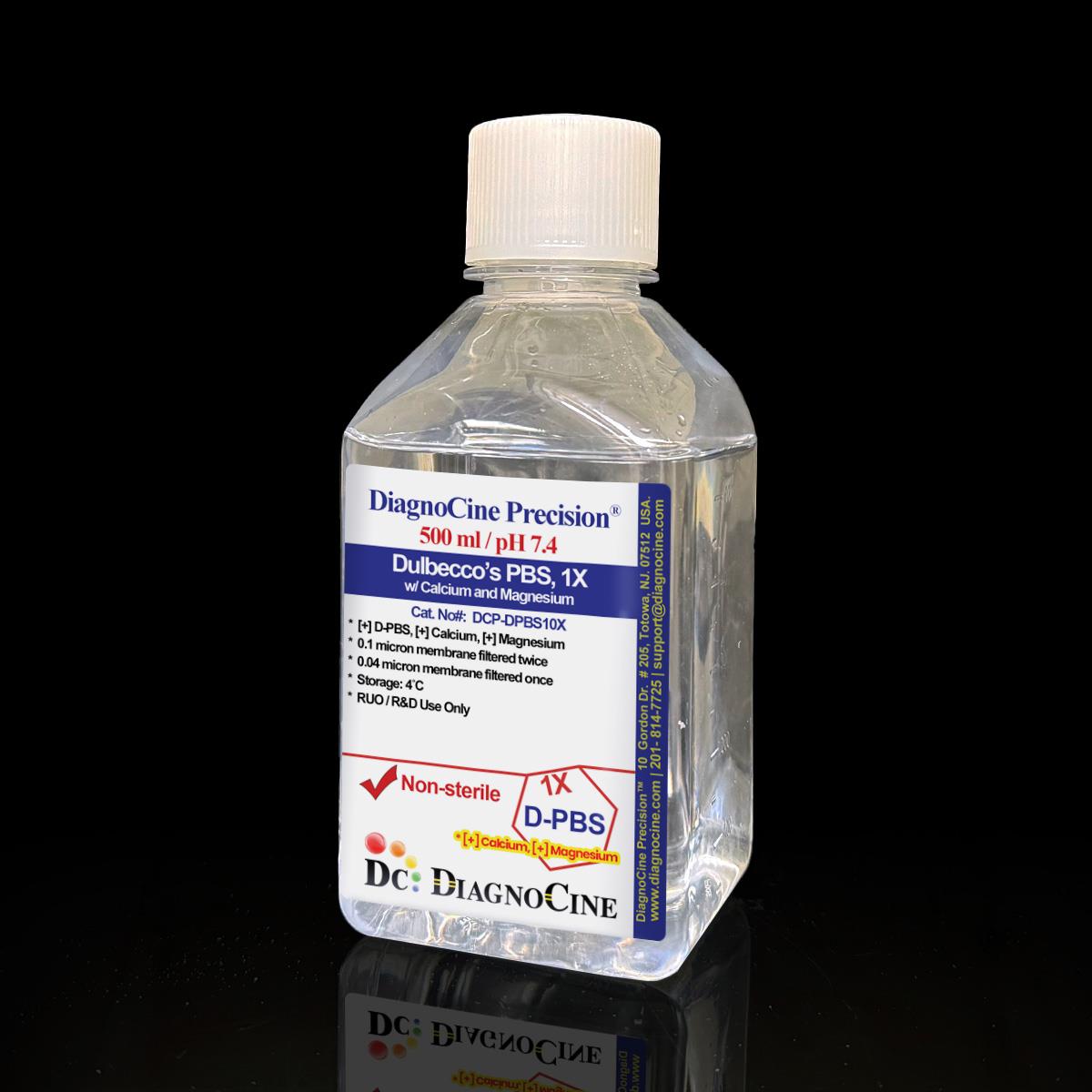
Dulbecco's PBS with Ca2+and Mg2+ (D-PBS), Non-Sterile, 10X
FluxMPS™ Dulbecco's PBS with Ca2+ and Mg2+ (D-PBS), Non-Sterile, 10X
DCP-DPBS10X is an MPS-grade 10X Dulbecco's phosphate-buffered saline concentrate formulated with calcium and magnesium at pH 7.4, delivering a defined, balanced salt chemistry for microfluidic, organ-on-a-chip, and general cell culture workflows. Each lot is filtered twice (2X) through a 0.1 µm membrane in a controlled clean environment and prepared with ASTM 0.05 µS/cm Type 1 ultrapure deionized water for microchannel-safe purity.
- Filtered twice (2X) through a 0.1 µm membrane filter in a controlled clean environment
- Defined pH 7.4 formulation with individually specified molarity for every salt component
- Contains calcium and magnesium (Ca2+, Mg2+) supporting a physiologically balanced salt solution
- Prepared with ASTM 0.05 µS/cm Type 1 ultrapure, deionized water
- Tested negative for protease, DNase, RNase, and endonuclease activity
- Tissue Culture & Molecular Biology grade
- Custom pH, concentration (1X, 2X, 4X, 5X), and additive formulations available on request
- Manufactured under ISO 13485-certified, CE-approved facilities
- pH7.4
- Concentration10X
- FormulationBalanced salt solution with Ca2+/Mg2+
- Filtration0.1 µm membrane, twice (2X)
- AppearanceClear, colorless liquid
- Water QualityASTM 0.05 µS/cm Type 1 Ultrapure, deionized
- StorageRoom temperature; 4°C recommended long-term
- GradeTissue Culture & Molecular Biology
- Nuclease/ProteaseProtease(-), DNase(-), RNase(-), Endonuclease(-)
- Intended UseRUO - Research Use Only
Engineered where standard buffers fail
Conventional single-pass 0.22 µm-filtered buffers can carry subvisible particulates that accumulate in narrow microchannels, disrupt tonicity control, and elevate background in sensitive assays. FluxMPS™ DCP-DPBS10X is built with a defined salt chemistry and a dual-pass 0.1 µm filtration step to support microchannel-safe, reproducible performance.
Microchannel-safe purity
Filtered twice (2X) through a 0.1 µm membrane in a controlled clean environment to reduce particulate carryover into fine microfluidic channels.
Precise, stable pH
Formulated at pH 7.4 with individually defined molarity for potassium chloride, potassium phosphate monobasic, sodium phosphate dibasic, sodium chloride, calcium chloride, and magnesium chloride hexahydrate.
Ultrapure-grade water
Prepared using ASTM 0.05 µS/cm Type 1 ultrapure, deionized water as the base for the entire formulation.
Low background for imaging & assays
A balanced salt formulation with calcium and magnesium supports osmotic balance and physiological pH, helping protect cells from acute fluctuations during handling.
Defined, traceable composition
Every salt component is specified by molarity and mg/L concentration, supporting lot-to-lot traceability of the formulation.
Customization on demand
pH, concentration (1X, 2X, 4X, 5X), and additional chemicals, detergents, inhibitors, or proteins can be formulated on request.
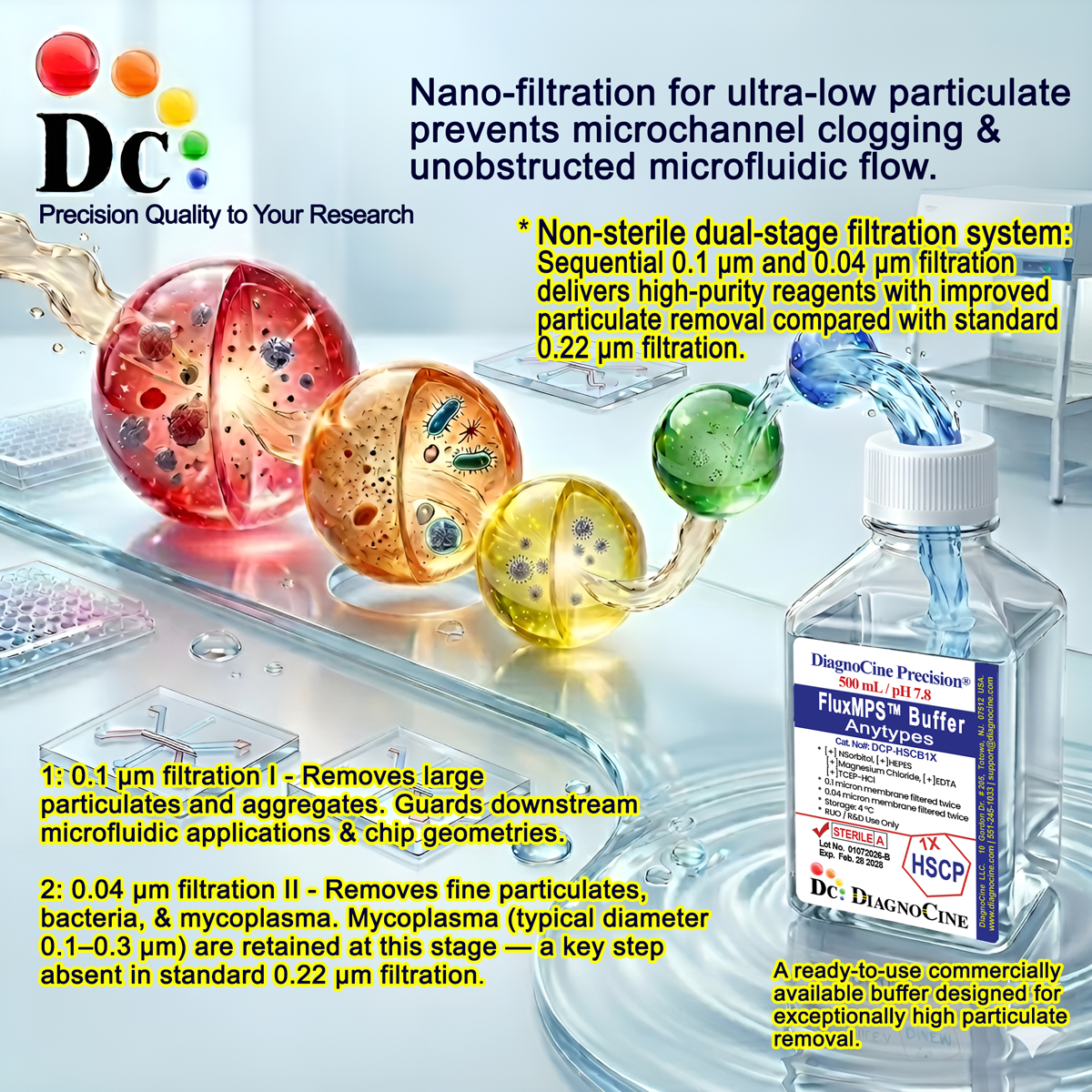
Dual-pass 0.1 µm filtration architecture
DCP-DPBS10X is sterilized by filtering twice (2X) through a 0.1 µm membrane filter in a controlled clean environment, providing redundant particulate and bioburden control for downstream microfluidic and cell culture use.
-
1
0.1 µm Filtration Pass 1
Initial pass through a 0.1 µm membrane filter removes larger particulates and aggregates in a controlled clean environment.
-
2
0.1 µm Filtration Pass 2 – Final Polish
A second 0.1 µm membrane pass provides redundant filtration, helping to prevent mycoplasma contamination; the smallest mycoplasma types are approximately 0.2 microns, larger than the 0.1 µm pore used in this process.
Performance vs. conventional buffer
Two sequential passes through a 0.1 µm membrane are designed to reduce particulate carryover compared with a single conventional 0.22 µm filtration pass.
© Diagnocine® — DCP-DPBS10X
Where DCP-DPBS10X is used
Dulbecco's phosphate-buffered saline with calcium and magnesium is a balanced salt solution designed for multiple cell culture applications due to its osmotic balance properties, which are similar to the natural conditions of mammalian systems.
Automated Bioreactors & Robotics
For automated bioreactor and robotic liquid-handling platforms, an optional 0.01 µm (10 nm) ultra-filtered variant of this buffer can be requested to further reduce particulate exposure to sensitive valves and sensors.
- Total Particulate Exclusion for sensitive fluidic pathways
- Valve & Sensor Protection in automated systems
- Extended Perfusion Stability for long-duration runs
Inquiry Required: the 0.01 µm ultra-filtered grade is available on request; contact support@diagnocine.com.
Micro Physiological System (MPS) & Chip
Supports osmotic balance and physiological pH for cells cultured outside their regular growth environment in chip-based systems.
Wash, Dilution & Reconstitution
Used for washing adhesion cells before dissociation, diluting cells for counting, and preparing reagents with inorganic salts essential for basic cell metabolism.
iPSC-Derived Model Handling
Supports viable conditions for cells during handling outside their regular growth environment, maintaining osmotic balance and physiological pH.
Endothelial & Primary Cell Perfusion
Calcium- and magnesium-containing formulation is useful for transport media and reagent preparation where cell dissociation is not the goal.
ELISA, Blotting & Blocking
Serves as an inorganic base for standard media, wash, and reagent preparation in immunoassay workflows.
Microscopy & Optical Sensing
Buffering capacity effective at near-neutral pH supports imaging and sensor-based workflows where tonicity and pH stability matter.
Detailed specifications
All values below are as stated in the current product documentation for DCP-DPBS10X.
| Parameter | Specification |
|---|---|
| Formulation | Balanced salt solution containing potassium chloride, potassium phosphate monobasic, sodium phosphate dibasic, sodium chloride, calcium chloride, and magnesium chloride hexahydrate |
| Appearance | Sterilized Liquid, Clear, Colorless |
| pH | 7.4 |
| Concentration Factor | 10X |
| Parameter | Specification |
|---|---|
| Nuclease/Protease Testing | Protease(-), DNase(-), RNase(-), Endonuclease(-) |
| Filtration System | 0.1 µm membrane filtration, twice (2X) |
| Water Quality | ASTM 0.05 µS/cm Type 1 Ultrapure H2O, Deionized |
| Manufacturing Standard | ISO 13485-certified, CE-approved facilities |
| Parameter | Specification |
|---|---|
| Storage Temperature | Room Temperature; 4°C recommended for long-term storage |
| Parameter | Specification |
|---|---|
| Raw Material Grade | Tissue Culture & Molecular Biology grade |
| Manufacturing QMS | ISO 13485-certified facilities |
| Regulatory Alignment | CE-approved facilities |
| Production & Assembly Location | Customization and assembly accomplished at DiagnoCine Precision, Totowa, New Jersey, USA |
| Intended Use | Laboratory research use only; not for animal or human therapeutic use, human or animal consumption, or diagnostic use |
Full composition
Component concentrations are expressed in mM and mg/L as specified for this formulation.
| Component | CAS Number | Concentration |
|---|---|---|
| Potassium Chloride (KCl) | 7447-40-7 | 26.7 mM (2000.00 mg/L) |
| Potassium Phosphate monobasic (KH2PO4) | 7778-77-0 | 14.7 mM (2000 mg/L) |
| Sodium Phosphate Dibasic (Na2HPO4) | 7558-79-4 | 81.0 mM (11500 mg/L) |
| Sodium Chloride (NaCl) | 7647-14-5 | 81.0 mM (80000 mg/L) |
| Calcium Chloride (CaCl2) | 10043-52-4 | 9.0 mM (1000 mg/L) |
| Magnesium Chloride Hexahydrate (MgCl2) | 7791-18-6 | 4.9 mM (1000 mg/L) |
Manufacturing & compliance
DCP-DPBS10X is produced and finished under a controlled quality system, with final packaging, quality assurance, and testing performed at the DiagnoCine R&D and Quality Testing Center.
ISO 13485:2016 QMS
Manufactured under ISO 13485-certified and CE-approved facilities (Suppliers of DiagnoCine Precision).
Ultrapure Water
Formulated with ASTM 0.05 µS/cm Type 1 ultrapure, deionized water.
Dual-Pass Filtration
Filtered twice (2X) through a 0.1 µm membrane in a clean environment to reduce mycoplasma and particulate contamination risk.
Micro-Batch Precision
All specific customization requests and assembly are accomplished at DiagnoCine Precision in Totowa, New Jersey, USA.
Nuclease/Protease Testing
Tested negative for protease, DNase, RNase, and endonuclease activity.
Filtration Verification
0.1 µm membrane filtration performed twice (2X); the smallest mycoplasma types are approximately 0.2 microns.
Documentation
Certificate of Analysis available; final packaging, QA, and testing performed at the DiagnoCine R&D and Quality Testing Center.
Regulatory Alignment
Research Use Only; manufactured in ISO 13485-certified, CE-approved facilities.
How DCP-DPBS10X compares
A summary comparison of DCP-DPBS10X against conventional single-pass filtered buffers.
| Parameter | DCP-DPBS10X (FluxMPS™) | Conventional Buffer | Standard Alternative |
|---|---|---|---|
| Filtration Method | 0.1 µm membrane, twice (2X) | Single 0.22 µm filtration | Single 0.22 µm filtration |
| Final Filtration Pore Size | 0.1 µm | 0.22 µm | 0.22 µm |
| Number of Filtration Passes | 2 | 1 | 1 |
| Calcium & Magnesium Included | check_circle | cancel | cancel |
| Ultrapure Deionized Water | check_circle | cancel | cancel |
| ISO 13485 Manufacturing | check_circle | cancel | cancel |
| Nuclease/Protease-Tested Negative | check_circle | cancel | cancel |
| Microfluidic Channel Compatibility | check_circle | cancel | cancel |
| Custom pH/Concentration Formulation | check_circle | cancel | cancel |
Frequently asked questions
Common questions about DCP-DPBS10X.
Supporting literature
Curated literature relevant to phosphate-buffered saline use in cell culture and microfluidic systems.
- Bhatia, S.N. & Ingber, D.E. Microfluidic organs-on-chips. Nature Biotechnology. doi:10.1038/nbt.2989
- Dulbecco, R. & Vogt, M. Plaque formation and isolation of pure lines with poliomyelitis viruses. Journal of Experimental Medicine. doi:10.1084/jem.99.2.167
- Freshney, R.I. Culture of Animal Cells: A Manual of Basic Technique and Specialized Applications. doi:10.1002/9780470649367
- Low, L.A. et al. Organs-on-chips: into the next decade. Nature Reviews Drug Discovery. doi:10.1038/s41573-020-0079-3
- Ryan, J.A. Understanding and managing cell culture contamination. Corning Technical Bulletin. doi:10.1002/9780470112637.ch1
- Rottem, S. & Barile, M.F. Beware of mycoplasmas. Trends in Biotechnology. doi:10.1016/0167-7799(93)90003-8
- Halldorsson, S. et al. Advantages and challenges of microfluidic cell culture in polydimethylsiloxane devices. Biosensors and Bioelectronics. doi:10.1016/j.bios.2014.07.029
- Good, N.E. et al. Hydrogen ion buffers for biological research. Biochemistry. doi:10.1021/bi00866a011
- Van der Meer, A.D. & van den Berg, A. Organs-on-chips: breaking the in vitro impasse. Integrative Biology. doi:10.1039/c2ib00219a