

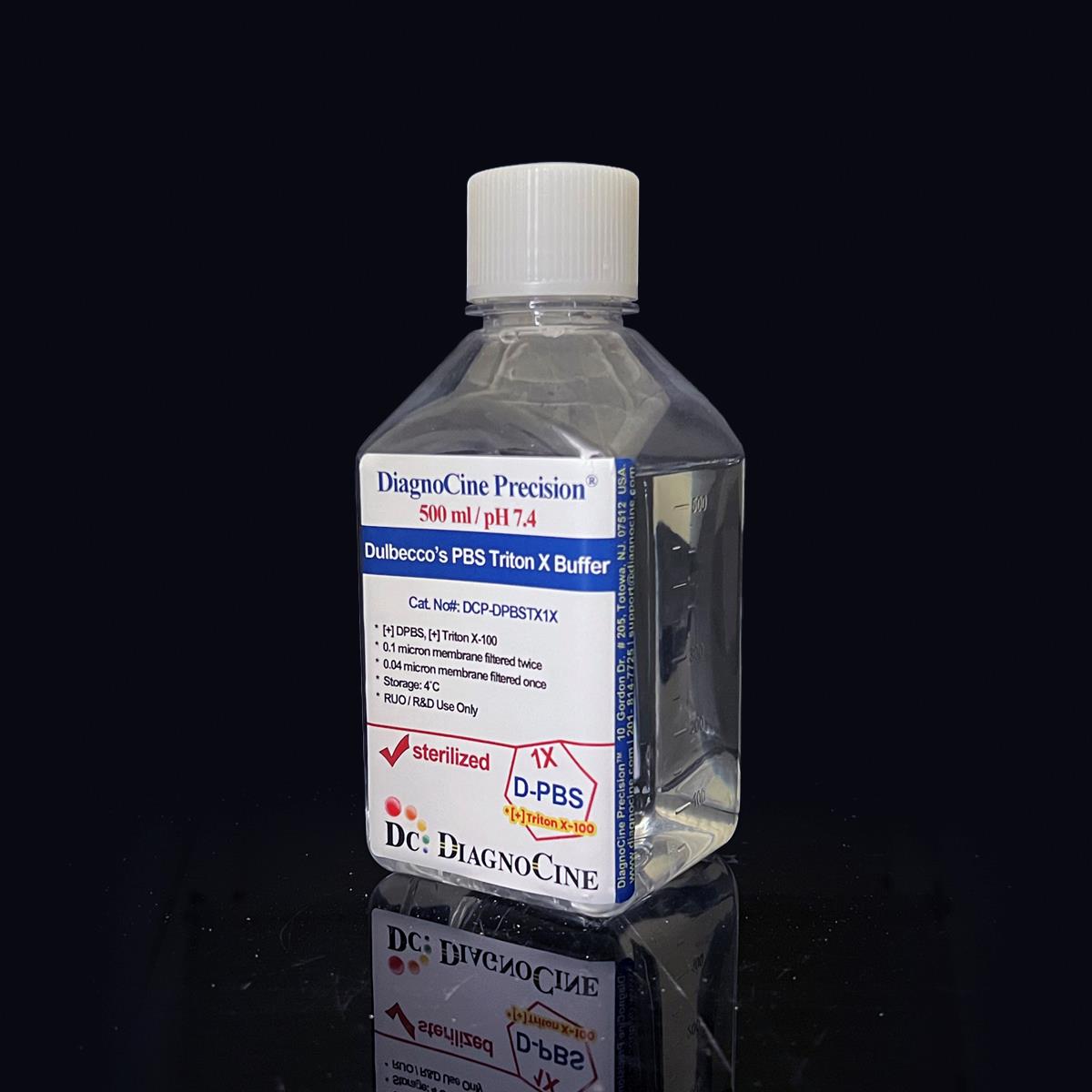
Dulbecco’s PBS Triton X Buffer [1X]
FluxMPS™ Dulbecco’s PBS Triton X Buffer [1X]
An MPS-grade Dulbecco’s Phosphate Buffered Saline formulated with 1% Triton X-100 for reliable membrane permeabilization, protein extraction, and immunostaining across cell and molecular biology workflows. Quadruple-stage, 0.1 µm and 0.04 µm filtration and a defined pH 7.4 keep this buffer microchannel-safe for organ-on-a-chip (OoC) and microfluidic systems.
- Quadruple-stage filtration — filtered 0.1-micron membrane twice and 0.04-micron membrane twice for microchannel-safe purity
- Defined pH 7.4 for consistent, isotonic buffering
- Contains 1% Triton X-100 non-ionic detergent for membrane permeabilization and protein solubilization
- Sterile formulation, tested DNase- and RNase-free
- Manufactured with ultrapure Type 1 water for low-background imaging and molecular biology
- Filled in an ISO Class 5 (Class 100) aseptic environment
- Custom pH, concentration, and additive content available on request
- pH
- 7.4
- Formulation
- DPBS + 1% Triton X-100
- Filtration
- 0.1 µm x2 + 0.04 µm x2
- Sterility
- Sterile, filtered
- DNase Activity
- None detected
- RNase Activity
- None detected
- Appearance
- Clear, colorless liquid
- Storage
- 4°C
- Shelf Life
- 2 years
- Water Quality
- Ultrapure Type 1 (18.2 MΩ·cm)
Engineered where standard permeabilization buffers fail
Conventional 0.22 µm-filtered PBS/Triton X-100 blends carry subvisible particulates that accumulate in microchannels, drift in pH under storage, and add background to sensitive imaging and immunoassay workflows. FluxMPS™ addresses each failure mode directly.
Microchannel-safe purity
Final 0.04 µm filtration reduces particulate load relative to single-pass 0.22 µm processing, protecting microfluidic channels, valves, and sensors.
Precise, stable pH
Formulated to a defined pH of 7.4 with a consistent phosphate-salt composition, lot to lot.
Ultrapure-grade water
Prepared with ultrapure Type 1 water (18.2 MΩ·cm), consistent with USP <85> quality expectations.
Low background for imaging and assays
Sterile, DNase- and RNase-free formulation supports immunostaining, confocal imaging, and biosensor applications with reduced background noise.
Defined, traceable composition
Each salt and the Triton X-100 detergent content is controlled and documented, supporting reproducible permeabilization and lysis.
Customization on demand
Alternate pH, concentration, or additive/supplement formulations available — contact support@diagnocine.com.
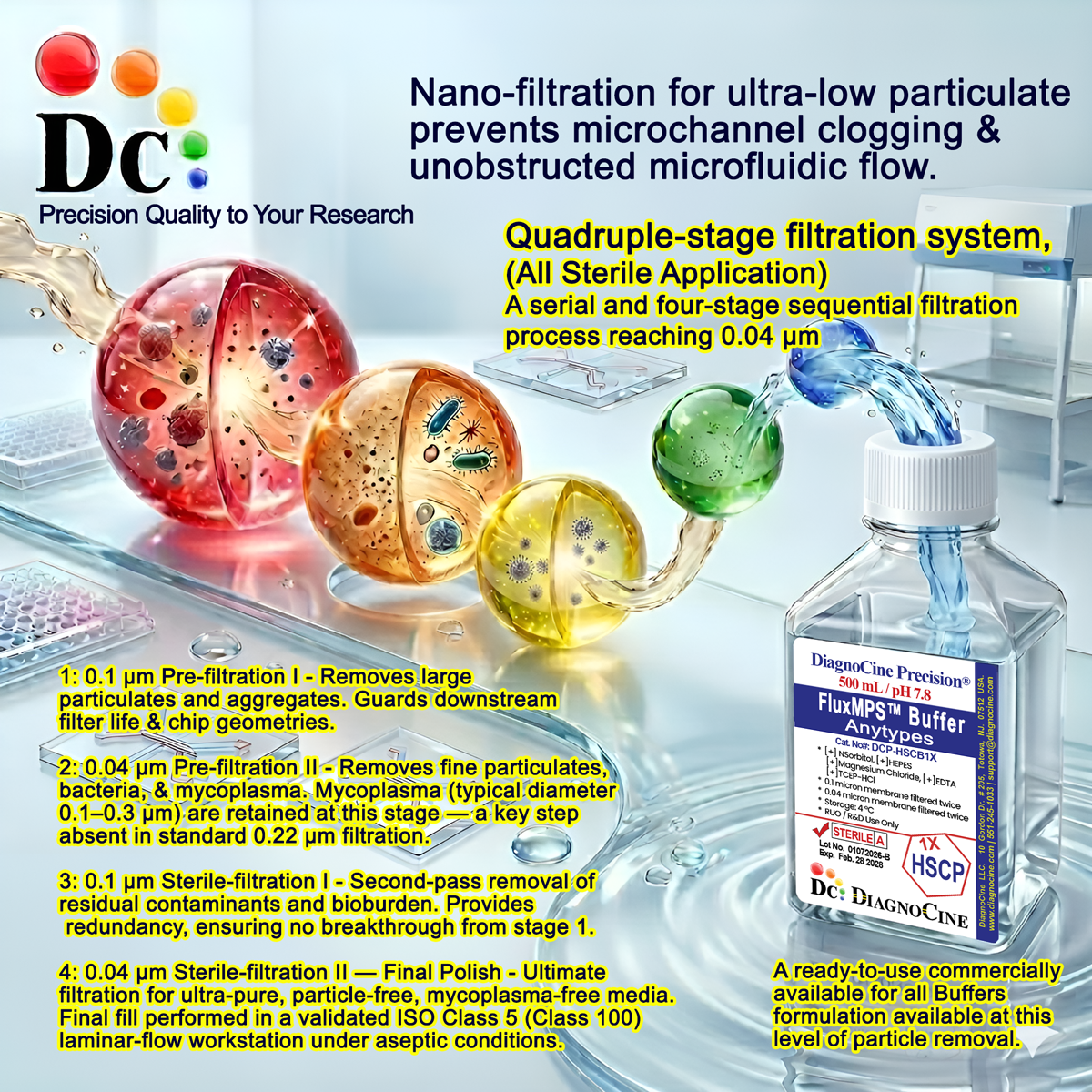
Quadruple-stage filtration system
Every lot of this buffer is filtered 0.1-micron membrane twice and 0.04-micron membrane twice, in a sterile environment, before final release.
-
1
0.1 µm Pre-filtration I
Removes large particulates and aggregates, extending the life of downstream filters.
-
2
0.04 µm Pre-filtration II
Retains fine particulates and bioburden ahead of the sterile-filtration passes.
-
3
0.1 µm Sterile-filtration I
A second 0.1 µm pass provides redundancy against membrane breakthrough.
-
4
0.04 µm Sterile-filtration II — Final Polish
A second 0.04 µm pass is the final polish, performed in an ISO Class 5 (Class 100) aseptic fill environment. The smallest known mycoplasma types are about 0.2 microns, so a 0.04 µm final pore size is well below that threshold.
Performance vs. conventional buffer
Sequential 0.1 µm and 0.04 µm filtration, applied across four total passes, removes finer particulates than a single 0.22 µm pass used in conventional buffer preparations, supporting cleaner microfluidic and cell/molecular biology work.
© Diagnocine® — DCP-DPBSTX1X
Built for permeabilization, extraction, and purification workflows
Dulbecco’s PBS with Triton X-100 maintains pH and osmotic balance for cell viability while the non-ionic detergent solubilizes membrane proteins and creates pores for entry of otherwise cell-impermeant molecules.
Automated Bioreactors & Robotics
An optional 0.01 µm (10 nm) ultra-filtered variant of this buffer is available for automated bioreactor and robotic liquid-handling platforms where valve and sensor protection is critical.
- Total Particulate Exclusion — sub-10 nm filtration for closed automated systems
- Valve & Sensor Protection — minimizes fouling of precision fluidic hardware
- Extended Perfusion Stability — supports longer unattended run times
Inquiry Required: the 0.01 µm ultra-filtered grade is produced to order — contact support@diagnocine.com to request this configuration.
Micro Physiological System (MPS) & Chip
Buffer washing, dilution, and perfusion in microfluidic and chip-based culture systems.
Wash, Dilution & Reconstitution
Cell washing, dissociation-process buffering, dilution, and rinse steps in cell culture environments.
iPSC-Derived Model Handling
Permeabilization and wash steps compatible with iPSC-derived model handling protocols.
Endothelial & Primary Cell Perfusion
Buffering for wash and perfusion steps with endothelial and primary cell models.
ELISA, Blotting & Blocking
Triton X-100 permeabilization supports antibody access in ELISA, blotting, and blocking protocols.
Microscopy & Optical Sensing
Permeabilization enhances delivery of optical contrast agents and antibodies for imaging and labeling.
Product specifications
Values reflect the documented formulation and quality-control parameters for this product.
| Parameter | Specification |
|---|---|
| Formulation / Composition | DPBS with 1% Triton X-100 (see full composition table below) |
| Appearance | Clear, colorless liquid |
| pH (USP <791>) | 7.4 |
| Molarity / Concentration | NaCl 137 mM; KCl 2.67 mM; KH2PO4 1.47 mM; Na2HPO4 8.09 mM |
| Detergent Content | Triton X-100, 1% |
| Parameter | Specification |
|---|---|
| Sterility | Filtered 0.1-micron membrane twice and 0.04-micron membrane twice in a sterile environment USP |
| DNase Activity | None detected after 18 hr incubation with plasmid DNA at room temperature |
| RNase Activity | None detected after 18 hr incubation with ribosomal RNA at room temperature |
| Water Quality | Ultrapure Type 1 water (18.2 MΩ·cm) USP <85> |
| Fill Environment | ISO Class 5 (Class 100) ISO |
| Parameter | Specification |
|---|---|
| Storage Temperature | 4°C |
| Shelf Life | 2 years |
| Parameter | Specification |
|---|---|
| Manufacturing QMS | ISO 13485-certified facilities ISO |
| Regulatory Alignment | CE-approved facilities |
| Production Method | Final packaging, quality assurance, and testing at the DiagnoCine R&D and Quality Testing Center; custom assembly at DiagnoCine Precision, Totowa, New Jersey, USA |
| Intended Use | Research Use Only (RUO) |
Full composition
Component concentrations for Dulbecco’s PBS Triton X Buffer [1X], expressed in mM and %, per lot release documentation.
| Component | CAS Number | Concentration |
|---|---|---|
| Sodium Chloride (NaCl) | 7647-14-5 | 137 mM |
| Potassium Chloride (KCl) | 7447-40-7 | 2.67 mM |
| Potassium Phosphate monobasic (KH2PO4) | 7778-77-0 | 1.47 mM |
| Sodium Phosphate dibasic (Na2HPO4) | 7558-79-4 | 8.09 mM |
| Triton X-100 | 9002-93-1 | 1% |
Manufacturing & compliance
Produced and released under a documented quality management system with final assembly and testing performed by DiagnoCine.
ISO 13485:2016 QMS
Manufactured under ISO 13485-certified and CE-approved facilities.
Ultrapure Type 1 Water
Prepared with 18.2 MΩ·cm Type 1 water for low-background performance.
ISO Class 5 Fill & Finish
Final 0.04 µm filtration pass and fill performed in an ISO Class 5 (Class 100) environment.
Micro-Batch Precision
Final packaging, quality assurance, and testing completed at the DiagnoCine R&D and Quality Testing Center.
Endotoxin (USP <85> BET)
Each production lot is screened using USP <85> Bacterial Endotoxins Test methodology as part of routine release testing.
Particulate (USP <788> Method 2)
Quadruple-stage 0.1 µm / 0.04 µm filtration is monitored consistent with USP <788> Method 2 particulate-control practices.
Osmolality (USP <785>)
Batch osmolality is monitored using USP <785> methodology to support isotonic performance.
Documentation / CoA
A Certificate of Analysis is available for this lot — contact support@diagnocine.com.
How DCP-DPBSTX1X compares
A side-by-side view of this buffer against conventional 0.22 µm-filtered alternatives.
| Parameter | DCP-DPBSTX1X (FluxMPS™) | Conventional 0.22 µm Buffer | Standard Alternative 0.22 µm Buffer |
|---|---|---|---|
| Non-ionic detergent permeabilization (1% Triton X-100) | check_circle | cancel | cancel |
| Final filtration pore size | 0.04 µm | 0.22 µm | 0.22 µm |
| Number of filtration stages | 4 | 1 | 1 |
| DNase / RNase tested | check_circle | cancel | cancel |
| Ultrapure Type 1 water | check_circle | cancel | cancel |
| ISO 13485 manufacturing QMS | check_circle | cancel | cancel |
| Microfluidic channel compatibility | check_circle | cancel | cancel |
| Defined pH 7.4 | check_circle | check_circle | cancel |
| Custom formulation available | check_circle | cancel | cancel |
Frequently asked questions
Answers to common questions about this DPBS Triton X-100 buffer.
Supporting literature
Curated references on organ-on-a-chip systems, Triton X-100 permeabilization, and phosphate-buffered saline chemistry.
- Bhatia SN, Ingber DE. Microfluidic organs-on-chips. Nat Biotechnol. 2014;32(8):760-772. doi:10.1038/nbt.2989
- Koivisto JT, et al. Bioengineered approaches for organ-on-chip platforms. Trends Biotechnol. 2019. doi:10.1016/j.tibtech.2019.01.006
- Koley D, Bard AJ. Triton X-100 concentration effects on membrane permeability. Proc Natl Acad Sci. 2010;107(39):16783-16787. doi:10.1073/pnas.1011614107
- Ashkenazi A, et al. Detergent-based membrane permeabilization for immunostaining. J Histochem Cytochem. 2018. doi:10.1369/0022155417750777
- Dulbecco R, Vogt M. Plaque formation and isolation of pure lines with poliomyelitis viruses. J Exp Med. 1954;99(2):167-182. doi:10.1084/jem.99.2.167
- Koontz L. TX-100 and other detergents in protein extraction protocols. Methods Enzymol. 2014;541:3-10. doi:10.1016/B978-0-12-420119-4.00001-X
- Halldorsson S, et al. Advantages and challenges of microfluidic cell culture in polydimethylsiloxane devices. Biosens Bioelectron. 2015;63:218-231. doi:10.1016/j.bios.2014.07.029
- Low LA, Tagle DA. Organs-on-chips: progress, challenges, and future directions. Exp Biol Med. 2017;242(16):1573-1578. doi:10.1177/1535370217700523
- Williams DF. Endotoxin control in biomaterials and reagent manufacturing. Biomaterials. 2013. doi:10.1016/j.biomaterials.2013.01.032
- Van Meer BJ, et al. Small molecule absorption by PDMS in the context of drug response bioassays. Biochem Biophys Res Commun. 2017. doi:10.1016/j.bbrc.2017.01.176