Dulbecco’s PBS NP-40 Buffer [1X]
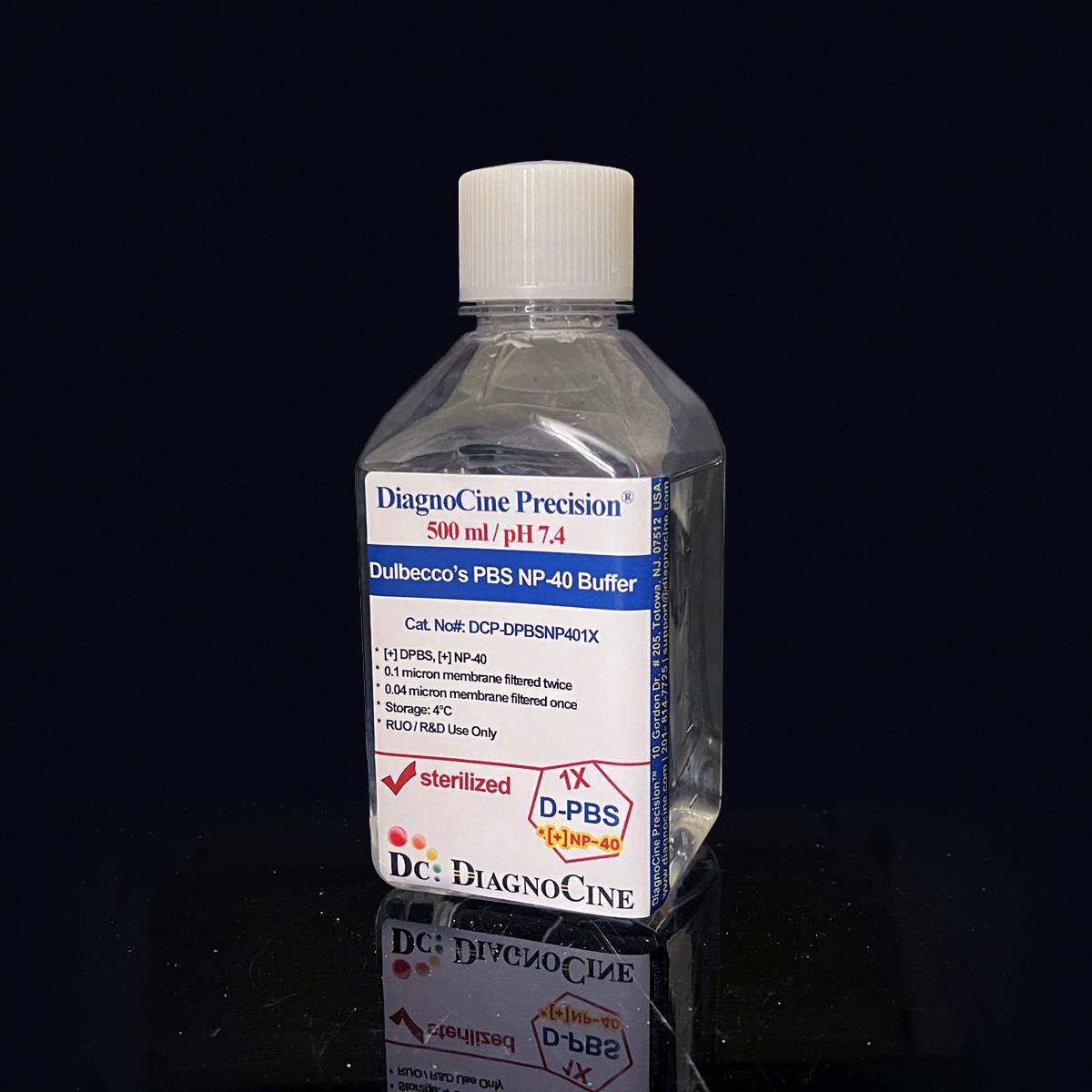
FluxMPS™ Dulbecco's PBS NP-40 Buffer [1X]
An MPS-grade, ultrapure lysis and extraction buffer that combines the osmotic balance and pH stability of Dulbecco's phosphate-buffered saline with the gentle membrane-permeabilization power of 1% NP-40 detergent. Dual-stage filtered through a 0.1 µm membrane once and a 0.04 µm membrane once for ultra-clean, microchannel-safe performance in cell lysis, fractionation, and immunostaining protocols.
- Filtered 0.1 µm membrane once and 0.04 µm membrane once for ultra-clean, low-particulate buffer
- Formulated with 1% NP-40 detergent for gentle, effective membrane protein extraction
- Phosphate-buffered pH 7.4 for stable osmotic balance during lysis and downstream assays
- Manufactured in ISO 13485-certified, CE-approved facilities
- Supplied non-sterile, formulated for research bench lysis, fractionation, and immunostaining workflows
- Compatible with centrifugal ultrafiltration for NP-40 removal and high-recovery protein purification
- Customizable concentration, pH, and additive content available on request
- pH7.4
- Sodium Chloride137 mM
- Potassium Chloride2.67 mM
- Potassium Phosphate monobasic1.47 mM
- Sodium Phosphate dibasic8.09 mM
- NP-40 Detergent1%
- AppearanceClear, Colorless Liquid
- Filtration0.1 µm once + 0.04 µm once
- Storage4°C
- Shelf Life2 years
Engineered where standard lysis buffers fall short
Conventional 0.22 µm-filtered PBS-NP-40 preparations can carry subvisible particulates that accumulate in microchannels, interfere with imaging, and introduce variability into protein extraction workflows. DCP-DPBSNP401X is built for cleaner, more reproducible lysis.
Microchannel-safe purity
Dual-stage 0.1 µm and 0.04 µm membrane filtration removes particulates that can clog microchannels and biosensor surfaces, keeping the buffer compatible with lysis and fractionation steps on- and off-chip.
Precise, stable pH
The phosphate buffer system holds pH 7.4, preserving protein structure and activity during NP-40-mediated membrane permeabilization and extraction.
Ultrapure-grade water
Formulated with Ultrapure Type 1 water (18.2 MΩ·cm), reducing background contamination in sensitive downstream assays.
Low background for imaging & assays
Gentle NP-40 permeabilization supports immunostaining protocols that require intracellular antibody access without harsh membrane disruption.
Defined, traceable composition
Every salt and detergent component — from sodium chloride to NP-40 — is documented at a fixed concentration for reproducible lysis performance.
Customization on demand
Concentration, pH, and additive content can be adjusted upon request for specialized extraction or fractionation protocols.
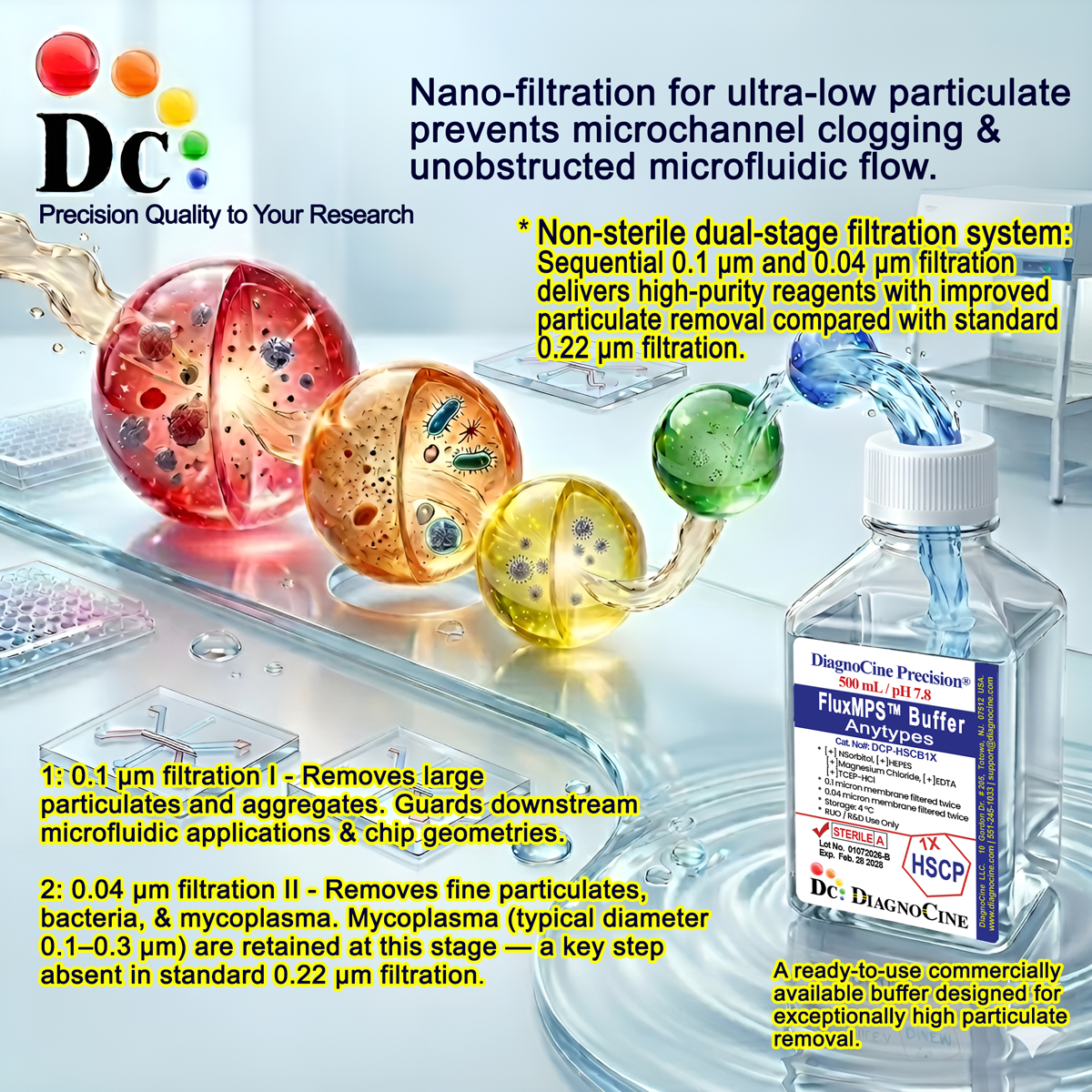
Dual-stage filtration system
DCP-DPBSNP401X is a non-sterile, ultrapure buffer filtered through a 0.1 µm membrane once and a 0.04 µm membrane once, removing coarse and fine particulates before fill.
-
1
0.1 µm Pre-filtration I
Removes large particulates and aggregates, extending the working life of the finer downstream membrane.
-
2
0.04 µm Pre-filtration II
Retains fine particulates and bioburden below the size of the smallest known mycoplasma types (about 0.2 µm), supporting an ultra-clean buffer for cell and molecular biology work.
Performance vs. conventional buffer
Sequential 0.1 µm and 0.04 µm filtration removes finer particulates than a single-pass 0.22 µm filtered buffer, supporting a cleaner working buffer for cell and molecular biology experiments.
© Diagnocine® — DCP-DPBSNP401X
Where DCP-DPBSNP401X performs
The addition of NP-40 to Dulbecco's PBS creates a versatile buffer that combines osmotic balance and pH stability with protein extraction and membrane permeabilization, valuable across a wide range of biological and biochemical workflows.
Automated Bioreactors & Robotics
For automated perfusion and robotic liquid-handling platforms, an optional 0.01 µm (10 nm) ultra-filtered variant of this buffer is available to further reduce particulate load on sensitive valves and sensors.
- Total Particulate Exclusion for closed-loop perfusion systems
- Valve & Sensor Protection in automated liquid-handling equipment
- Extended Perfusion Stability for long-duration bioreactor runs
Inquiry Required: the 0.01 µm ultra-filtered grade is produced to order — contact support@diagnocine.com to request it.
Micro Physiological System (MPS) & Chip Lysis
Ultra-clean NP-40 lysis buffer for on-chip cell disruption and protein extraction in microfluidic culture systems.
Cell Lysis & Protein Extraction
NP-40 effectively lyses cells and solubilizes membrane proteins, preparing lysates for downstream biochemical assays.
iPSC-Derived Model Lysate Preparation
Gentle detergent lysis supports protein recovery from iPSC-derived neuronal, cardiac, and hepatic models.
Endothelial & Primary Cell Fractionation
Used in protocols to separate nuclear and cytoplasmic fractions of endothelial and primary cell cultures.
Immunostaining & Membrane Permeabilization
Permeabilizes cells to allow antibody access to intracellular targets in immunostaining protocols.
Nuclear/Cytoplasmic Fractionation Imaging
Low-background formulation supports downstream microscopy and biosensor readouts after fractionation.
Specifications at a glance
Values reflect the DCP-DPBSNP401X formulation as documented by DiagnoCine Precision.
| Parameter | Specification |
|---|---|
| Formulation / Composition | Dulbecco's PBS with 1% NP-40 detergent — see full composition table below |
| Appearance | Clear, Colorless Liquid |
| pH (USP <791>) | 7.4 |
| Parameter | Specification |
|---|---|
| Sterility (USP <71>) | Non-sterile; filtered 0.1 µm membrane once and 0.04 µm membrane once |
| Water Purity USP <85> | Ultrapure Type 1 water (18.2 MΩ·cm) |
| Manufacturing Standard ISO 13485 | ISO 13485-certified, CE-approved facilities |
| Parameter | Specification |
|---|---|
| Storage Temperature | 4°C |
| Shelf Life | 2 years |
| Parameter | Specification |
|---|---|
| Manufacturing QMS ISO 13485 | ISO 13485-certified facilities |
| Regulatory Alignment | CE-approved supplier facilities |
| Production & Assembly Site | Final packaging, QA, and testing at the DiagnoCine R&D and Quality Testing Center; customization and assembly at DiagnoCine Precision, Totowa, New Jersey, USA |
| Intended Use | Research Use Only (RUO) |
Full composition
Every component and concentration of the DCP-DPBSNP401X formulation, as documented by DiagnoCine Precision.
| Component | CAS Number | Concentration |
|---|---|---|
| Sodium Chloride | 7647-14-5 | 137 mM |
| Potassium Chloride | 7447-40-7 | 2.67 mM |
| Potassium Phosphate monobasic (KH2PO4) | 7778-77-0 | 1.47 mM |
| Sodium Phosphate dibasic (Na2HPO4) | 7558-79-4 | 8.09 mM |
| NP-40 Detergent | 9036-19-5 | 1% |
Manufacturing & compliance
DCP-DPBSNP401X is produced under a controlled quality management system with documented filtration, verification, and traceability practices.
ISO 13485:2016 QMS
Manufactured under ISO 13485-certified and CE-approved supplier facilities.
Ultrapure Type 1 Water
Formulated with Ultrapure Type 1 water (18.2 MΩ·cm).
Dual-Stage Membrane Filtration
Filtered 0.1 µm membrane once and 0.04 µm membrane once ahead of fill.
Micro-Batch Precision
Final packaging, QA, and testing are completed at the DiagnoCine R&D and Quality Testing Center; customization and assembly at DiagnoCine Precision, Totowa, New Jersey, USA.
pH Verification (USP <791>)
Formulated and verified to pH 7.4 using USP <791> potentiometric methodology.
Dual-Stage Membrane Filtration
Sequential 0.1 µm and 0.04 µm filtration, each applied once, prior to fill.
Water Quality
Formulated with Ultrapure Type 1 water (18.2 MΩ·cm).
Documentation / CoA
A Certificate of Analysis is available upon request via support@diagnocine.com.
How DCP-DPBSNP401X compares
A side-by-side look at filtration architecture and manufacturing practice versus conventional buffer options.
| Parameter | DCP-DPBSNP401X (FluxMPS™) | Conventional 0.22 µm Filtered Buffer | Standard Alternative (0.22 µm Filtered Buffer) |
|---|---|---|---|
| NP-40 detergent-based lysis + phosphate-buffered pH stability | check_circle | cancel | cancel |
| Final filtration pore size | 0.04 µm | 0.22 µm | 0.22 µm |
| Number of filtration stages | 2 | 1 | 1 |
| Water quality | Ultrapure Type 1 (18.2 MΩ·cm) | Standard purified water | Standard purified water |
| Manufacturing QMS | ISO 13485-certified, CE-approved | Not specified | Not specified |
| Microfluidic / microchannel compatibility | check_circle | cancel | cancel |
| Documented, lot-defined pH 7.4 formulation | check_circle | cancel | cancel |
| Custom formulation available | check_circle | cancel | cancel |
Frequently asked questions
Answers to common questions about DCP-DPBSNP401X.
Supporting literature
Curated literature relevant to phosphate-buffered saline chemistry, NP-40 lysis, and buffer use in microfluidic and organ-on-a-chip systems.
- Bhatia SN, Ingber DE. Microfluidic organs-on-chips. Nat Biotechnol. 2014. doi:10.1038/nbt.2989
- Huh D, et al. Reconstituting organ-level lung functions on a chip. Science. 2010. doi:10.1126/science.1188302
- Ganesan A, et al. Comparison of lysis buffers for extraction of membrane proteins from mammalian cells. J Proteome Res. 2011. doi:10.1021/pr200070h
- Seddon AM, Curnow P, Booth PJ. Membrane proteins, lipids and detergents: not just a soap opera. Biochim Biophys Acta. 2004. doi:10.1016/j.bbamem.2004.04.011
- Good NE, et al. Hydrogen ion buffers for biological research. Biochemistry. 1966. doi:10.1021/bi00866a011
- Suarez-Arnedo A, et al. An image-based method to quantify cell permeabilization efficiency. PLoS One. 2020. doi:10.1371/journal.pone.0232565
- Low LA, Tagle DA. Microphysiological systems (organs-on-chips) for drug efficacy and toxicity testing. Clin Transl Sci. 2017. doi:10.1111/cts.12444
- Ho C-T, et al. Liver-cell patterning lab chip: mimicking the morphology of liver lobule tissue. Lab Chip. 2013. doi:10.1039/C3LC50402F
- Rathnasinghe R, et al. Sample preparation methods for downstream immunoassay applications. Methods Mol Biol. 2018. doi:10.1007/978-1-4939-7883-0