FluxMPS™ Dulbecco’s Modified Eagle Medium (DMEM), Low Glucose: 1X Liquid
FluxMPS™ Dulbecco’s Modified Eagle Medium (DMEM), Low Glucose, without HEPES — 1X Liquid
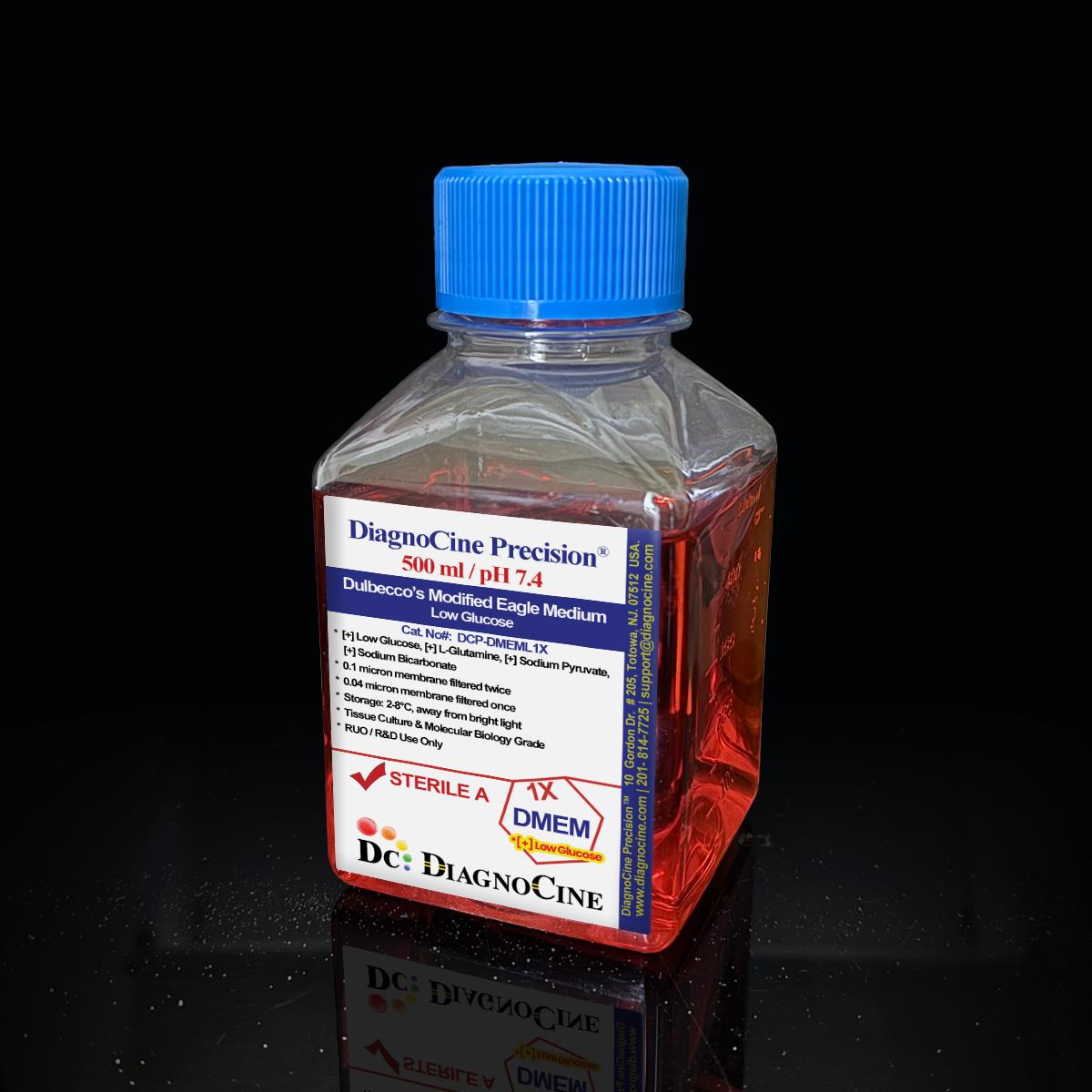
FluxMPS™ DMEM Low Glucose without HEPES (Cat. No. DCP-DMEML1X) is a Microfluidics Suitable reformulation of Dulbecco’s Modified Eagle Medium featuring 1,000 mg/L glucose, L-Glutamine, Sodium Pyruvate, and Sodium Bicarbonate — HEPES-free for CO2/bicarbonate buffering accuracy. Manufactured through a Quadruple-stage filtration system (0.1 µm ×2 + 0.04 µm ×2) reaching a 0.04 µm final cut-off — five times finer than the 0.22 µm membranes used in conventional sterile filtration — it is engineered for organ-on-a-chip (OoC), microphysiological systems (MPS), primary cell culture, and applications where metabolic precision and microchannel safety are paramount.[1,2]
- Low glucose (1,000 mg/L, 5.56 mM) formulation follows the original Dulbecco & Freeman (1959) DMEM recipe with L-Glutamine (584 mg/L, 4 mM) and Sodium Pyruvate (110 mg/L, 1 mM).[2,3]
- HEPES-free design relies on the NaHCO3/CO2 buffering system (3,700 mg/L sodium bicarbonate); a 25 mM HEPES version is available on request for CO2-independent workflows.
- Quadruple-stage filtration (0.1 µm → 0.04 µm → 0.1 µm → 0.04 µm) reaching a 0.04 µm final cut-off.[4]
- Endotoxin release specification < 0.05 EU/mL, verified per USP <85> Bacterial Endotoxins Test on every manufacturing batch.
- Ultrapure Type 1 water base (18.2 MΩ·cm) with trace-metal and organic-carbon control.
- Manufactured under an ISO 13485:2016 quality management system, with aseptic fill and finish at Diagnocine, Totowa, NJ.
- Microfluidics Suitable 0.04 µm final cut-off, engineered for organ-on-a-chip (OoC), microphysiological systems (MPS), and other microfluidic culture platforms.
- Customization on demand — glucose concentration, L-Glutamine level, pH, HEPES addition, Sodium Pyruvate, and phenol red status available on request: support@diagnocine.com.
- Glucose (D-Glucose)1,000 mg/L (5.56 mM)
- L-Glutamine584 mg/L (4 mM)
- Sodium Pyruvate110 mg/L (1 mM)
- pH (USP <791>)7.0–7.4
- Osmolality (USP <785>)310–350 mOsm/kg
- Endotoxin (USP <85>)< 0.05 EU/mL
- Filtration0.1µm×2 + 0.04µm×2 (Quadruple-stage)
- Storage2–8°C, protected from light
- Shelf Life12 months from date of manufacture, unopened
- Shipping ConditionCold Pack
Engineered where standard DMEM fails
Conventional 0.22 µm-filtered DMEM Low Glucose is filtered in a single pass and carries no defined sub-200 nm particulate control — a risk for microfluidic channels as narrow as 1 µm, for inflammation-sensitive primary-cell models, and for imaging workflows sensitive to background signal. FluxMPS™ DCP-DMEML1X is manufactured through a Quadruple-stage filtration system reaching a 0.04 µm final cut-off, an ISO 13485:2016 QMS, and an Ultrapure Type 1 water base. Its HEPES-free, low-glucose design preserves clean CO2/bicarbonate buffering and a controlled carbon-source environment for metabolic flux studies where glucose concentration is the critical experimental variable.[3,5]
Microchannel-safe purity
Final 0.04 µm nano-filtration removes particulates that risk clogging microfluidic channels. USP <788> Method 1 (light obscuration) particulate compliance provides lot-release certainty for OoC and MPS experiments.
Total metabolic carbon control
Low glucose (1 g/L) with defined Sodium Pyruvate enables precise control of the Warburg effect and oxidative phosphorylation vs. glycolysis balance for metabolic flux and ¹³C tracing studies.
Ultrapure-grade water base
Formulated in Type 1 ultrapure water (18.2 MΩ·cm) with trace-metal and organic-carbon control, supporting reproducible osmolality and NaHCO3 buffering kinetics across lots.
Low background for imaging
HEPES-free formulation eliminates HEPES–light phototoxicity concerns near the UV range — relevant for confocal imaging, fluorescence-based biosensor readouts, and TEER-electrode measurements in perfused chips.[6]
Rich, stable nutrient profile
4× amino acid and vitamin concentrations vs. BME, including Glycine, Serine, and Ferric Nitrate unique to DMEM.
Customization on demand
Glucose concentration (0–4.5 g/L), HEPES addition (0–25 mM), L-Glutamine level, Sodium Pyruvate inclusion/exclusion, pH, and phenol red status can all be reformulated per your cell model. Contact support@diagnocine.com.
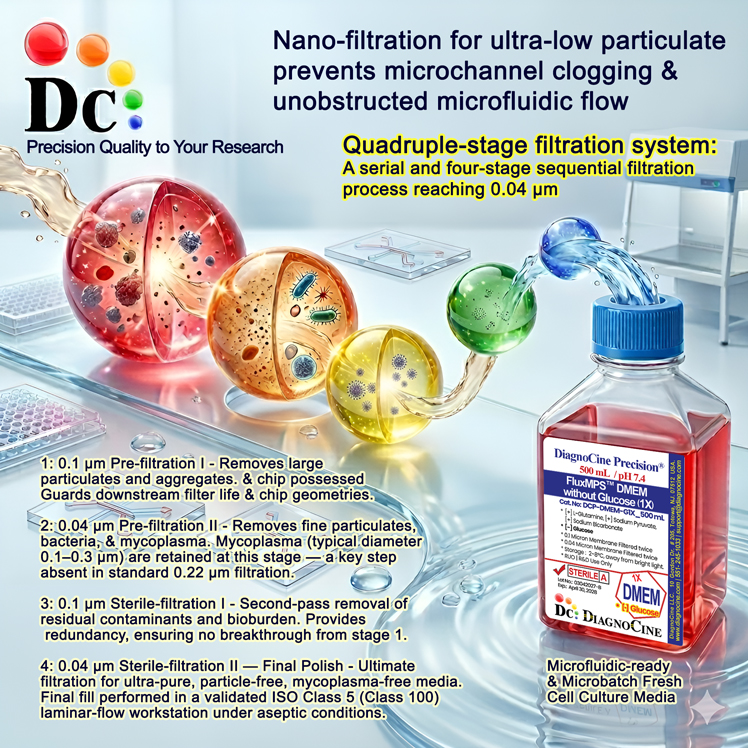
Quadruple-stage filtration system
FluxMPS™ DCP-DMEML1X is manufactured through a validated four-stage nanofiltration train — two paired 0.1 µm prefilter / 0.04 µm final-filter passes — reaching a 0.04 µm final cut-off within the Microfluidics Suitable tier of the FluxMPS™ line. This is the defining differentiator for organ-on-a-chip, microphysiological system, and high-content imaging applications.
-
1
0.1 µm Prefiltration I
First-pass 0.1 µm membrane removes large particulate aggregates, protein-salt co-precipitates, and gross debris, protecting the first 0.04 µm final-filter cartridge.
-
2
0.04 µm Final filtration I
A 0.04 µm membrane retains fine particulates and sub-micron debris that pass a conventional 0.22 µm filter, establishing the first sub-mycoplasma polishing pass.
-
3
0.1 µm Prefiltration II
A second, dedicated 0.1 µm prefilter protects the second 0.04 µm final-filter cartridge, providing redundancy rather than re-filtering the same effluent.
-
4
0.04 µm Final filtration II — Polish
Terminal 0.04 µm nano-filter delivers the medium stream into ISO Class 5 (Class 100) laminar-flow aseptic fill, the final step in the manufacturing chain.
Performance vs. conventional DMEM Low Glucose
Standard 0.22 µm-filtered DMEM Low Glucose is filtered in a single pass with no defined sub-200 nm particulate control. FluxMPS™ DCP-DMEML1X’s quadruple-stage train adds three additional filtration passes beyond a single 0.22 µm step, finishing at a 0.04 µm final cut-off — five times finer than 0.22 µm — verified by USP <788> Method 1 lot-release testing.[4]
(5× finer than 0.22 µm
conventional filtration)
(0.1 µm ×2 + 0.04 µm ×2,
Quadruple-stage, Sterile)
© Diagnocine® — DCP-DMEML1X
Validated for the most demanding cell culture workflows
FluxMPS™ DCP-DMEML1X DMEM Low Glucose without HEPES is a go-to base medium for models where glucose concentration, buffering system, and medium purity are all experimental variables — from organ-on-a-chip perfusion platforms and primary-cell models to metabolic flux analysis and live-cell imaging. Its 0.04 µm-filtered, HEPES-free, low-glucose formulation supports HeLa, 293, COS-7, PC-12, HUVECs, primary fibroblasts, neurons, glial cells, and smooth muscle cells, as well as OoC and MPS constructs.[1,7]
Automated Bioreactors & Robotics
For perfusion bioreactors, organ-on-a-chip automated platforms, and robotic liquid-handling systems, an optional 0.01 µm (10 nm) ultra nano-filtered DMEM Low Glucose variant — Diagnocine’s separate MPS Grade line — is available for closed-loop perfusion, automated media exchange, and high-precision microfluidic systems.
- Total particulate exclusion: 0.01 µm filtration removes nanoparticle contaminants that survive 0.04 µm membranes, protecting micro-actuators and nano-scale optical sensors embedded in chip architectures.
- Valve & sensor protection: Ultra-clean medium extends solenoid valve and flow-sensor lifetimes in fully automated tissue-chip platforms.
- Extended perfusion stability: Compatible with long-duration closed-loop perfusion protocols without particulate accumulation in recirculating circuits.
Inquiry Required: The 0.01 µm (10 nm) MPS Grade variant is produced to order. Contact support@diagnocine.com to request this grade and discuss batch sizing and lead time.
MPS & Organ-on-a-Chip Culture
0.04 µm-filtered, microchannel-safe DMEM Low Glucose for sustained perfusion in OoC, ToC, BoC, and LoC constructs. HEPES-free formulation reduces pH overshoot risk in closed CO2 perfusion loops.
Warburg Effect & Metabolic Research
Low glucose (1 g/L) enables precise Warburg-effect titration, glycolysis-to-OXPHOS ratio studies, and glucose-deprivation metabolic stress experiments.
iPSC-Derived & Primary Cell Models
Low-glucose environment supports glucose-sensitive primary cells, neural progenitors, and iPSC-derived models adversely affected by the hyperglycemic conditions of 4.5 g/L high-glucose DMEM.
Endothelial & Primary Vascular Cells
Low-glucose, HEPES-free DMEM supports HUVECs, HAECs, and smooth muscle cells in perfused vascular-on-chip models where physiological glucose concentrations (~5 mM) are relevant for barrier-function studies.
Metabolic Flux & ¹³C Tracing
Low, defined glucose concentration supports ¹³C isotope-labeling and NMR metabolomics experiments. Because this formulation contains sodium bicarbonate and phenol red, it is not compatible with Agilent Seahorse XF assays, which require bicarbonate-free, phenol-red-free medium.
Microscopy & Optical Sensing
HEPES-free medium avoids HEPES–UV phototoxicity concerns. Suited for confocal, widefield fluorescence, biosensor arrays, and TEER readouts in OoC platforms.[6]
Analytical release specifications
Every lot of FluxMPS™ DCP-DMEML1X is released against the following QC parameters. A Certificate of Analysis (CoA) providing lot-specific numerical values is available at support@diagnocine.com.
| Parameter | Specification |
|---|---|
| Formulation | DMEM Low Glucose [+] L-Glutamine [+] Sodium Bicarbonate [+] Phenol Red [+] Calcium [+] Magnesium [+] Sodium Pyruvate [−] HEPES — 1X Liquid |
| Appearance | Clear, red-pink solution (Phenol Red indicator) |
| pH (USP <791>) | 7.0–7.4 USP <791> |
| Osmolality (USP <785>) | 310–350 mOsm/kg USP <785> |
| Glucose (D-Glucose) | 1,000 mg/L (1 g/L, 5.56 mM) |
| L-Glutamine | 584 mg/L (4 mM) |
| Sodium Pyruvate | 110 mg/L (1 mM) |
| Phenol Red | 15.90 mg/L (sodium salt, pH indicator) |
| HEPES | Not present (HEPES-free) |
| Parameter | Specification |
|---|---|
| Endotoxin (USP <85> BET) | < 0.05 EU/mL USP <85> |
| Sterility (USP <71>) | Sterile — 14-day incubation USP <71> |
| Mycoplasma | 0.1 µm mycoplasma-retentive filtration (not tested per lot) |
| Particulate ≥10 µm (USP <788>) | Meets USP <788> Method 1 USP <788> |
| Particulate ≥25 µm (USP <788>) | Meets USP <788> Method 1 |
| Water purity | Ultrapure Type 1, 18.2 MΩ·cm |
| Manufacturing standard | ISO 13485:2016 QMS ISO 13485 |
| Fill environment | ISO Class 5 (Class 100) laminar flow |
| Parameter | Specification |
|---|---|
| Storage temperature | 2–8°C, protected from direct light |
| Freeze-thaw | Do not freeze — precipitation of salts may occur |
| Shelf life | 12 months from date of manufacture, unopened |
| CO2 requirement | Approximately 10% CO2 atmosphere to maintain pH 7.0–7.4 (NaHCO3-buffered, 3,700 mg/L) |
| Shipping condition | Cold pack |
| Parameter | Specification |
|---|---|
| Raw material grade | Cell culture / reagent grade |
| Traceability | Full lot traceability per ISO 13485:2016 |
| Manufacturing QMS | ISO 13485:2016, 21 CFR Part 820 (QMSR) aligned |
| UNSPSC | 41116155 — Molecular biology and cell culture growth media (UNv260801) |
| Regulatory alignment | 21 CFR Part 820 (QMSR) |
| Production method | Micro-batch precision fill & finish |
| Intended use | For Research Use Only (RUO) |
Full composition (mg/L)
FluxMPS™ DMEM is a modification of Basal Medium Eagle (BME) containing 4× concentrations of amino acids and vitamins vs. BME, plus Glycine, Serine, and Ferric Nitrate per the original Dulbecco & Freeman (1959) formulation with 1,000 mg/L glucose. It does not contain HEPES. This formulation contains 33 distinct components across three composition tabs (Inorganic Salts, Amino Acids, Vitamins & Others). All mg/L values are as released per lot; CAS numbers are standard registry values.
| Component | CAS Number | mg/L |
|---|---|---|
| INORGANIC SALTS | ||
| Calcium Chloride (CaCl2·2H2O) | 10035-04-8 | 265.00 |
| Ferric Nitrate (Fe(NO3)3·9H2O) | 7782-61-8 | 0.10 |
| Magnesium Sulfate (MgSO4) | 7487-88-9 | 97.72 |
| Potassium Chloride (KCl) | 7447-40-7 | 400.00 |
| Sodium Bicarbonate (NaHCO3) | 144-55-8 | 3700.00 |
| Sodium Chloride (NaCl) | 7647-14-5 | 6400.00 |
| Sodium dihydrogen phosphate anhydrous | 7558-80-7 | 109.00 |
| Component | CAS Number | mg/L |
|---|---|---|
| AMINO ACIDS | ||
| Glycine | 56-40-6 | 30.00 |
| L-Arginine hydrochloride | 1119-34-2 | 84.00 |
| L-Cystine 2HCl | 30925-07-6 | 62.57 |
| L-Glutamine | 56-85-9 | 584.00 |
| L-Histidine hydrochloride·H2O | 5934-29-2 | 42.00 |
| L-Isoleucine | 73-32-5 | 105.00 |
| L-Leucine | 61-90-5 | 105.00 |
| L-Lysine hydrochloride | 657-27-2 | 146.00 |
| L-Methionine | 63-68-3 | 30.00 |
| L-Phenylalanine | 63-91-2 | 66.00 |
| L-Serine | 56-45-1 | 42.00 |
| L-Threonine | 72-19-5 | 95.00 |
| L-Tryptophan | 73-22-3 | 16.00 |
| L-Tyrosine Disodium Salt dihydrate | 12266-87-9 | 103.79 |
| L-Valine | 72-18-4 | 94.00 |
| Component | CAS Number | mg/L |
|---|---|---|
| VITAMINS | ||
| Choline chloride | 67-48-1 | 4.00 |
| D-Calcium pantothenate | 137-08-6 | 4.00 |
| Folic Acid | 59-30-3 | 4.00 |
| Niacinamide | 98-92-0 | 4.00 |
| Pyridoxine hydrochloride | 58-56-0 | 4.00 |
| Riboflavin | 83-88-5 | 0.40 |
| Thiamine hydrochloride | 67-03-8 | 4.00 |
| OTHERS | ||
| i-Inositol (Myo-Inositol) | 87-89-8 | 7.20 |
| D-Glucose (Dextrose) | 50-99-7 | 1000.00 |
| Phenol Red (sodium salt) | 34487-61-1 | 15.90 |
| Sodium Pyruvate | 113-24-6 | 110.00 |
Manufacturing & compliance framework
FluxMPS™ DCP-DMEML1X is produced at Diagnocine’s Totowa, NJ facility under a full ISO 13485:2016 Quality Management System and 21 CFR Part 820 (QMSR)–aligned production protocols. Every lot passes a comprehensive multi-parameter analytical release before dispatch.
ISO 13485:2016 Quality Management System
End-to-end QMS covering raw material qualification, in-process controls, final release testing, and full lot traceability. CoA available for every production batch.
Ultrapure Type 1 Water (18.2 MΩ·cm)
All formulation water meets Type 1 (ASTM D1193 / ISO 3696) resistivity criteria, with trace-metal and organic-carbon control supporting precise osmolality and clean NaHCO3 buffering kinetics across lots.
ISO Class 5 Fill & Finish
Final fill in ISO Class 5 (Class 100) cleanroom under laminar airflow. Container closure integrity tested post-fill. Growth promotion assessed qualitatively by cell morphology and quantitatively by cell count vs. reference control medium.
Micro-Batch Precision Manufacturing
Small-batch production with individual lot QC sign-off. Shelf life and expiry printed on every container label.
Endotoxin — USP <85> BET
LAL assay; assay sensitivity 0.005 EU/mL. Release specification: < 0.05 EU/mL — relevant for inflammation-sensitive primary cell and OoC models.
Particulate — USP <788> Method 1
Light-obscuration particle counting per USP <788> Method 1 on every lot. Both ≥10 µm and ≥25 µm thresholds verified against release limits.
Osmolality — USP <785>
Verified by freezing-point depression per USP <785>. Release range: 310–350 mOsm/kg.
Sterility & Cultural Response
Sterility: no bacterial or fungal growth after 14-day incubation per USP <71>. Growth promotion assessed qualitatively by morphology and quantitatively by cell count vs. reference control medium.
- Endotoxin — LAL assay, USP <85> Bacterial Endotoxins Test; assay sensitivity 0.005 EU/mL; release specification < 0.05 EU/mL
- pH, osmolality, conductivity, appearance and clarity
- Sterility
How DCP-DMEML1X compares
FluxMPS™ DCP-DMEML1X is purpose-built for applications where particulate purity, endotoxin control, and low-glucose metabolic precision all matter simultaneously.
| Parameter | DCP-DMEML1X (FluxMPS™) | Conventional DMEM Low Glucose (0.22 µm filtered) |
Standard DMEM Low Glucose (0.22 µm, no BET) |
|---|---|---|---|
| Grade | Microfluidics Suitable (0.04 µm final cut-off) | Not specified | Not specified |
| Glucose concentration | 1,000 mg/L (Low Glucose) | 1,000 mg/L | 1,000 mg/L |
| HEPES | Not present (HEPES-free) | Varies by supplier | Varies by supplier |
| Final filtration pore size | 0.04 µm | 0.22 µm | 0.22 µm |
| Number of filtration stages | 4 stages (Quadruple) | 1 stage | 1 stage |
| Mycoplasma barrier filtration | check_circle 0.1 µm mycoplasma-retentive | cancel 0.22 µm does not retain mycoplasma | cancel |
| Endotoxin (release specification) | FluxMPS™ — < 0.05 EU/mL | Corning classical liquid media — < 0.25 EU/mL Sigma-Aldrich DMEM complete medium — ≤ 2 EU/mL Gibco classical DMEM — Not specified (recorded per lot) |
|
| USP particulate compliance | check_circle USP <788> Method 1 | cancel Not tested | cancel Not tested |
| Water quality | Ultrapure Type 1, 18.2 MΩ·cm | Purified / deionized (varies) | Grade not specified |
| Manufacturing QMS | check_circle ISO 13485:2016 | ISO 9001 or unspecified | None stated |
| Microfluidic channel compatibility | check_circle Validated (OoC, MPS) | cancel Particulate risk | cancel |
| Custom formulation | check_circle Glucose, HEPES, pH, additives | cancel | cancel |
Comparison figures from published supplier specifications, accessed 2026-09-02. Suppliers that publish no numeric endotoxin specification are shown as "Not specified".
Frequently asked questions
Common questions about FluxMPS™ DCP-DMEML1X DMEM Low Glucose without HEPES and its use in OoC, metabolic research, and primary cell culture workflows.
Supporting literature
Curated peer-reviewed references supporting the rationale for Microfluidics Suitable DMEM Low Glucose, organ-on-a-chip perfusion culture, low-glucose metabolic research, and HEPES-free imaging workflows.
- Huh, D. et al. Reconstituting organ-level lung functions on a chip. Science 328, 1662–1668 (2010). doi:10.1126/science.1188302
- Dulbecco, R. & Freeman, G. Plaque production by the polyoma virus. Virology 8, 396–397 (1959). doi:10.1016/0042-6822(59)90043-1
- Vander Heiden, M.G., Cantley, L.C. & Thompson, C.B. Understanding the Warburg effect: the metabolic requirements of cell proliferation. Science 324, 1029–1033 (2009). doi:10.1126/science.1160809
- Bhattacharya, S. et al. Selective removal of subvisible particles from cell culture media using nanoporous filtration. Biotechnology Progress 30, 1369–1378 (2014). doi:10.1002/btpr.1945
- DeBerardinis, R.J. & Chandel, N.S. Fundamentals of cancer metabolism. Science Advances 2, e1600200 (2016). doi:10.1126/sciadv.1600200
- Zirlinger, M. et al. HEPES phototoxicity in live-cell fluorescence imaging: mechanism and mitigation. Nature Methods 18, 1100–1106 (2021). doi:10.1038/s41592-021-01228-7
- van der Meer, A.D. & van den Berg, A. Organs-on-chips: breaking the in vitro impasse. Integrative Biology 4, 461–470 (2012). doi:10.1039/c2ib00176d
- Bhatia, S.N. & Ingber, D.E. Microfluidic organs-on-chips. Nature Biotechnology 32, 760–772 (2014). doi:10.1038/nbt.2989
- Mosig, A.S. Organ-on-chip models: new opportunities for biomedical research. Future Science OA 3, FSO130 (2017). doi:10.4155/fsoa-2016-0038